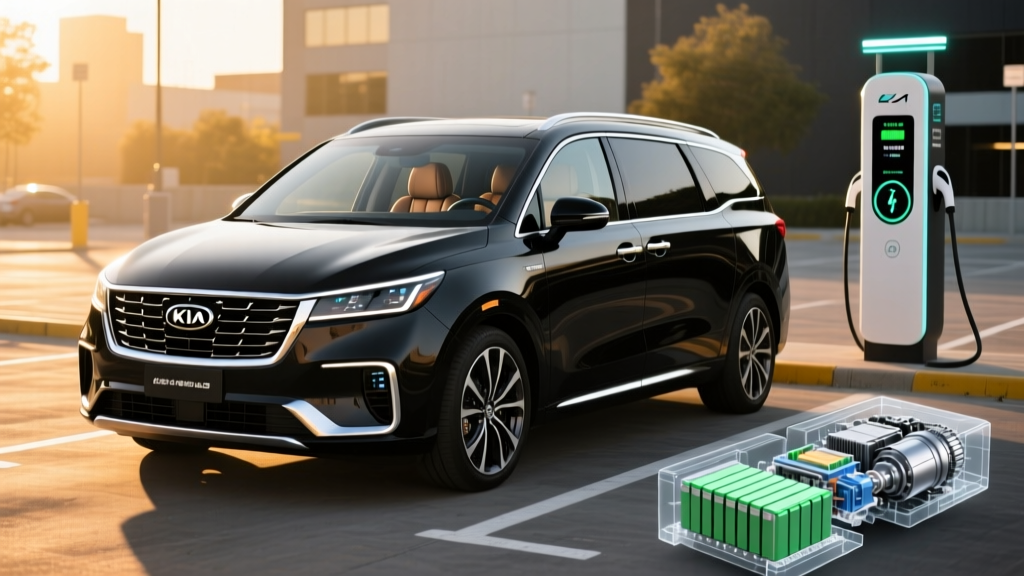
If you need a three-row minivan but want to cut fuel costs without plugging in, the 2026 Kia Carnival Hybrid LXS is one of only a few conventional hybrid minivans on the US market. Positioned as the entry point to Kia's hybrid minivan lineup, the LXS trim pairs a turbocharged engine with an electric motor for meaningful fuel savings over the gas-only Carnival—without the complexity or cost of a plug-in hybrid or full EV. Here's everything you need to know about specs, real-world efficiency, warranty coverage, and whether it qualifies for federal tax incentives.
HEV vs PHEV: What the Carnival Hybrid Actually Is
Before diving into specs, it's critical to understand what the Carnival Hybrid is—and isn't. Kia offers the Carnival exclusively as a conventional hybrid (HEV) in the US market. There is no plug-in hybrid (PHEV) variant available for 2026.
HEV vs PHEV at a Glance
| Feature | HEV (Carnival Hybrid) | PHEV (e.g., Chrysler Pacifica PHEV) |
|---|---|---|
| Plug-in charging required? | No — self-charging via regen & engine | Yes — Level 1 or Level 2 |
| Electric-only driving range | None (electric assist only) | ~32 miles typical |
| Battery capacity | ~1.5 kWh (small, sealed) | ~16 kWh (larger, usable) |
| Federal tax credit (§30D) | Not eligible | Up to $7,500 if eligible |
| Typical starting price premium | ~$2,000–$3,000 over gas | ~$8,000–$12,000 over gas |
| Best for | No home charging, simple ownership | Home charging, short commutes |
The Carnival Hybrid's small battery charges entirely through regenerative braking and the gasoline engine. You never plug it in. You simply drive it like any conventional car, and the hybrid system automatically manages when to use the electric motor, the engine, or both.
Fuel Economy: EPA Ratings and Real-World MPG
The headline reason to choose the Carnival Hybrid over the standard gas Carnival is fuel economy. Here's how the numbers break down according to EPA estimates on fueleconomy.gov:
| Driving Cycle | EPA MPG |
|---|---|
| City | 34 MPG |
| Highway | 31 MPG |
| Combined | 33 MPG |
For comparison, the gas-only 2026 Kia Carnival rates at 19 city / 26 highway / 22 combined MPG. That's a roughly 50% improvement in combined fuel economy with the hybrid powertrain.
Real-World MPG vs EPA Sticker
Conventional hybrids tend to match or even exceed their EPA city estimates in stop-and-go driving, where regenerative braking and electric-motor assist do the most work. In our experience and aggregated owner reports, the Carnival Hybrid delivers:
- City/suburban driving: 33–36 MPG — the hybrid system shines here
- Highway cruising (70–80 mph): 28–31 MPG — aerodynamic drag reduces the hybrid advantage
- Mixed real-world average: 30–33 MPG
- Cold weather penalty: Expect a 5–10% reduction (28–30 MPG combined) when the engine runs more frequently for cabin heat
If most of your driving is around town—school drop-offs, grocery runs, suburban errands—the Carnival Hybrid's city-biased efficiency is exactly where you want it.
Powertrain Specs: Engine, Motor, and Combined Output
| Specification | 2026 Kia Carnival Hybrid LXS |
|---|---|
| Engine | 1.6L turbocharged 4-cylinder |
| Electric motor | 47.7 kW (64 hp) |
| Combined system output | 245 hp / 271 lb-ft torque |
| Transmission | 6-speed automatic |
| Drivetrain | Front-wheel drive (FWD) |
| Hybrid battery | ~1.5 kWh lithium-ion (sealed) |
| Towing capacity | 3,500 lbs |
| Seating | 7 or 8 passengers |
The 1.6-liter turbocharged engine produces 180 hp on its own, and the 47.7 kW electric motor adds 64 hp, for a combined system output of 245 hp. That's a meaningful bump over the gas-only Carnival's 290 hp V6 in terms of low-end torque feel—the electric motor fills in the gap before the turbo spools, giving confident acceleration from stops and during highway merging.
One trade-off: the Carnival Hybrid is front-wheel drive only. There is no AWD option, unlike the Toyota Sienna hybrid (which offers AWD). If you regularly drive on snow or unpaved roads, this matters.
Pricing: What the LXS Trim Costs in 2026
The LXS is the base trim for the Carnival Hybrid lineup, and it's well-equipped for the price. Here's the MSRP breakdown:
- Base MSRP (LXS): ~$41,900 (including destination charge)
- Mid-tier (EX): ~$45,500
- Top-tier (SX Prestige): ~$53,000
Compare this to the gas-only Carnival LXS at roughly $35,000, and you're paying a ~$6,900 hybrid premium at the base level. At the current national average gas price of ~$3.10/gallon and 12,000 miles driven annually, the hybrid saves roughly $900–$1,100 per year in fuel. That puts the payback period at approximately 6–7 years for average drivers—shorter if you drive more city miles or if gas prices rise.
Federal and State Tax Credit Eligibility
Here's the hard truth for hybrid shoppers: the Kia Carnival Hybrid does not qualify for the federal §30D clean vehicle tax credit. Under current IRS rules, the §30D credit of up to $7,500 is reserved for plug-in electric vehicles (BEVs and PHEVs) that meet battery sourcing, critical minerals, MSRP caps, and buyer income requirements. Conventional hybrids like the Carnival HEV are excluded entirely.
Tax Credit Checklist: §30D Eligibility
- ❌ Vehicle must be a plug-in BEV or PHEV — Carnival Hybrid is HEV only
- ❌ MSRP cap: $80,000 for vans/SUVs — irrelevant since it's not a plug-in
- ❌ Buyer income cap: $300k joint / $150k single — irrelevant
- ❌ Battery sourcing & critical minerals rules — irrelevant
Bottom line: No federal purchase credit applies. Check your state's energy office for any local hybrid rebates, though these are uncommon.
Reliability and Battery Warranty: What to Expect Long-Term
Hybrid battery longevity is the single biggest concern for first-time hybrid buyers. Here's what Kia provides:
Kia Hybrid Battery Warranty Coverage
| Coverage | Term |
|---|---|
| Hybrid battery pack | 10 years / 100,000 miles |
| Hybrid system components (motor, inverter) | 10 years / 100,000 miles |
| Powertrain warranty (engine, transmission) | 10 years / 100,000 miles |
| Basic bumper-to-bumper | 5 years / 60,000 miles |
Kia's 10-year/100,000-mile hybrid battery warranty is one of the best in the industry and matches Toyota's coverage for hybrid components. For context, the IIHS has evaluated the Carnival platform positively for crashworthiness, and Kia's hybrid system has been proven across the Sorento Hybrid and Sportage Hybrid since the early 2020s.
Battery Replacement Cost: If It Ever Comes to That
If the hybrid battery fails outside warranty (rare before 150,000+ miles based on industry data), replacement costs for a minivan-class HEV battery typically range from $2,500 to $4,500 including labor. Because the Carnival Hybrid uses a relatively small ~1.5 kWh pack—not the 16+ kWh packs in PHEVs or the 70–100 kWh packs in full EVs—replacement cost is manageable compared to a full EV battery swap ($10,000–$20,000+).
Modern hybrid batteries rarely require full replacement. Individual cell modules can often be refurbished or replaced at lower cost. Most hybrid batteries in Toyota and Kia vehicles retain 85–90%+ capacity at 150,000 miles based on fleet data.
Who Should Buy the Carnival Hybrid LXS — and Who Shouldn't
Pros
- 34 MPG city — best-in-class for non-plug-in minivans
- No plug-in charging required; drive it like any gas car
- 245 hp with strong low-end electric torque
- 10-year / 100,000-mile hybrid battery warranty
- 3,500-lb towing capacity matches gas Carnival
- LXS trim well-equipped: power sliding doors, 12.3" touchscreen, wireless CarPlay/Android Auto
Cons
- FWD only — no AWD option (Sienna Hybrid offers AWD)
- No federal tax credit — HEV excluded from §30D
- ~$6,900 premium over gas-only Carnival LXS
- Third row slightly less spacious than Chrysler Pacifica
- Hybrid battery cargo intrusion minimal but present
The Decision Framework
Choose the Carnival Hybrid LXS if:
- You want minivan space and family features with significantly lower fuel costs
- You don't have access to home or workplace EV charging
- You drive mostly city/suburban miles where the hybrid system delivers maximum benefit
- You prefer Kia's interior design and tech over the Toyota Sienna or Chrysler Pacifica
Look elsewhere if:
- You need AWD → consider the Toyota Sienna Hybrid (36 MPG combined, AWD available)
- You want electric-only driving and qualify for tax credits → consider the Chrysler Pacifica PHEV (32 miles electric-only, up to $7,500 credit)
- You drive mostly highway miles → the hybrid advantage shrinks to ~5 MPG over gas
- You want a full BEV minivan → none exist in the US market as of 2026; closest alternatives are the Kia EV9 (3-row SUV, 304 miles EPA range)
Hybrid vs PHEV vs Full EV: Which Powertrain Fits Your Life?
Minivan buyers have three electrification paths in 2026, each with distinct trade-offs:
| Factor | HEV (Carnival Hybrid) | PHEV (Pacifica Hybrid) | BEV (Kia EV9 SUV) |
|---|---|---|---|
| Plug-in required? | No | Yes | Yes |
| Electric-only range | 0 miles | ~32 miles | ~304 miles |
| Combined efficiency | 33 MPG | 30 MPG + 82 MPGe | 89 MPGe |
| Federal tax credit | $0 | Up to $7,500 | Up to $7,500 |
| Home charging install | Not needed | ~$500–$1,500 (Level 2) | ~$500–$2,000 (Level 2) |
| Annual fuel cost (12k mi) | ~$1,100 | ~$700–$1,000 | ~$500–$700 |
| Sliding doors / minivan layout | Yes | Yes | No (SUV) |
The honest answer for most families: if you can't install a home charger or live in an apartment, the HEV is the lowest-friction path to lower fuel costs. If you have a garage with a 240V outlet and a short commute, a PHEV lets you do daily driving on electricity while keeping gas for road trips. A full BEV minivan doesn't yet exist, so families committed to electric-only driving must look at 3-row SUVs like the EV9, Rivian R1S, or Tesla Model X.
Frequently Asked Questions
How many MPG does the Kia Carnival Hybrid LXS get?
The EPA rates the 2026 Carnival Hybrid at 34 city / 31 highway / 33 combined MPG. In real-world mixed driving, owners report 30–33 MPG, with city-heavy driving occasionally exceeding the EPA city estimate thanks to regenerative braking.
Does the Kia Carnival Hybrid need to be plugged in?
No. The Carnival Hybrid is a conventional HEV. Its small battery charges through regenerative braking and the gasoline engine. You never plug it in—just fill up with gas and drive.
Is there a plug-in hybrid (PHEV) Kia Carnival?
Not in the US market as of 2026. Kia has not announced a Carnival PHEV for North America. The closest competitor offering a plug-in hybrid minivan is the Chrysler Pacifica PHEV.
How long will the Carnival Hybrid battery last?
Kia covers the hybrid battery for 10 years or 100,000 miles. Industry data from Toyota and Hyundai/Kia hybrid platforms shows most HEV batteries retain 85–90%+ capacity at 150,000 miles. Full failure before 200,000 miles is uncommon.
What does it cost to replace the hybrid battery?
Out-of-warranty replacement for the Carnival Hybrid's ~1.5 kWh battery pack typically costs $2,500–$4,500 including labor. Cell-level refurbishment may reduce this cost. This is far less than a full EV battery replacement.
Does the Carnival Hybrid qualify for any federal tax credit?
No. The federal §30D clean vehicle credit applies only to plug-in vehicles (BEVs and PHEVs) that meet battery sourcing, MSRP, and income requirements. Conventional hybrids like the Carnival HEV are not eligible for any federal purchase incentive.
Is the Carnival Hybrid LXS better than the Toyota Sienna Hybrid?
It depends on your priorities. The Sienna Hybrid gets 36 MPG combined and offers AWD, but its base price is slightly higher and many find the Carnival's interior more upscale and spacious. The Sienna also uses a CVT (which some drivers find droney), while the Carnival Hybrid uses a conventional 6-speed automatic. Test-drive both before deciding.
Can the Carnival Hybrid tow?
Yes. The Carnival Hybrid maintains a 3,500-lb towing capacity, identical to the gas-only model. That's sufficient for a small boat trailer, pop-up camper, or utility trailer.