The minivan segment hasn't seen much electrification, but the Kia Carnival Hybrid fills a gap for families who want three rows, serious cargo space, and better fuel economy without plugging in. For 2026, the Carnival HEV continues as a conventional hybrid—no charging cord required—pairing a turbocharged engine with an electric motor for meaningful MPG gains over the gas-only model. This review focuses on what buyers research most: the Kia Carnival Hybrid interior, real-world efficiency, powertrain details, and long-term ownership costs.
2026 Kia Carnival Hybrid Interior: Space, Tech, and Comfort
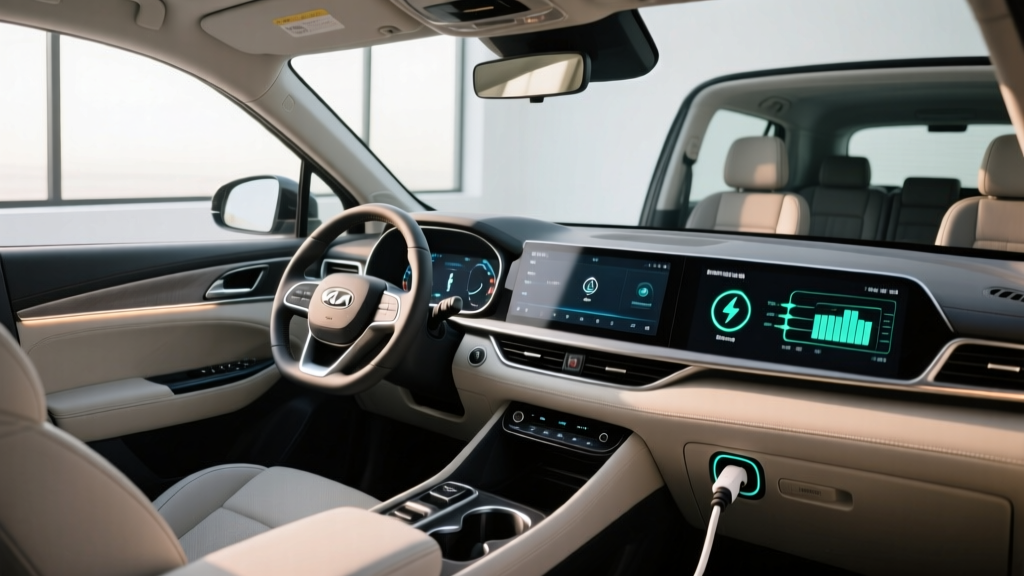
The Carnival Hybrid shares its cabin with the gas-only model, meaning you get one of the most spacious interiors in the minivan class. The hybrid battery pack is tucked beneath the floor, preserving the Carnival's signature flat-load cargo area and all three rows of seating.
Key interior dimensions and features for the 2026 model year:
- Cargo volume (behind 3rd row): 41.1 cu ft
- Cargo volume (3rd row folded): 86.9 cu ft
- Cargo volume (all rear seats folded): 145.1 cu ft
- Seating capacity: 7 or 8 passengers (trim-dependent)
- Infotainment: Dual 12.3-inch panoramic displays (instrument cluster + touchscreen) on EX and above; 8-inch base screen on LX
- Wireless Apple CarPlay / Android Auto: Standard on all trims
- Available features: Dual power-sliding doors, power liftgate, heated/ventilated front seats, rear-seat entertainment, Digital Key 2
The hybrid's battery placement means no compromise to the "Slide-Flex" second-row seating (on EX+ trims), which slides fore and aft or folds flat into the floor well. Third-row adults will find adequate legroom for trips under two hours, though the Toyota Sienna Hybrid still edges it in third-row knee room. Materials on the SX Prestige trim approach luxury territory with quilted leather and open-pore wood accents, while the LX uses durable cloth and hard plastics that are easier to clean with kids.
HEV vs. PHEV: The Carnival Is a Conventional Hybrid Only
A common question: is the Carnival Hybrid a plug-in? No. The 2026 Carnival is offered only as a conventional hybrid (HEV). It charges its small battery through regenerative braking and the gasoline engine—no plug, no cord, no home charger needed.
| Attribute | Kia Carnival HEV | Chrysler Pacifica PHEV |
|---|---|---|
| Powertrain Type | Conventional Hybrid (HEV) | Plug-In Hybrid (PHEV) |
| Plug-In Charging? | No — self-charging | Yes — Level 1 or Level 2 |
| Electric-Only Range | None (motor assists engine) | 32 miles (EPA) |
| Battery Size | ~1.5 kWh (small, self-charging) | 16 kWh |
| EPA Combined MPG | 34 MPG | 30 MPG (gas) / 82 MPGe (electric) |
| Starting MSRP | ~$41,000 | ~$51,000 |
If you want electric-only commuting in a minivan, the Chrysler Pacifica PHEV is currently the only plug-in option. But it costs roughly $10,000 more and sacrifices some cargo space to its larger battery. The Carnival HEV trades electric-only capability for simplicity and a lower price.
Fuel Economy: EPA MPG and Real-World Results
The 2026 Kia Carnival Hybrid carries the same powertrain calibration as the refreshed 2025 model, so EPA ratings remain consistent.
| Driving Cycle | EPA Estimate |
|---|---|
| City | 34 MPG |
| Highway | 31 MPG |
| Combined | 34 MPG* |
*EPA combined weighted at 55% city / 45% highway per fueleconomy.gov.
Hybrids typically shine in stop-and-go driving where regenerative braking recaptures energy that a gas car wastes as brake heat. Expect the Carnival Hybrid to meet or slightly exceed its 34 MPG city rating in suburban driving. On sustained highway trips at 75+ mph, real-world numbers tend to dip to 28-30 MPG because the electric motor contributes less at constant high speed.
For comparison, the gas-only 2026 Carnival with the 3.5L V6 is rated at 22 MPG combined—a 12 MPG advantage for the hybrid that translates to roughly $500-$650 in annual fuel savings for a driver covering 15,000 miles per year (assuming $3.40/gallon regular unleaded).
Powertrain: Turbo Four-Cylinder Meets Electric Motor
The Carnival Hybrid uses Kia's 1.6-liter turbocharged four-cylinder engine paired with an electric motor integrated into the transmission housing. Combined output is 245 horsepower and 271 lb-ft of torque, routed to the front wheels through a 6-speed automatic transmission.
| Specification | Value |
|---|---|
| Engine | 1.6L turbocharged inline-4 |
| Electric Motor | 47 kW (64 hp), integrated |
| Combined Output | 245 hp / 271 lb-ft |
| Transmission | 6-speed automatic |
| Drivetrain | Front-wheel drive |
| Hybrid Battery | ~1.5 kWh lithium-ion (self-charging) |
| Towing Capacity | 3,500 lbs |
| 0-60 mph (est.) | ~7.8 seconds |
The turbo four lacks the V6's smoothness at wide-open throttle—you'll hear some four-cylinder drone during hard merges—but the electric motor fills the torque gap at low RPMs, making around-town acceleration feel responsive. The 3,500-lb towing rating is adequate for a small trailer or a pair of jet skis, though the gas V6 Carnival matches it at 3,500 lbs as well.
One note: AWD is not available on the Carnival Hybrid. If you need all-wheel drive in a hybrid minivan, the Toyota Sienna (standard AWD on hybrid trims) is the only option in the segment.
Pricing, Trims, and Tax Credit Eligibility
The 2026 Carnival Hybrid is offered across four trims, with pricing that undercuts the Toyota Sienna Hybrid and Chrysler Pacifica PHEV:
- LX Hybrid: ~$41,000 MSRP
- EX Hybrid: ~$44,000 MSRP
- SX Hybrid: ~$48,000 MSRP
- SX Prestige Hybrid: ~$52,500 MSRP
Federal tax credit: The conventional Carnival HEV does not qualify for the IRS §30D Clean Vehicle Credit. That credit is limited to battery electric vehicles (BEVs) and plug-in hybrids (PHEVs) meeting battery-sourcing, critical-mineral, MSRP cap, and buyer income requirements. Since the Carnival HEV cannot be plugged in, it is ineligible. Some states offer separate hybrid rebates—check your local energy office or dealer for current programs.
Battery Warranty, Reliability, and Replacement Cost
Kia Hybrid Battery Warranty: 10 years / 100,000 miles (whichever comes first) for the hybrid battery pack and all hybrid-system components. This applies to the original owner; subsequent owners receive 10 years / 100,000 miles from the vehicle's original in-service date under Kia's current transferable warranty policy. The standard powertrain warranty is 10 years / 100,000 miles, and bumper-to-bumper is 5 years / 60,000 miles.
Kia's hybrid system has proven durable since its introduction in the Niro and Sorento Hybrid. The Carnival's ~1.5 kWh battery is small and never deeply cycled—it operates in a narrow state-of-charge window (roughly 40-60% SoC), which minimizes degradation. Most hybrid batteries outlast the vehicle itself. If replacement is ever needed out of warranty, a hybrid battery for a Kia of this size typically runs $2,500-$4,000 including labor, far less than a full EV battery pack.
The 1.6T engine has been in Kia/Hyundai products since 2022 with no widespread failure patterns. The 6-speed automatic is a conventional torque-converter unit (not a CVT), which many buyers prefer for its familiar shift feel and long-term serviceability.
Who Should Buy the Carnival Hybrid (and Who Shouldn't)
Pros
- 34 MPG combined — best-in-class among non-plug-in minivans
- Class-leading cargo volume with no hybrid-battery compromise
- No plug required — works for apartment dwellers and street parkers
- 10-year/100k-mile hybrid and powertrain warranty
- Premium interior on SX Prestige rivals luxury SUVs
- Lower starting price than Sienna Hybrid and Pacifica PHEV
Cons
- No AWD option (Sienna Hybrid offers it standard)
- No electric-only driving mode (not a PHEV)
- Turbo four-cylinder sounds coarse under hard acceleration
- No federal tax credit eligibility
- Third row slightly tighter than Sienna for tall adults
Choose the Carnival Hybrid if: You want the most cargo space in a hybrid minivan, don't need AWD, can't install a home charger, and want a lower entry price than the Sienna or Pacifica PHEV.
Choose the Toyota Sienna Hybrid if: You need standard AWD, prioritize third-row comfort, or want slightly higher real-world highway MPG (36 combined EPA).
Choose a full EV (e.g., Kia EV9) if: You have reliable home Level 2 charging, your daily driving is under 250 miles, you want zero tailpipe emissions, and you qualify for the $7,500 federal tax credit.
Frequently Asked Questions
How many MPG does the 2026 Kia Carnival Hybrid get?
The EPA rates the Carnival Hybrid at 34 MPG city, 31 MPG highway, and 34 MPG combined. In real-world suburban driving, many owners report 33-36 MPG. Highway-only trips at 75+ mph typically yield 28-30 MPG.
Can you plug in the Kia Carnival Hybrid?
No. The Carnival Hybrid is a conventional HEV, not a plug-in hybrid. Its small battery charges via regenerative braking and the gasoline engine. You never need to plug it in. If you want plug-in capability in a minivan, the Chrysler Pacifica PHEV offers 32 miles of electric-only range.
Does the Kia Carnival Hybrid qualify for a tax credit?
The Carnival HEV does not qualify for the federal §30D Clean Vehicle Credit, which is reserved for BEVs and PHEVs. Some states may offer separate hybrid incentives—check your state energy office. Per IRS guidelines, only plug-in vehicles with qualifying battery sourcing meet the credit's requirements.
Is the Carnival Hybrid reliable, and what does a battery replacement cost?
Kia's hybrid system has a strong reliability record since 2022. The hybrid battery is covered for 10 years / 100,000 miles. Out-of-warranty replacement, if ever needed, typically costs $2,500-$4,000. The small battery operates in a narrow charge window, which greatly extends its lifespan.
How does the Carnival Hybrid interior compare to the gas model?
The interior is identical in layout, cargo volume, and seating. The hybrid battery is packaged under the floor and does not reduce cargo space or alter the Slide-Flex second-row seating. The only difference is the hybrid-specific digital instrument cluster showing energy flow and regen data.
Does the Carnival Hybrid have AWD?
No. The 2026 Carnival Hybrid is front-wheel drive only. If AWD is essential, the Toyota Sienna Hybrid includes electronic AWD on all trims as standard equipment.