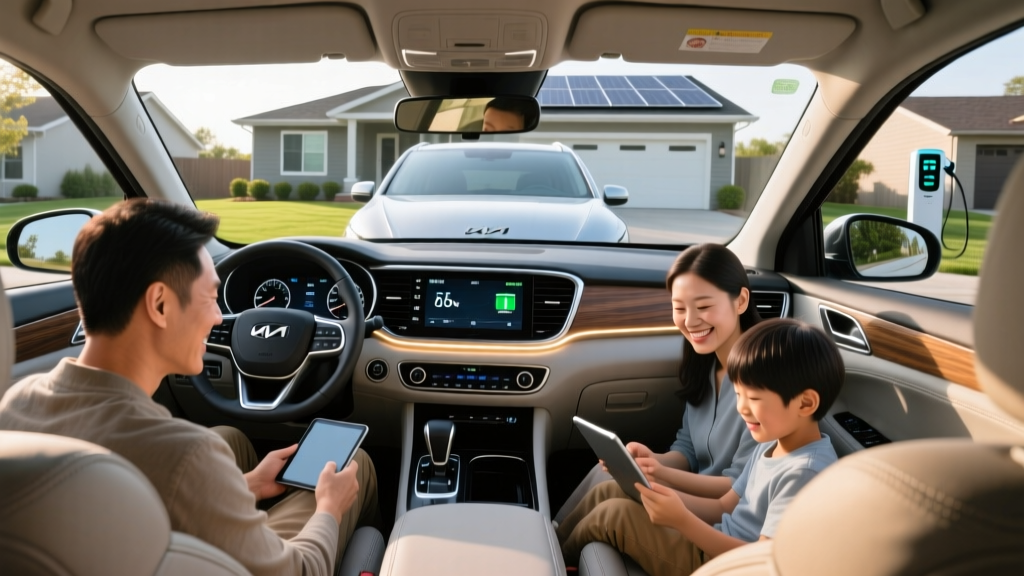
The minivan segment has been slow to embrace electrification, but the Kia Carnival Hybrid changes that equation for families who want better fuel economy without plugging in. The EX trim sits in the middle of the hybrid lineup, offering a compelling blend of tech features, seating for up to eight, and a turbocharged hybrid powertrain that sips fuel in city traffic. If you've been searching for a Kia Carnival Hybrid EX and wondering whether the real-world MPG lives up to the EPA sticker — and whether a hybrid minivan makes more sense than a full EV or a conventional gas model — this guide covers every number that matters.
HEV vs PHEV: What the Carnival Hybrid Actually Is
Before diving into specs, it's critical to understand what you're buying. The Kia Carnival Hybrid is a conventional hybrid electric vehicle (HEV), not a plug-in hybrid (PHEV). That distinction matters for your daily routine:
| Feature | Carnival Hybrid (HEV) | Plug-In Hybrid (PHEV) | Full EV (BEV) |
|---|---|---|---|
| Plugs in to charge? | No — self-charging via regen & engine | Yes — has a charge port | Yes — charge port required |
| Electric-only range | ~1 mile at low speed | 20–45 miles typical | 200–400+ miles |
| Battery size | 1.49 kWh (small buffer) | 13–25 kWh | 60–120+ kWh |
| Fuel source | Gasoline + regenerative braking | Gasoline + grid electricity | Grid electricity only |
| Federal tax credit (§30D) | Not eligible | Up to $7,500 (if qualified) | Up to $7,500 (if qualified) |
The Carnival Hybrid's 1.49 kWh lithium-ion battery is there to assist the gas engine and capture energy from braking — you never plug it in. If you want electric-only school runs and grocery trips, you'd need to look at a PHEV like the Chrysler Pacifica Hybrid or wait for Kia to potentially offer a Carnival PHEV variant in future model years.
Powertrain Specs: 1.6L Turbo Hybrid System
Kia pairs a 1.6-liter turbocharged four-cylinder engine with an electric motor integrated into the transmission housing. Here's the complete powertrain breakdown for the 2026 model year:
| Specification | 2026 Kia Carnival Hybrid EX |
|---|---|
| Engine | 1.6L turbocharged GDI 4-cylinder |
| Engine output | 180 hp / 195 lb-ft torque |
| Electric motor | 47.7 kW (64 hp) permanent-magnet synchronous |
| Combined system output | 245 hp / 271 lb-ft torque |
| Transmission | 6-speed automatic (torque-converter, hybrid-optimized) |
| Drivetrain | Front-wheel drive (FWD) |
| Hybrid battery | 1.49 kWh lithium-ion |
| 0–60 mph (est.) | ~7.8 seconds |
| Towing capacity | 3,500 lbs (properly equipped) |
The 245 combined horsepower is competitive with rival hybrid minivans and gives the Carnival Hybrid confident highway merging and passing ability. The turbo four avoids the drone typical of CVT-equipped competitors because Kia uses a conventional 6-speed automatic rather than an e-CVT. On the road, this means shifts feel natural and acceleration is linear rather than rubber-bandy.
EPA Fuel Economy and Real-World MPG
Fuel economy is the headline reason buyers choose the Carnival Hybrid over the standard gas-only Carnival. Here's what the EPA rates it at, along with what you can realistically expect:
| Driving Condition | EPA Rating | Real-World Expectation |
|---|---|---|
| City | 34 MPG | 32–36 MPG (hybrids often exceed EPA in stop-and-go) |
| Highway | 31 MPG | 27–30 MPG (turbo works harder at sustained speed) |
| Combined | 33 MPG | 29–33 MPG |
According to fueleconomy.gov, the Carnival Hybrid's 33 MPG combined represents a meaningful improvement over the gas-only Carnival, which returns roughly 22 MPG combined. Over 15,000 miles per year, that translates to approximately 165 fewer gallons of fuel annually — roughly $500–$650 in savings at $3.25–$3.90 per gallon, depending on your region.
Real-world note: Hybrid minivans, like all hybrids, perform best in city driving where regenerative braking recovers energy at every stoplight. If your commute is 80% highway, expect MPG closer to 28–30. In cold weather (below 30°F), the engine runs more frequently to maintain cabin heat, which can drop city MPG by 2–4 points. Families doing school runs, errands, and suburban driving will see the best results.
Pricing: What the Carnival Hybrid EX Costs
The EX trim occupies the value sweet spot in the Carnival Hybrid lineup. Here's the pricing structure for the 2026 model year:
| Trim | MSRP (incl. destination) | Key Features Over Base |
|---|---|---|
| LX Hybrid | ~$41,500 | Base hybrid with 8 seats, 8" touchscreen |
| EX Hybrid | ~$44,500 | Power sliding doors, power liftgate, leatherette, wireless CarPlay/Android Auto, Smart Cruise Control |
| SX Hybrid | ~$48,000 | Navigation, 12.3" display, heated/ventilated front seats, highway driving assist |
| SX Prestige Hybrid | ~$52,500 | Nappa leather, dual sunroofs, rear entertainment, surround-view monitor |
The EX trim at approximately $44,500 adds the features most families actually want: power sliding doors (essential for kids in parking lots), a power liftgate, upgraded upholstery, and Kia's full suite of ADAS including blind-spot monitoring and rear cross-traffic avoidance. Adding the EX Touring package (~$1,500) brings a panoramic sunroof and a 12.3-inch infotainment display.
Tax Credit Eligibility
Federal tax credit: The Kia Carnival Hybrid is a conventional HEV — it does not qualify for the §30D Clean Vehicle Credit (up to $7,500), which is reserved for plug-in hybrids and battery-electric vehicles with sufficient battery capacity. Check the latest rules at IRS.gov §30D.
Some states offer modest rebates for conventional hybrids, but these vary by jurisdiction. Check your state energy office or DMV for current programs.
Battery Warranty and Long-Term Reliability
Hybrid battery longevity is consistently the top concern for first-time hybrid buyers. Here's the warranty and reliability picture for the Carnival Hybrid:
| Coverage | Duration |
|---|---|
| Hybrid battery warranty | 10 years / 100,000 miles (original owner) |
| Hybrid system components | 10 years / 100,000 miles |
| Powertrain warranty | 10 years / 100,000 miles |
| Basic (bumper-to-bumper) | 5 years / 60,000 miles |
| Hybrid battery replacement cost (out of warranty, est.) | $2,500–$4,000 |
Kia's 10-year/100,000-mile hybrid battery warranty is among the best in the segment and should cover most original owners through the vehicle's prime ownership period. The 1.49 kWh battery is small and operates within a narrow state-of-charge window (roughly 40–60% SoC most of the time), which significantly reduces degradation stress compared to the large batteries in PHEVs and BEVs.
Replacement cost context: Because the Carnival Hybrid's battery pack is compact, replacement is considerably less expensive than a full EV battery swap. Independent hybrid specialists and Kia dealerships report costs in the $2,500–$4,000 range if needed beyond the warranty period. For comparison, a Toyota Sienna hybrid battery replacement runs a similar figure. Most hybrid batteries in modern vehicles last well beyond 150,000 miles with minimal capacity loss, based on long-term fleet data from hybrid taxis and high-mileage owners.
Who Should Buy the Carnival Hybrid EX — and Who Shouldn't
Pros
- 33 MPG combined — saves ~$500–$650/year vs. gas Carnival
- No charging required — fuel it like a normal minivan
- 10-year/100,000-mile hybrid battery warranty
- 3,500-lb towing capacity (best in hybrid minivan class)
- Quiet, refined 6-speed auto (no CVT drone)
- Spacious 8-passenger interior with SUV-like styling
Cons
- No federal tax credit eligibility (HEV, not PHEV)
- FWD only — no AWD option (Sienna Hybrid offers AWD)
- Highway MPG drops to ~28 in real-world cruising
- EX trim still uses an 8" base screen without navigation
- ~$3,000 premium over gas-only Carnival EX
Decision Framework: Is the Carnival Hybrid Right for You?
Choose the Carnival Hybrid EX if:
- You drive mostly city/suburban miles (school runs, errands, stop-and-go)
- You don't have access to home or workplace charging
- You want a fuel-efficient minivan without changing your refueling habits
- You value Kia's 10-year warranty and plan to own the vehicle 7+ years
Consider a PHEV (like the Pacifica Hybrid) if:
- You can charge at home and your daily driving is under 35 miles
- You want some electric-only driving for short trips
- You qualify for the §30D federal tax credit and want to offset the PHEV price premium
Consider a full EV (like the Kia EV9) if:
- You have reliable home Level 2 charging
- Your daily driving is under 250 miles and you rarely tow
- You want the lowest per-mile energy cost and zero tailpipe emissions
- You qualify for federal/state EV incentives
Stick with the gas Carnival if:
- You drive predominantly highway miles where the hybrid advantage shrinks
- You want the lowest possible upfront price and AWD availability
How the Carnival Hybrid Compares to Rivals
The hybrid minivan field is small but competitive. Here's how the Carnival Hybrid EX stacks up against its key rivals on the metrics that matter:
| Metric | 2026 Kia Carnival Hybrid EX | 2026 Toyota Sienna Hybrid LE | 2026 Chrysler Pacifica Hybrid (PHEV) |
|---|---|---|---|
| Powertrain type | HEV (no plug) | HEV (no plug) | PHEV (plug-in) |
| Combined system HP | 245 hp | 245 hp | 260 hp |
| EPA combined MPG | 33 MPG | 36 MPG | 30 MPG (gas) / 82 MPGe (elec) |
| Electric-only range | N/A | N/A | 32 miles |
| AWD available? | No | Yes | No |
| Towing capacity | 3,500 lbs | 3,500 lbs | 3,600 lbs |
| Hybrid battery warranty | 10 yr / 100k mi | 10 yr / 150k mi | 10 yr / 100k mi |
| Starting MSRP (mid trim) | ~$44,500 | ~$42,000 | ~$51,000 (before credit) |
| Federal tax credit | None | None | Up to $7,500 (if eligible) |
The Sienna Hybrid leads on raw MPG (36 combined) and offers AWD, making it the efficiency pick for snow-belt families. The Pacifica Hybrid offers 32 miles of electric-only range and potential tax credit savings, but starts significantly higher. The Carnival Hybrid EX occupies the middle ground: strong power, competitive fuel economy, Kia's excellent warranty, and a more SUV-like exterior design that many buyers prefer over traditional minivan styling.
Frequently Asked Questions
How many MPG does the Kia Carnival Hybrid EX get?
The EPA rates the 2026 Carnival Hybrid at 34 MPG city, 31 MPG highway, and 33 MPG combined. In real-world driving, expect 32–36 MPG in city conditions and 27–30 MPG on sustained highway trips. Cold weather and heavy cargo loads will reduce these figures by 2–4 MPG.
Does the Kia Carnival Hybrid need to be plugged in?
No. The Carnival Hybrid is a conventional HEV — it charges its small 1.49 kWh battery through regenerative braking and the gas engine. You never plug it in. You simply fill up at a gas station as you would with any other vehicle.
Does the Carnival Hybrid qualify for a federal tax credit?
No. The IRS §30D Clean Vehicle Credit applies only to plug-in hybrids (PHEVs) and battery-electric vehicles (BEVs) with battery capacities of at least 7 kWh. The Carnival Hybrid's 1.49 kWh battery does not meet this threshold. Some states may offer small hybrid rebates — check your local program.
Is the Kia Carnival Hybrid reliable? What about battery replacement cost?
Kia covers the hybrid battery for 10 years or 100,000 miles, which is among the longest warranties in the segment. Modern hybrid batteries in vehicles like the Toyota Prius and Kia Niro have demonstrated lifespans exceeding 150,000–200,000 miles with minimal degradation. If replacement is needed out of warranty, expect $2,500–$4,000 — far less than a full EV battery replacement.
Can the Carnival Hybrid drive on electric power alone?
Only at very low speeds (under ~25 mph) for brief distances, such as creeping through a parking lot or coasting to a stop. It cannot sustain highway speeds on electric power alone. For meaningful electric-only range, you need a PHEV or BEV.
Is the Carnival Hybrid EX worth the premium over the gas model?
The hybrid EX costs roughly $3,000 more than a comparably equipped gas Carnival EX. At 15,000 miles per year and a 10–12 MPG improvement, the fuel savings pay back the premium in approximately 5–6 years. If you plan to keep the van for 7+ years and do a lot of city driving, the hybrid is the better long-term value — plus you get the quieter, smoother hybrid powertrain.
Does the Carnival Hybrid have AWD?
No. The Carnival Hybrid is front-wheel drive only across all trims. If AWD is a priority for snow or rain, the Toyota Sienna Hybrid offers available electronic AWD.