Quick Verdict: America's Only Hybrid AWD Minivan
The 2026 Kia Carnival Hybrid AWD occupies a unique position in the U.S. minivan market: it's the only hybrid minivan offering all-wheel drive. Toyota's Sienna is hybrid-only but pairs AWD with a less powerful system, while Chrysler's Pacifica PHEV offers plug-in electric range but no AWD option. For families who need year-round traction, three-row seating for up to eight, and fuel economy that undercuts any gas-only rival, the Carnival Hybrid AWD makes a compelling case at a starting MSRP of $41,900.
This is a conventional hybrid (HEV), not a plug-in. You never need to plug it in — the 1.6-liter turbocharged engine and electric motor work together seamlessly, regenerating energy during braking and coasting to keep the small battery charged. Let's break down exactly what you get.
Fuel Economy: EPA Ratings and Real-World MPG
The headline number for any hybrid buyer is fuel economy. The 2026 Carnival Hybrid AWD carries EPA ratings that make it substantially cheaper to fuel than a gas-only minivan, and real-world driving often beats the EPA city estimate — a common trait of parallel hybrid systems that lean heavily on electric motor assist in stop-and-go traffic.
| Metric | EPA Rating | Real-World Expectation |
|---|---|---|
| City MPG | 34 MPG | 33–36 MPG (hybrids excel in city) |
| Highway MPG | 31 MPG | 28–31 MPG (aero drag hurts at 70+ mph) |
| Combined MPG | 33 MPG | 30–34 MPG depending on driving mix |
| Fuel Tank | 19.0 gallons | ~570–620 miles per tank |
| Annual Fuel Cost* | ~$1,650 | Based on 15,000 mi/yr, $3.30/gal regular |
*Source: fueleconomy.gov estimates; actual costs vary by region and driving habits.
Powertrain: Turbo Hybrid Meets AWD Traction
Kia's hybrid system in the Carnival pairs a 1.6-liter turbocharged four-cylinder engine with a 54 kW (72 hp) electric motor integrated into the transmission housing. The combined system output is 245 horsepower and 271 lb-ft of torque, routed through a 6-speed automatic transmission to all four wheels via an electronically controlled AWD system.
| Component | Specification |
|---|---|
| Engine | 1.6L turbocharged GDI 4-cylinder |
| Engine Output | 178 hp / 195 lb-ft |
| Electric Motor | 54 kW (72 hp) / 195 lb-ft |
| Combined System Output | 245 hp / 271 lb-ft |
| Transmission | 6-speed automatic |
| Drivetrain | AWD (electronically controlled) |
| 0–60 mph | ~7.5 seconds (estimated) |
| Towing Capacity | 3,500 lbs |
| Battery Type | Lithium-ion polymer, ~1.5 kWh (HEV) |
The AWD system is torque-on-demand: under normal cruising, the Carnival operates primarily in front-wheel drive for efficiency, sending torque rearward when slip is detected or during hard acceleration. This is not a dedicated rear-motor AWD system like the Sienna's electronic rear axle — instead, a mechanical driveshaft routes power from the front transaxle. The result is confident traction in rain and light snow, though it adds roughly 150 lbs compared to the FWD Hybrid variant.
HEV (Conventional Hybrid): The Carnival Hybrid is an HEV. It has a small battery (~1.5 kWh) charged by the engine and regenerative braking. You never plug it in. The electric motor assists the gas engine and enables brief EV-only driving at low speeds (typically under 1 mile).
PHEV (Plug-in Hybrid): A PHEV like the Chrysler Pacifica Hybrid has a larger battery (~16 kWh), a charge port, and 30+ miles of electric-only range before the gas engine engages. You plug it in overnight to maximize electric driving.
Why it matters: If you can charge at home and most of your trips are under 30 miles, a PHEV saves more fuel. If you lack home charging or frequently take long road trips, the HEV's simplicity and lower purchase price make more sense.
Hybrid vs. PHEV vs. Full EV: Which Minivan Fits Your Family?
The minivan segment now offers all three electrification paths. Here's how to decide:
| Factor | Kia Carnival Hybrid (HEV) | Chrysler Pacifica PHEV | Full EV (e.g., upcoming electric minivans) |
|---|---|---|---|
| Starting Price | ~$41,900 | ~$51,000 | $60,000+ (estimated) |
| Home Charging Needed? | No | Yes (for max benefit) | Yes (mandatory) |
| Electric-Only Range | None meaningful | 32 miles EPA | 250–300+ miles |
| AWD Available? | Yes | No | Likely |
| Best For | No home charger, road trips, snow | Home charger, short commutes | Home charger, low operating cost |
| Federal Tax Credit | None | Up to $7,500 (§30D) | Up to $7,500 (§30D) |
Choose the Carnival Hybrid AWD if you need all-weather traction, don't have reliable home charging access, take frequent road trips where you don't want to plan around charging stops, or want a lower purchase price while still cutting fuel costs by 30–40% versus a gas-only minivan.
Consider a PHEV instead if you have a garage with a 120V or 240V outlet, your daily driving is under 30 miles, and you want to drive mostly on electricity while keeping a gas engine for road trips. The Pacifica PHEV's lack of AWD is the dealbreaker for many northern-climate families.
Pricing, Trims, and Tax Credit Eligibility
The 2026 Kia Carnival Hybrid AWD is offered across multiple trim levels. Pricing below reflects MSRP before destination charges (~$1,395):
| Trim | MSRP | Key Features |
|---|---|---|
| LXS | $41,900 | 8-passenger seating, 8" touchscreen, Smart Power Sliding Doors |
| EX | $44,500 | Leatherette seats, power liftgate, wireless CarPlay/Android Auto |
| SX | $47,900 | Navigation, 12.3" display, Highway Driving Assist 2 |
| SX Prestige | $52,500 | Nappa leather, dual sunroofs, surround-view monitor, VIP rear seats |
Battery Warranty, Reliability, and Replacement Cost
Hybrid battery longevity remains a top concern for first-time hybrid buyers, but the data is reassuring. Kia's hybrid battery pack in the Carnival is a relatively small lithium-ion polymer unit (~1.5 kWh usable) that never undergoes deep charge cycles — it typically operates between 40% and 80% state of charge, which dramatically extends cell life.
- Hybrid Battery: 10 years / 100,000 miles (whichever comes first)
- Hybrid System Components: 10 years / 100,000 miles
- Powertrain (engine, transmission): 10 years / 100,000 miles
- Bumper-to-Bumper: 5 years / 60,000 miles
What does hybrid battery replacement cost? If the battery fails outside warranty — which is rare based on data from Hyundai/Kia's hybrid fleet now exceeding 10 years on the road — a replacement battery pack for the Carnival Hybrid runs approximately $2,500–$4,000 including labor. This is substantially less than a full EV battery replacement ($8,000–$20,000+) because the HEV pack is small. Independent hybrid battery repair shops can often replace individual modules for $800–$1,500.
Reliability outlook: Kia's 1.6T hybrid powertrain has been deployed across the Sorento Hybrid, Tucson Hybrid, and Sportage Hybrid since 2022 with generally positive results. The 6-speed automatic avoids the drone and rubber-band feel of CVTs found in the Toyota Sienna. IIHS has rated recent Carnival models highly for crashworthiness, and the hybrid variant shares the same body structure.
Interior, Cargo, and Family-Focused Tech
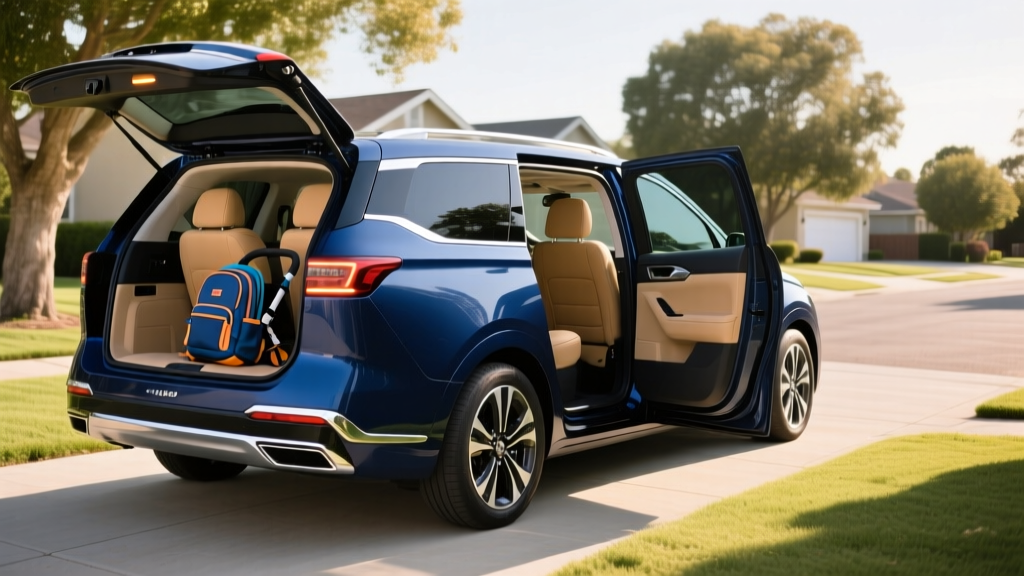
The Carnival Hybrid AWD shares its interior with the gas model — and that's a compliment. The minivan's boxy, SUV-inspired styling translates to genuine advantages in passenger and cargo space:
- Seating: 7-passenger (SX Prestige with captain's chairs) or 8-passenger (bench second row)
- Cargo behind 3rd row: 41.1 cu ft
- Cargo behind 2nd row: 86.9 cu ft
- Max cargo (both rows folded): 145.1 cu ft
- Sliding door opening width: Among the widest in the segment
The hybrid powertrain adds no compromise to interior volume — the battery pack is packaged under the cargo floor without reducing space. Kia's Highway Driving Assist 2 (standard on SX and above) provides SAE Level 2 driver assistance with adaptive cruise, lane centering, and lane-change assist. The driver must remain engaged at all times; this is not autonomous driving.
Pros and Cons at a Glance
- Only AWD hybrid minivan available in the U.S.
- 33 MPG combined saves ~$800/yr vs. gas V6 minivans
- 245 hp — significantly more power than Sienna's 245 hp combined but with better low-end torque delivery
- No plug-in charging required
- Industry-leading 10-year/100,000-mile hybrid warranty
- Class-leading cargo volume
- 3,500-lb towing capacity
- No federal tax credit (HEV, not PHEV)
- No meaningful electric-only driving range
- AWD system adds weight; slightly lower MPG than FWD Hybrid
- Highway fuel economy drops at sustained 75+ mph speeds
- Top SX Prestige trim pushes past $53,000
- No spare tire (tire repair kit only)
Frequently Asked Questions
How many MPG does the Kia Carnival Hybrid AWD get?
The EPA rates the 2026 Carnival Hybrid AWD at 34 city / 31 highway / 33 combined MPG. In real-world city and suburban driving, many owners see 34–37 MPG thanks to the hybrid system's electric motor assist at low speeds. Highway-heavy driving at 70+ mph typically yields 28–31 MPG.
Does the Kia Carnival Hybrid need to be plugged in?
No. The Carnival Hybrid is a conventional HEV, not a plug-in hybrid. The battery charges through regenerative braking and the gasoline engine. You simply fill up at any gas station with regular 87-octane fuel.
How far can the Carnival Hybrid drive on electric power alone?
Very short distances — typically under 1 mile at low speeds (under 25 mph) in EV mode. This is normal for conventional hybrids. The electric motor's primary role is to assist the gas engine during acceleration and capture energy during braking, not to provide meaningful standalone range. If you want 30+ miles of electric driving, you need a PHEV like the Chrysler Pacifica Hybrid.
Is the hybrid battery reliable, and what does replacement cost?
Kia covers the hybrid battery for 10 years / 100,000 miles. Based on data from Kia and Hyundai's hybrid fleet (now with hundreds of thousands of vehicles in service), premature battery failure is rare. Out-of-warranty replacement costs approximately $2,500–$4,000, and partial module repairs can cost under $1,500 at specialist shops.
Does the Kia Carnival Hybrid qualify for any tax credit?
The Carnival Hybrid (HEV) does not qualify for the federal §30D Clean Vehicle Credit, which requires a plug-in vehicle with a minimum battery capacity. Some states offer hybrid-specific rebates or HOV lane access — check the Alternative Fuels Data Center for your state's current incentives.
How does the Carnival Hybrid AWD compare to the Toyota Sienna?
The Sienna is hybrid-only with 36 MPG combined (FWD) and available AWD via a separate rear electric motor, but total system output is just 245 hp and the CVT can feel sluggish under hard acceleration. The Carnival Hybrid AWD sacrifices 3 MPG combined for a more responsive 6-speed automatic, stronger low-end torque, more cargo space, and a longer warranty. If maximum fuel economy is your sole priority, the Sienna FWD wins. If you need AWD, towing capacity, and a more engaging drive, the Carnival Hybrid AWD has the edge.
What is the Carnival Hybrid's towing capacity?
The 2026 Carnival Hybrid AWD is rated to tow up to 3,500 lbs when properly equipped — sufficient for a small boat, pop-up camper, or utility trailer. This matches most V6 minivans and exceeds the Sienna's 3,500-lb rating.