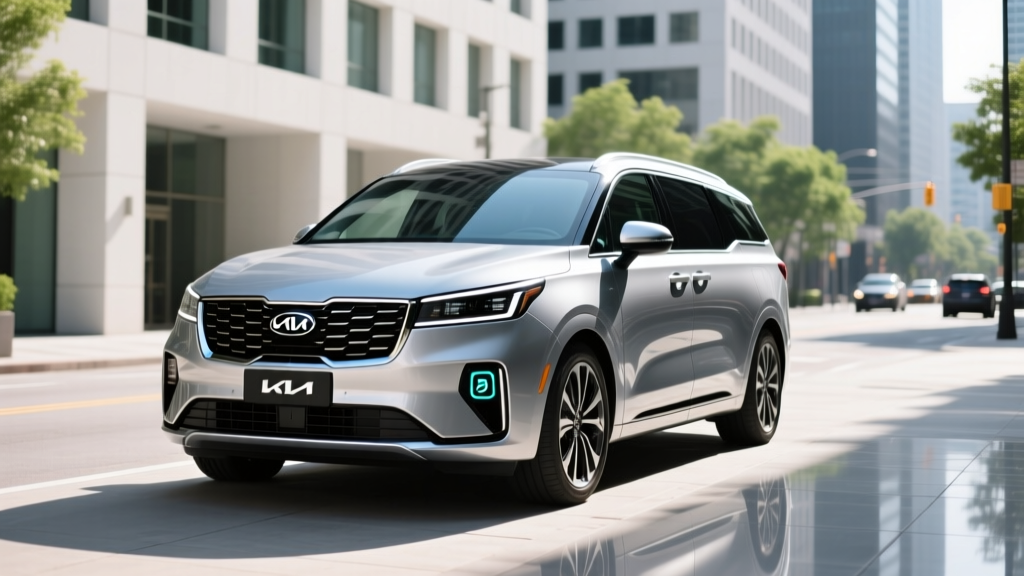
The minivan segment has a new efficiency benchmark. The Kia Carnival Hybrid 2026 arrives as the first electrified variant of Kia's popular people-mover, pairing a turbocharged 1.6-liter four-cylinder with an electric motor for a combined 242 horsepower and 271 lb-ft of torque. The result: EPA-estimated 33 MPG combined — a massive leap over the standard Carnival's 22 MPG combined — without the range anxiety or charging logistics of a full electric van.
For families who cover serious miles but aren't ready to commit to an EV charging routine, the Carnival Hybrid occupies a compelling middle ground. Here's everything you need to know about specs, real-world efficiency, pricing, and how it stacks up against plug-in hybrids and battery-electric alternatives.
HEV vs PHEV: What the Carnival Hybrid Actually Is
Before diving into specs, it's essential to clarify what you're buying — because Kia uses different electrification strategies across its lineup.
| Feature | Carnival Hybrid (HEV) | Sorento PHEV (Plug-In) |
|---|---|---|
| Powertrain Type | Conventional Hybrid | Plug-In Hybrid |
| Needs to Be Plugged In? | No — self-charging via engine & regen | Yes — plug in for electric-only miles |
| Battery Size | 1.49 kWh (small buffer) | 13.8 kWh |
| Electric-Only Range | ~1 mile at low speed | 32 miles (EPA) |
| Charging Port | None | Level 1 & Level 2 AC |
| DC Fast Charging | N/A | No |
| Federal Tax Credit (§30D) | Not eligible | Up to $7,500 (eligibility varies) |
The 2026 Carnival Hybrid is a conventional hybrid (HEV). It captures energy through regenerative braking and engine optimization, storing it in a small battery that assists during acceleration and low-speed driving. You never plug it in — just fill it with gas and drive. This makes it fundamentally different from the Sorento Plug-In Hybrid, which offers meaningful electric-only range but requires home or public charging infrastructure.
Fuel Economy: EPA Ratings vs Real-World MPG
The headline number for the 2026 Carnival Hybrid is its EPA-estimated fuel economy, which dramatically outpaces the standard gasoline model.
| Model | City | Highway | Combined |
|---|---|---|---|
| Carnival Hybrid (HEV) | 34 MPG | 31 MPG | 33 MPG |
| Carnival (Gas V6) | 19 MPG | 26 MPG | 22 MPG |
| Toyota Sienna (HEV) | 36 MPG | 36 MPG | 36 MPG |
Data source: fueleconomy.gov
Real-World MPG Expectations
Hybrids typically outperform their EPA estimates in city driving, where regenerative braking and electric assist work hardest. In mixed suburban driving with frequent stops, expect the Carnival Hybrid to deliver 33–36 MPG in warm weather.
On sustained highway trips at 70+ mph, the advantage narrows. Expect 29–31 MPG on flat interstates, as the engine bears more of the load and aerodynamic drag dominates. In cold weather (below 35°F), anticipate a 5–10% reduction across all driving conditions due to cabin heating demands and reduced battery efficiency.
Over a 15,000-mile year, the hybrid's 33 MPG combined versus the gas model's 22 MPG saves roughly 150 gallons of fuel — approximately $525 at $3.50/gallon, or significantly more in high-cost fuel states like California.
Powertrain Specs: Engine, Motor, and Performance
| Specification | 2026 Kia Carnival Hybrid |
|---|---|
| Engine | 1.6L Turbocharged 4-Cylinder |
| Electric Motor | 47.7 kW (64 hp) integrated |
| Combined System Output | 242 hp / 271 lb-ft torque |
| Transmission | 6-Speed Automatic |
| Drivetrain | Front-Wheel Drive |
| Hybrid Battery | 1.49 kWh lithium-ion |
| 0–60 mph (est.) | ~7.8 seconds |
| Towing Capacity | 3,500 lbs |
| Fuel Tank | 16.9 gallons |
| Total Driving Range (est.) | ~557 miles |
Kia's turbocharged hybrid powertrain is a carryover from the Sorento Hybrid, adapted for the Carnival's larger chassis. The 242-horsepower combined output is competitive with the gas V6's 290 hp, though the hybrid trades some peak power for substantially better low-end torque delivery — the electric motor fills in the turbo lag and makes around-town acceleration feel surprisingly eager for a 4,700-lb minivan.
Notably, the Carnival Hybrid is front-wheel drive only. Families in snow-belt states who want all-wheel drive will need to consider the Toyota Sienna (standard AWD hybrid) or the gas-only Carnival with available AWD.
Pricing, Trims, and Tax Credit Eligibility
The 2026 Kia Carnival Hybrid starts at an MSRP of $41,900 for the base EX trim, rising to approximately $50,500 for the fully loaded SX Prestige. That represents a premium of roughly $2,000–$3,000 over equivalent gas-only Carnival trims.
Federal Tax Credit Status
Because the Carnival Hybrid is a conventional HEV (not a plug-in), it does not qualify for the federal §30D clean vehicle tax credit. The IRS restricts that credit — up to $7,500 — to plug-in electric vehicles (BEVs and PHEVs) meeting battery sourcing, MSRP caps, and buyer income limits. See current rules at irs.gov.
However, some states and utilities offer rebates for conventional hybrids. Check your state energy office and local utility for potential incentives — these vary widely by jurisdiction and change frequently.
Pros
- 50% fuel economy improvement over gas Carnival (33 vs 22 MPG combined)
- No charging infrastructure required — just fill up and go
- Strong low-end torque from electric motor assist
- Proven hybrid powertrain shared with Sorento Hybrid
- Retains 3,500-lb towing capacity
- Class-leading cargo space and sliding second-row seats
Cons
- FWD only — no AWD option (Sienna offers standard AWD hybrid)
- Not eligible for federal §30D tax credit
- ~$2,000–$3,000 price premium over gas model
- 33 MPG combined trails Sienna's 36 MPG
- Hybrid battery adds weight over rear axle (minor cargo floor impact)
Battery Warranty, Lifespan, and Replacement Cost
Kia Hybrid Battery Warranty: 10 years / 100,000 miles (whichever comes first) for the original owner; coverage may differ for subsequent owners depending on state — California and states adopting CARB emissions standards typically mandate 10-year/150,000-mile coverage for hybrid components.
Kia's hybrid system uses a relatively small 1.49 kWh lithium-ion battery pack — far smaller than a full EV's 70–100 kWh pack. This battery is not designed to be "depleted" in the way an EV battery is; instead, the hybrid control system keeps it operating in a narrow state-of-charge window (roughly 40–60%) to maximize longevity. This shallow-cycling approach is why hybrid batteries routinely last 150,000+ miles without significant degradation.
Should replacement be necessary out of warranty, a Carnival Hybrid battery pack is estimated at $2,500–$4,000 for the part plus labor — considerably less than EV battery replacement, which can exceed $10,000. Real-world data from the Sorento Hybrid (which shares this powertrain) shows no widespread battery failure patterns through the 2024–2025 model years.
Who Should Choose the Carnival Hybrid vs an EV or Gas Van
Choose the Carnival Hybrid if:
- You drive 12,000–20,000 miles/year and want fuel savings without lifestyle changes
- You lack reliable home or workplace charging for an EV
- You take frequent road trips exceeding 300 miles and don't want to plan charging stops
- You want a minivan specifically (EV minivans remain extremely limited in 2026)
Stick with the gas Carnival if:
- You drive under 8,000 miles/year (hybrid premium takes too long to recoup)
- You need AWD for heavy snow — gas Carnival offers available AWD
Consider a full EV instead if:
- You have Level 2 home charging and mostly drive under 250 miles/day
- You qualify for the full $7,500 federal tax credit on a BEV (which can offset the EV price premium)
- You want the lowest possible per-mile fuel cost (~$0.04/mile on home solar vs ~$0.12/mile hybrid)
Hybrid vs PHEV vs EV — Which Fits Your Family?
The minivan and three-row SUV segment now offers all three electrification paths. Here's how to think about them:
| Factor | Conventional Hybrid (HEV) | Plug-In Hybrid (PHEV) | Battery Electric (BEV) |
|---|---|---|---|
| Plug In Required? | No | Yes (for max benefit) | Yes |
| Electric-Only Range | ~1 mile | 25–40 miles | 250–350+ miles |
| Fuel Cost per Mile | ~$0.11 | ~$0.05 (electric) / $0.11 (gas) | ~$0.04 (home) |
| Road Trip Convenience | Excellent | Good (gas backup) | Requires planning |
| Home Charging Needed? | No | Recommended | Essential |
| §30D Tax Credit | No | Up to $7,500 | Up to $7,500 |
| Best For | High-mileage, no charger | Short commute + road trips | Home charger + daily driving |
For the Carnival Hybrid specifically, the value proposition is strongest for families who put on serious highway miles, take regular road trips, and want the fuel savings of electrification without any infrastructure investment. It's the lowest-friction path to better efficiency.
Reliability and Ownership Considerations
Kia's 1.6T hybrid powertrain has been in production since the 2021 Sorento Hybrid, giving it a multi-year track record. IIHS has not yet crash-tested the 2026 Carnival Hybrid specifically, but the standard Carnival earned top marks in prior model years, and the hybrid variant shares the same body structure.
Key ownership notes:
- Maintenance: Hybrid maintenance costs are similar to gas models — oil changes, brake service (actually less frequent due to regen braking), and tire rotation. No spark plug changes are needed on the turbo hybrid's Atkinson-cycle operation.
- Insurance: Expect premiums 5–10% higher than the gas Carnival due to higher repair costs for hybrid-specific components.
- Resale value: Hybrids have shown stronger residual values than gas counterparts in the current market, particularly as fuel prices fluctuate.
- Warranty: Kia's standard 5-year/60,000-mile bumper-to-bumper and 10-year/100,000-mile powertrain warranty apply, with hybrid components covered under the 10-year hybrid battery warranty noted above.
Frequently Asked Questions
How many MPG does the 2026 Kia Carnival Hybrid get?
The EPA rates the Carnival Hybrid at 34 city / 31 highway / 33 combined MPG. In real-world suburban driving, owners typically see 33–36 MPG. Highway-only driving at 70+ mph yields around 29–31 MPG.
Does the Carnival Hybrid need to be plugged in?
No. The Carnival Hybrid is a conventional (self-charging) hybrid. It recovers energy through regenerative braking and engine optimization. You fuel it like a normal gas vehicle — there is no charging port.
Does the 2026 Carnival Hybrid qualify for a federal tax credit?
No. The federal §30D clean vehicle credit applies only to plug-in vehicles (BEVs and PHEVs). The Carnival Hybrid is a conventional HEV and is not eligible. Some state or utility rebates may apply — check local programs.
How long will the Carnival Hybrid battery last?
Kia covers the hybrid battery for 10 years / 100,000 miles. Based on the shared Sorento Hybrid powertrain's track record, these batteries routinely last 150,000+ miles. Replacement cost, if needed out of warranty, is estimated at $2,500–$4,000.
Is the Carnival Hybrid available with all-wheel drive?
No. The 2026 Carnival Hybrid is front-wheel drive only. If AWD is a priority, consider the Toyota Sienna (standard AWD on all hybrid trims) or the gas-only Carnival with available AWD.
How does it compare to the Toyota Sienna hybrid?
The Sienna hybrid achieves 36 MPG combined (vs. 33 for the Carnival) and offers standard AWD. The Carnival counters with more cargo volume, a more premium interior on upper trims, and a slightly lower starting price. Both are strong choices — prioritize efficiency and AWD (Sienna) or interior versatility and value (Carnival).