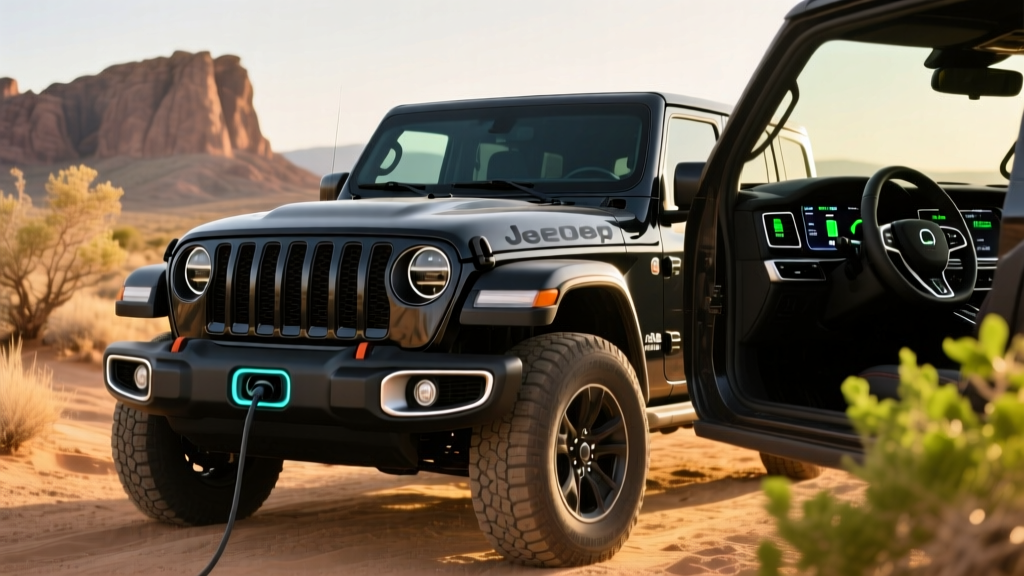
The Jeep Wrangler Rubicon 4xe is the only plug-in hybrid that pairs serious off-road hardware with a meaningful electric-only commute mode. For 2026, Jeep continues to refine the 4xe powertrain, but the core proposition remains: 375 combined horsepower, a solid rear axle with front and rear locking differentials, and roughly 22 miles of gas-free driving before the turbocharged 2.0-liter four-cylinder wakes up. If you've been searching for a Jeep Rubicon hybrid that can handle rock crawling on Saturday and a zero-emission commute on Monday, this is effectively your only option — and it's a compelling one, provided you understand the trade-offs inherent to electrifying a body-on-frame off-roader.
Below, we break down the real-world MPG, electric range, charging logistics, powertrain details, tax credit status, and long-term battery reliability so you can decide whether the Rubicon 4xe fits your garage — or whether a conventional hybrid, full EV, or gas Rubicon makes more sense.
HEV vs. PHEV: What the Wrangler 4xe Actually Is
Before diving into specs, it's critical to understand what the Wrangler 4xe is — and what it isn't. The 4xe (pronounced "four-by-e") is a plug-in hybrid electric vehicle (PHEV), not a conventional hybrid (HEV).
| Feature | Conventional Hybrid (HEV) | Plug-In Hybrid (PHEV) — Wrangler 4xe |
|---|---|---|
| Plug-in charging? | No — charges via regenerative braking and engine | Yes — plug in to maximize electric range |
| Electric-only driving | Minimal (low-speed assist only) | Up to ~22 miles on battery alone |
| Battery size | ~1-2 kWh | 17.3 kWh (gross) / ~14.0 kWh usable |
| Federal tax credit | Not eligible | May qualify for partial §30D credit |
| Weight penalty | Minimal | ~600 lbs heavier than gas Rubicon |
If you never plug in, the 4xe still functions as a hybrid — the engine and electric motor work together, and regenerative braking recovers energy. But you'll see diminished fuel economy and miss the entire point of the larger battery. Plan to charge at home or work to extract full value.
Fuel Economy: EPA MPG and Real-World Numbers
The 2026 Jeep Wrangler Rubicon 4xe carries EPA ratings that reflect its dual personality: efficient around town on electric power, thirsty on the highway once the battery depletes.
| Metric | City | Highway | Combined |
|---|---|---|---|
| Charge-depleting (EV mode) | 49 MPGe (electric + gas combined) | ||
| Charge-sustaining (hybrid mode, battery depleted) | 20 MPG | 20 MPG | 20 MPG |
Real-world expectations: In city driving with a full charge and short commutes under 20 miles, owners routinely report using almost no gasoline for weeks. On a depleted battery during highway cruising at 70-75 mph, expect 18-19 MPG — the Rubicon's boxy aerodynamics, 33-inch mud-terrain tires, and solid axles create substantial drag. In mixed driving with nightly Level 2 charging, many owners average 25-30 MPGe over a month, though this varies enormously based on commute length and charging discipline.
For context, the gas-only 2026 Wrangler Rubicon with the 2.0L turbo achieves 20 city / 22 highway / 21 combined per fueleconomy.gov. The 4xe's advantage only materializes if you plug in regularly.
Electric-Only Range and Total Driving Range
EPA Electric-Only Range: 22 miles
Real-World Electric Range: 17-20 miles in moderate weather; 13-16 miles in freezing temperatures with cabin heat on
Total Combined Range (electric + full 17.2-gal tank): ~370 miles
The 4xe's 17.3 kWh battery pack (approximately 14.0 kWh usable to protect longevity) delivers an EPA-rated 22 miles of electric-only driving. In practice, the Rubicon trim's aggressive tires and higher weight reduce that figure slightly compared to the lighter Sahara 4xe. Expect 17-20 miles in real-world suburban driving at moderate speeds.
Cold weather hits PHEVs particularly hard because the cabin heater draws from the same battery. At 20°F, expect electric range to drop to roughly 13-16 miles. The 4xe does include a cabin preheating function while plugged in, which helps preserve battery charge for actual driving.
Once the battery depletes, the gasoline engine takes over seamlessly, and you have the full 17.2-gallon fuel tank for approximately 340-350 additional miles. Total system range is roughly 370 miles — more than sufficient for trail runs or cross-country road trips without range anxiety.
Powertrain: 375 HP from Turbo Four + Electric Motors
The 4xe powertrain combines a 2.0-liter turbocharged inline-four engine with two electric motor-generators integrated into the TorqueFlite 8-speed automatic transmission. Here's the hardware breakdown:
| Component | Specification |
|---|---|
| Gas engine | 2.0L turbocharged I-4, 270 hp / 295 lb-ft |
| Electric motors | Two motor-generators (one integrated in transmission, one engine-mounted) |
| Combined system output | 375 hp / 470 lb-ft torque |
| 0-60 mph | ~6.0 seconds |
| Transmission | 8-speed automatic (TorqueFlite 8P75PH) |
| Drive system | Rock-Trac 4:1 part-time 4WD, front/rear locking diffs, electronic sway-bar disconnect |
| Battery (gross / usable) | 17.3 kWh / ~14.0 kWh, NMC lithium-ion |
| Curb weight | ~5,322 lbs (Rubicon 4xe Unlimited) |
| Towing capacity | 3,500 lbs |
| Water fording | 31.5 inches (sealed battery pack) |
The 470 lb-ft of combined torque is the real story for off-road use. Electric motors deliver peak torque from zero RPM, which makes the Rubicon 4xe exceptionally controllable on technical rock-crawling terrain — you can feather the throttle with precision that the gas-only Rubicon can't match. The sealed battery pack sits under the rear seats, and Jeep rates the 4xe for the same 31.5-inch water fording depth as the gas model.
In electric-only mode, the 4xe is rear-wheel drive only. Engaging 4WD requires the engine to start, which connects the front driveshaft through the transfer case. This is a deliberate engineering choice: full-time electric 4WD would require a dedicated front motor, adding cost and complexity.
Charging: Level 1, Level 2, and the DC Fast-Charging Question
The Wrangler 4xe uses a standard J1772 charge port (located on the driver-side front fender). Here's what charging looks like in practice:
| Level | Power | 0-100% Time | Notes |
|---|---|---|---|
| Level 1 (120V household) | ~1.4 kW | ~12 hours | Comes with dual-level cord; overnight top-up only |
| Level 2 (240V home/public) | ~7.2 kW (onboard charger max) | ~2-2.5 hours | Requires J1772 home station; ~$500-$1,200 installed |
| DC Fast Charging | Not supported | N/A | No DC fast-charge capability on any Wrangler 4xe |
The most common buyer question: Can the Wrangler 4xe DC fast charge? No. The 4xe lacks DC fast-charging hardware entirely. The 14 kWh usable battery is small enough that Jeep determined Level 2 charging (2-2.5 hours for a full charge) is sufficient for the vehicle's use case. On a road trip, you simply drive on gasoline — there's no benefit to stopping at a DC fast charger even if one were compatible.
For home charging, a Level 2 wall connector (32A or 40A circuit) is strongly recommended. The included Level 1 cord will add roughly 4-5 miles of electric range per hour of charging, which is barely enough to replenish a daily commute. A 240V Level 2 station adds roughly 15-18 miles of range per hour, fully replenishing the battery in about 2 hours.
Pricing, Trims, and Federal Tax Credit Eligibility
The 2026 Wrangler Rubicon 4xe is a premium off-roader with a premium price tag. Here's the current pricing landscape:
| Trim | Base MSRP | Typical As-Tested |
|---|---|---|
| Rubicon 4xe (Unlimited) | ~$57,790 | $62,000-$68,000 (options/destination) |
| Rubicon 4xe Willys | ~$53,790 | $57,000-$62,000 |
Federal tax credit (§30D): The Wrangler 4xe's eligibility for the federal plug-in hybrid tax credit has been in flux since the Inflation Reduction Act tightened battery-sourcing and critical-mineral requirements. As of 2026, the Wrangler 4xe may qualify for a partial credit of $3,750 (meeting critical-mineral requirements but not full battery-component sourcing thresholds). This credit is subject to:
- Buyer income caps: $150,000 single / $300,000 married filing jointly (modified AGI)
- MSRP cap: $80,000 for SUVs (Wrangler 4xe qualifies)
- Point-of-sale transfer: Eligible buyers can apply the credit as an immediate dealer discount rather than waiting for tax filing
- Battery sourcing rules: Must meet critical-mineral and battery-component thresholds per IRS §30D guidelines
Always verify current eligibility with your dealer and a tax professional before purchasing. Credit rules can change mid-year, and the credit may phase out for Stellantis based on cumulative sales thresholds.
Battery Longevity, Warranty, and Replacement Cost
Hybrid Battery Warranty: 8 years / 100,000 miles (whichever comes first)
Coverage threshold: Battery must retain minimum capacity (typically 60-70% of original) — if degradation exceeds this, Jeep replaces or repairs the pack under warranty.
Powertrain warranty: 5 years / 60,000 miles
The 4xe's 17.3 kWh NMC (nickel-manganese-cobalt) lithium-ion battery pack is liquid-cooled and thermally managed, which significantly extends cycle life compared to passively cooled packs. Jeep warranties the high-voltage battery for 8 years or 100,000 miles, which aligns with the federal requirement for emissions-related components on PHEVs.
Is the Rubicon 4xe reliable? The 4xe powertrain has been in production since the 2021 model year, giving it a multi-year track record. Early models (2021-2022) saw several recalls related to high-voltage battery management software and potential thermal events, which Jeep addressed through software updates and, in some cases, battery module replacements. The 2024-2026 models benefit from these refinements. The conventional hybrid components (motor-generators, power electronics) have proven robust in Jeep's broader PHEV lineup.
Battery replacement cost: Out of warranty, a full 4xe battery pack replacement currently runs $8,000-$12,000 including parts and labor, based on dealer service estimates. However, individual module replacement (the pack contains multiple modules) can reduce costs significantly if only partial degradation or failure occurs. Most owners will never need a replacement within the vehicle's practical lifespan given the 8-year warranty and the moderate depth-of-discharge typical of PHEV use.
Rubicon 4xe vs. Gas Rubicon vs. Full EV: Which Fits You?
The Rubicon 4xe occupies a narrow but real niche. Here's a decision framework based on how you actually drive:
Choose the Rubicon 4xe (PHEV) if:
- Your daily commute is under 20 miles round-trip and you can charge at home nightly
- You want serious off-road capability (lockers, sway-bar disconnect, 4:1 low range) without a second vehicle
- You value silent, electric-only operation around campsites and on quiet trails
- You want 470 lb-ft of instant torque for technical rock crawling
Choose the gas-only Rubicon if:
- You cannot charge at home (apartment, no garage outlet access)
- You want the lowest purchase price and don't mind 20-22 MPG
- You want maximum cargo space (the 4xe loses some under-floor storage to the battery)
- You do mostly highway driving where the 4xe's weight and tire drag negate its efficiency advantage
Choose a full EV (e.g., Rivian R1S, Tesla Model Y) if:
- You don't need hardcore rock-crawling hardware (lockers, solid axles)
- You want 250+ miles of range and zero gasoline expenses
- You prioritize low maintenance costs and instant acceleration on pavement
- You can charge at home and have access to DC fast-charging for road trips
The honest truth: if your primary vehicle use is commuting and road trips with no real off-roading, a full EV will save you more money and deliver a smoother experience. The Rubicon 4xe exists for buyers who genuinely need both capabilities — and that's a smaller group than Jeep's marketing suggests.
Pros and Cons at a Glance
Pros
- 375 hp / 470 lb-ft — most powerful stock Wrangler ever
- ~22 miles electric-only eliminates most daily fuel use
- Full Rubicon off-road hardware retained (lockers, disconnect, 4:1)
- Instant electric torque ideal for technical crawling
- Quiet EV mode for neighborhoods and campsites
- May qualify for partial $3,750 federal tax credit
- 31.5-inch water fording — battery fully sealed
Cons
- No DC fast charging — Level 2 only
- ~600 lbs heavier than gas Rubicon (affects handling and braking)
- Only 20 MPG once battery depletes (highway especially)
- $57,790+ starting price — significant premium over gas Rubicon
- Electric-only mode is rear-wheel drive only (4WD requires engine)
- Cold weather cuts electric range by 25-35%
- Early model years had battery-related recalls
Frequently Asked Questions
How many MPG does the Jeep Rubicon 4xe hybrid get?
The EPA rates the 2026 Wrangler Rubicon 4xe at 49 MPGe in charge-depleting (mixed EV/gas) mode and 20 MPG combined once the battery is fully depleted and the vehicle operates as a conventional hybrid. Real-world MPG depends heavily on charging habits: owners who plug in nightly and commute under 20 miles may use almost no gasoline for weeks, while those who never plug in will see 18-20 MPG — roughly the same as the gas-only Rubicon.
How far can the Rubicon 4xe go on electric only?
The EPA rates the 4xe at 22 miles of electric-only range. Real-world range is typically 17-20 miles in moderate weather and drops to 13-16 miles in freezing temperatures due to cabin heating draw and reduced battery efficiency. This covers most daily commutes but won't handle a round-trip highway drive without the engine engaging.
Does the Jeep Rubicon hybrid qualify for a tax credit?
The Wrangler 4xe may qualify for a partial federal tax credit of $3,750 under IRS §30D rules, subject to buyer income limits ($150K single / $300K joint), MSRP caps ($80K for SUVs), and battery-sourcing requirements. Eligibility can change based on Stellantis's cumulative sales and annual rule updates. Verify current status at fueleconomy.gov and consult a tax professional.
Is the Wrangler 4xe reliable, and what does a battery replacement cost?
The 4xe powertrain has been in production since 2021 and benefits from multiple years of refinement. Early models had battery-related recalls that have been addressed. The high-voltage battery is warrantied for 8 years / 100,000 miles. Out-of-warranty battery replacement costs approximately $8,000-$12,000 for a full pack, though individual module repair can be less expensive. Most owners will not need replacement within the warranty period.
Can I charge the Rubicon 4xe at a DC fast charger?
No. The Wrangler 4xe does not support DC fast charging. It charges via J1772 at Level 1 (120V, ~12 hours for a full charge) or Level 2 (240V, ~2-2.5 hours). For a PHEV with a 14 kWh usable battery, this is adequate — the vehicle is designed to charge at home overnight or at work, not at highway fast-charging stations.
Is the 4xe better off-road than the gas Rubicon?
In technical rock crawling, the 4xe has a distinct advantage: instant electric torque from zero RPM allows precise throttle control without the turbo lag or idle-creep of the gas engine. However, the 4xe is approximately 600 lbs heavier, which can be a disadvantage in deep sand or mud where weight matters. Both share identical ground clearance, approach/departure angles, and Rock-Trac 4WD hardware.
Should I get the Rubicon 4xe or a full electric SUV?
If you need genuine off-road capability (solid axles, locking differentials, 4:1 low range, 31.5-inch water fording), no current EV matches the Rubicon's hardware. If your needs are primarily on-pavement with occasional light trail use, a full EV like the Rivian R1S or even a Ford Bronco Sport PHEV offers better daily efficiency and lower running costs. The Rubicon 4xe is a specialist tool — buy it for the off-road hardware, and treat the plug-in hybrid system as a bonus.
Sources: EPA fuel economy data via fueleconomy.gov; IRS §30D credit rules via irs.gov; manufacturer specifications via Jeep/Stellantis official press materials.