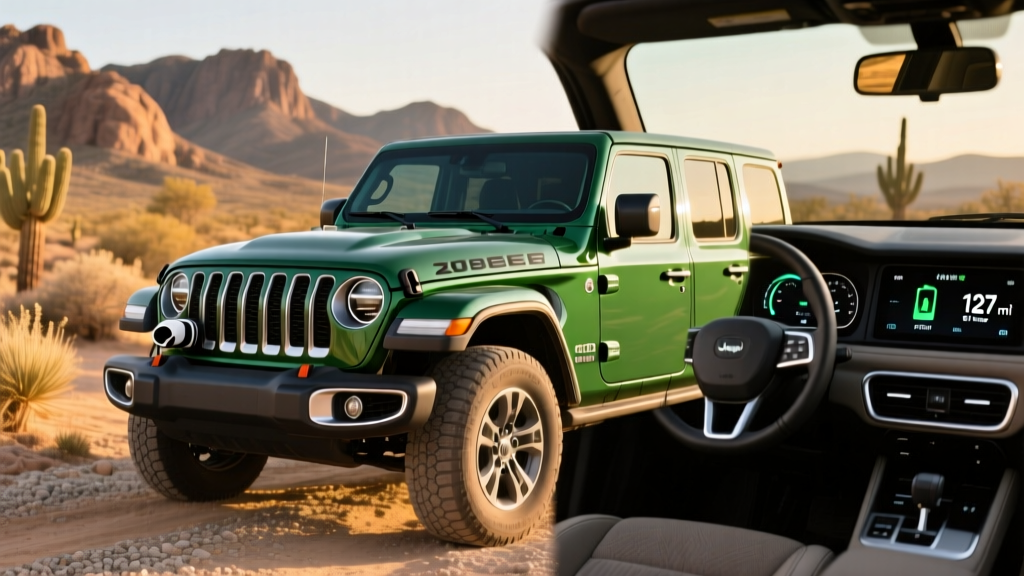
The Jeep Wrangler 4xe is one of the few plug-in hybrids that can tackle serious off-road trails while offering electric-only commuting. For 2026, Jeep continues to refine the Wrangler PHEV formula: a turbocharged engine paired with two electric motors, a 17.3 kWh battery pack, and full-time 4WD. But how does this unconventional PHEV perform in the real world — on pavement, on trails, and at the charger?
We break down the 2026 Jeep Wrangler 4xe with exact EPA figures, real-world efficiency data, charging specifics, pricing, and federal tax credit eligibility so you can decide if this plug-in hybrid fits your garage.
HEV vs PHEV: How the Wrangler 4xe Differs From a Standard Hybrid
Before diving into specs, it's critical to understand what the Wrangler 4xe is — and what it isn't.
| Feature | Conventional Hybrid (HEV) | Plug-In Hybrid (PHEV) — Wrangler 4xe |
|---|---|---|
| Plug-in charging required? | No — regenerative braking only | Yes — Level 1 or Level 2 AC charging |
| Electric-only driving | Very limited (under 1 mi, low speed) | 22 miles EPA at highway-capable speeds |
| Battery size | Small (1–2 kWh) | 17.3 kWh (usable ~14.5 kWh) |
| Federal tax credit | None | Up to $3,750 under §30D (subject to eligibility) |
| Best for | Drivers who can't plug in at home | Drivers with home charging who want short EV commutes + gas range |
The Wrangler 4xe is a PHEV, not a conventional hybrid. It requires plug-in charging to realize its efficiency and cost advantages. If you have no access to a home or workplace charger, the 4xe operates as a heavy gas vehicle once the battery depletes — and you'll pay a premium for capability you can't use.
Powertrain Specs: 375 HP From Engine + Dual Motors
| Specification | 2026 Jeep Wrangler 4xe |
|---|---|
| Engine | 2.0L turbocharged inline-4 |
| Engine output | 270 hp / 295 lb-ft torque |
| Electric motors | Two integrated motors (one in P0 position, one between engine and transmission) |
| Combined system output | 375 hp / 470 lb-ft torque |
| Transmission | 8-speed automatic (TorqueFlite) |
| Drivetrain | Full-time 4WD (Selec-Trac or Rock-Trac depending on trim) |
| Battery capacity | 17.3 kWh total (~14.5 kWh usable), NMC lithium-ion |
| 0–60 mph | ~6.0 seconds |
| Towing capacity | 3,500 lbs |
| EPA electric-only range | 22 miles |
| EPA total combined range | ~370 miles (gas + electric) |
| EPA MPGe (electric + gas) | 49 MPGe |
| EPA MPG (gas-only, charge-depleted) | 20 combined (20 city / 20 highway) |
The 4xe's 470 lb-ft of torque is available nearly instantly thanks to the electric motors, making it feel significantly quicker than the gas-only Wrangler's 2.0L turbo. The 6.0-second 0–60 time is genuinely quick for a 5,000+ lb body-on-frame SUV. Off-road, the instant electric torque at low speeds is a real advantage in rock-crawling scenarios — the Wrangler 4xe can crawl in pure electric mode with zero engine noise.
Electric Range & Real-World Efficiency
The EPA rates the 2026 Wrangler 4xe at 22 miles of electric-only range. That number holds reasonably well in moderate temperatures on suburban routes. But real-world results vary significantly based on conditions:
EPA Electric-Only Range: 22 miles
Real-World Expectations:
- Mild weather, suburban driving (under 45 mph): 20–23 miles — close to EPA
- Highway (70+ mph): 14–17 miles — aerodynamic drag crushes EV efficiency on the Wrangler's boxy shape
- Cold weather (below 32°F): 12–16 miles — battery chemistry slows, cabin heating draws significant power
- Off-road/low-range: 8–12 miles — heavy load, low-speed crawling depletes battery faster
Once the battery depletes, the 4xe operates as a conventional (albeit heavy) hybrid, relying on the 2.0L turbo engine with regenerative braking assist. The EPA rates charge-depleted operation at 20 MPG combined. In real-world mixed driving without plugging in, expect 18–21 MPG — the Wrangler's weight (over 5,100 lbs for the 4xe) and poor aerodynamics work against it.
If you never plug in, the 4xe is actually less efficient than the gas-only Wrangler with the 2.0L turbo (EPA 22 combined), because you're hauling ~800 lbs of dead battery and motor weight. The PHEV only makes sense with regular charging.
MPG Breakdown
| Mode | City | Highway | Combined |
|---|---|---|---|
| Electric + Gas (MPGe) | 49 MPGe | 49 MPGe | 49 MPGe |
| Gas Only (charge-depleted) | 20 MPG | 20 MPG | 20 MPG |
| Real-world gas only (observed) | 18–21 MPG | 17–19 MPG | 18–20 MPG |
Source: fueleconomy.gov — Jeep Wrangler 4xe
Charging Specs: Level 2 Only, No DC Fast Charging
The Wrangler 4xe charges exclusively via AC — there is no DC fast-charging capability. Here's what to expect:
| Charging Level | Power (kW) | 0–100% Time | Notes |
|---|---|---|---|
| Level 1 (120V household outlet) | ~1.4 kW | ~12 hours | Emergency/overnight trickle — adequate if you drive under 20 mi/day |
| Level 2 (240V, 32A) | ~7.2 kW (onboard charger limited) | ~2.5 hours | Recommended for daily home charging |
| DC Fast Charge | N/A | N/A | Not supported — no CCS or NACS DC port |
The onboard AC charger maxes out at approximately 7.2 kW, meaning even a 48A Level 2 circuit won't charge faster. A standard 32A/240V home charger (like a ChargePoint Home Flex or Wallbox Pulsar Plus) is ideal. You'll need a J1772 connector — the industry standard for non-Tesla AC charging. If you own a Tesla wall connector, you'll need a J1772 adapter.
At $0.13/kWh (national average residential electricity rate), a full 14.5 kWh usable charge costs roughly $1.88 — enough for ~20 miles of electric driving, or about $0.09/mile. Compare that to gas-only operation at 20 MPG and $3.40/gallon: $0.17/mile. The electric savings are meaningful, but only if you're charging daily.
Pricing, Trims & Federal Tax Credit Eligibility
The 2026 Wrangler 4xe is available across several trims, starting from the Willys 4xe and extending to the Rubicon and High Altitude:
- Willys 4xe: ~$51,795 MSRP (including destination)
- Sport S 4xe: ~$53,795 MSRP
- Sahara 4xe: ~$57,795 MSRP
- Rubicon 4xe: ~$60,795 MSRP
- High Altitude 4xe: ~$65,795 MSRP
Federal §30D Tax Credit: The Wrangler 4xe may qualify for a partial federal tax credit. As of 2026, the IRS §30D credit provides up to $7,500 for new PHEVs meeting battery component and critical mineral sourcing requirements. However, the Wrangler 4xe's battery sourcing has historically limited it to $3,750 (meeting one of the two sourcing thresholds but not both). Eligibility also depends on:
- MSRP cap: SUVs must be under $80,000 — all Wrangler 4xe trims qualify
- Buyer income cap: AGI under $150,000 (single) / $300,000 (joint) / $225,000 (head of household)
- Battery sourcing: Must meet critical mineral and battery component thresholds set by the IRS — verify current-year compliance at irs.gov
- Point-of-sale transfer: As of 2024+, eligible credits can be transferred to the dealer as a down payment reduction — confirm with your dealer at purchase
Always consult a tax professional before relying on credit eligibility. Sourcing requirements tighten annually, and the credit amount may change for the 2026 model year. Jeep's parent company Stellantis has been working to reshore battery supply chains, which could improve credit qualification over time.
Battery Warranty, Reliability & Replacement Cost
High-Voltage Battery Warranty: 8 years / 100,000 miles (whichever comes first)
Capacity retention guarantee: Jeep warrants the battery against failure to hold a minimum charge capacity — typically 60–70% of original capacity, though exact threshold should be confirmed in your owner's manual.
Powertrain warranty: 5 years / 60,000 miles (covers engine, transmission, electric motors)
The Wrangler 4xe's NMC battery pack is liquid-cooled, which helps mitigate degradation compared to passively cooled packs. Based on data from 2021–2025 model-year 4xe owners, battery degradation has been modest — most owners report losing 1–2 miles of electric range over the first 3–4 years, which is within normal expectations for NMC chemistry.
Battery replacement cost: If out of warranty, a full 4xe battery replacement currently runs approximately $12,000–$16,000 including labor. This is a significant expense, though it's comparable to other PHEV battery replacements in this class. Module-level repairs (replacing individual degraded cells rather than the full pack) may be available for less through specialized shops.
Reliability notes: The Wrangler 4xe's powertrain adds complexity over the gas-only model — two electric motors, high-voltage wiring, and a larger battery introduce more potential failure points. Early 2021–2022 models saw some recalls related to battery cell manufacturing defects (fire risk while parked, leading to a recall and battery replacement campaign). Later model years (2023+) have shown improved reliability. Check NHTSA recall data for specific VIN lookups before purchasing.
Pros & Cons: The Honest Assessment
Pros
- 375 hp and 470 lb-ft torque — quickest Wrangler in the lineup
- Silent electric off-road crawling is a genuine advantage on trails
- 22 miles of EV range covers most daily commutes without gas
- No range anxiety — gas engine provides 370+ total miles
- Full Wrangler capability: removable doors/top, solid axles, 3,500-lb towing
- May qualify for partial §30D federal tax credit
Cons
- 20 MPG gas-only is poor — worse than the gas 2.0L if you don't plug in
- No DC fast charging — road trips rely entirely on gas
- Only 22 miles EV range — short compared to PHEV rivals (RAV4 PHEV: 42 mi)
- Premium MSRP: $51K+ starting, $60K+ for Rubicon
- Heavy: 5,100+ lbs impacts handling, braking, and tire wear
- Early model-year recalls raise reliability concerns
Who Should Buy the Wrangler 4xe — And Who Shouldn't
Choose the Wrangler 4xe if:
- You want a Wrangler for off-road use AND have a short commute (under 20 miles) with home charging
- You value instant electric torque for rock crawling and trail use
- You need a vehicle that can do weekday EV commuting and weekend trail runs without a second car
- You can plug in nightly to capture the efficiency and cost benefits
Choose a full EV instead if:
- You want 250+ miles of range and DC fast charging for road trips
- You don't need serious off-road capability
- You want lower operating costs and zero tailpipe emissions
- Consider: Ford Mustang Mach-E, Hyundai Ioniq 5, or Rivian R1S (if you need off-road)
Choose the gas-only Wrangler if:
- You cannot charge at home or work
- Your budget is tighter — the gas Wrangler starts ~$15,000 lower
- You drive primarily highway miles where the 4xe's EV range is irrelevant
Frequently Asked Questions
How many MPG does the Jeep Wrangler 4xe PHEV get?
The EPA rates the Wrangler 4xe at 49 MPGe when combining electric and gas operation. In gas-only (charge-depleted) mode, it drops to 20 MPG combined (20 city / 20 highway). Real-world gas-only driving typically yields 18–21 MPG depending on terrain, speed, and weather.
How far can the Wrangler 4xe go on electric only?
The EPA rates the 4xe at 22 miles of electric-only range. Real-world results range from 14–17 miles on the highway to 20–23 miles in suburban driving at moderate temperatures. Cold weather and off-road use reduce this further to 8–16 miles.
Does the Jeep Wrangler 4xe qualify for a tax credit?
The Wrangler 4xe may qualify for up to $3,750 under the IRS §30D federal clean vehicle credit, depending on battery sourcing compliance, buyer income limits (under $150K single / $300K joint), and the SUV MSRP cap ($80K). All trims fall under the cap. Credit amounts and sourcing rules can change yearly — verify at irs.gov or with a tax professional.
Is the Wrangler 4xe reliable and what does battery replacement cost?
The high-voltage battery is warrantied for 8 years / 100,000 miles. Real-world degradation has been modest (1–2 miles range loss over 3–4 years). However, early 2021–2022 models had battery-related recalls. Out-of-warranty battery replacement runs approximately $12,000–$16,000. Check NHTSA for recall status on any specific VIN.
Can the Wrangler 4xe DC fast charge?
No. The Wrangler 4xe supports only AC charging: Level 1 (120V, ~1.4 kW) and Level 2 (240V, up to 7.2 kW). A full charge on Level 2 takes approximately 2.5 hours. There is no DC fast-charging port.
Hybrid vs PHEV vs EV — which fits me?
A conventional hybrid (HEV) like the Toyota RAV4 Hybrid needs no plug-in and gets 40 MPG but offers no electric-only driving. A PHEV like the Wrangler 4xe offers 22 miles EV range plus gas flexibility — ideal if you can charge at home but need long range. A full EV (BEV) like the Rivian R1S offers 250+ miles electric with zero gas but requires reliable charging access and a higher upfront budget. The PHEV is the bridge option for drivers not ready to go fully electric.
Does the 4xe lose off-road capability compared to the gas Wrangler?
No. The 4xe retains the same ground clearance, approach/departure/breakover angles, and available locking differentials as the gas Rubicon. The added battery weight (~800 lbs more than gas models) is a trade-off, but the instant electric torque is actually an advantage in low-speed technical terrain. The 4xe can run in electric-only 4WD Low mode for silent crawling.