Quick Verdict: The Wrangler 4xe Is a Plug-In Hybrid With Real Trail Credentials
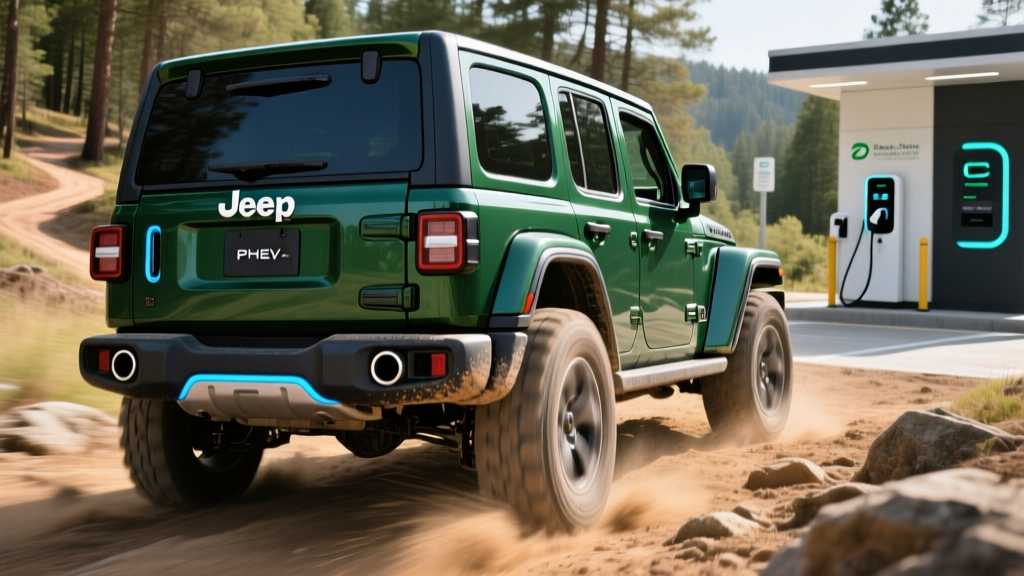
The Jeep Wrangler 4xe is not your typical plug-in hybrid. While most PHEVs prioritize commuter efficiency, the 4xe pairs a 17 kWh battery pack and two electric motors with a turbocharged 2.0-liter engine to deliver 375 horsepower and genuine off-road capability. For 2026, the Wrangler 4xe continues as the best-selling PHEV in America — and for good reason. It offers 22 miles of electric-only driving, a total range exceeding 370 miles, and the same trail-rated hardware that makes the gas Wrangler a legend.
But the 4xe isn't for everyone. Its fuel economy advantage only materializes if you charge regularly, its electric range is modest by PHEV standards, and its starting price sits well above the gas-only Wrangler. This guide breaks down every spec, real-world efficiency figure, charging requirement, and ownership cost you need to decide if the Wrangler 4xe is the right electrified vehicle for your driveway.
Jeep Wrangler 4xe Powertrain: How the Plug-In Hybrid System Works
Before diving into numbers, it's worth clarifying what the Wrangler 4xe actually is — because confusing a conventional hybrid (HEV) with a plug-in hybrid (PHEV) is one of the most common mistakes shoppers make.
HEV vs. PHEV: What's the Difference?
Conventional Hybrid (HEV): A small battery (typically 1–2 kWh) is recharged only through regenerative braking and the engine. You never plug it in. Examples: Toyota RAV4 Hybrid, Honda CR-V Hybrid. Fuel savings come from electric assist during acceleration and low-speed driving.
Plug-In Hybrid (PHEV): A larger battery (typically 10–25 kWh) can be charged from an external power source — a wall outlet or Level 2 charger. This enables meaningful electric-only driving (15–45 miles depending on the model) before the gas engine engages. The Jeep Wrangler 4xe is a PHEV.
Key takeaway: If you never plug in a PHEV, you're carrying dead battery weight and getting worse fuel economy than a conventional hybrid. The 4xe rewards daily charging.
The Wrangler 4xe's powertrain combines three power sources:
- 2.0L turbocharged inline-4 engine: 270 hp, 295 lb-ft torque
- Electric motor (transmission-mounted): Integrated into the 8-speed automatic
- Front-mounted electric motor/generator: Handles regenerative braking and engine starting
- Combined system output: 375 hp, 470 lb-ft torque
That 470 lb-ft figure matters off-road. The instant torque from the electric motors gives the 4xe exceptionally smooth low-speed crawling — no turbo lag, no stalling. Jeep engineers designed the 4xe's hybrid system to work seamlessly with the Wrangler's Dana 44 axles, locking differentials, and sway-bar disconnect. You can even drive in pure electric mode on the trail for silent, zero-emission rock crawling.
Fuel Economy and Electric Range: EPA Numbers vs. Real-World Results
The Wrangler 4xe's efficiency depends entirely on your driving and charging habits. Here are the official EPA figures and what you can actually expect.
| Metric | EPA Rating | Real-World Expectation |
|---|---|---|
| MPGe (electric + gas combined) | 49 MPGe | 45–50 MPGe (with daily charging) |
| Gas-only MPG (combined) | 20 MPG | 17–19 MPG highway; 20–22 city |
| Electric-only range | 22 miles | 17–20 mi (highway/cold); 22–24 mi (city/mild weather) |
| Total combined range | 370 miles | 340–380 miles depending on conditions |
| Fuel tank capacity | 17.2 gallons | — |
Real-world context: The 22-mile EPA electric range is achievable in moderate temperatures with city driving where regenerative braking recaptures energy. On a 70 mph highway run in 30°F weather, expect that range to drop to roughly 15–17 miles. The Wrangler's boxy shape and 5,000+ pound curb weight work against it aerodynamically. According to fueleconomy.gov, the 4xe's combined gas-only rating of 20 MPG is competitive with the V6 gas Wrangler (19–21 MPG combined) but not dramatically better — the efficiency gains come almost entirely from electric-mode driving.
If your daily commute is under 20 miles round-trip and you charge every night, you may go weeks without burning fuel. If you never plug in, you're simply driving a heavy, slightly less efficient gas Wrangler.
Battery, Charging, and Electrical Specs
The Wrangler 4xe uses a 17.3 kWh lithium-ion battery pack (14.0 kWh usable) mounted under the rear seat. This location keeps the battery protected during off-road use and preserves interior cargo space.
| Specification | Value |
|---|---|
| Battery chemistry | NMC (nickel-manganese-cobalt) lithium-ion |
| Total battery capacity | 17.3 kWh |
| Usable capacity | ~14.0 kWh |
| Onboard charger (Level 2) | 7.2 kW |
| Level 1 (120V) charge time, 0–100% | ~12 hours |
| Level 2 (240V) charge time, 0–100% | ~2.5–3 hours |
| DC fast charging | Not available |
| Charge port location | Front driver-side fender (J1772 connector) |
No DC fast charging: This is a critical limitation for road-trip planning. The 4xe cannot use public DC fast chargers (Electrify America, EVgo, Tesla Superchargers). You are limited to Level 1 (standard 120V outlet) or Level 2 (240V home or public charger). For a vehicle with only 22 miles of electric range, this isn't a dealbreaker — the battery recharges fully in under three hours on a Level 2 home charger, and the gas engine handles longer trips. But don't expect to top up at a highway fast-charging station.
Home charging setup: Most 4xe owners install a Level 2 home charger (240V, 32–40 amp circuit). A quality Level 2 unit like the ChargePoint Home Flex or Emporia Vue costs $400–$700, with professional installation running $500–$1,500 depending on your electrical panel. Jeep also includes a Level 1 charging cord for standard 120V outlets, which works if you park near a garage outlet and don't mind the 12-hour charge time.
Performance and Capability: 375 HP Meets Trail Rated
The Wrangler 4xe's hybrid system isn't just about efficiency — it's the most powerful engine option in the Wrangler lineup short of the 392 V8 Rubicon. Here's what the numbers look like:
- Combined horsepower: 375 hp
- Combined torque: 470 lb-ft
- 0–60 mph: ~6.0 seconds
- Towing capacity: 3,500 lbs
- Ground clearance (Rubicon): 10.8 inches
- Water fording: 30 inches (battery and electrical components are sealed and waterproof)
The electric torque fill transforms the Wrangler's driving character. Where the gas-only 2.0L turbo can feel laggy at low RPMs, the 4xe delivers instant thrust from a stop. The 8-speed automatic transmission is well-calibrated for the hybrid system, with smooth transitions between electric-only, hybrid, and engine-only modes.
Off-road, the 4xe's electric motors provide precise low-speed control that's actually superior to the gas engine for rock crawling. You can select Electric mode to crawl silently — a genuine advantage on trails where noise matters. The battery's under-seat placement keeps the center of gravity low, and Jeep has sealed all high-voltage components to the same water-fording standards as the gas Wrangler.
Pricing, Trims, and Federal Tax Credit Eligibility
The 2026 Wrangler 4xe is available across multiple trims. Pricing has shifted for the 2026 model year, and federal tax credit eligibility requires careful attention to current IRS rules.
| Trim | Starting MSRP | Key Features |
|---|---|---|
| Willys 4xe | $51,790 | 33" tires, LED lights, off-road suspension |
| Sport S 4xe | $53,790 | Alloy wheels, Uconnect 5, dual-zone climate |
| Sahara 4xe | $57,790 | Leather, premium audio, body-color fenders |
| Rubicon 4xe | $59,790 | Front/rear lockers, sway-bar disconnect, 35" tires |
| High Altitude 4xe | $63,790 | Sky One-Touch power top, full leather, 20" wheels |
All prices include destination charge. Actual dealer prices may vary.
§30D Federal Tax Credit: What Wrangler 4xe Buyers Need to Know
Under current IRS §30D rules, the Wrangler 4xe may qualify for a partial or full federal clean vehicle credit, but eligibility depends on several factors that change frequently:
- MSRP cap: SUVs must have an MSRP at or below $80,000 — all 4xe trims qualify.
- Buyer income cap: Modified AGI must not exceed $300,000 (joint), $225,000 (head of household), or $150,000 (single).
- Battery sourcing: Critical minerals and battery components must meet phased-in domestic sourcing thresholds. Jeep has adjusted supply chains, but the qualifying credit amount can shift. As of early 2026, the 4xe qualifies for a $3,750 credit (partial — meeting critical minerals requirements but not full component sourcing).
- Point-of-sale transfer: You can transfer the credit to the dealer at purchase for an immediate price reduction rather than claiming it on your tax return.
Verify before buying: Credit eligibility changes as sourcing rules tighten. Check the latest qualifying vehicle list on fueleconomy.gov and consult a tax professional for your specific situation.
Battery Warranty, Reliability, and Long-Term Ownership
Wrangler 4xe Battery Warranty
Coverage: 8 years / 100,000 miles (whichever comes first)
Capacity retention threshold: Jeep warrants the high-voltage battery to retain at least 70% of its original capacity during the warranty period. If capacity drops below 70%, Jeep will repair or replace the battery at no cost.
Powertrain warranty: 5 years / 60,000 miles on the hybrid powertrain components (electric motors, inverter, onboard charger).
Reliability track record: The Wrangler 4xe has been on sale since the 2021 model year, giving us several years of real-world data. Early models experienced some software-related recalls (related to the hybrid control module and battery management system), which Jeep addressed through dealer service campaigns. The mechanical hardware — Dana axles, transfer case, electric motors — has proven robust. According to NHTSA data, there have been no widespread battery failure patterns.
Battery replacement cost: If the battery falls outside warranty coverage, a full replacement runs approximately $12,000–$15,000 including parts and labor. However, PHEV battery degradation is typically gradual. NMC chemistry in the 4xe is liquid-cooled (active thermal management), which significantly extends cycle life compared to passively cooled packs. Most owners report less than 5% capacity loss after 3–4 years of daily charging.
Maintenance advantages: The 4xe's hybrid system actually reduces some maintenance costs. Regenerative braking extends brake pad life significantly — many owners report 60,000+ miles on original pads. The engine runs less frequently, reducing oil-change intervals under the oil-life monitoring system.
Wrangler 4xe vs. Full EV vs. Gas Wrangler: Which Should You Choose?
The Wrangler 4xe occupies a specific niche. Here's a framework for deciding whether it's the right choice versus a full battery-electric vehicle or the conventional gas Wrangler.
Decision Framework: Which Wrangler (or EV) Fits You?
Choose the Wrangler 4xe PHEV if:
- You have home charging access (garage or driveway with 240V outlet)
- Your daily commute is under 25 miles round-trip
- You regularly go off-road and want the silent electric-crawling advantage
- You take road trips into areas with sparse charging infrastructure
- You want maximum Wrangler power (375 hp / 470 lb-ft) without stepping to the $90K+ 392 V8
Choose a full EV (e.g., Rivian R1S, Ford Bronco if EV variant launches) if:
- You want zero gas-engine maintenance and the lowest per-mile fuel cost
- You have reliable home and workplace charging
- Your road trips are within DC fast-charging corridor coverage
- You want 250+ miles of range without the gas engine engaging
Choose the gas Wrangler (3.6L V6 or 2.0T) if:
- You don't have access to home charging
- You want the lowest upfront purchase price (gas models start ~$10,000 less)
- You drive very few miles annually (the fuel savings won't offset the 4xe premium)
- You prefer simpler mechanicals with no high-voltage system
Pros and Cons: The Honest Assessment
Pros
- 375 hp and 470 lb-ft — most powerful non-V8 Wrangler
- Genuine trail-rated off-road capability with electric crawling mode
- 22-mile electric range covers most daily commutes
- Seamless transitions between EV, hybrid, and gas modes
- Regenerative braking extends brake life dramatically
- Eligible for partial $3,750 federal tax credit (verify current status)
- 8-year/100,000-mile battery warranty
Cons
- 22-mile electric range is short compared to rivals (RAV4 Prime: 42 mi)
- No DC fast charging capability
- Gas-only MPG (20 combined) is barely better than the gas Wrangler
- $51,790+ starting price — significant premium over gas models
- Heavy: ~5,100 lbs curb weight impacts handling and tire wear
- Early model years had software-related recalls
- Only qualifies for partial tax credit ($3,750 vs. full $7,500)
Frequently Asked Questions
How many MPG does the Jeep Wrangler 4xe get?
The EPA rates the Wrangler 4xe at 49 MPGe when combining electric and gas operation, and 20 MPG combined when running on gasoline alone. In real-world driving, expect 17–19 MPG on highway road trips (gas-only) and 20–22 MPG in city driving. Your actual MPGe depends heavily on how often you charge — owners who plug in daily and commute under 20 miles report effective MPGe well above the EPA rating, while those who rarely charge see figures close to the gas-only rating.
How far can the Wrangler 4xe drive on electric only?
The EPA rates the 4xe at 22 miles of electric-only range. In real-world conditions, expect 17–20 miles during highway driving or cold weather, and up to 22–24 miles in mild-weather city driving where regenerative braking recaptures energy frequently. This range is sufficient for short commutes and errands but shorter than PHEV competitors like the Toyota RAV4 Prime (42 miles) or the Chrysler Pacifica Hybrid (32 miles).
Does the Wrangler 4xe qualify for a federal tax credit?
As of early 2026, the Wrangler 4xe qualifies for a partial $3,750 federal clean vehicle credit under IRS §30D. It meets the critical minerals requirement but does not fully satisfy the battery component sourcing threshold for the full $7,500. Eligibility also depends on your income (must be under $300K joint / $150K single) and the vehicle's MSRP (must be under $80K for SUVs — all 4xe trims qualify). The credit can be transferred to the dealer at point of sale for an immediate price reduction. Always verify current eligibility on fueleconomy.gov before purchasing, as sourcing rules phase in annually.
Is the Wrangler 4xe reliable, and what does battery replacement cost?
The 4xe has been on sale since 2021, and overall reliability has been acceptable, with early software-related recalls largely resolved. The mechanical hybrid components (electric motors, transmission integration) have proven durable. The high-voltage battery is covered by an 8-year/100,000-mile warranty with a 70% capacity retention guarantee. Out-of-warranty battery replacement costs approximately $12,000–$15,000, though the liquid-cooled NMC pack is designed for long cycle life and most owners report minimal degradation in the first 4–5 years.
Can I charge the Wrangler 4xe at a public fast-charging station?
No. The Wrangler 4xe does not support DC fast charging. It can only charge via Level 1 (120V standard outlet, ~12 hours for a full charge) or Level 2 (240V, ~2.5–3 hours for a full charge). This means you cannot use Electrify America, EVgo, Tesla Supercharger, or any other DC fast-charging network. For a PHEV with a 17 kWh battery and 22-mile electric range, this limitation is manageable — most charging happens at home overnight — but it's important to understand before buying.
Hybrid vs. PHEV vs. full EV — which powertrain is right for me?
A conventional hybrid (HEV) like the Toyota RAV4 Hybrid requires no plug-in charging and delivers consistent fuel savings (roughly 35–40% better MPG than a gas equivalent). A plug-in hybrid (PHEV) like the Wrangler 4xe offers 15–42 miles of electric driving but only delivers its efficiency advantage if you charge regularly. A full EV eliminates gas entirely but requires reliable charging access and acceptance of range limitations on road trips. If you can charge at home, drive under 30 miles daily, and take occasional long trips, a PHEV is an excellent bridge. If you always charge and rarely take long trips, a full EV offers lower operating costs. If you can't charge at home, a conventional hybrid is the better choice.
Does the 4xe's hybrid system affect off-road capability?
No — and in some ways, it improves it. The 4xe retains the full Trail Rated hardware package: Dana 44 axles, electronic locking differentials, electronic sway-bar disconnect (Rubicon), and the same ground clearance and water-fording ratings as the gas Wrangler. The electric motors provide instant, precise torque at low speeds, which is actually advantageous for rock crawling. You can select Electric mode for silent, zero-emission trail driving. The battery pack is sealed and mounted under the rear seats, protected from water and impacts.
Sources: EPA fuel economy data via fueleconomy.gov; IRS clean vehicle credit rules via irs.gov; Jeep Wrangler 4xe specifications via jeep.com. Pricing and tax credit eligibility reflect 2026 model year information available at time of publication and are subject to change.