Quick Verdict: The Hybrid Wrangler That Does Both
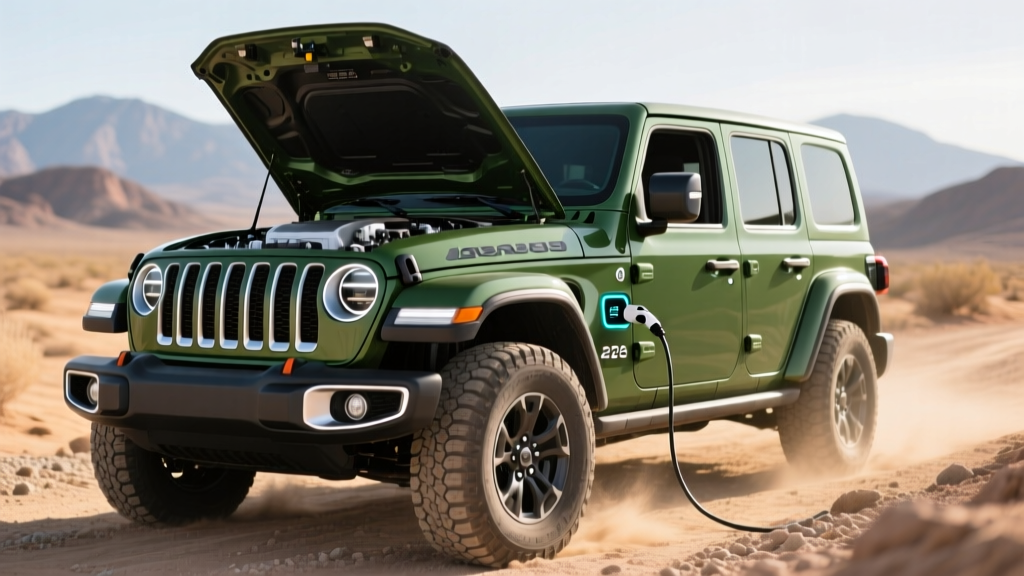
The Jeep Wrangler 4xe is the plug-in hybrid (PHEV) version of America's most iconic off-roader, and it remains one of the best-selling PHEVs in the United States. For 2026, Jeep continues to refine the formula: a turbocharged 2.0-liter inline-four paired with two electric motors, a 17.3 kWh battery pack, and standard 4WD. The result is 375 combined horsepower, 22 miles of electric-only range, and 49 MPGe when running on both electricity and gasoline.
If you've been searching for a hybrid Wrangler, the 4xe is currently your only factory option. Jeep does not offer a conventional hybrid (HEV) Wrangler — no self-charging, no mild-hybrid-only trim. The 4xe is a full plug-in hybrid that you can charge at home, drive on pure electricity for short commutes, and then rely on the gas engine for longer trips or serious trail work.
| Spec | Value |
|---|---|
| Powertrain | 2.0L turbo I-4 + 2 electric motors |
| Combined Horsepower | 375 HP / 470 lb-ft torque |
| Battery (usable) | 17.3 kWh (NMC lithium-ion) |
| EPA Electric-Only Range | 22 miles |
| EPA MPGe (combined) | 49 MPGe |
| EPA MPG (gas-only, combined) | 20 MPG |
| 0–60 mph | |
| Max Level 2 Charge Rate | 7.2 kW (AC only, no DC fast charge) |
| Charge Time (Level 2, 0–100%) | ~2.5 hours |
| Charge Time (Level 1, 120V) | ~12 hours |
| Base MSRP (Willys 4xe) | $49,995 |
| Battery Warranty | 8 years / 100,000 miles |
| Federal Tax Credit (§30D) | Up to $3,750 (see eligibility below) |
HEV vs. PHEV: Why the Wrangler 4xe Is a Plug-In Hybrid
Understanding the distinction between a conventional hybrid (HEV) and a plug-in hybrid (PHEV) is essential before evaluating the Wrangler 4xe:
- Conventional Hybrid (HEV): A small battery (typically 1–2 kWh) is recharged solely through regenerative braking and the engine. You never plug it in. Electric-only driving is limited to very low speeds for brief distances. Think Toyota RAV4 Hybrid.
- Plug-In Hybrid (PHEV): A larger battery (17.3 kWh in the 4xe) can be charged from a wall outlet or charging station, enabling meaningful electric-only range (22 miles EPA). Once the battery depletes, the vehicle operates like a conventional hybrid. The Wrangler 4xe falls here.
The Wrangler has never been offered as a conventional HEV. If you want a hybrid Wrangler, the 4xe PHEV is the only path. That means you'll need access to a 120V outlet (Level 1) or, ideally, a 240V Level 2 charger at home to take full advantage of the electric range.
Fuel Economy: Real-World MPG vs. EPA Sticker
| Mode | City | Highway | Combined |
|---|---|---|---|
| Electric + Gas (MPGe) | — | — | 49 MPGe |
| Gas-Only (MPG) | 20 | 20 | 20 MPG |
The EPA rates the Wrangler 4xe at 49 MPGe when operating with a full battery, blending electric and gas driving. Once the 22 miles of electric range are depleted, the vehicle reverts to a gas-only combined rating of 20 MPG — which is essentially identical to the non-hybrid 2.0L turbo Wrangler.
Real-world expectations: The 4xe's fuel economy is highly dependent on your driving pattern. If your daily commute is under 22 miles round-trip and you charge nightly, you may use almost no gasoline for weeks. Owners who charge regularly report seeing 40–60+ MPG in mixed city driving during warm months, well above the EPA combined figure. On the highway at 75+ mph with a depleted battery, expect 18–20 MPG — the 4xe's boxy aerodynamics and heavy curb weight (~5,300 lbs) work against it.
In cold weather (below freezing), the electric-only range can drop to 16–18 miles as the battery's usable capacity shrinks and cabin heating draws additional power. This is typical for all PHEVs and BEVs — plan accordingly if you live in northern climates.
Electric Range, Charging, and Battery Details
The 2026 Wrangler 4xe carries a 17.3 kWh battery pack (NMC chemistry), of which approximately 14–15 kWh is usable to protect long-term battery health. This delivers an EPA-rated 22 miles of electric-only driving at moderate speeds.
Charging capabilities:
- Level 1 (120V household outlet): The included portable cordset delivers ~1.4 kW, requiring roughly 12 hours for a full charge. Fine for overnight top-ups if your daily electric use is modest.
- Level 2 (240V home charger or public station): At the 4xe's maximum acceptance rate of 7.2 kW, a full charge takes approximately 2.5 hours. A Level 2 home charger (such as a ChargePoint Home Flex or Wallbox Pulsar Plus) is strongly recommended for daily PHEV use.
- DC Fast Charging: The Wrangler 4xe does not support DC fast charging. There is no CCS or NACS DC port. This is a deliberate engineering choice — the relatively small 17.3 kWh battery doesn't justify the added cost, weight, and thermal management complexity of a DC fast-charge system.
For PHEV ownership, Level 2 home charging is the sweet spot. A 240V/32A circuit will replenish the 4xe's battery fully while you sleep or work, maximizing your daily electric miles.
Battery Warranty & Replacement Cost: Jeep covers the 4xe's high-voltage battery for 8 years or 100,000 miles (whichever comes first), with a capacity retention threshold of 70%. If the battery degrades below 70% of its original capacity within the warranty period, Jeep will repair or replace it at no cost.
Out-of-warranty replacement cost: based on current dealer pricing and industry data, a full 4xe battery pack replacement runs approximately $8,000–$12,000 including parts and labor. However, real-world PHEV battery degradation data from the broader Stellantis fleet suggests most packs retain 85–90%+ capacity at 100,000 miles when not routinely fast-charged or deeply cycled. The 4xe's relatively small battery and conservative buffer strategy should support a long service life.
Powertrain, Performance, and Off-Road Capability
The Wrangler 4xe's powertrain combines a 2.0-liter turbocharged inline-four gasoline engine (270 HP / 295 lb-ft on its own) with two electric motor-generators integrated into the 8-speed automatic transmission housing. Combined output is 375 HP and 470 lb-ft of torque — more torque than the Wrangler's 3.6L V6 and rivaling the older 5.7L HEMI V8.
Electric torque delivery is immediate, which makes the 4xe surprisingly responsive around town and exceptionally capable on technical off-road terrain. At low crawl speeds on a trail, you can operate in pure electric mode for silent, precise throttle control with zero engine noise — a genuine advantage over the gas-only Wrangler in sensitive environments.
The 4xe retains the Wrangler's core off-road hardware: Dana 44 axles, available electronic locking differentials, electronic sway-bar disconnect (Rubicon trim), and up to 10.8 inches of ground clearance. The added weight of the battery and motors (~600 lbs over the gas 2.0L) is noticeable in on-road cornering but barely matters on a trail where low-range gearing and torque multiplication dominate.
Towing capacity is rated at 3,500 lbs — unchanged from the gas Wrangler. Payload capacity is slightly reduced due to the battery weight.
Pricing, Trims, and Federal Tax Credit Eligibility
The 2026 Wrangler 4xe is offered across multiple trims. Pricing starts at $49,995 for the Willys 4xe (including destination), climbing through Sport S, Sahara, Rubicon, High Altitude, and the range-topping Rubicon 392 (which uses a different powertrain). A well-equipped Rubicon 4xe typically lands between $60,000 and $65,000 before options.
Federal Tax Credit (§30D) — Current 2026 Rules:
- The Wrangler 4xe qualifies for up to $3,750 under the IRS §30D clean vehicle credit. It does not receive the full $7,500 because it meets the critical minerals requirement but does not fully satisfy the battery component sourcing threshold for the additional $3,750 half.
- MSRP cap: The 4xe qualifies as an SUV under IRS rules, so the MSRP cap is $80,000. All 4xe trims fall under this limit.
- Buyer income caps: Modified AGI must not exceed $150,000 (single), $225,000 (head of household), or $300,000 (joint filers).
- Point-of-sale transfer: You can elect to transfer the credit to the dealer at purchase, reducing your out-of-pocket cost by $3,750 at the point of sale rather than waiting to claim it on your tax return.
- Always verify current eligibility on IRS.gov and confirm with your tax professional, as sourcing requirements and qualified-vehicle lists are updated periodically.
Some states offer additional PHEV incentives. California's CVRP program, Colorado's state tax credit, and various utility rebates may stack on top of the federal credit. Check your state energy office or utility provider for current programs.
Who Should Buy the Hybrid Wrangler — And Who Shouldn't
Choose the Wrangler 4xe if:
- Your daily commute is under 25 miles and you can charge at home — you'll run mostly on electricity and rarely visit a gas station.
- You want genuine off-road capability (locking diffs, sway-bar disconnect, 4:1 low range) without sacrificing daily-driver practicality.
- You want the instant low-end torque that electric motors provide for rock crawling and technical trails.
- You need a vehicle that can do weekday commuting and weekend backcountry trips without range anxiety.
Choose a full EV (like the Rivian R1S or upcoming electric Wrangler) if:
- You never want to buy gasoline and have reliable home + public charging access.
- Your driving is predominantly on-road and you don't need Wrangler-specific off-road hardware.
Choose the gas-only Wrangler if:
- You lack home charging access and cannot plug in regularly — a PHEV you never charge is just a heavier, more expensive gas car.
- You primarily drive long highway distances where the 4xe's gas-only MPG (20) offers no advantage over the 2.0L gas model.
- You want to minimize upfront cost — the gas Wrangler starts around $33,000, roughly $17,000 less than the 4xe.
Reliability and Long-Term Ownership
The Wrangler 4xe's powertrain adds complexity compared to the gas-only model: you have a turbocharged engine, two electric motors, a high-voltage battery, a charging system, and the standard 8-speed transmission. Early 2021–2022 model-year 4xes experienced some software-related recalls and battery-cell issues that prompted service campaigns. Jeep has since updated the battery management software and revised cell sourcing.
For the 2026 model year, the 4xe benefits from several production years of refinement. The 8-year/100,000-mile battery warranty provides meaningful peace of mind, and the conventional powertrain components (engine, transmission) are covered under Jeep's standard 5-year/60,000-mile powertrain warranty.
According to NHTSA recall data, the 4xe's recall count has trended downward with each successive model year. As with any PHEV, the key ownership best practices are: avoid leaving the battery at 100% state of charge for extended periods, use Level 2 charging rather than relying exclusively on Level 1, and follow the manufacturer's scheduled maintenance intervals for the engine (which still requires oil changes, spark plugs, and coolant service).
Wrangler 4xe Pros and Cons
Pros
- 375 HP / 470 lb-ft — the most torque of any non-V8 Wrangler
- 22 miles electric-only covers most daily commutes
- Silent electric trail crawling is a genuine off-road advantage
- No range anxiety — gas engine covers unlimited distance
- Retains full Wrangler off-road hardware (Dana 44, lockers, disconnect)
- Eligible for up to $3,750 federal tax credit + state incentives
- 8-year / 100,000-mile battery warranty
Cons
- 20 MPG gas-only is no improvement over the standard 2.0L Wrangler
- No DC fast charging — limited to 7.2 kW Level 2
- ~600 lbs heavier than the gas model, affecting on-road dynamics
- Base MSRP near $50K — significant premium over gas Wrangler
- Boxy aero limits real-world highway MPG to 18–20
- Cold weather reduces electric range to ~16–18 miles
- Early model-year reliability issues (though improving)
Frequently Asked Questions
How many MPG does the hybrid Wrangler get?
The EPA rates the 2026 Wrangler 4xe at 49 MPGe combined when using both electric and gas power, and 20 MPG combined when running on gasoline alone. In real-world driving, owners who charge daily and commute short distances regularly report effective fuel economy well above 40 MPG. On long highway trips with a depleted battery, expect 18–20 MPG.
How far can the Wrangler 4xe go on electric only?
The EPA-rated electric-only range is 22 miles. In warm weather with moderate speeds, you may see 24–26 miles. In freezing temperatures or at highway speeds, expect 16–18 miles. The total combined range (electric + a full 21.5-gallon gas tank) exceeds 370 miles.
Is the Wrangler 4xe a conventional hybrid or a plug-in hybrid?
The Wrangler 4xe is a plug-in hybrid (PHEV). It must be plugged into a 120V or 240V outlet to recharge its 17.3 kWh battery for electric-only driving. Jeep does not currently offer a conventional (self-charging) hybrid Wrangler. If you don't plug it in, it operates as a gas vehicle with regenerative braking — but you lose the main benefit of the PHEV system.
Is the hybrid Wrangler reliable, and what does battery replacement cost?
The 4xe's reliability has improved with each model year since the 2021 launch. The battery is covered by an 8-year / 100,000-mile warranty (70% capacity retention threshold). Out-of-warranty battery replacement costs approximately $8,000–$12,000. Real-world data from similar Stellantis PHEV platforms suggests most batteries retain 85%+ capacity at 100,000 miles with normal use.
Does the Wrangler 4xe qualify for a tax credit?
Yes. Under current 2026 IRS §30D rules, the Wrangler 4xe qualifies for up to $3,750 in federal tax credit (meeting the critical minerals requirement but not the full battery component threshold). Buyer income caps apply ($150K single / $300K joint). The credit can be transferred to the dealer at point of sale. Always verify current eligibility at IRS.gov before purchasing.
Can the Wrangler 4xe charge at a Tesla Supercharger?
No. The Wrangler 4xe only supports AC Level 1 and Level 2 charging via its J1772 port. It does not have a DC fast-charge port (no CCS, no NACS). Tesla Superchargers deliver DC power and are not compatible with the 4xe. You can use any J1772 Level 2 public charger (ChargePoint, EVgo Level 2, Blink, etc.).
Hybrid Wrangler vs. full EV — which should I choose?
Choose the 4xe if you need serious off-road capability, want electric commuting for short distances, and need gas-engine flexibility for long trips or remote areas with no charging. Choose a full EV (like the Rivian R1S or Ford Bronco EV when available) if your driving is mostly on-road, you have reliable home charging, and you want zero tailpipe emissions with no gasoline dependency. The 4xe is a bridge vehicle — ideal if you're not ready to go fully electric but want to reduce daily fuel consumption.
Sources: EPA Fuel Economy (fueleconomy.gov), IRS Clean Vehicle Credits, Jeep Wrangler 4xe Official Page.