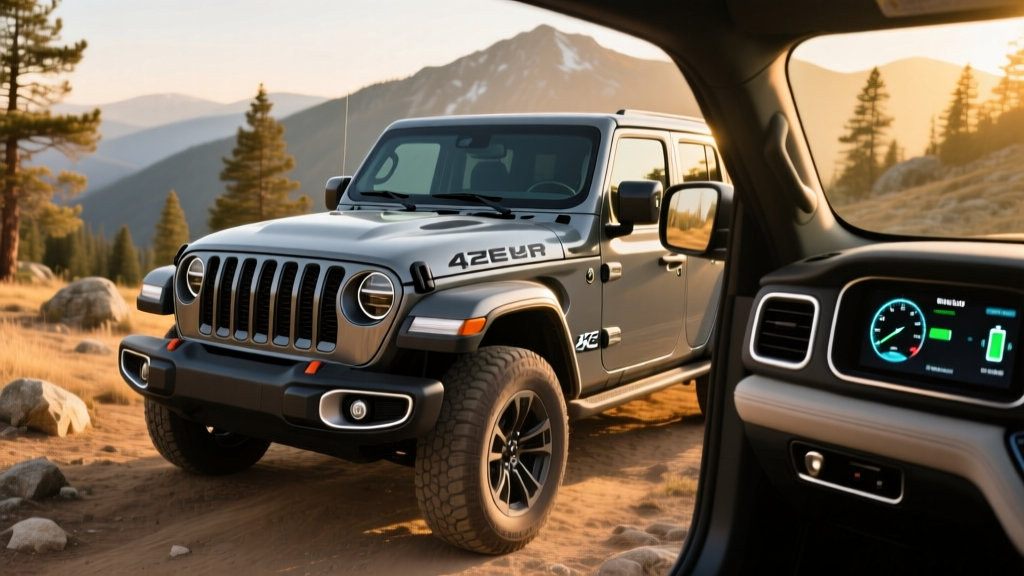
The Jeep Wrangler 4xe occupies a unique position in the electrified-vehicle landscape: it is the only plug-in hybrid (PHEV) body-on-frame off-roader on the US market. For buyers who want trail capability and daily electric commuting without full range-anxiety, the 4xe powertrain wraps a turbocharged 2.0-liter four-cylinder around two electric motors and a 17.3 kWh battery pack. But does the math work for real owners? We break down every number that matters for the 2026 model year.
Wrangler 4xe Powertrain: What You're Actually Getting
Before examining efficiency, it helps to understand what the 4xe system actually is. The Wrangler 4xe is a plug-in hybrid electric vehicle (PHEV), not a conventional hybrid (HEV). That distinction matters:
| Feature | Conventional Hybrid (HEV) | Plug-In Hybrid (PHEV) — Wrangler 4xe |
|---|---|---|
| Plug in to charge? | No — regenerative braking only | Yes — external charging required for EV range |
| Electric-only driving | Minimal (low-speed assist) | 22 EPA miles at highway speeds |
| Battery size | ~1–2 kWh | 17.3 kWh (usable ~14.5 kWh) |
| Federal tax credit (§30D) | Not eligible | Potentially eligible — see rules below |
| Best for | Drivers who can't plug in at home | Drivers with home/work Level 2 charging |
The 4xe pairs a 2.0L turbocharged inline-four (270 hp / 295 lb-ft on its own) with an electric motor integrated into the 8-speed automatic transmission and a second motor-generator on the engine. Combined output is 375 horsepower and 470 lb-ft of torque — more torque than the 3.6L V6 mild-hybrid and rivaling the old 5.7L Hemi. Power reaches the wheels through Jeep's proven Selec-Trac or Rock-Trac 4x4 systems depending on trim.
| Specification | 2026 Wrangler 4xe |
|---|---|
| Combined horsepower | 375 hp |
| Combined torque | 470 lb-ft |
| Engine | 2.0L turbocharged I-4 |
| Transmission | 8-speed automatic (TorqueFlite 8P75PH) |
| Battery capacity | 17.3 kWh total / ~14.5 kWh usable |
| Battery chemistry | NMC (nickel-manganese-cobalt) |
| EPA electric-only range | 22 miles |
| EPA combined range (EV + gas) | ~370 miles |
| Fuel tank | 17.2 gallons |
| 0–60 mph | ~6.0 seconds |
| Towing capacity | 3,500 lbs |
| Ground clearance (Rubicon) | 10.8 inches |
Fuel Economy: EPA Numbers vs. Real-World MPG
The Wrangler 4xe carries two efficiency ratings because it operates in two distinct modes: charge-depleting (electric-first) and charge-sustaining (hybrid after battery is depleted). The EPA publishes both.
| Driving Mode | City | Highway | Combined |
|---|---|---|---|
| Charge-depleting (EV+gas blended) | 49 MPGe (EPA) | ||
| Charge-sustaining (hybrid, battery depleted) | 20 MPG | 20 MPG | 20 MPG |
According to EPA data at fueleconomy.gov, the 4xe achieves 49 MPGe when operating with a charged battery, blending electric and gasoline miles. Once the battery depletes to its charge-sustaining threshold (around 15–20% state of charge), the vehicle operates as a conventional hybrid and returns 20 MPG combined.
Electric-Only Range and Charging: What to Expect
The 4xe's 22-mile EPA electric range is modest compared to rivals like the Toyota RAV4 Prime (42 miles) or Hyundai Tucson PHEV (33 miles), but it serves a specific use case: short commutes and errands. For a 15-mile round-trip commute with home charging, you may burn gasoline only on weekends.
| Charging Level | Power | Connector | 0–100% Time | Availability |
|---|---|---|---|---|
| Level 1 (120V household) | ~1.4 kW | J1772 | ~12–14 hours | Included cord |
| Level 2 (240V home/public) | ~7.2 kW | J1772 | ~2.5–3 hours | Home install or public stations |
| DC Fast Charging | N/A | N/A | N/A | Not supported |
A critical limitation: the Wrangler 4xe does not support DC fast charging. The onboard charger maxes out at approximately 7.2 kW on Level 2. For most PHEV owners who charge overnight at home or at a workplace Level 2 station, this is perfectly adequate — the battery is small enough that a full charge takes under three hours. But you cannot top up quickly on a road trip.
The charge port is located on the driver-side front fender. Jeep provides a Level 1 (120V) charging cord with the vehicle. For meaningful daily use, budget $500–$1,200 for a Level 2 home charger installation (240V, 32–40 amp circuit) depending on your electrical panel's proximity to the parking spot. A licensed electrician should evaluate your panel capacity before committing to a charger.
Pricing, Trims, and Federal Tax Credit Eligibility
The 2026 Wrangler 4xe is offered across several trims, with pricing that reflects the premium of the plug-in powertrain over the conventional gas models:
| Trim | Base MSRP (est.) | Key Equipment |
|---|---|---|
| Willys 4xe | ~$51,795 | Selec-Trac 4x4, 33-inch tires, basic infotainment |
| Sport S 4xe | ~$53,795 | Convenience group, upgraded audio |
| Sahara 4xe | ~$57,795 | Full-time 4x4, leather, 12.3-inch Uconnect |
| Rubicon 4xe | ~$60,795 | Rock-Trac 4x4, front/rear lockers, sway-bar disconnect |
| High Altitude 4xe | ~$65,795 | Monochrome package, Nappa leather, 20-inch wheels |
Prices shown are estimated MSRP including destination charge. Verify with your dealer for exact current pricing.
- Credit amount: Up to $7,500, split into $3,750 for battery components (North American manufacturing) and $3,750 for critical minerals sourcing.
- MSRP cap: SUVs must be under $80,000 MSRP — all Wrangler 4xe trims qualify.
- Buyer income cap: AGI must not exceed $150,000 (single), $225,000 (head of household), or $300,000 (joint).
- Battery sourcing: The percentage of critical minerals and battery components from FTA-partner countries determines the actual credit amount. Jeep's supply chain has shifted significantly; check the latest IRS-qualified vehicle list at fueleconomy.gov for the current credit amount before purchasing.
- Point-of-sale transfer: You can transfer the credit to the dealer at purchase to reduce the sale price directly, rather than waiting for a tax refund.
Tax credit rules are complex and subject to change. Consult a tax professional and verify at IRS.gov before relying on any specific credit amount.
Battery Warranty, Reliability, and Replacement Cost
PHEV battery longevity is the single most common concern among prospective buyers. The Wrangler 4xe uses an NMC (nickel-manganese-cobalt) lithium-ion pack mounted under the rear seats, sealed against water and dust to maintain the Wrangler's Trail Rated off-road credentials (30-inch water fording remains intact).
- High-voltage battery: 8 years / 100,000 miles (whichever comes first)
- Warranty threshold: Coverage applies if battery capacity drops below ~70% of original capacity
- Powertrain (engine, transmission, electric motors): 5 years / 60,000 miles
- Bumper-to-bumper: 3 years / 36,000 miles
The 8-year/100,000-mile battery warranty is federally mandated for PHEVs and EVs in the US, and Jeep complies. In practice, NMC batteries in PHEV applications tend to degrade slowly because the battery management system (BMS) maintains a large buffer — you never use the full 17.3 kWh. Real-world degradation data from early 2021–2022 4xe owners suggests roughly 5–8% capacity loss over the first three years, which is within normal expectations.
If the battery does require out-of-warranty replacement, current estimates place the cost between $8,000 and $12,000 including labor. This is a significant expense, but it's a worst-case scenario that the warranty is designed to prevent. For context, most PHEV batteries outlast the vehicle's useful life under normal operating conditions.
Regarding overall reliability: the 4xe powertrain adds complexity — a turbocharged engine, two electric motors, high-voltage wiring, and a liquid-cooled battery — all on top of the Wrangler's already complex solid-axle 4x4 system. The Wrangler as a platform has historically scored below average in long-term reliability surveys from Consumer Reports and J.D. Power. The 4xe variant adds electrical-system complaints to the mix, with early models reporting issues related to the hybrid control module and 12V battery drain. Later model years (2024+) have shown improvement, but buyers should be aware that this is not a low-complexity vehicle.
Who Should Buy the Wrangler 4xe — and Who Shouldn't
The 4xe is not the right choice for everyone. Its value proposition is highly dependent on your driving pattern, charging access, and off-road needs.
- You have home or workplace Level 2 charging and a commute under 22 miles round-trip
- You want genuine off-road capability (solid axles, lockers, sway-bar disconnect on Rubicon) with reduced daily fuel cost
- You need a removable roof/doors and open-air driving no crossover EV can match
- You want to reduce gasoline consumption without committing to a full EV on long road trips or remote trails
- You qualify for the §30D tax credit, which can reduce effective cost by $3,750–$7,500
- You never go off-road and prioritize on-road comfort, handling, and low running costs
- Your commute exceeds 40+ miles — the 4xe's small EV range means you'll burn gas daily
- You want minimal maintenance (no oil changes, no turbo, no transmission fluid)
- Consider: Rivian R1S, Tesla Model Y, or Hyundai Ioniq 5 for on-road duties
- You cannot charge at home or work — without plugging in, the 4xe is a heavier, more expensive hybrid getting 20 MPG
- Your budget is under $48,000 — the gas Wrangler Sport starts significantly lower
- You want maximum simplicity and proven long-term reliability for expedition overlanding
- 375 hp / 470 lb-ft is the torquiest Wrangler ever sold — excellent for rock crawling
- 22-mile EV range covers many daily commutes entirely on electricity
- No range anxiety on road trips — 370-mile total range with easy gas refueling
- Full Trail Rated capability retained (Rubicon 4xe is a serious trail rig)
- Eligible for potential §30D federal tax credit (verify current sourcing status)
- Electric-only mode is near-silent — great for wildlife areas and early-morning neighborhood departures
- Only 22 miles EV range — trails behind RAV4 Prime (42 mi) and Tucson PHEV (33 mi)
- No DC fast charging — road-trip top-ups aren't possible
- 20 MPG charge-sustaining is unimpressive; the aero penalty is real
- $52K+ starting price — a $10K+ premium over gas Wrangler trims
- Below-average predicted reliability; complex powertrain with multiple failure points
- Added battery weight (~600 lbs) affects payload and slightly reduces breakover angle
Wrangler 4xe vs. the PHEV Competition
The 4xe competes in a narrow niche. There is no other PHEV body-on-frame off-roader. But cross-shoppers often consider these alternatives:
| Spec | Wrangler 4xe | Toyota RAV4 Prime | Ford Bronco (no PHEV) |
|---|---|---|---|
| Powertrain type | PHEV | PHEV | Gas / Mild Hybrid |
| Combined HP | 375 hp | 302 hp | 300 hp (2.7L EcoBoost) |
| EV-only range | 22 miles | 42 miles | N/A |
| Combined MPG (gas) | 20 MPG | 38 MPG | 18–20 MPG |
| Starting MSRP | ~$51,795 | ~$44,500 | ~$40,000 |
| Off-road capability | Excellent (Trail Rated) | Moderate (AWD) | Excellent (G.O.A.T. modes) |
| Removable roof/doors | Yes | No | Yes (doors only) |
The RAV4 Prime wins on efficiency, EV range, and reliability. The Bronco matches off-road ability but lacks a PHEV option. The Wrangler 4xe is the only vehicle that combines all of: plug-in electric commuting, serious trail hardware, and open-air driving.
Frequently Asked Questions
How many MPG does the Wrangler 4xe hybrid get?
The EPA rates the 2026 Wrangler 4xe at 49 MPGe when blending electric and gasoline driving with a charged battery. Once the battery depletes, it operates as a conventional hybrid and returns 20 MPG combined (20 city / 20 highway). In real-world use with regular home charging, many owners average 22–28 MPG across mixed driving because a significant portion of miles are electric.
How far can the Wrangler 4xe drive on electric only?
The EPA rates the 4xe at 22 miles of electric-only range. In real-world conditions, expect 18–20 miles in cold weather (below 40°F) or at sustained highway speeds above 70 mph, and up to 24–25 miles in mild weather around town where regenerative braking recovers energy. The total combined range (electric + 17.2-gallon fuel tank) is approximately 370 miles.
Do I need to plug in the Wrangler 4xe?
You don't have to — the 4xe will operate as a conventional hybrid if you never plug it in, generating and using electricity through regenerative braking. However, without plug-in charging, you lose the 22-mile EV range benefit and the 49 MPGe rating. You'll get roughly 20 MPG combined, which is worse than many gas-only crossovers. Plug-in charging is strongly recommended to capture the vehicle's value proposition.
Does the Wrangler 4xe qualify for the $7,500 federal tax credit?
It may qualify for up to $7,500 under the §30D Clean Vehicle Credit, but the actual amount depends on battery-component and critical-mineral sourcing requirements that change over time. The Wrangler 4xe's MSRP is under the $80,000 SUV cap, and buyer income limits apply ($150K single / $300K joint). Always verify the current qualified-vehicle list at fueleconomy.gov and consult a tax professional before relying on a specific credit amount. The credit can be transferred to the dealer at point of sale.
How reliable is the Wrangler 4xe and what does a battery replacement cost?
The 4xe adds hybrid-system complexity to the Wrangler platform, which already rates below average in long-term reliability surveys. Early model years (2021–2022) saw complaints related to the hybrid control module and electrical gremlins. The high-voltage battery is warrantied for 8 years / 100,000 miles against capacity loss below approximately 70%. Out-of-warranty battery replacement is estimated at $8,000–$12,000. Most PHEV batteries last the vehicle's lifetime under normal conditions, but the 4xe's overall reliability remains a consideration for long-term ownership.
Can the Wrangler 4xe DC fast charge?
No. The 4xe supports Level 1 (120V, ~1.4 kW) and Level 2 (240V, up to ~7.2 kW) charging only. A full charge on Level 2 takes approximately 2.5–3 hours. DC fast charging is not available on any current Wrangler 4xe model.
Is the Wrangler 4xe good for off-roading?
Yes — particularly in Rubicon 4xe trim, which retains Rock-Trac 4:1 low-range gearing, front and rear electronic locking differentials, an electronic sway-bar disconnect, and 33-inch all-terrain tires. The instant torque from the electric motor is excellent for precise rock-crawling throttle control. The battery pack is sealed and mounted high, preserving the Wrangler's 30-inch water-fording capability. The added ~600 lbs of hybrid weight is noticeable on steep climbs but does not meaningfully compromise trail performance.