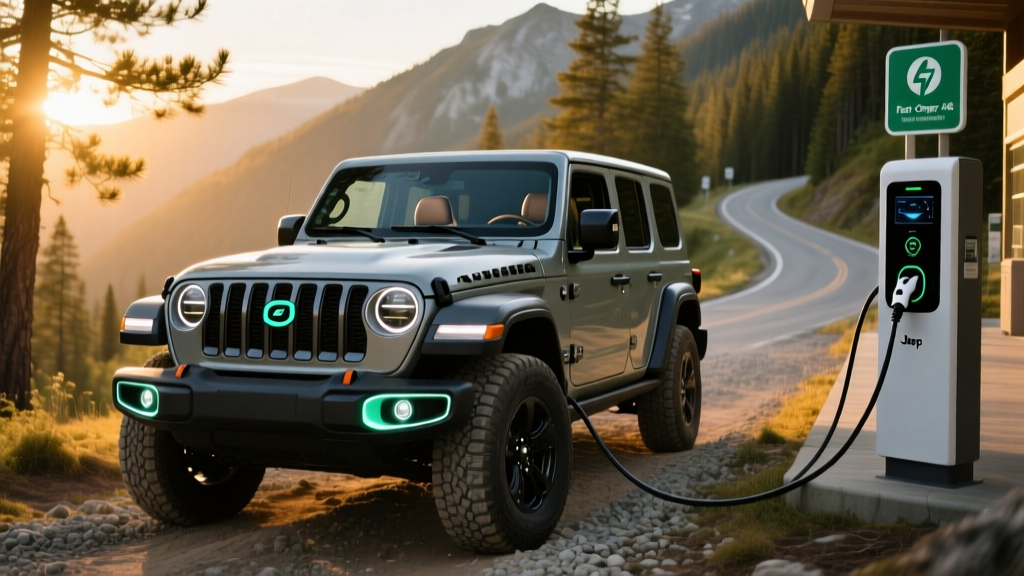
If you're searching for an American hybrid SUV that can handle genuine off-road duty while trimming your fuel bill, the 2026 Jeep Wrangler 4xe occupies a category of one. Built in Toledo, Ohio, on the same assembly line as the conventional Wrangler, this plug-in hybrid (PHEV) pairs a turbocharged gasoline engine with two electric motors and a 17.3 kWh battery pack. The result is a body-on-frame SUV that can commute on electricity alone, tackle the Rubicon Trail in near-silence, and still tow 3,500 pounds.
But the 4xe isn't without trade-offs. Its electric-only range is modest by modern PHEV standards, its highway fuel economy once the battery is depleted won't beat a compact hybrid sedan, and its starting price requires careful tax-credit planning. Here's the full breakdown for 2026 buyers.
What Is the Jeep Wrangler 4xe? HEV vs. PHEV Explained
Before diving into specs, let's clarify a distinction that trips up many shoppers. The Wrangler 4xe is a plug-in hybrid electric vehicle (PHEV), not a conventional hybrid (HEV) like the Toyota RAV4 Hybrid. Here's the difference:
| Feature | Conventional Hybrid (HEV) | Plug-In Hybrid (PHEV) |
|---|---|---|
| Plug-in charging | No — charges via regenerative braking and engine | Yes — plug in to unlock full electric range |
| Electric-only range | 1 mile or less at low speeds | Typically 20–40 miles |
| Battery size | ~1–2 kWh | ~13–25 kWh |
| Home charging needed | No | Recommended (Level 2 for best experience) |
| Federal tax credit | Generally not eligible | May qualify (up to $7,500 under §30D) |
The Wrangler 4xe has a charge port on the driver-side front fender. Plug it into a Level 2 home charger overnight and you'll wake up with roughly 22 miles of electric-only driving — enough for many commutes and school runs. Don't plug it in, and it operates as a heavy, thirsty conventional hybrid.
Powertrain, Horsepower, and Performance Specs
| Specification | 2026 Jeep Wrangler 4xe |
|---|---|
| Engine | 2.0L turbocharged inline-4 |
| Electric motors | 2 (one integrated in transmission, one on engine crankshaft) |
| Combined system output | 375 hp / 470 lb-ft torque |
| Transmission | 8-speed automatic (TorqueFlite) |
| Drivetrain | 4WD (Selec-Trac or Rock-Trac depending on trim) |
| 0–60 mph | |
| Towing capacity | 3,500 lbs |
| Battery (usable) | 17.3 kWh (NMC lithium-ion) |
| EPA electric-only range | 22 miles |
| EPA combined MPGe | 49 MPGe (electric + gas) |
| EPA MPG (gas-only, battery depleted) | 20 combined (20 city / 20 highway) |
| Total combined range | ~370 miles |
| Ground clearance (Rubicon) | 10.8 inches |
| Water fording | 31.5 inches |
The 470 lb-ft of combined torque is the headline figure. Electric motors deliver peak torque at zero RPM, which makes the 4xe surprisingly responsive off the line and exceptionally controllable on technical off-road terrain where precise throttle modulation matters. In Electric mode, the Wrangler 4xe can crawl over rocks in near-silence — a genuinely unique experience in the off-road world.
Fuel Economy: EPA Ratings vs. Real-World MPG
| Driving Condition | EPA Rating | Real-World Expectation |
|---|---|---|
| Electric + Gas (MPGe) | 49 MPGe combined | 44–52 MPGe depending on charge frequency |
| Gas only — City | 20 MPG | 18–21 MPG (regen helps in stop-and-go) |
| Gas only — Highway | 20 MPG | 17–19 MPG (aerodynamic drag of a box on wheels) |
| Gas only — Combined | 20 MPG | 18–20 MPG |
The Wrangler 4xe's fuel economy story is two chapters. Chapter one: if you charge daily and your commute is under 22 miles round-trip, you may go weeks without visiting a gas station. Your effective MPGe can climb well above the EPA's 49 rating because you're burning almost no gasoline. According to the EPA, a driver who charges regularly and drives 15,000 miles per year could spend roughly $1,650 annually on energy (electricity + gas combined).
Chapter two: once the battery is depleted — say, on a road trip — the 2.0L turbo engine is hauling a 5,100-pound brick. Expect 18–20 MPG in mixed driving and potentially 17 MPG at sustained highway speeds above 70 mph. The Wrangler's flat windshield, removable top, and all-terrain tires create enormous aerodynamic drag. This is a vehicle that rewards short, chargeable commutes far more than cross-country road trips.
Charging: Battery Size, Charge Times, and Home Setup
The 4xe's 17.3 kWh battery pack (approximately 14.8 kWh usable to protect longevity via a buffer) supports the following charging scenarios:
| Charging Level | Power | 0–100% Time | Practical Use |
|---|---|---|---|
| Level 1 (120V household outlet) | ~1.4 kW | ~12 hours | Emergency/top-up only |
| Level 2 (240V home or public) | ~7.2 kW | ~2.5 hours | Daily home charging — recommended |
| DC Fast Charging | Not supported | N/A | N/A |
A critical point: the Wrangler 4xe does not support DC fast charging. This is common among current PHEVs — the battery is small enough that Level 2 replenishes it quickly, and adding DC fast-charge hardware increases cost and weight. For a 22-mile electric range, a full charge in 2.5 hours on Level 2 is practical for most routines: plug in when you get home, and you're full before bedtime.
For home Level 2 charging, you'll need a 240V outlet (NEMA 14-50 or hardwired) and a Level 2 EVSE rated for at least 32 amps. Expect home installation costs of $500–$1,500 for the charger unit plus $500–$2,000 for electrician labor, depending on whether your panel needs an upgrade.
Pricing, Trims, and Federal Tax Credit Eligibility
The 2026 Wrangler 4xe lineup spans multiple trims, with pricing that reflects the Wrangler's premium positioning:
| Trim | MSRP (est.) | Key Features |
|---|---|---|
| Willys 4xe | ~$52,995 | Base 4xe, 4WD, 33-inch tires, LED lighting |
| Sahara 4xe | ~$56,995 | Leather, larger infotainment, side steps |
| Rubicon 4xe | ~$60,495 | Rock-Trac 4WD, front/rear lockers, disconnecting sway bar |
| High Altitude 4xe | ~$63,995 | Luxury package, 20-inch wheels, full-leather |
Federal §30D Tax Credit — Does the Wrangler 4xe Qualify?
The Wrangler 4xe may qualify for up to $3,750 of the federal Plug-In Electric Drive Vehicle Credit under IRS §30D rules. Full $7,500 eligibility depends on whether the vehicle's battery meets both critical-mineral and battery-component sourcing requirements, which are subject to annual tightening under the Inflation Reduction Act. Key buyer requirements:
- MSRP cap: SUVs must be under $80,000 — all 4xe trims qualify.
- Income cap: Modified AGI ≤ $150,000 (single) / $300,000 (joint).
- Point-of-sale transfer: You can transfer the credit to the dealer for an immediate price reduction at purchase.
- Assembly: Must be assembled in North America — the Toledo-built Wrangler qualifies.
Always verify current-year eligibility on fueleconomy.gov and consult a tax professional before relying on the credit.
Reliability, Battery Warranty, and Long-Term Costs
Battery and Powertrain Warranty
- High-voltage battery: 8 years / 100,000 miles (capacity retention threshold: ~70%)
- Powertrain (engine + electric motors + transmission): 5 years / 60,000 miles
- Bumper-to-bumper: 3 years / 36,000 miles
The Wrangler 4xe's hybrid system has been in production since the 2021 model year, giving Jeep several years of real-world reliability data. The high-voltage battery is sealed and liquid-cooled, with a thermal management system designed to handle both extreme heat and sub-zero cold — important for a vehicle marketed for off-road use in diverse climates.
If the battery pack does need replacement out of warranty, current estimates from Stellantis service data and third-party shops place the cost between $8,000 and $12,000 including labor. However, PHEV battery packs rarely fail catastrophically; more commonly, individual modules can be serviced. The 8-year/100,000-mile warranty covers capacity loss below the stated threshold, which is federally mandated for emissions-related components in PZEV states and generally adopted nationwide.
Conventional maintenance costs are similar to a gas Wrangler: oil changes, brake service (though regenerative braking extends pad life significantly), and tire rotation. The electric motors require no routine maintenance.
Pros and Cons
Pros
- Genuine off-road capability with electric-only crawling mode
- 375 hp / 470 lb-ft — the quickest Wrangler ever sold
- 22-mile electric range covers most daily commutes
- Built in USA (Toledo, Ohio) — qualifies for North American assembly requirement
- Removable doors and roof — unique open-air experience
- 3,500-lb towing capacity retained vs. gas models
Cons
- Only 20 MPG combined on gas alone — poor highway efficiency
- 22-mile electric range is short vs. rivals (RAV4 Prime: 42 mi)
- No DC fast charging
- Starting price above $52,000 before incentives
- Ride quality and road noise reflect body-on-frame, solid-axle design
- Interior cargo space reduced slightly by battery packaging
Wrangler 4xe vs. Full EV vs. Gas Wrangler — Which Fits You?
Choose the Wrangler 4xe if: You want a genuinely capable off-road SUV with daily electric commuting, you can charge at home, and you don't drive enough highway miles for gas-only MPG to dominate your fuel costs. It's ideal for the weekend-trail-enthusiast with a sub-22-mile weekday commute.
Choose a full EV (like the Ford F-150 Lightning or Rivian R1S) if: You want zero tailpipe emissions, lower per-mile fueling costs, minimal maintenance, and 250+ miles of range — and you don't need the Wrangler's specific open-air/removable-door experience or its rock-crawling hardware.
Choose the gas Wrangler if: You can't charge at home, you take frequent long road trips where the 4xe's gas-only MPG would frustrate you, and the $5,000–$8,000 price premium for the 4xe powertrain isn't justified by your commute savings.
Frequently Asked Questions
How many MPG does the Jeep Wrangler 4xe get?
The EPA rates the 2026 Wrangler 4xe at 49 MPGe combined when using both electric and gas power, and 20 MPG combined (20 city / 20 highway) once the battery is depleted. In real-world driving, expect 18–21 MPG on gas alone depending on terrain, tire choice, and speed. If you charge daily and commute under 22 miles, your actual gasoline consumption may be negligible.
How far can the Wrangler 4xe go on electric only?
The EPA rates the 4xe at 22 miles of electric-only range. In real-world conditions — moderate temperatures, flat terrain, speeds under 45 mph — some drivers report 24–25 miles. In cold weather (below 30°F) or at highway speeds, expect the range to drop to 16–18 miles. The total combined range (electric + full gas tank) is approximately 370 miles.
Is the Wrangler 4xe reliable, and what does battery replacement cost?
The 4xe powertrain has been in production since 2021, and early reliability data is broadly in line with other Stellantis products — some minor electrical gremlins reported in early model years have been addressed via software updates. The high-voltage battery is warranted for 8 years / 100,000 miles against capacity loss below ~70%. Out-of-warranty battery replacement runs approximately $8,000–$12,000, though full pack replacements are rare.
Does the Wrangler 4xe qualify for a tax credit?
The 4xe may qualify for a partial federal tax credit (up to $3,750–$7,500 depending on battery-sourcing compliance under current-year IRS §30D rules). It meets the North American assembly requirement and the $80,000 MSRP cap for SUVs. Buyer income limits apply ($150K single / $300K joint MAGI). The credit can be transferred to the dealer at point of sale for an immediate price reduction. Verify current eligibility on fueleconomy.gov and consult a tax professional.
Can I charge the Wrangler 4xe at a public DC fast charger?
No. The Wrangler 4xe does not have a DC fast-charge port. It can only accept AC charging via Level 1 (120V) or Level 2 (240V). This is typical for PHEVs with smaller battery packs — the 17.3 kWh battery charges fully in about 2.5 hours on Level 2, making DC fast charging less necessary.
Hybrid vs. PHEV vs. EV — which powertrain is right for me?
A conventional hybrid (HEV) like the Toyota Highlander Hybrid needs no plug and delivers consistent fuel savings (typically 30–36 MPG in a midsize SUV). A PHEV like the Wrangler 4xe offers the best of both worlds if you can charge at home — short electric commutes plus gas-engine range for road trips. A full EV (BEV) offers the lowest running costs and zero tailpipe emissions but requires reliable charging access and acceptance of range planning on long trips. If you can't charge at home, an HEV or gas vehicle will serve you better than a PHEV.