The 2026 Jeep 4xe Lineup: What's Available and What Changed
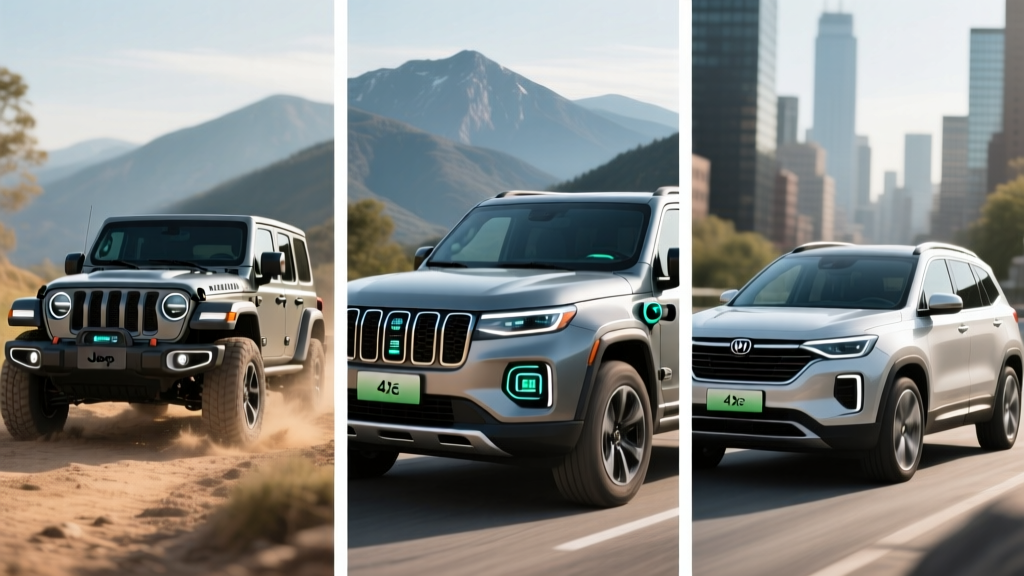
Jeep's electrification strategy in 2026 centers on its "4xe" plug-in hybrid (PHEV) branding across two core models: the Wrangler 4xe and the Grand Cherokee 4xe. The smaller Compass 4xe, previously sold in select markets, has been discontinued for the U.S. market as of the 2025 model year. If you're researching Jeep hybrid models 2026, these two vehicles represent the full lineup — and they serve very different buyers.
Both use a PHEV architecture, meaning they pair a turbocharged gasoline engine with a larger battery pack and electric motor(s) that can drive the vehicle on electricity alone for a limited range before the engine engages. This is fundamentally different from a conventional hybrid (HEV) like a Toyota RAV4 Hybrid, which cannot plug in and has no meaningful electric-only range.
HEV vs PHEV — What Jeep Buyers Need to Know
| Feature | Conventional Hybrid (HEV) | Plug-In Hybrid (PHEV / 4xe) |
|---|---|---|
| Plugs in to charge? | No — charges via regenerative braking and engine | Yes — Level 1 (120V) or Level 2 (240V) |
| Electric-only range | ~1 mile or less at low speed | 21–26 miles (Jeep 4xe models) |
| Battery size | ~1–2 kWh | 17.3 kWh (Jeep 4xe) |
| Federal tax credit eligible? | No (not sufficient battery capacity) | Potentially — up to $3,750 under §30D rules |
| Best for | Drivers who can't charge at home | Drivers with home charging and short commutes |
2026 Jeep Wrangler 4xe: Specs, Range, and Real-World MPG
The Wrangler 4xe remains Jeep's best-selling plug-in hybrid and one of the most popular PHEVs in the U.S. market. For 2026, the powertrain carries over with minor software refinements to improve regenerative braking calibration and electric-mode throttle response.
| Spec | Value |
|---|---|
| Powertrain | 2.0L turbo I-4 + two electric motors + 8-speed auto |
| Combined output | 375 hp / 470 lb-ft torque |
| Battery (usable) | 17.3 kWh (NMC lithium-ion) |
| EPA electric-only range | 22 miles |
| EPA MPGe (electric + gas) | 49 MPGe combined |
| EPA MPG (gas only, after battery depletes) | 20 city / 20 hwy / 20 combined |
| Total range (electric + gas) | ~370 miles |
| Level 2 charge time (0–100%) | ~2 hours at 7.2 kW (Level 1: ~12 hours) |
| DC fast charging | Not supported |
| 0–60 mph | ~6.0 seconds |
| Towing capacity | 3,500 lbs |
| Drivetrain | 4WD (Selec-Trac or Rock-Trac depending on trim) |
| Base MSRP (Willys 4xe) | $51,790 (incl. destination) |
| Top trim MSRP (Rubicon X 4xe) | ~$64,090 |
The EPA rates the Wrangler 4xe at 22 miles of electric-only range. In real-world testing, expect 18–20 miles in mixed driving and as low as 14–16 miles in cold weather (below 35°F) or sustained highway speeds above 65 mph. The boxy aerodynamics and 5,000+ lb curb weight work against efficiency once the battery depletes — gas-only MPG drops to roughly 17–18 on the highway at 75 mph.
2026 Jeep Grand Cherokee 4xe: The Family-Oriented PHEV
The Grand Cherokee 4xe trades the Wrangler's rugged removable-top character for a more refined, family-friendly package with better on-road efficiency. The 2026 model continues with the same 2.0L turbo PHEV powertrain but benefits from updated battery management software that slightly improves electric-range consistency.
| Spec | Value |
|---|---|
| Powertrain | 2.0L turbo I-4 + two electric motors + 8-speed auto |
| Combined output | 375 hp / 470 lb-ft torque |
| Battery (usable) | 17.3 kWh (NMC lithium-ion) |
| EPA electric-only range | 26 miles |
| EPA MPGe (electric + gas) | 56 MPGe combined |
| EPA MPG (gas only, after battery depletes) | 23 city / 24 hwy / 23 combined |
| Total range (electric + gas) | ~440 miles |
| Level 2 charge time (0–100%) | ~2 hours at 7.2 kW (Level 1: ~12 hours) |
| DC fast charging | Not supported |
| 0–60 mph | ~6.3 seconds |
| Towing capacity | 6,000 lbs (properly equipped) |
| Base MSRP (4xe base) | $61,665 (incl. destination) |
| Top trim MSRP (Summit Reserve 4xe) | ~$78,095 |
The Grand Cherokee 4xe's better aerodynamics and slightly lighter weight give it a meaningful edge: 4 more miles of EPA electric range and 3 more MPG once the battery is depleted. For a family hauling kids and gear, the 6,000-lb tow rating and quieter cabin make it the more practical daily driver.
How Many MPG Do Jeep Hybrids Actually Get?
This is where PHEV math gets nuanced. The EPA provides two numbers for plug-in hybrids: MPGe (miles-per-gallon-equivalent, measuring efficiency when running on electricity) and MPG (miles-per-gallon when the engine is burning gasoline after the battery is depleted).
| Model | EPA City MPG | EPA Hwy MPG | EPA Combined | Real-World Combined (est.) |
|---|---|---|---|---|
| Wrangler 4xe (gas-only mode) | 20 | 20 | 20 | 17–19 |
| Grand Cherokee 4xe (gas-only mode) | 23 | 24 | 23 | 21–23 |
Key insight: Your actual fuel economy depends entirely on how often you charge and how far you drive. If your daily commute is under 22 miles round-trip and you plug in every night, the Wrangler 4xe might use almost no gasoline for weeks. If you never plug in and drive 400 miles, you'll get the gas-only MPG figures — which, for the Wrangler, are worse than a conventional gas-only Wrangler due to the extra ~600 lbs of battery weight.
Data from fueleconomy.gov confirms these EPA figures. The Grand Cherokee 4xe's slightly superior gas-only efficiency comes from its more aerodynamic profile and standard all-wheel-drive system versus the Wrangler's part-time or on-demand 4WD with higher rolling-resistance tires.
Charging the Jeep 4xe: What You Need at Home
Neither the Wrangler 4xe nor Grand Cherokee 4xe supports DC fast charging. This is a deliberate engineering choice — the 17.3 kWh battery is small enough that Level 2 charging fully replenishes it in about 2 hours, which Jeep/Stellantis determined was sufficient for overnight or workplace charging.
| Level | Power | Time (0–100%) | Miles of EV Range per Hour |
|---|---|---|---|
| Level 1 (120V household outlet) | ~1.4 kW | ~12 hours | ~2 miles/hr |
| Level 2 (240V, 32A circuit) | 7.2 kW | ~2 hours | ~12 miles/hr |
| DC Fast Charge | N/A | N/A | Not supported |
The onboard charger uses a J1772 connector (standard for non-Tesla PHEVs). If you have a Tesla Wall Connector at home, you'll need a J1772 adapter or a dedicated Level 2 station like a ChargePoint Home Flex or Emporia Vue. A basic 240V/32A circuit installation typically runs $500–$1,500 depending on panel proximity, according to industry estimates — factor this into your purchase budget.
Tax Credits and Incentives: What You Can Actually Claim
Federal tax credit eligibility for PHEVs under IRS §30D is more restrictive than many buyers assume. Here's the current framework for 2026:
- Battery capacity: Must be ≥7 kWh — both Jeep 4xe models qualify (17.3 kWh).
- MSRP cap: SUVs/vans/pickups capped at $80,000 MSRP. Most 4xe trims fall under this, but Summit Reserve and some loaded Rubicon X builds may exceed it.
- Buyer income cap: Modified AGI ≤ $150,000 (single) / $300,000 (married filing jointly).
- Battery component sourcing: Critical minerals and battery components must meet escalating domestic-content thresholds. For 2026, the sourcing requirements are stringent — check the fueleconomy.gov credit lookup for the specific trim you're buying, as eligibility varies by build date and supply chain changes.
- Point-of-sale transfer: You can transfer the credit to the dealer at purchase to reduce the sale price, rather than waiting to claim it on your tax return.
Realistic expectation: Depending on battery sourcing compliance, qualifying buyers may receive up to $3,750 (partial credit if critical-mineral requirements are met but component requirements are not) or the full $7,500. Always verify the specific VIN's eligibility before purchase — do not assume the maximum credit applies.
Battery Warranty, Reliability, and Replacement Costs
- High-voltage battery: 8 years / 100,000 miles (whichever comes first), warrantied to retain at least 70% of original capacity.
- Powertrain (engine + electric motors + transmission): 5 years / 60,000 miles.
- Bumper-to-bumper: 3 years / 36,000 miles.
The 17.3 kWh NMC battery pack in both 4xe models is a proven unit shared across the Stellantis PHEV platform (also used in the Chrysler Pacifica Hybrid). Long-term degradation data from 2021–2024 model-year 4xe owners suggests 5–8% capacity loss over the first three years of regular use, which is within normal expectations for NMC chemistry with active thermal management.
Replacement cost: If the battery fails outside of warranty, a replacement 4xe battery pack currently costs between $7,500 and $10,000 (parts only), with labor adding $1,500–$2,500. Total out-of-pocket replacement: approximately $9,000–$12,500. This is a real financial risk for second owners or high-mileage drivers — factor it into long-term ownership planning.
Reliability for the 4xe powertrain has been mixed. The electric motor and battery systems have been generally trouble-free, but some owners have reported issues with the 2.0L turbo engine's cooling system and the PHEV control module software. Jeep has issued several software updates via OTA and dealer visits to address these. Check NHTSA recall data for the specific model year and trim you're considering.
Jeep 4xe vs Full EV vs Gas: Which Should You Choose?
Decision Framework: Which Powertrain Fits You?
Choose the Jeep 4xe (PHEV) if:
- Your daily commute is under 25 miles round-trip and you can charge at home
- You need serious off-road capability (Wrangler) or towing (Grand Cherokee) that most EVs can't match
- You take road trips to areas with sparse charging infrastructure
- You want to reduce fuel consumption without committing to full electric
Choose a full EV (like a Rivian R1S or Tesla Model X) if:
- You have reliable home Level 2 charging
- Your daily driving is under 250 miles and you can plan road-trip charging stops
- You want near-zero maintenance (no oil changes, no engine cooling system)
- You want to maximize fuel savings — electricity at $0.14/kWh costs ~$0.04/mile vs $0.18/mile for gas at $3.50/gal and 20 MPG
Choose a gas-only Jeep if:
- You cannot charge at home or at work
- You drive very low annual miles and the PHEV premium ($5,000–$8,000 over gas trims) won't pay back
- You prioritize lowest upfront purchase price over operating cost
✓ Pros
- 22–26 miles electric-only covers most commutes gas-free
- 375 hp / 470 lb-ft — more torque than any gas-only Wrangler or Grand Cherokee
- Full off-road capability retained (Wrangler 4xe Rubicon includes front/rear lockers, sway-bar disconnect)
- Potential $3,750–$7,500 federal tax credit reduces effective price
- No range anxiety — gas engine provides 370–440 mile total range
✗ Cons
- Gas-only MPG is poor (20 combined Wrangler) — worse than some gas-only trims
- No DC fast charging — limits usefulness of public charging on road trips
- PHEV premium of $5,000–$8,000 over equivalent gas trims requires years of fuel savings to recoup
- Battery replacement cost ($9,000–$12,500) is a significant out-of-warranty risk
- Heavy: ~600 lbs more than gas equivalents, affecting tire wear and braking distances
Frequently Asked Questions
How many MPG does the 2026 Jeep Wrangler 4xe get?
The EPA rates the Wrangler 4xe at 20 MPG combined (20 city / 20 highway) when running on gasoline after the battery is depleted. In real-world driving, expect 17–19 MPG combined, and potentially 15–17 MPG in cold weather or sustained 75+ mph highway driving. When operating in electric mode, it achieves 49 MPGe combined.
How far can the Jeep Grand Cherokee 4xe go on electric only?
The EPA rates the Grand Cherokee 4xe at 26 miles of electric-only range. In real-world conditions, expect 22–24 miles in mild weather and 16–20 miles in freezing temperatures or at highway speeds. The battery's thermal management system helps but cannot fully offset the efficiency impact of cold weather on NMC chemistry.
Do Jeep 4xe models qualify for the federal tax credit?
They may, but it depends on the specific VIN's battery sourcing compliance, the MSRP of the trim you choose (must be ≤$80,000 for SUVs), and your income (≤$150K single / ≤$300K married filing jointly). The credit ranges from $3,750 to $7,500 depending on critical-mineral and battery-component sourcing thresholds. Verify eligibility at fueleconomy.gov before purchasing.
Is the Jeep 4xe battery reliable, and what does replacement cost?
The 4xe battery has been generally reliable with 5–8% degradation over three years. It's covered by an 8-year/100,000-mile warranty (70% capacity retention threshold). Out-of-warranty replacement costs approximately $9,000–$12,500 including labor. The 2.0L turbo engine and PHEV control software have had some service bulletins — check NHTSA for the specific model year.
Can I charge a Jeep 4xe at a Tesla Supercharger?
Not directly, and not at DC fast chargers at all — Jeep 4xe models do not support DC fast charging. For Level 2 AC charging, you can use a J1772 adapter with a Tesla Wall Connector at home, or use any standard J1772 public Level 2 station (ChargePoint, EVgo L2, Blink, etc.).
Should I buy a Jeep 4xe or wait for a fully electric Jeep?
Stellantis has announced future electric Jeep models, but as of 2026, no fully electric Wrangler or Grand Cherokee is available for purchase in the U.S. If you need a Jeep with off-road capability and towing today, the 4xe is the most electrified option available. If you can wait 2–3 years, a next-generation EV platform may offer better efficiency and DC fast charging — but timelines remain uncertain.