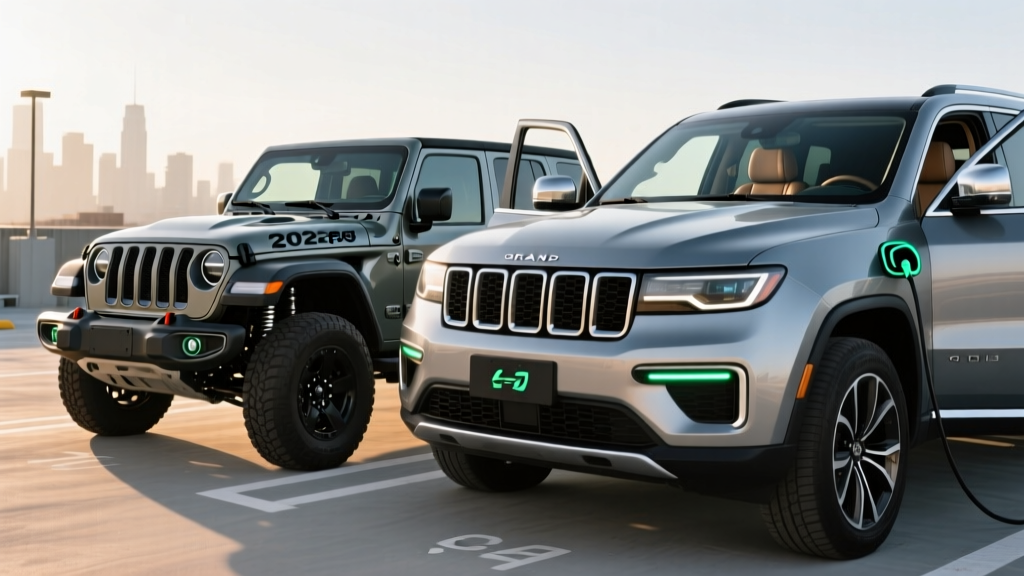
If you have been searching for a Jeep hybrid lease, you are likely weighing two things: the off-road capability Jeep is known for and the promise of lower fuel costs from electrification. For 2026, Jeep's plug-in hybrid lineup centers on two models wearing the 4xe (pronounced "four-by-e") badge: the Wrangler 4xe and the Grand Cherokee 4xe. Both are plug-in hybrids (PHEVs), not conventional hybrids, which means they pair a turbocharged engine with a larger battery you can recharge from a wall outlet for genuine electric-only driving.
Leasing a PHEV can be a smart move — you capture the federal tax credit benefit (passed through as a lease credit in many cases), avoid long-term battery degradation concerns, and lock in a fixed monthly cost. But the numbers need to make sense. Here is the full breakdown on range, efficiency, pricing, and real-world ownership to help you decide.
HEV vs PHEV: What Jeep Actually Offers
Conventional Hybrid (HEV): Uses a small battery and electric motor to assist a gas engine. You never plug it in. It recharges through regenerative braking. Jeep's mild-hybrid eTorque system (available on some gas-only Wrangler and Grand Cherokee trims in prior years) is a basic form of this, but it provides minimal electric assist and no electric-only driving. For 2026, Jeep does not offer a full HEV model in the US market.
Plug-in Hybrid (PHEV): Uses a larger battery pack (typically 15–25 kWh) that you can plug in to charge. It offers a meaningful electric-only range (20–30+ miles) before the gas engine kicks in. Both the Wrangler 4xe and Grand Cherokee 4xe are PHEVs. This is what you are actually leasing when you look for a "Jeep hybrid."
The distinction matters because PHEVs require access to charging (ideally a home Level 2 outlet) to capture their full efficiency benefit. If you never plug in a PHEV, you are just driving a heavier, less efficient gas car.
2026 Wrangler 4xe: Electric Range, MPG, and Powertrain
The Wrangler 4xe pairs a 2.0-liter turbocharged inline-four engine with two electric motors integrated into an 8-speed automatic transmission. A 17.3 kWh battery pack (gross; roughly 14.5 kWh usable) sits under the rear seats.
| Spec | Value |
|---|---|
| Combined Horsepower | 375 hp / 470 lb-ft torque |
| Engine | 2.0L turbo I4 + dual electric motors |
| Battery (gross / usable) | 17.3 kWh / ~14.5 kWh (NMC) |
| EPA Electric-Only Range | 22 miles |
| EPA Combined Range (gas + electric) | ~370 miles |
| EPA Fuel Economy (hybrid mode) | 20 MPG combined (city/hwy) |
| MPGe (electric + gas) | 49 MPGe |
| Level 2 Charging (0–100%) | ~2.5 hours at 7.2 kW |
| DC Fast Charging | Not available |
| 0–60 mph | ~6.0 seconds |
| Towing Capacity | 3,500 lbs |
| Base MSRP (Willys 4xe) | ~$51,790 |
Real-World Range Reality: The EPA rates the Wrangler 4xe at 22 miles electric-only. In practice, expect 18–20 miles in warm weather with mixed driving, and as low as 14–16 miles in cold weather (below freezing) when cabin heating and battery conditioning draw additional power. Highway driving at 70+ mph also reduces electric range significantly due to the Wrangler's brick-like aerodynamics. Once the battery depletes, fuel economy drops to roughly 20 MPG combined — comparable to a gas Wrangler, not better.
2026 Grand Cherokee 4xe: A More Refined PHEV
The Grand Cherokee 4xe uses the same 2.0L turbo + dual-motor powertrain but packages it in a more aerodynamic, family-oriented SUV. Its 17.3 kWh battery is slightly better optimized for efficiency thanks to the vehicle's lower drag coefficient.
| Spec | Value |
|---|---|
| Combined Horsepower | 375 hp / 470 lb-ft torque |
| Engine | 2.0L turbo I4 + dual electric motors |
| Battery (gross / usable) | 17.3 kWh / ~14.5 kWh (NMC) |
| EPA Electric-Only Range | 26 miles |
| EPA Combined Range (gas + electric) | ~440 miles |
| EPA Fuel Economy (hybrid mode) | 23 MPG combined |
| MPGe (electric + gas) | 56 MPGe |
| Level 2 Charging (0–100%) | ~2.5 hours at 7.2 kW |
| DC Fast Charging | Not available |
| 0–60 mph | ~6.3 seconds |
| Towing Capacity | 6,000 lbs |
| Base MSRP (Base 4xe) | ~$60,495 |
Real-World Range Reality: The Grand Cherokee 4xe's EPA rating of 26 electric miles is more achievable than the Wrangler's — expect 22–25 miles in moderate temperatures with conservative driving. Cold weather still knocks this down to roughly 17–19 miles. On longer trips where the engine runs continuously, expect 22–24 MPG highway, which is decent for a midsize SUV but not class-leading. Source: fueleconomy.gov.
Fuel Economy Compared: 4xe vs Gas Wrangler and Grand Cherokee
| Model | City MPG | Highway MPG | Combined MPG | MPGe (PHEV) |
|---|---|---|---|---|
| Wrangler 4xe (hybrid mode) | 20 | 20 | 20 | 49 MPGe |
| Wrangler (2.0L turbo gas) | 21 | 24 | 22 | — |
| Wrangler (3.6L V6 gas) | 17 | 23 | 19 | — |
| Grand Cherokee 4xe (hybrid mode) | 23 | 24 | 23 | 56 MPGe |
| Grand Cherokee (3.6L V6 gas) | 19 | 26 | 22 | — |
The takeaway: The 4xe models only beat their gas counterparts on paper when you factor in electric-only driving (the MPGe figure). In hybrid mode with a depleted battery, the Wrangler 4xe actually matches or slightly trails the 2.0L gas Wrangler because of the added battery weight (~600 lbs). The Grand Cherokee 4xe does slightly better than its V6 gas equivalent. The fuel savings are real only if you plug in daily and keep most trips under the electric-only range.
Charging a Jeep 4xe: What You Need to Know
Neither Jeep 4xe model supports DC fast charging. This is a deliberate engineering choice — the 17.3 kWh battery is small enough that Level 2 charging fills it quickly, and adding DC fast-charge hardware would increase cost, weight, and complexity for minimal benefit.
| Charging Level | Power | Time (0–100%) | Notes |
|---|---|---|---|
| Level 1 (120V household) | ~1.4 kW | ~12 hours | Emergency only; too slow for daily use |
| Level 2 (240V home/public) | 7.2 kW | ~2.5 hours | Recommended; full charge overnight |
| DC Fast Charge | N/A | N/A | Not supported on any 4xe model |
Home charging setup: Most 4xe owners install a Level 2 home charger (240V, 32A or 40A circuit). A quality Level 2 unit costs $300–$600 for equipment, plus $500–$1,500 for professional electrical installation depending on panel proximity and local permit requirements. Total budget: roughly $800–$2,100. The onboard charger caps at 7.2 kW, so a 48A charger will not charge the 4xe any faster than a 32A unit.
Pricing, Lease Deals, and Tax Credit Eligibility
Here is where a Jeep hybrid lease can get interesting. The federal EV tax credit under IRS §30D has specific requirements that affect PHEVs:
- Vehicle MSRP cap: SUVs must have an MSRP at or below $80,000. Both 4xe models qualify on most trims, but fully loaded Grand Cherokee 4xe Summit Reserve trims may exceed this cap.
- Buyer income limits: Modified adjusted gross income must not exceed $150,000 (single), $225,000 (head of household), or $300,000 (joint filing).
- Battery sourcing requirements: The critical minerals and battery component requirements have tightened significantly by 2026. Many PHEVs have seen their credit amounts reduced or eliminated as sourcing rules phase in. Check the fueleconomy.gov tax credit lookup for the specific model and trim you are considering.
- Lease loophole (commercial credit): When you lease a vehicle, the leasing company (the lessor) technically owns it and may qualify for the commercial clean vehicle credit under §45W. Many automakers pass this savings to the lessee as a "lease cash" incentive — often $3,750 to $7,500 off. This can make leasing a 4xe more attractive than buying, especially if you would not qualify for the §30D credit due to income or sourcing restrictions.
Typical 2026 lease structure (illustrative): A Wrangler 4xe Willys with a ~$51,790 MSRP might lease for $499–$599/month for 36 months with $3,999 due at signing, depending on region, dealer markup, and available lease cash incentives. The Grand Cherokee 4xe typically runs $599–$749/month under similar terms. Always ask the dealer to itemize the lease cash/credit applied.
Reliability, Battery Warranty, and Long-Term Costs
Hybrid Battery Warranty: Jeep covers the 4xe high-voltage battery pack for 8 years or 100,000 miles (whichever comes first), with a capacity retention threshold of approximately 70%. If the battery degrades below that threshold within the warranty period, Jeep will repair or replace it at no cost. The powertrain (engine, transmission, electric motors) is covered for 5 years or 60,000 miles.
Battery replacement cost (out of warranty): Based on current parts pricing, a full 4xe battery pack replacement runs approximately $8,000–$12,000 including labor. However, PHEV batteries experience less stress than full BEV batteries due to their smaller size and shallower daily cycling. Most 4xe owners who charge daily and avoid extreme heat/cold storage should see minimal degradation within the warranty period.
Regarding overall reliability: the Wrangler 4xe has had a mixed track record. Early model years (2021–2022) saw recalls related to the high-voltage battery and software issues. Jeep has issued multiple software updates and hardware revisions since then. The Grand Cherokee 4xe, introduced later, has had fewer reported issues. Always check NHTSA recall data for the specific VIN you are considering.
Who Should Lease a Jeep 4xe (and Who Shouldn't)
Lease a Jeep 4xe If:
- You want off-road capability with some electric commuting (Wrangler 4xe)
- Your daily commute is under 20–25 miles round trip
- You can install a Level 2 charger at home
- You want to capture lease cash incentives without worrying about long-term battery risk
- You need a vehicle that can tow (3,500 lbs Wrangler / 6,000 lbs Grand Cherokee)
- You live in an area with limited public DC fast-charging infrastructure
Look Elsewhere If:
- Your daily commute exceeds 30+ miles (you will burn gas most of the time)
- You cannot charge at home or work (the PHEV advantage disappears)
- You want a pure electric experience with 250+ miles of range — consider a full BEV like the Tesla Model Y, Hyundai Ioniq 5, or Ford Mustang Mach-E
- You prioritize fuel efficiency above all — a Toyota RAV4 Prime PHEV offers 42 miles of electric range and better MPG
- You plan to keep the vehicle 8+ years (leasing repeatedly costs more long-term than buying)
Choose the Wrangler 4xe if: Off-road capability is non-negotiable, you want the iconic Jeep experience, and your daily driving fits within ~20 electric miles. The Wrangler has no direct PHEV competitor in the off-road segment.
Choose the Grand Cherokee 4xe if: You want a refined family SUV with more electric range (26 miles), better highway efficiency, higher towing capacity, and a more comfortable ride. It competes with the Toyota RAV4 Prime (42 mi electric, more efficient but smaller) and the Volvo XC60 Recharge (35 mi electric, more expensive).
Choose a full BEV if: You have reliable home charging, your daily driving is under 250 miles, and you want zero tailpipe emissions with no engine maintenance. You will save more on fuel and maintenance over time, but you sacrifice the go-anywhere range flexibility of a PHEV.
Frequently Asked Questions
How many MPG does a Jeep hybrid get?
The Wrangler 4xe gets 20 MPG combined in hybrid mode (battery depleted) and 49 MPGe when factoring in electric driving. The Grand Cherokee 4xe gets 23 MPG combined and 56 MPGe. Real-world MPG depends heavily on how often you charge — if you plug in daily and drive under the electric range, your gas consumption drops dramatically. If you never plug in, expect MPG at or slightly below the gas-only equivalent.
How far can the Jeep 4xe go on electric only?
The Wrangler 4xe is EPA-rated at 22 miles electric-only; the Grand Cherokee 4xe at 26 miles. Real-world figures are typically 18–20 miles (Wrangler) and 22–25 miles (Grand Cherokee) in moderate weather, dropping 20–30% in freezing temperatures. Neither model offers enough electric range for drivers with long commutes.
Does the Jeep 4xe qualify for a tax credit?
Eligibility depends on the specific model year, trim, your income, and current battery sourcing requirements under IRS §30D. As of 2026, the tightening critical-minerals and battery-component rules have reduced or eliminated the credit for several PHEVs. However, leasing may still capture savings through the commercial clean vehicle credit (§45W) that the lessor receives and passes through as lease cash. Always verify current eligibility on fueleconomy.gov and consult a tax professional.
Is the Jeep 4xe reliable, and what does battery replacement cost?
Reliability has been mixed, particularly for early Wrangler 4xe model years that saw battery and software recalls. Post-2024 models have improved. The battery is warrantied for 8 years/100,000 miles. Out-of-warranty replacement costs approximately $8,000–$12,000. With a 36-month lease, battery longevity is the leasing company's concern, not yours — one of the strongest arguments for leasing over buying a PHEV.
Can I DC fast charge the Jeep 4xe?
No. Neither the Wrangler 4xe nor the Grand Cherokee 4xe supports DC fast charging. The maximum charge rate is 7.2 kW on Level 2 (240V), which fills the 17.3 kWh battery in approximately 2.5 hours. For a PHEV with this battery size, DC fast charging is unnecessary — Level 2 is sufficient for overnight replenishment.
Hybrid vs PHEV vs EV — which fits me?
A conventional hybrid (HEV) is best if you cannot charge at home and want better MPG with zero behavior change. A PHEV like the Jeep 4xe is best if you can charge at home, have a short commute, but still need gas-engine range for road trips or towing. A full EV (BEV) is best if you have home charging, want the lowest operating costs, and rarely exceed 250 miles in a day. For a Jeep buyer specifically, the 4xe PHEV is the only electrified option — Jeep does not currently offer a full BEV or conventional HEV in the US market.