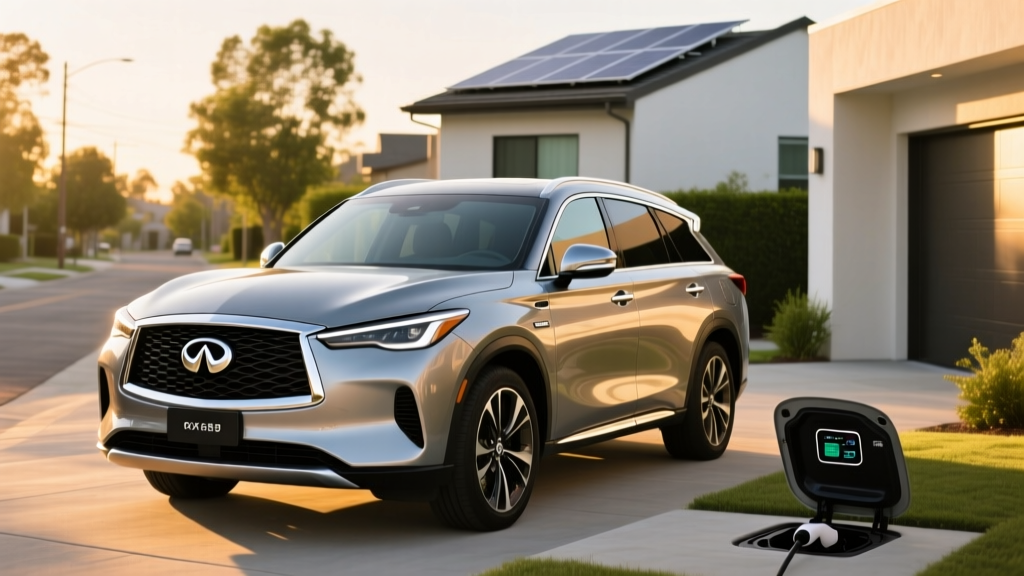
Infiniti has historically lagged behind rivals like Lexus and BMW in electrified powertrains, but the brand's 2026 lineup finally includes genuine hybrid options. If you're researching Infiniti hybrids this year, the conversation centers almost entirely on the three-row QX60 SUV, which now offers both a conventional hybrid (HEV) and a plug-in hybrid (PHEV) variant. This guide breaks down exact EPA figures, real-world expectations, battery warranties, and whether these models qualify for any federal incentives.
Infiniti's 2026 Hybrid Lineup at a Glance
For 2026, Infiniti offers electrified powertrains exclusively on the QX60 midsize luxury SUV. The brand's sedan lineup (Q50, Q60) remains conventional, and the smaller QX50 and QX55 have not received hybrid variants. Here's how the two QX60 hybrid models stack up:
| Model | Powertrain | Combined HP | EPA Combined MPG | Electric-Only Range | Starting MSRP |
|---|---|---|---|---|---|
| QX60 HEV | 2.0L turbo + motor (HEV) | 268 hp | 27 MPG | N/A (no plug) | $54,200 |
| QX60 PHEV | 2.0L turbo + motor + 18.1 kWh battery | 292 hp | 28 MPG (gas) / 62 MPGe (combined) | 32 miles | $59,950 |
HEV vs PHEV: Which Infiniti Hybrid Is Which?
This distinction matters enormously for ownership experience and cost, so let's be precise:
Conventional Hybrid (HEV) — QX60 HEV
- No plug required. The small battery recharges via regenerative braking and the gasoline engine.
- No electric-only range. The electric motor assists the gas engine but cannot propel the vehicle alone for meaningful distances.
- No federal tax credit under IRS §30D, which applies only to plug-in vehicles with sufficient battery capacity.
- Lower upfront cost and simpler ownership — treat it like a gas car that gets better mileage.
Plug-In Hybrid (PHEV) — QX60 PHEV
- Plugs in to charge via a standard J1772 Level 2 connector (or 120V Level 1 household outlet).
- 32 miles EPA electric-only range — enough for many daily commutes without burning gas.
- Potential federal tax credit depending on battery sourcing, your income, and the vehicle's MSRP.
- Higher MSRP but lower fuel cost if you charge regularly.
Fuel Economy: EPA Numbers vs Real-World MPG
According to fueleconomy.gov, the EPA rates the two models as follows:
| Model | City MPG | Highway MPG | Combined MPG | MPGe (PHEV only) |
|---|---|---|---|---|
| QX60 HEV | 25 | 30 | 27 | N/A |
| QX60 PHEV (gas mode) | 26 | 30 | 28 | 62 MPGe (charge-sustaining + EV) |
Real-world expectations: Hybrids typically outperform their EPA city estimates because stop-and-go traffic maximizes regenerative braking. Expect 28–30 MPG in city driving for both models. Highway driving at sustained 75+ MPH, however, often yields 1–3 MPG below the EPA highway figure because aerodynamic drag dominates and the electric motor provides less benefit. On a 200-mile highway trip, plan for roughly 26–27 MPG from the HEV and 27 MPG from the PHEV once the battery is depleted.
For the PHEV specifically: if your daily commute is under 30 miles round-trip and you charge nightly, you may burn almost zero gasoline for weeks. Once the 32-mile electric range is exhausted, the PHEV operates as a conventional hybrid at its 28 MPG combined rating. Total combined range (electric + gas) exceeds 450 miles.
Powertrain and Performance Details
Both QX60 hybrid variants share Infiniti's 2.0-liter VC-Turbo variable-compression four-cylinder engine, paired with an electric motor integrated into the transmission housing.
| Specification | QX60 HEV | QX60 PHEV |
|---|---|---|
| Engine | 2.0L VC-Turbo I4 | 2.0L VC-Turbo I4 |
| Electric Motor Output | 48 hp | 74 hp |
| Combined System HP | 268 hp | 292 hp |
| Combined Torque | 286 lb-ft | 310 lb-ft |
| Transmission | CVT | CVT |
| Drivetrain | FWD or AWD | AWD standard |
| 0-60 MPH (est.) | 7.4 sec | 6.8 sec |
| Towing Capacity | 6,000 lbs | 5,500 lbs |
The PHEV's larger electric motor provides noticeably stronger low-speed acceleration — useful for merging and city driving. The trade-off: the PHEV's heavier battery pack slightly reduces towing capacity compared to the HEV.
QX60 PHEV: Battery, Charging, and Electric Range
The QX60 PHEV uses an 18.1 kWh lithium-ion battery pack (NMC chemistry), of which approximately 15.2 kWh is usable — the rest is buffer to protect long-term battery health.
| Charging Level | Power (kW) | 0–100% Time | Notes |
|---|---|---|---|
| Level 1 (120V household) | ~1.4 kW | ~11 hours | Overnight; adequate for daily top-up |
| Level 2 (240V home/public) | ~6.6 kW | ~2.5 hours | Recommended for daily use |
| DC Fast Charge | Not supported | N/A | J1772 AC only — no CCS DC capability |
A critical limitation: the QX60 PHEV does not support DC fast charging. This is common among PHEVs (the Toyota RAV4 Prime and most BMW X5 PHEVs also lack DC fast charging), but it means you cannot quickly top up at highway fast-charging stations. All charging is AC via the J1772 connector. For a PHEV with 32 miles of range, this is rarely a practical problem — most owners charge overnight at home and never need public charging.
Battery Warranty Coverage
Infiniti covers the QX60 hybrid and PHEV battery packs with an 8-year/100,000-mile warranty (10 years/150,000 miles in California and states that follow CARB emissions standards). The warranty guarantees the battery will retain sufficient capacity to deliver its rated performance; if capacity drops below approximately 60–70% of original, Infiniti will repair or replace the pack at no cost.
Out-of-warranty hybrid battery replacement for the QX60 is estimated at $3,500–$5,500 for the HEV and $6,000–$9,000 for the larger PHEV pack, based on current dealer pricing for similar Infiniti/Nissan hybrid systems.
Pricing and Tax Credit Eligibility
Here's where the math gets specific. The 2026 QX60 hybrid pricing by trim:
| Trim | QX60 HEV MSRP | QX60 PHEV MSRP |
|---|---|---|
| Pure (base) | $54,200 | $59,950 |
| Luxe | $57,700 | $63,450 |
| Sensory | $62,100 | $67,850 |
| Autograph | $66,500 | $72,250 |
Federal tax credit (§30D): The QX60 HEV does not qualify — conventional hybrids are ineligible. The QX60 PHEV may qualify for up to $7,500 under the IRS §30D clean vehicle credit, but eligibility depends on several conditions that change frequently:
- MSRP cap: SUVs must have an MSRP at or below $80,000. All QX60 PHEV trims currently fall under this cap.
- Buyer income cap: Modified AGI must not exceed $150,000 (single), $225,000 (head of household), or $300,000 (joint filers).
- Battery sourcing: The vehicle must meet critical-mineral and battery-component sourcing requirements that phase in more strictly each year. Check the latest eligibility list at IRS.gov before purchasing.
- Point-of-sale transfer: As of 2024, eligible buyers can transfer the credit to the dealer at purchase, reducing the sale price directly rather than waiting for a tax refund.
State incentives vary widely. California, Colorado, and several other states offer additional rebates for PHEVs — check your state's energy office for current programs.
Who Should Choose an Infiniti Hybrid vs a Full EV or Gas Car?
Pros: Infiniti QX60 Hybrids
- Three-row seating (6–7 passengers) with hybrid efficiency
- No range anxiety — gas engine provides 400+ mile total range
- Infiniti's luxury interior and ProPILOT Assist ADAS
- PHEV covers most daily commutes on electricity alone
- Lower maintenance than a pure gas vehicle (less brake wear from regen)
Cons: Infiniti QX60 Hybrids
- No DC fast charging on the PHEV
- HEV offers modest MPG gains over the standard QX60 (24 MPG combined)
- Premium fuel recommended for optimal performance
- Limited competitor pricing: Lexus TX hybrid starts lower
- AWD-only PHEV raises base price
Decision Framework
Choose the QX60 HEV if: You want better fuel economy than the standard QX60 without changing your fueling habits, you drive mostly highway miles, and you want the lowest upfront cost in a three-row luxury hybrid.
Choose the QX60 PHEV if: You have home charging access (garage or driveway with a 120V or 240V outlet), your daily commute is under 30 miles, you want to minimize gasoline use without committing to a full EV, and you meet the income/sourcing requirements for the federal tax credit.
Choose a full EV (like the Tesla Model X or Rivian R1S) if: You have reliable home Level 2 charging, you regularly drive under 250 miles between charges, you want zero tailpipe emissions and the lowest per-mile fuel cost, and you're comfortable with public DC fast charging for road trips.
Stick with the standard gas QX60 if: You lack any home charging access, you tow frequently near the 6,000-lb limit, or your annual mileage is low enough that fuel savings won't offset the hybrid premium.
Reliability and Long-Term Ownership
Infiniti's hybrid system is derived from Nissan's e-Power and hybrid architectures, which have been in production globally since 2017. The 2.0L VC-Turbo engine is more complex than a conventional four-cylinder due to its variable compression mechanism, and long-term reliability data specific to the hybrid pairing is still limited for the North American market.
What we do know: Infiniti's 8-year/100,000-mile hybrid battery warranty is competitive with the industry standard (Toyota offers 10yr/150,000mi in CARB states; Hyundai offers 10yr/100,000mi). The lithium-ion packs in modern hybrids are designed for shallow cycling — they never fully charge or fully discharge — which significantly extends lifespan compared to early-generation hybrid batteries.
For peace of mind, consider that IIHS and NHTSA safety ratings for the QX60 platform are strong, and Infiniti dealers in most metro areas can service hybrid-specific components. Parts availability for the VC-Turbo hybrid system may be slower than for mainstream Toyota or Honda hybrids, however, given Infiniti's lower sales volume.
Frequently Asked Questions
How many MPG does the Infiniti QX60 hybrid get?
The QX60 HEV is EPA-rated at 25 city / 30 highway / 27 combined MPG. The QX60 PHEV achieves 26/30/28 MPG in gas-only operation and 62 MPGe when factoring in electric-only driving. In real-world city conditions, expect both to deliver 1–3 MPG above their EPA city figures thanks to regenerative braking.
How far can the QX60 PHEV go on electric only?
The EPA rates the QX60 PHEV at 32 miles of electric-only range. In mild weather (50–75°F) at city speeds, some owners report 34–36 miles. In cold weather (below 32°F) or at sustained highway speeds, expect 24–28 miles before the gas engine engages.
Do Infiniti hybrids need to be plugged in?
No — only the QX60 PHEV needs (and benefits from) plugging in. The QX60 HEV is a conventional hybrid that charges its own small battery through regenerative braking and the gas engine. You fuel it like any other car.
Does the Infiniti QX60 PHEV qualify for the $7,500 tax credit?
It may, depending on your income, the vehicle's battery sourcing compliance, and current IRS rules. The MSRP is under the $80,000 SUV cap for all trims. Verify current eligibility on IRS.gov and consult a tax professional before relying on the credit in your purchase decision.
What does an Infiniti hybrid battery replacement cost?
Out-of-warranty replacement is estimated at $3,500–$5,500 for the HEV battery and $6,000–$9,000 for the PHEV pack. However, modern hybrid batteries rarely need replacement within the 8–10 year warranty period. Infiniti's warranty covers capacity loss below approximately 60–70% of original.
Is the Infiniti QX60 hybrid reliable?
Long-term data is still limited for the QX60 hybrid specifically, but the underlying Nissan/Infiniti hybrid architecture has been in global use since 2017. The 8-year/100,000-mile battery warranty provides solid coverage. For maximum reliability confidence, the Lexus TX 500h hybrid has a longer track record in the three-row luxury segment.
Can the QX60 PHEV DC fast charge?
No. The QX60 PHEV supports only AC charging via J1772 (Level 1 at 120V or Level 2 at 240V). A full charge on Level 2 takes approximately 2.5 hours. This is typical for PHEVs, whose smaller batteries make DC fast charging less practical and less common.