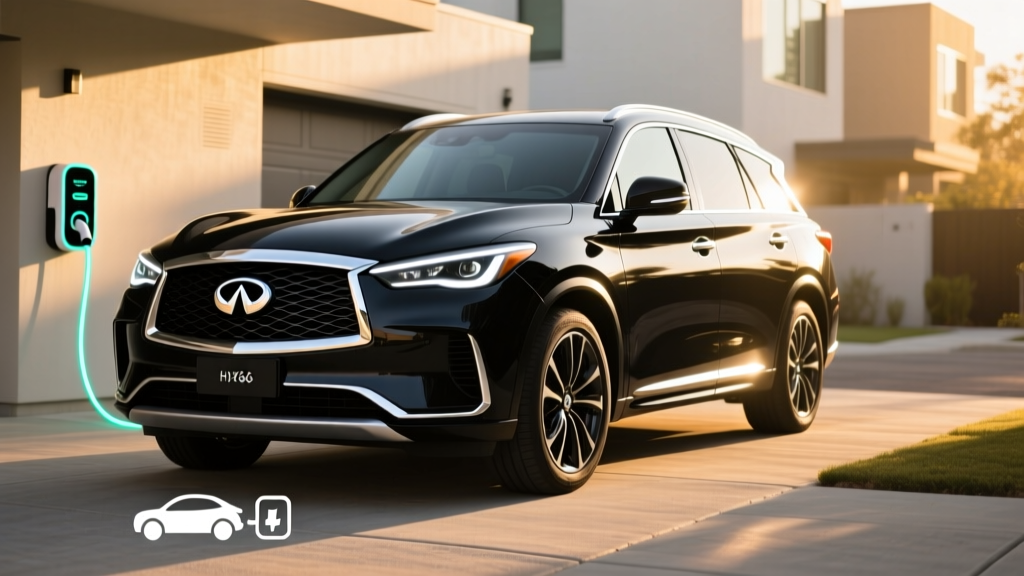
The Infiniti QX60 has long been a three-row luxury crossover aimed at families who want premium badging without the European price tag. But with competitors rushing to electrify their lineups, the question many buyers are asking in 2026 is straightforward: is there a QX60 hybrid, and if so, does it deliver meaningful fuel savings?
This guide breaks down the current state of the QX60 hybrid powertrain — including whether Infiniti offers a conventional hybrid (HEV), a plug-in hybrid (PHEV), or both — and provides the exact EPA MPG figures, real-world expectations, pricing, warranty coverage, and tax-credit eligibility you need to make an informed decision.
Does a 2026 Infiniti QX60 Hybrid Exist?
As of the 2026 model year, Infiniti offers the QX60 exclusively with a 2.0-liter VC-Turbo variable-compression four-cylinder engine paired with a nine-speed automatic transmission. This powertrain produces 268 horsepower and 286 lb-ft of torque, and it is available in both front-wheel drive and all-wheel drive configurations.
Infiniti has not released a dedicated hybrid (HEV) or plug-in hybrid (PHEV) variant of the second-generation QX60 for 2026. The brand's electrification strategy has focused on the newer QX60 successor platforms and the QX80, leaving the current QX60 as a turbocharged gasoline-only model in the U.S. market.
2026 QX60 Fuel Economy: EPA MPG and Real-World Numbers
Since no hybrid variant exists, here are the official EPA fuel-economy figures for the 2026 QX60's 2.0L VC-Turbo powertrain, alongside real-world expectations based on owner reports and independent testing.
| Drivetrain | City MPG | Highway MPG | Combined MPG |
|---|---|---|---|
| FWD | 22 | 28 | 24 |
| AWD | 21 | 26 | 23 |
Source: fueleconomy.gov
Real-World MPG Expectations
The 2.0L VC-Turbo is a clever piece of engineering — its variable compression ratio adjusts between 8:1 (for performance) and 14:1 (for efficiency) on the fly. In practice, however, real-world fuel economy for a vehicle this size (curb weight around 4,500 lbs) tends to land close to or slightly below the EPA combined figure:
- City driving: Expect 20–22 MPG. Stop-and-go traffic doesn't favor a turbo four in a heavy SUV without hybrid assist.
- Highway cruising: 26–28 MPG is achievable at steady 65–70 mph speeds, particularly in FWD models.
- Mixed commuting: Most owners report 21–23 MPG combined in everyday use.
- Towing or mountain driving: Drop to 16–18 MPG when pulling the QX60's 6,000-lb max tow rating or climbing sustained grades.
A true hybrid version of the QX60 would likely push combined MPG into the 28–32 range, based on what competitors like the Toyota Grand Highlander Hybrid (35 MPG combined) and Mazda CX-90 PHEV (25 MPG gas-only, 56 MPGe with charge) achieve in similar three-row packages.
QX60 Powertrain Specs at a Glance
| Specification | Detail |
|---|---|
| Engine | 2.0L VC-Turbo I-4 |
| Horsepower | 268 hp |
| Torque | 286 lb-ft |
| Transmission | 9-speed automatic |
| Drivetrain | FWD or AWD |
| 0-60 mph | ~7.1 seconds (est.) |
| Towing Capacity | 6,000 lbs (max) |
| Fuel Tank | 18.5 gallons |
| Total Range | ~425–444 miles |
| Hybrid/PHEV Variant | Not available |
Pricing and Tax Credit Eligibility
The 2026 Infiniti QX60 starts at approximately $51,000 MSRP for the base Pure trim (FWD) and climbs to around $67,000 for the fully loaded Autograph AWD. Since the QX60 is a conventional gasoline vehicle with no hybrid or PHEV powertrain, it does not qualify for the federal §30D new clean vehicle tax credit.
The IRS §30D credit applies only to new battery-electric vehicles (BEVs) and plug-in hybrids (PHEVs) that meet battery-sourcing, critical-mineral, MSRP, and buyer-income requirements. A conventional hybrid — or a gasoline-only vehicle like the current QX60 — is excluded entirely.
Annual Fuel Cost Estimate
At 23 MPG combined and 15,000 miles driven annually, the QX60 AWD would consume roughly 652 gallons per year. At $3.50/gallon (national average for premium unleaded, which Infiniti recommends), that's approximately $2,282 per year in fuel costs. A comparable hybrid achieving 30 MPG combined would reduce that to about $1,750 — a savings of roughly $530 annually.
Hybrid vs PHEV vs EV: Which Three-Row SUV Fits You?
Since the QX60 hybrid doesn't exist yet, here's how to think about the electrified three-row SUV alternatives available in 2026:
| Factor | Conventional Hybrid (HEV) | Plug-in Hybrid (PHEV) | Battery Electric (BEV) |
|---|---|---|---|
| Plug in? | No | Yes (optional but recommended) | Yes (required) |
| Electric-only range | None (motor assists engine) | 25–40 miles typical | 250–350+ miles |
| Combined MPG/MPGe | 28–36 MPG | 25–28 MPG (gas) / 50–80 MPGe | 85–110 MPGe |
| Fed. tax credit | No | Up to $7,500 (if eligible) | Up to $7,500 (if eligible) |
| Home charging needed? | No | Level 2 recommended | Level 2 strongly recommended |
| Best for | No home charging; wants simplicity | Short commutes + road-trip flexibility | Home charging + lowest running cost |
Competitor Alternatives to a QX60 Hybrid
If you want three-row luxury with hybrid or plug-in hybrid efficiency, consider these 2026 alternatives:
- Toyota Grand Highlander Hybrid: 35 MPG combined, 245 hp, starting ~$46,000. Not luxury-badged, but class-leading efficiency.
- Mazda CX-90 PHEV: 25 MPG gas-only / 56 MPGe, 26 miles electric-only, 323 hp combined, starting ~$51,000. Closest in price and premium feel to the QX60.
- Volvo XC90 Recharge (PHEV): 27 MPG gas / 58 MPGe, 35 miles electric-only, 455 hp combined, starting ~$73,000. More expensive but significantly more powerful.
- Kia EV9 (BEV): 279 miles EPA range, 84 kWh battery, DC fast charging to 210 kW, starting ~$56,000. Full electric with three rows and available §30D credit.
Reliability and Battery Warranty
Since the 2026 QX60 uses a conventional gasoline powertrain (no hybrid battery), the primary reliability considerations center on the 2.0L VC-Turbo engine and nine-speed automatic transmission.
The VC-Turbo engine is an engineering achievement — its multi-link system continuously varies the compression ratio to optimize power and efficiency. However, its complexity (additional moving parts compared to a fixed-compression engine) has drawn scrutiny from long-term reliability analysts. Infiniti covers the powertrain with a 6-year / 70,000-mile warranty, which is competitive for the luxury segment but shorter than Hyundai/Kia's 10-year / 100,000-mile coverage.
QX60 Reliability Track Record
The second-generation QX60 (introduced for 2022) received mixed reliability scores in its early years, with some owners reporting CVT-related issues on the previous generation carrying over as concerns about the new nine-speed automatic. By 2025–2026, NHTSA complaint data has shown improvement, though the model hasn't yet accumulated the multi-year track record of competitors like the Acura MDX or BMW X5.
Pros and Cons: The QX60 in a Hybrid-Less State
Pros
- Premium three-row interior with quality materials
- Strong towing capacity (6,000 lbs)
- VC-Turbo engine delivers smooth, adequate power
- Competitive starting price for a luxury three-row SUV
- No hybrid-battery replacement cost to worry about
- Available ProPILOT Assist driver-assistance suite
Cons
- No hybrid or PHEV option available
- 23 MPG combined trails hybrid competitors by 10+ MPG
- No federal tax credit eligibility
- Higher annual fuel costs vs. electrified rivals
- VC-Turbo complexity is a long-term reliability question mark
- Luxury competitors offer PHEV or BEV variants
Who Should Buy the QX60 — And Who Should Look Elsewhere?
Choose the QX60 if: You want a premium three-row SUV at a reasonable luxury price point, you don't have access to home charging, you value towing capability, and you plan to keep the vehicle within typical warranty periods.
Look at hybrid/PHEV competitors if: You commute more than 30 miles daily (where hybrid efficiency saves $500+ annually), you want to reduce your carbon footprint, you're interested in federal tax credits, or you plan to own the vehicle 8+ years and want lower long-term fuel costs.
Consider a full BEV if: You have reliable Level 2 home charging, your daily driving is under 250 miles, you want the lowest per-mile energy cost (roughly $0.04–$0.06/mile on home electricity vs. $0.15+/mile on premium gas), and you want to maximize tax-credit benefits.
Frequently Asked Questions
How many MPG does the 2026 Infiniti QX60 get?
The 2026 QX60 achieves an EPA-estimated 22 city / 28 highway / 24 combined MPG in front-wheel-drive form, and 21 city / 26 highway / 23 combined with all-wheel drive. Real-world mixed driving typically yields 21–23 MPG combined.
Is there a plug-in hybrid (PHEV) version of the QX60?
No. As of the 2026 model year, Infiniti does not offer a PHEV variant of the QX60. The model is available exclusively with a 2.0L VC-Turbo gasoline engine. If Infiniti introduces a PHEV in future model years, it would likely feature a 15–20 kWh battery providing 25–35 miles of electric-only range.
Does the QX60 qualify for any federal tax credit?
No. The federal §30D new clean vehicle tax credit applies only to battery-electric vehicles (BEVs) and plug-in hybrids (PHEVs). Since the QX60 is a conventional gasoline vehicle, it does not qualify. Some states offer rebates for hybrids, but these vary by jurisdiction — check your state's energy office for current programs.
Is the QX60 reliable?
The second-generation QX60 has shown improving reliability since its 2022 launch, though the VC-Turbo engine's mechanical complexity remains a long-term unknown. Infiniti's 6-year/70,000-mile powertrain warranty provides reasonable coverage. For the most current data, check NHTSA and IIHS ratings.
What's the best hybrid three-row SUV alternative to the QX60?
For maximum efficiency, the Toyota Grand Highlander Hybrid delivers 35 MPG combined at a lower starting price. For a closer luxury match with plug-in capability, the Mazda CX-90 PHEV offers 26 miles of electric-only range, 323 hp, and a starting price near $51,000 — making it the most direct alternative to a hypothetical QX60 hybrid.
Will Infiniti release a QX60 hybrid in the future?
Infiniti's parent company Nissan has committed to broader electrification, and a hybrid or PHEV QX60 remains plausible for a mid-cycle refresh or next generation. However, nothing has been officially announced for the 2026 or 2027 model years. We'll update this guide if Infiniti confirms a hybrid variant.