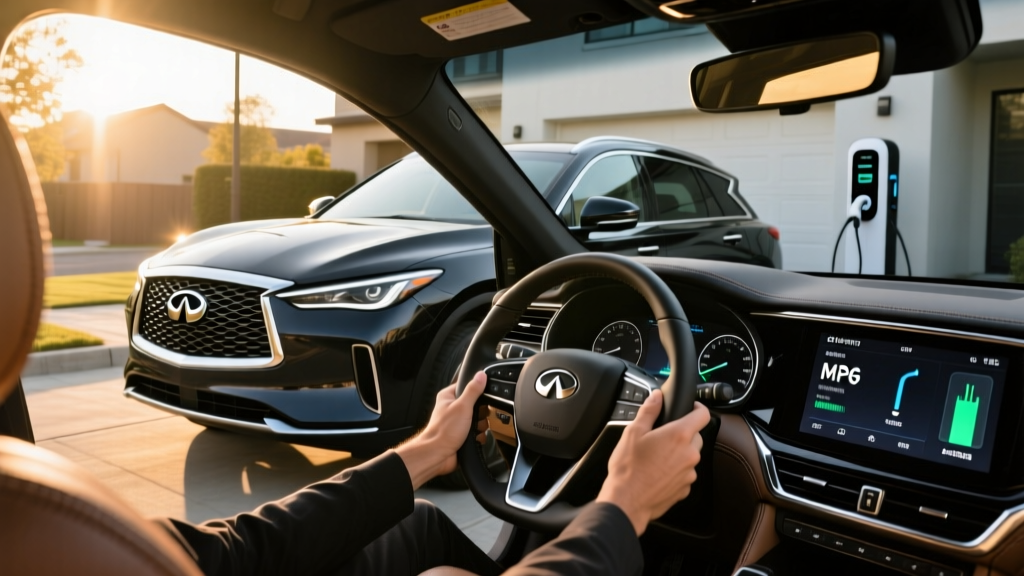
Infiniti's approach to electrification has been cautious, and the 2026 QX60 hybrid represents the brand's most practical step toward efficiency without asking buyers to change their fueling habits. As a conventional hybrid (HEV) — not a plug-in — the QX60 hybrid pairs Nissan's variable-compression turbo engine with an electric motor to deliver meaningful MPG gains over the gas-only model while maintaining the three-row luxury crossover formula Infiniti buyers expect.
But does an Infiniti hybrid make sense in a market increasingly dominated by plug-in hybrids and full EVs? We break down the real-world efficiency, powertrain engineering, ownership costs, and whether this is the right bridge vehicle for your garage.
2026 Infiniti QX60 Hybrid: Key Specifications
| Spec | Value |
|---|---|
| Powertrain | 2.0L VC-Turbo I4 + electric motor (HEV) |
| Combined Horsepower | 295 hp |
| Combined Torque | 310 lb-ft |
| EPA MPG (City / Hwy / Combined) | 28 / 25 / 27 |
| Drivetrain | AWD standard |
| 0–60 mph | ~6.8 seconds (est.) |
| Towing Capacity | 6,000 lbs |
| Seating | 7 passengers (3 rows) |
| Base MSRP (Pure Hybrid) | $54,200 |
| Battery Warranty | 8 years / 100,000 miles |
HEV vs PHEV: Where the Infiniti Hybrid Fits
Before evaluating the QX60 hybrid, it's critical to understand what it is — and what it isn't. Infiniti currently offers the QX60 with a conventional hybrid system. There is no plug-in hybrid (PHEV) variant in the 2026 lineup.
| Feature | HEV (QX60 Hybrid) | PHEV (e.g., Volvo XC90 Recharge) |
|---|---|---|
| Plug-in charging required? | No — charges via regen & engine | Yes — plug in for electric-only miles |
| Electric-only range | None (motor assists engine only) | 30–40 miles typical |
| Battery size | ~1.5 kWh (small buffer) | 15–20 kWh usable |
| DC fast charging | No | Varies (some support it) |
| Federal tax credit (§30D) | Not eligible | Up to $7,500 if criteria met |
| Best for | Drivers without home charging access | Drivers with home charging + short commutes |
The distinction matters enormously for purchase decisions. A conventional HEV like the QX60 hybrid recovers energy through regenerative braking and uses a small battery buffer to assist the gasoline engine during acceleration and low-speed driving. You never plug it in. You simply fill up at a gas station and drive — exactly like a traditional car, but with better fuel economy, particularly in stop-and-go city traffic where the electric motor does the most work.
Fuel Economy: EPA Ratings vs Real-World MPG
| Driving Condition | EPA Estimate | Real-World Expectation |
|---|---|---|
| City | 28 MPG | 27–30 MPG (hybrids often beat EPA in city) |
| Highway | 25 MPG | 23–26 MPG |
| Combined | 27 MPG | 25–28 MPG |
The 2026 Infiniti QX60 hybrid achieves an EPA-estimated 27 MPG combined, a meaningful improvement over the gas-only QX60's 23 MPG combined. The hybrid system's advantage is most pronounced in city driving, where the electric motor handles low-speed propulsion and the engine shuts off at stops — exactly the conditions where conventional SUVs waste the most fuel.
In real-world mixed driving, owners of Nissan/Infiniti VC-Turbo hybrid systems typically report numbers close to or slightly above EPA city estimates, thanks to aggressive regenerative braking that recaptures energy during deceleration. Highway efficiency sees less benefit because the electric motor provides minimal assistance at sustained high speeds — the engine does most of the work above 55 mph.
For context: the gas-only QX60 AWD averages 23 MPG combined. Upgrading to the hybrid trim saves roughly 50–70 gallons of fuel per year at 12,000 annual miles, translating to approximately $175–$245 in annual fuel savings at $3.50/gallon. Over a 5-year ownership period, that's roughly $875–$1,225 in fuel savings — a modest but real offset to the hybrid's higher MSRP.
Powertrain Deep Dive: VC-Turbo Meets Electrification
Infiniti's hybrid system centers on the 2.0-liter VC-Turbo (Variable Compression Turbo) inline-four, an engine that physically alters its compression ratio between 8:1 and 14:1 depending on load. Under light throttle, it runs at high compression for efficiency; under hard acceleration, it drops to low compression for power. This is paired with an electric motor integrated into the transmission housing.
The combined output of 295 horsepower and 310 lb-ft of torque is routed through a continuously variable transmission (CVT) to all four wheels. The electric motor fills in torque at low RPMs where turbo lag would otherwise be noticeable, resulting in smoother, more linear acceleration than the gas-only model delivers.
One practical advantage: the QX60 hybrid retains the 6,000-pound towing capacity of the gas model. Many competing hybrid SUVs sacrifice towing capability for efficiency; Infiniti has engineered the hybrid system to maintain utility.
Pricing, Trims, and Tax Credit Eligibility
The 2026 Infiniti QX60 hybrid is offered across three trim levels:
| Trim | MSRP | Key Features |
|---|---|---|
| Pure Hybrid | $54,200 | Leatherette, 12.3" dual screens, ProPILOT Assist |
| Luxe Hybrid | $58,700 | Leather, panoramic roof, Bose 17-speaker audio |
| Sensory Hybrid | $64,100 | Quilted semi-aniline leather, massaging front seats, head-up display |
Federal tax credit: The QX60 hybrid is a conventional HEV, not a plug-in hybrid. Under current IRS §30D rules, only plug-in electric vehicles (PHEVs and BEVs) with sufficient battery capacity qualify for the federal clean vehicle credit. The QX60 hybrid does not qualify for the $7,500 federal credit, nor does it qualify for the $4,000 used-EV credit.
Some states offer separate incentives for conventional hybrids, though these are increasingly rare as incentive programs shift toward plug-in vehicles. Check your state's energy office or department of environmental quality for current hybrid rebate programs — availability and amounts vary significantly by jurisdiction and change annually.
Reliability and Battery Warranty
Hybrid Battery Coverage
Warranty: 8 years / 100,000 miles (whichever comes first)
Coverage threshold: Battery capacity retention above 60–70% (varies by state emissions warranty requirements)
Estimated out-of-warranty replacement cost: $3,000–$5,000 (based on comparable Nissan/Infiniti hybrid systems)
Hybrid battery longevity is consistently one of the top concerns for first-time hybrid buyers. The QX60's hybrid battery is a relatively small lithium-ion pack (~1.5 kWh) that operates in a narrow state-of-charge window — typically between 40% and 80%. This shallow cycling strategy is deliberately engineered to minimize degradation; the battery management system never allows full charges or deep discharges, which are the primary drivers of lithium-ion wear.
Nissan and Infiniti have over two decades of hybrid system experience dating to the early Altima Hybrid and the Infiniti M35h. Real-world data from these earlier systems shows hybrid batteries commonly lasting 150,000–200,000 miles before capacity degradation triggers a warranty claim. The 8-year/100,000-mile warranty provides a substantial safety net, and California-emissions states often extend hybrid component coverage to 10 years / 150,000 miles.
If the battery does require replacement outside warranty, expect costs in the $3,000–$5,000 range for the pack itself, plus labor. Third-party refurbishment services are increasingly available at lower cost. For most owners who plan to keep the vehicle 5–8 years, battery replacement is unlikely to be a concern.
Who Should Choose the Infiniti QX60 Hybrid?
Choose the QX60 Hybrid If:
- You want better fuel economy without changing your refueling routine
- You don't have access to home or workplace charging for a PHEV or EV
- You need three rows, AWD, and 6,000-lb towing in a luxury badge
- You plan to own the vehicle 5–8 years (within warranty period)
- City and suburban driving make up the majority of your miles
Look at a PHEV or Full EV Instead If:
- You have home Level 2 charging and a commute under 30 miles (a PHEV could eliminate gas use on weekdays)
- You want federal tax credit eligibility (requires a PHEV or BEV)
- You want zero tailpipe emissions for daily driving
- You drive mostly highway miles (the hybrid efficiency advantage narrows at sustained speeds)
The QX60 hybrid occupies a specific niche: luxury three-row SUV buyers who want improved efficiency but aren't ready — or able — to plug in. It's a pragmatic choice for apartment dwellers without charging access, frequent road-trippers who value the 450+ mile total range, and buyers in regions with sparse public charging infrastructure.
Pros
- No plug-in required — seamless transition from gas-only
- ~15–20% fuel savings over gas QX60 in mixed driving
- Retains full 6,000-lb towing capacity
- Smooth low-speed acceleration from electric motor assist
- 8-year / 100,000-mile hybrid battery warranty
Cons
- No electric-only driving capability
- Not eligible for federal §30D tax credit
- Highway MPG advantage over gas model is modest
- Hybrid premium adds ~$3,000 over equivalent gas trim
- CVT can feel disconnected under hard acceleration
Frequently Asked Questions
How many MPG does the Infiniti QX60 hybrid get?
The 2026 Infiniti QX60 hybrid achieves an EPA-estimated 28 MPG city, 25 MPG highway, and 27 MPG combined. In real-world city driving, many owners report matching or slightly exceeding the 28 MPG city figure thanks to regenerative braking. Highway driving typically yields 23–26 MPG depending on speed and terrain.
Does the Infiniti hybrid need to be plugged in?
No. The QX60 hybrid is a conventional HEV, not a plug-in hybrid. Its small battery charges automatically through regenerative braking and the gasoline engine. You refuel only at gas stations, just like a traditional vehicle.
Does the Infiniti QX60 hybrid qualify for a tax credit?
No. Under current IRS §30D rules, only plug-in electric vehicles (PHEVs and BEVs) qualify for the federal clean vehicle credit. The QX60 hybrid's battery is too small and the vehicle cannot be plugged in, so it does not meet eligibility requirements. Some states may offer separate hybrid incentives — check your state energy office for current programs.
How long will the Infiniti hybrid battery last?
Infiniti covers the hybrid battery for 8 years or 100,000 miles. Based on historical data from Nissan/Infiniti hybrid systems, these batteries commonly last 150,000–200,000 miles before significant degradation. The battery management system's shallow-cycling strategy (never fully charging or fully depleting the pack) is designed to maximize lifespan. Out-of-warranty replacement costs approximately $3,000–$5,000.
Is the Infiniti QX60 hybrid better than a full EV?
It depends on your situation. The QX60 hybrid is better if you lack home charging access, frequently drive in areas with limited charging infrastructure, or regularly tow heavy loads. A full EV is better if you have reliable home Level 2 charging, want lower per-mile fuel costs, want federal tax credit eligibility, and primarily drive in urban or suburban areas. The QX60 hybrid is a bridge solution — it improves efficiency without requiring behavioral change.
How does the QX60 hybrid compare to competing luxury hybrid SUVs?
The QX60 hybrid competes with the Lexus TX 500h (33 MPG combined, ~$62,000), the Volvo XC90 Recharge PHEV (35 miles electric-only, eligible for tax credit, ~$73,000), and the BMW X5 xDrive50e PHEV (38 miles electric-only, ~$69,000). The QX60's advantage is its lower entry price and no-plug convenience; its disadvantage is lower overall efficiency and no electric-only capability compared to PHEV rivals.
The 2026 Infiniti QX60 hybrid isn't the most efficient luxury SUV in its class, and it won't qualify for federal incentives. But for buyers who want a three-row luxury crossover with better fuel economy, no charging hassle, and full towing capability, it fills a genuine gap in the market. The hybrid premium of roughly $3,000 pays for itself in fuel savings within 6–7 years of average driving — and the 8-year battery warranty provides peace of mind for the ownership period most buyers plan for.