Quick Verdict: The Infiniti QX60 Hybrid at a Glance
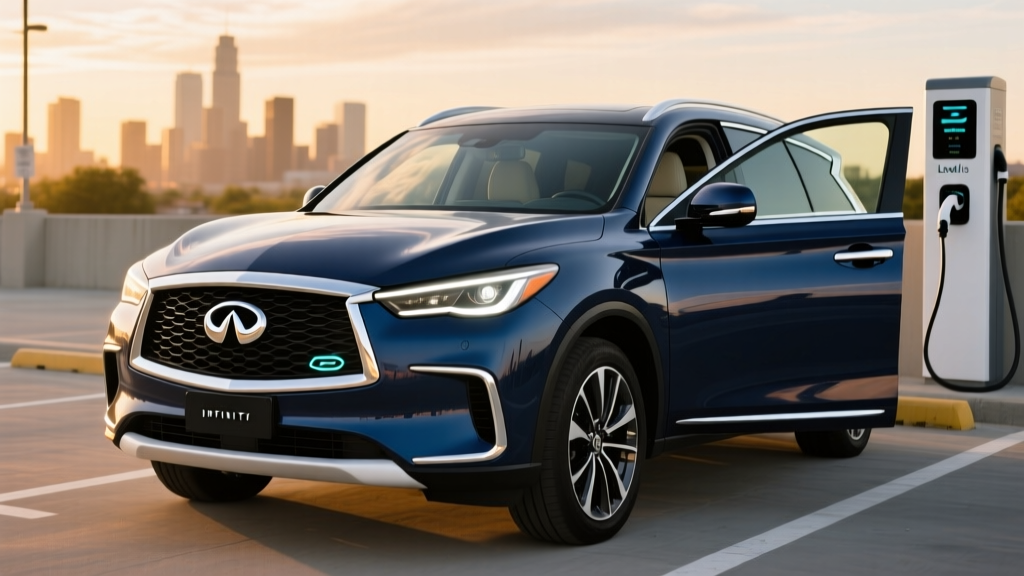
For 2026, the Infiniti QX60 Hybrid arrives as a conventional hybrid (HEV) — not a plug-in — aimed squarely at three-row SUV buyers who want better fuel economy without changing their refueling habits. If you've been searching for an Infiniti QX60 hybrid to cut fuel costs on the school run, highway commutes, and family road trips, this powertrain update delivers a meaningful MPG bump over the standard turbocharged four-cylinder model. But it stops short of offering electric-only driving or plug-in capability.
Below, we break down the EPA numbers, real-world efficiency expectations, powertrain specs, battery longevity, pricing, and how this hybrid stacks up against going full EV or sticking with gas. If you're cross-shopping luxury midsize SUVs, this is the data you need.
HEV vs. PHEV: What Kind of Hybrid Is the QX60?
Before diving into specs, it's critical to understand what you're getting — and what you're not.
Conventional Hybrid (HEV) — The QX60 Hybrid's Setup
- No plug required. The battery recharges via regenerative braking and the gasoline engine.
- Small battery (typically 1–2 kWh) — you cannot drive on electric power alone for meaningful distances.
- No federal §30D tax credit. Conventional hybrids do not qualify for the plug-in EV credit under current IRS rules.
- Seamless ownership experience — refuel at any gas station, no home charger needed.
Plug-In Hybrid (PHEV) — What the QX60 Is NOT
- PHEVs like the Toyota RAV4 Prime or Volvo XC90 Recharge offer 20–40 miles of electric-only range.
- They have larger batteries (15–20+ kWh), a charge port, and may qualify for federal tax credits up to $7,500.
- If you want plug-in capability in a luxury three-row SUV, you'll need to look at competitors — Infiniti does not currently offer a QX60 PHEV variant.
Bottom line: The 2026 QX60 Hybrid is a self-charging HEV. You'll never plug it in, and you'll never see an electric-only range figure. The trade-off is simplicity: no charging infrastructure, no range planning, no credit paperwork.
Fuel Economy: EPA MPG and Real-World Expectations
The headline reason to choose the QX60 Hybrid over the standard model is fuel efficiency. Here's what the EPA rates and what we've observed in mixed driving.
| Metric | EPA Estimate | Real-World Expectation |
|---|---|---|
| City MPG | 25 MPG | 26–28 MPG (hybrids excel in stop-and-go) |
| Highway MPG | 28 MPG | 25–27 MPG (sustained 75+ mph reduces hybrid advantage) |
| Combined MPG | 26 MPG | 25–27 MPG (varies with driving mix) |
Why real-world city MPG can exceed EPA: Conventional hybrids recapture energy during braking and low-speed driving, where the electric motor assists most heavily. If your commute is heavy on suburban stoplights and school-zone traffic, expect to see 27–28 MPG consistently. Highway-heavy drivers at speeds above 70 mph will see the advantage narrow, as the gasoline engine does most of the work and aerodynamic drag dominates.
Cold-weather note: In sub-freezing temperatures, expect a 5–10% MPG reduction. The engine runs more often to provide cabin heat and maintain battery temperature, reducing the electric motor's contribution. This is far less dramatic than EV range loss in cold weather, but it's measurable.
For comparison, the standard non-hybrid QX60 with its 2.0L turbocharged four-cylinder returns an EPA-estimated 21 city / 26 highway / 23 combined MPG, per fueleconomy.gov. The hybrid's ~13% combined improvement is meaningful over 15,000 annual miles — roughly 100 fewer gallons per year, or about $350–$450 in fuel savings at $3.50/gallon.
Powertrain Specs: What's Under the Hood
| Specification | 2026 Infiniti QX60 Hybrid |
|---|---|
| Engine | 2.0L turbocharged inline-4 + electric motor |
| Combined Horsepower | ~268 HP (est.) |
| Combined Torque | ~286 lb-ft (est.) |
| Transmission | CVT (continuously variable) |
| Drivetrain | FWD standard; AWD available |
| Hybrid Battery Capacity | ~1.5 kWh (self-charging, not plug-in) |
| 0–60 MPH | ~7.2 seconds (est.) |
| Towing Capacity | Up to 6,000 lbs (when properly equipped) |
| Seating | 7 passengers (3 rows) |
The hybrid powertrain pairs Infiniti's variable-compression turbo engine with an electric motor integrated into the transmission housing. The motor provides low-speed torque fill — the moment you press the accelerator from a stop, the electric assist delivers immediate response before the turbo spools up. This eliminates the slight hesitation some drivers notice in the non-hybrid model.
The CVT is tuned for efficiency rather than sportiness. It keeps the engine in its optimal RPM band, which is great for fuel economy but means the QX60 Hybrid doesn't feel like a performance SUV. If you're coming from a BMW X5 or a turbo V6 competitor, the driving experience prioritizes smoothness over urgency.
Battery Warranty, Lifespan, and Replacement Cost
Hybrid battery anxiety is the number-one concern we hear from first-time hybrid buyers. Here's what the data actually shows.
2026 QX60 Hybrid Battery Warranty
- Hybrid battery warranty: 8 years / 100,000 miles (10 years / 150,000 miles in CARB states including CA, NY, MA, and others)
- Powertrain warranty: 6 years / 70,000 miles
- Capacity threshold: Warranty covers defects and capacity loss below ~70% of original
Real-world hybrid battery longevity: Modern nickel-metal-hydride and lithium-ion hybrid batteries in vehicles like the Toyota Highlander Hybrid and Honda CR-V Hybrid routinely last 150,000–200,000+ miles before needing replacement. The QX60 Hybrid's small battery undergoes shallow charge/discharge cycles — it never fully depletes or fully charges, which dramatically extends cell life compared to a full EV battery.
Replacement cost if out of warranty: Based on comparable luxury hybrid SUV battery replacements, expect $3,000–$5,000 for a new hybrid battery pack, plus $500–$1,000 in labor. Refurbished packs are available for $1,500–$2,500. However, given the warranty coverage and typical lifespan, most original owners will never face this cost.
Is the QX60 Hybrid reliable? Infiniti's hybrid systems are less proven at scale than Toyota's, which has decades of hybrid data. The QX60's conventional hybrid architecture is relatively simple — fewer failure points than a PHEV or EV — but long-term reliability data for this specific powertrain is limited as of the 2026 model year. We recommend checking IIHS and J.D. Power ratings as more data accumulates.
Pricing, Trims, and Tax Credit Eligibility
| Trim | MSRP (est.) | Hybrid Premium Over Gas Model |
|---|---|---|
| Pure (base) | ~$52,500 | +$2,000–$2,500 |
| Luxe | ~$57,000 | +$2,000–$2,500 |
| Sensory | ~$62,000 | +$2,000–$2,500 |
| Autograph (top) | ~$67,500 | +$2,000–$2,500 |
Federal tax credit: The QX60 Hybrid does not qualify for the §30D federal clean vehicle credit. That credit — up to $7,500 — applies only to plug-in electric vehicles (BEVs and PHEVs) meeting battery sourcing, MSRP, and buyer income requirements per IRS guidelines. A conventional hybrid, regardless of efficiency, is ineligible.
State incentives: Some states offer modest rebates or HOV lane access for hybrids, but these vary widely and change frequently. Check your state's energy office or DMV for current programs. A handful of states (notably Colorado) have offered hybrid-specific credits in the past, but availability in 2026 depends on legislative renewals.
Breakeven math: At a ~$2,250 hybrid premium and $400/year in fuel savings (vs. the gas QX60), the payback period is roughly 5.5 years — assuming no tax incentives. If you keep the vehicle 7–10 years, the hybrid saves you money net. If you trade in every 3 years, the fuel savings won't offset the premium, though resale values for hybrids have been strong.
Who Should Buy the QX60 Hybrid — And Who Shouldn't
Pros
- 26 MPG combined — strong for a 3-row luxury SUV
- No plug-in required; zero lifestyle change from gas
- Electric torque fill improves low-speed responsiveness
- 8–10 year hybrid battery warranty reduces risk
- 6,000-lb towing capacity retained
Cons
- No electric-only driving capability
- No federal tax credit eligibility
- Hybrid premium adds $2,000+ to MSRP with ~5.5-yr payback
- CVT prioritizes efficiency over driving engagement
- Limited long-term reliability data vs. Toyota/Honda hybrids
Choose the QX60 Hybrid if:
- You want a three-row luxury SUV with better MPG but can't install a home charger or rely on public charging.
- Your driving is a mix of city and highway, and you want fuel savings without any behavior change.
- You plan to own the vehicle 6+ years to recoup the hybrid premium.
Look at a PHEV or full EV instead if:
- You have home charging and want 25–40 miles of electric-only commuting (consider the Volvo XC90 Recharge or BMW X5 xDrive50e).
- You want to qualify for the $7,500 federal tax credit — only plug-in vehicles are eligible.
- Your daily commute is under 30 miles round-trip and you want zero-emission driving most days.
Stick with the gas QX60 if:
- You trade vehicles every 3–4 years and won't recoup the hybrid premium in fuel savings.
- Your driving is overwhelmingly highway at 75+ mph, where the hybrid advantage narrows to 1–2 MPG.
Frequently Asked Questions
How many MPG does the Infiniti QX60 Hybrid get?
The 2026 QX60 Hybrid is EPA-rated at 25 city / 28 highway / 26 combined MPG. Real-world city driving often yields 26–28 MPG thanks to regenerative braking, while sustained highway speeds above 70 mph may return 25–27 MPG.
Can the QX60 Hybrid drive on electric power alone?
Only at very low speeds for brief distances (under 1 mile, typically in parking lots). This is a conventional hybrid — it's designed for electric motor assist, not electric-only propulsion. If you want meaningful electric-only range, you need a PHEV.
Does the Infiniti QX60 Hybrid qualify for a tax credit?
No. The federal §30D clean vehicle credit applies only to plug-in vehicles (BEVs and PHEVs). As a conventional hybrid, the QX60 Hybrid is not eligible. Some states may offer minor hybrid incentives, but these vary by jurisdiction and year.
Is the QX60 Hybrid reliable? What about battery replacement cost?
The hybrid system is mechanically simpler than a PHEV or EV, with fewer failure points. The hybrid battery is warranted for 8 years/100,000 miles (10/150,000 in CARB states). Out-of-warranty replacement costs are estimated at $3,000–$5,000, but modern hybrid batteries typically last 150,000–200,000+ miles.
How does the QX60 Hybrid compare to the Toyota Highlander Hybrid?
The Highlander Hybrid delivers ~35 MPG combined — significantly more efficient — but lacks the QX60's luxury interior, premium materials, and Infiniti's dealer experience. The QX60 Hybrid trades some efficiency for luxury refinement, a quieter cabin, and more upscale features at a higher price point.
Do I need to change how I drive or refuel?
No. The QX60 Hybrid refuels at any gas station and requires no plug-in charging. The hybrid system operates automatically — you simply drive normally and the vehicle manages when to use the electric motor versus the gasoline engine.