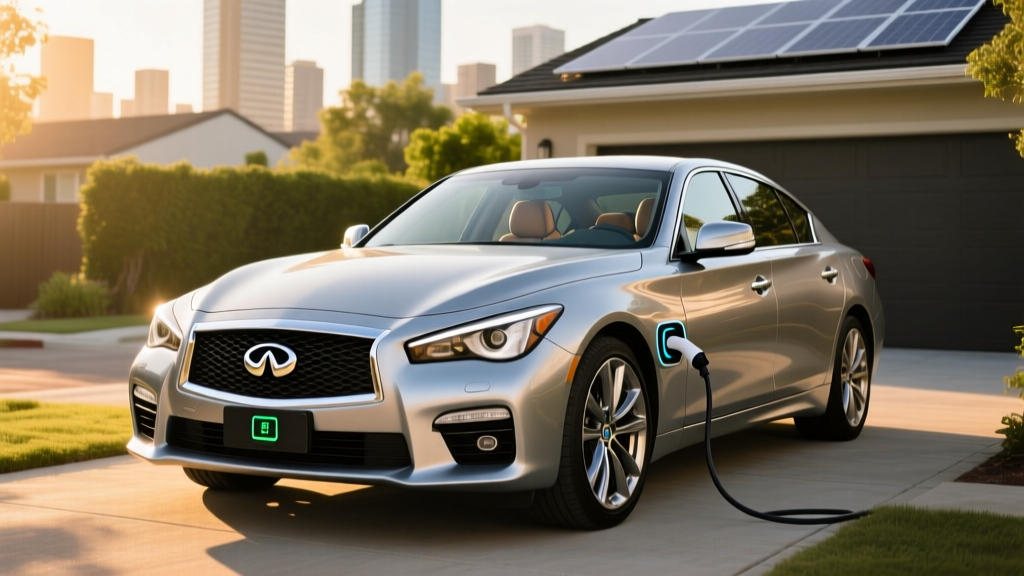
The Infiniti Q70 Hybrid occupies a narrow lane in the luxury sedan market: a conventional hybrid (HEV) that pairs a V6 with an electric motor for improved fuel economy without ever needing to be plugged in. Originally launched as part of the Q70 lineup and sold through the 2019 model year in the U.S., the Q70 Hybrid has since been discontinued — but it remains a popular target on the used luxury market. If you're researching an Infiniti Q70 Hybrid as a potential purchase or comparing it against newer hybrid and plug-in hybrid alternatives, this guide covers every number that matters.
Below, we break down EPA fuel economy, real-world MPG expectations, the hybrid powertrain, battery longevity, ownership costs, and how the Q70 Hybrid stacks up against modern PHEVs and full EVs in 2026.
Infiniti Q70 Hybrid Powertrain: V6 Meets Electric Assist
The Q70 Hybrid uses Infiniti's Direct Response Hybrid system, which pairs a 3.5-liter V6 gasoline engine with a 50 kW (67 hp) electric motor integrated into the 7-speed automatic transmission. The combined system output is 360 horsepower and 258 lb-ft of torque from the engine side, with the electric motor contributing additional low-end thrust for brisk acceleration.
| Specification | Value |
|---|---|
| Engine | 3.5L V6 (302 hp, 258 lb-ft) |
| Electric Motor | 50 kW (67 hp) |
| Combined System Output | 360 hp |
| Transmission | 7-speed automatic |
| Drivetrain | Rear-wheel drive (AWD not offered on hybrid) |
| Hybrid Battery | ~1.4 kWh lithium-ion (non-plug-in) |
| 0-60 mph | ~5.5 seconds (est.) |
Unlike a plug-in hybrid (PHEV), the Q70 Hybrid's small battery pack recharges entirely through regenerative braking and the gasoline engine. There is no charging port, no plug, and no electric-only driving range to speak of — the motor assists the engine and enables brief low-speed electric creep, but the gas engine is always the primary propulsion source.
EPA Fuel Economy: What the Sticker Says
According to fueleconomy.gov, the Infiniti Q70 Hybrid (rear-wheel drive) carries the following EPA ratings:
| Driving Cycle | MPG |
|---|---|
| City | 29 MPG |
| Highway | 33 MPG |
| Combined | 30 MPG |
For a 360-hp luxury sedan, 30 MPG combined is a meaningful improvement over the non-hybrid Q70 with its 3.7L V6 (rated around 21 MPG combined) or the 5.6L V8 variant (roughly 18 MPG combined). The hybrid system's biggest gains come in stop-and-go city driving, where regenerative braking and electric assist reduce the engine's workload most effectively.
Real-World MPG vs. EPA Estimates
Hybrid vehicles frequently exceed their EPA city ratings in real-world driving because regenerative braking recovers more energy in heavy traffic. The Q70 Hybrid is no exception.
Real-World MPG Expectations:
- City / stop-and-go: 28–32 MPG (regenerative braking shines here; some owners report slightly above the 29 MPG EPA city figure)
- Highway / steady cruise: 30–34 MPG (the hybrid advantage narrows at sustained speeds, but aerodynamic efficiency and the tall 7th gear help)
- Cold weather (below 35°F): Expect a 5–10% reduction — roughly 26–28 MPG combined — as the engine runs more often to maintain cabin heat and the battery's charge/discharge efficiency drops
- Mixed real-world average: Most owners report 27–31 MPG combined in everyday driving
The gap between the Q70 Hybrid's 30 MPG combined and a modern midsize hybrid like the Toyota Camry Hybrid (up to 52 MPG combined) is substantial — but the Q70 is a heavier, more powerful rear-wheel-drive luxury sedan, so the comparison is apples to oranges. Within its segment, the Q70 Hybrid's efficiency was competitive when new.
HEV vs. PHEV vs. EV: Which Fits Your Driving Pattern?
If you're cross-shopping the used Infiniti Q70 Hybrid against newer electrified options, the core decision comes down to charging access, daily mileage, and budget.
| Factor | HEV (Q70 Hybrid) | PHEV (e.g., BMW 330e) | Full EV (e.g., Tesla Model 3) |
|---|---|---|---|
| Plug-in required? | No | Yes (for EV range) | Yes |
| Electric-only range | ~0 mi (motor assist only) | 20–40 mi typical | 250–350+ mi |
| Fuel/energy cost per mile | ~$0.12–0.15 | ~$0.04–0.12 (depends on EV vs gas ratio) | ~$0.03–0.06 |
| Home charging needed? | No | Recommended (Level 2) | Essential |
| Upfront cost (2026 used/new) | ~$18,000–$28,000 (used) | ~$44,000–$55,000 (new) | ~$38,000–$55,000 (new) |
| Federal tax credit | None | Up to $3,750–$7,500 (§30D, if eligible) | Up to $7,500 (§30D, if eligible) |
| Best for | No charging access; want simplicity | Short commute + home charging; road trips | Home charging + mostly under 300 mi/day |
The Q70 Hybrid makes the most sense for buyers who lack access to home or workplace charging and want a luxury sedan with lower fuel costs than a gas-only equivalent — without any change to their refueling habits.
Hybrid Battery Longevity, Warranty & Replacement Cost
Hybrid battery lifespan is the single most common concern for used-hybrid buyers. Here's what you need to know about the Q70 Hybrid's pack:
Infiniti Q70 Hybrid Battery Warranty (When New):
- Hybrid battery warranty: 8 years / 100,000 miles (in most states)
- CARB states (CA, NY, MA, and others adopting California emissions standards): 10 years / 150,000 miles
- Warranty coverage threshold: Typically covers battery capacity loss below ~60–70% of original capacity or complete failure
Since the Q70 Hybrid's final U.S. model year was 2019, original factory battery warranties are expiring or have already expired by 2026–2027 (8-year mark) unless the vehicle was sold in a CARB state and has under 150,000 miles.
Real-world battery longevity: Lithium-ion hybrid batteries in Toyota, Honda, and Nissan/Infiniti systems have a strong track record of lasting 150,000–200,000+ miles before significant degradation, provided the vehicle wasn't routinely stored in extreme heat with a fully depleted pack. The Q70 Hybrid's relatively small 1.4 kWh pack undergoes shallow charge/discharge cycles, which is gentler on cell longevity than a PHEV or EV battery experiencing deeper cycles.
Battery replacement cost: If the hybrid battery does fail out of warranty, expect the following:
- OEM replacement battery: $3,000–$5,000 (parts and labor at a dealership)
- Refurbished / aftermarket battery: $1,500–$3,000
- Individual cell module replacement: $500–$1,500 (if only specific modules have failed — requires a qualified hybrid technician)
Before purchasing a used Q70 Hybrid, request a hybrid battery health report from a qualified Infiniti technician or use an OBD-II scanner with hybrid-compatible software to check the battery's state of health (SoH).
Pricing and Tax Credit Eligibility
Because the Infiniti Q70 Hybrid was discontinued after the 2019 model year, no new units are available in 2026. Pricing is entirely in the used market:
| Model Year | Mileage Range | Estimated Price |
|---|---|---|
| 2015–2016 | 80,000–120,000 mi | $14,000–$20,000 |
| 2017–2018 | 50,000–90,000 mi | $18,000–$25,000 |
| 2019 | 30,000–70,000 mi | $22,000–$28,000 |
Tax credit status: The Q70 Hybrid does not qualify for the federal §30D new clean vehicle credit (it was never a plug-in vehicle). For the federal used EV credit (up to $4,000 under §25E), the vehicle must be a qualified plug-in electric or fuel-cell vehicle — conventional hybrids like the Q70 Hybrid are excluded. Check IRS guidelines on the used clean vehicle credit for full eligibility rules.
No state-level hybrid-specific incentives apply to conventional HEVs in most jurisdictions, though a few states offer minimal perks (HOV lane access was available in some states when new — check current local rules).
Reliability and Ownership Costs
Infiniti's hybrid system, derived from Nissan's proven hybrid architecture, has been generally reliable. Key ownership considerations include:
- Powertrain: The 3.5L V6 (VQ35HR family) is a well-known engine with a strong reliability record when maintained. Timing chain, water pump, and standard maintenance items apply.
- Hybrid system: The inverter, electric motor, and battery management system have not been associated with widespread failures. The most common hybrid-specific issue is gradual battery capacity loss at high mileage.
- Transmission: The 7-speed automatic is conventional (not a CVT) and generally robust with regular fluid changes.
- Brakes: Regenerative braking reduces wear on the friction brakes — expect brake pad life of 60,000–80,000+ miles under normal driving.
- Insurance: Used luxury sedans typically carry moderate insurance premiums. The Q70 Hybrid's lower replacement value compared to new luxury cars keeps rates reasonable — expect $1,200–$1,800/year depending on your profile.
- 5-year fuel cost estimate: At 15,000 miles/year, 30 MPG combined, and $3.50/gallon gas = ~$8,750 in fuel. Compare that to the non-hybrid Q70 V6 at ~21 MPG combined = ~$12,500 over the same period. The hybrid saves roughly $3,750 in fuel over five years.
Who Should Buy the Infiniti Q70 Hybrid?
Pros
- 360 hp with 30 MPG combined — strong performance-to-efficiency ratio
- No plug-in required — zero change to refueling habits
- Luxury sedan comfort: leather, quiet cabin, premium audio
- Lower used prices than comparable BMW 5-Series or Mercedes E-Class hybrids
- Regenerative braking extends brake pad life significantly
Cons
- Discontinued — no new models, limited remaining factory warranty
- 30 MPG combined trails modern hybrids (Camry Hybrid: 52 MPG)
- Small 1.4 kWh battery means no meaningful electric-only driving
- No federal tax credits available (not a plug-in vehicle)
- Rear-wheel drive only — no AWD option on the hybrid trim
- Infiniti brand resale value has softened vs. German competitors
Choose the Infiniti Q70 Hybrid if:
- You want a used luxury sedan under $28,000 with better fuel economy than gas-only rivals
- You don't have access to home or workplace EV charging
- You value V6 performance and don't want a 4-cylinder hybrid
- Your commute is mixed city/highway and you drive 12,000–18,000 miles/year
Look elsewhere if:
- You want maximum fuel savings — a modern PHEV or full EV will cost far less per mile
- You need AWD for snow/ice — the Q70 Hybrid is RWD only
- You want current-model-year technology, warranty coverage, and ADAS features
- You're chasing tax credits — only plug-in vehicles qualify under §30D and §25E
Infiniti Q70 Hybrid FAQ
How many MPG does the Infiniti Q70 Hybrid get?
The EPA rates the Q70 Hybrid at 29 MPG city, 33 MPG highway, and 30 MPG combined. Real-world owners typically report 27–31 MPG combined, with city driving sometimes exceeding the EPA estimate thanks to regenerative braking.
Can the Infiniti Q70 Hybrid drive on electric power only?
Not in any practical sense. The Q70 Hybrid is a conventional hybrid (HEV), not a plug-in hybrid. Its electric motor assists the gasoline engine and enables very brief low-speed electric movement, but there is no usable electric-only range. The gas engine is always the primary power source.
Is the Infiniti Q70 Hybrid reliable?
The Q70 Hybrid's powertrain — the VQ35 V6 engine and Nissan-derived hybrid system — has a solid reliability track record. The main long-term concern is hybrid battery degradation at high mileage (150,000+ miles), but replacement costs ($1,500–$5,000 depending on OEM vs. refurbished) are manageable relative to the vehicle's value.
How much does it cost to replace the Q70 Hybrid battery?
An OEM hybrid battery replacement runs $3,000–$5,000 at a dealership. Refurbished or aftermarket batteries cost $1,500–$3,000. Individual module replacement (if only some cells have failed) can cost as little as $500–$1,500 through a qualified hybrid specialist.
Does the Infiniti Q70 Hybrid qualify for any tax credit?
No. Federal tax credits under §30D (new vehicle) and §25E (used vehicle) require the vehicle to be a plug-in electric vehicle or fuel-cell vehicle. The Q70 Hybrid is a conventional hybrid (HEV) with no plug, so it does not qualify for any federal EV tax credit. Always verify current rules at IRS.gov.
How does the Q70 Hybrid compare to a modern PHEV like the BMW 330e?
A modern PHEV like the BMW 330e offers roughly 22 miles of electric-only range, around 75 MPGe when running on electricity, and qualifies for potential federal tax credits. However, a new BMW 330e starts above $45,000, while a used Q70 Hybrid can be had for $18,000–$28,000. If you have home charging and a short commute, the PHEV saves significantly more on fuel. If you lack charging access or want to minimize upfront cost, the Q70 Hybrid is a practical used-luxury option.
What should I check before buying a used Q70 Hybrid?
Prior to purchase, have a qualified technician perform a hybrid battery state-of-health (SoH) check, inspect the inverter cooling system, review maintenance records (especially transmission fluid changes and engine oil), and verify that no hybrid system warning lights are present. A pre-purchase inspection at an Infiniti dealer or hybrid specialist is strongly recommended.