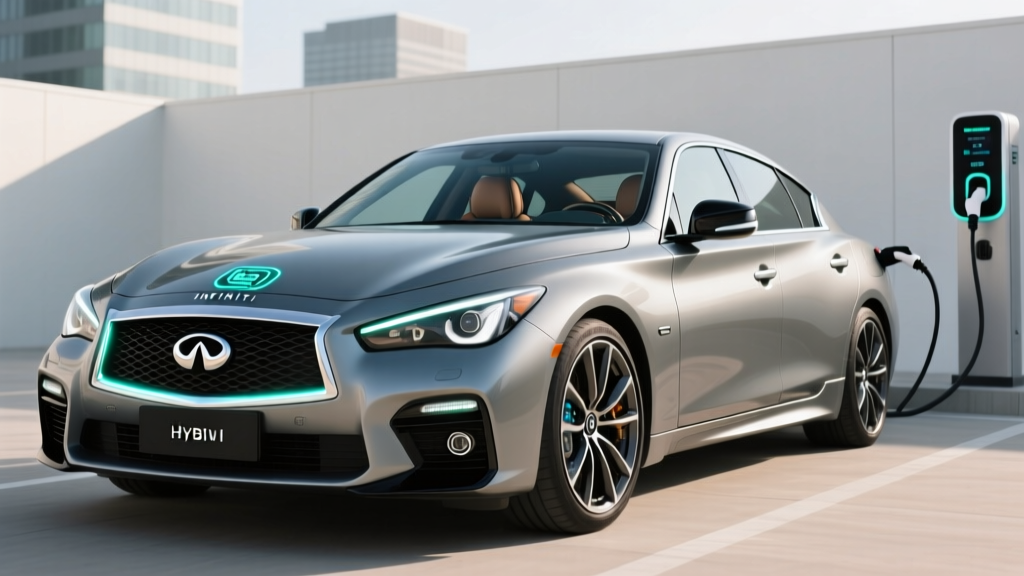
The Infiniti Q50 Hybrid: A Luxury Sport Sedan With an Electrified Twist
The Infiniti Q50 Hybrid paired a twin-turbo V6 with an electric motor to deliver sports-sedan thrust while sipping less fuel than its gas-only siblings. As a conventional hybrid electric vehicle (HEV), it never needs to be plugged in — the battery recharges through regenerative braking and the engine. But with Infiniti discontinuing the Q50 Hybrid after the 2019 model year and shifting its electrification strategy toward newer platforms, buyers in 2026 are primarily encountering this model on the used market. This guide covers exactly what you're getting: real-world MPG, powertrain specs, battery longevity, and whether this hybrid still stacks up against modern alternatives.
Powertrain Specs: Twin-Turbo V6 Meets Electric Motor
The Q50 Hybrid's powertrain was built around Nissan/Infiniti's Direct Response Hybrid system. Here's the breakdown of what's under the hood:
| Specification | Value |
|---|---|
| Gasoline Engine | 3.5L V6 (naturally aspirated, earlier models) / 3.0L Twin-Turbo V6 (later Red Sport variants) |
| Electric Motor | 50 kW (67 hp) AC synchronous motor integrated into transmission |
| Combined System Output | 360 hp / 350 lb-ft torque (3.5L V6 hybrid) |
| Transmission | 7-speed automatic with manual shift mode |
| Drivetrain | RWD standard; AWD available on select trims |
| Hybrid Battery | ~1.4 kWh lithium-ion (located in trunk) |
| 0-60 mph | ~4.9 seconds (RWD) |
| Plug-in Capable? | No — conventional HEV only |
The 3.5L V6 produces 302 hp on its own, and the 50 kW electric motor fills in torque gaps during acceleration. The result is a combined 360 hp that makes the Q50 Hybrid genuinely quick — quicker, in fact, than many competitors in its class when it was new. The electric motor's instant torque delivery eliminates the lag you'd expect from a large V6, making city driving and highway merging feel effortless.
Fuel Economy: EPA MPG Ratings and Real-World Expectations
Fuel efficiency is where the hybrid system earns its keep. According to EPA data on fueleconomy.gov, the Infiniti Q50 Hybrid achieved the following ratings:
| Driving Condition | EPA Rating | Real-World Expectation |
|---|---|---|
| City | 29 MPG | 28-32 MPG |
| Highway | 27 MPG | 25-28 MPG |
| Combined | 28 MPG | 26-30 MPG |
Why hybrids often beat EPA in the city: Conventional hybrids like the Q50 recapture energy during stop-and-go driving through regenerative braking. The electric motor handles low-speed acceleration — the most fuel-thirsty part of driving — while the gas engine kicks in at higher speeds. If your commute is heavy on city traffic, expect to see numbers at or slightly above the EPA city rating. Highway-heavy drivers will see results closer to or slightly below the EPA highway estimate.
Compared to the gas-only Q50 3.0t (rated at roughly 22 city / 28 highway / 24 combined), the hybrid delivers a meaningful 4-5 MPG improvement in combined driving. Over 15,000 miles per year at $3.50/gallon, that's roughly $300-$400 in annual fuel savings.
HEV vs PHEV vs EV: Which Powertrain Fits Your Driving?
The Q50 Hybrid is an HEV, but how does that compare to plug-in hybrids and full electric vehicles? Here's a practical decision framework:
| Factor | HEV (Q50 Hybrid) | PHEV | BEV |
|---|---|---|---|
| Plug in required? | No | Yes (for EV range) | Yes |
| Electric-only range | ~1 mile (low-speed only) | 20-50 miles typical | 200-400+ miles |
| Home charging needed? | No | Recommended (Level 2) | Essential |
| Fuel cost per mile | ~$0.13 | ~$0.04 (EV) / ~$0.12 (gas) | ~$0.04-$0.06 |
| Federal tax credit (new) | No | Up to $7,500 (§30D) | Up to $7,500 (§30D) |
| Best for | No home charging access | Short commutes + road trips | Home charging + daily driving |
- You don't have access to home or workplace charging
- You want better fuel economy without changing your fueling habits
- You want a luxury sport sedan with strong acceleration
- You take frequent long road trips and don't want to plan around chargers
- You have reliable Level 2 charging at home
- Your daily commute is under 40 miles (a PHEV can cover it entirely on electricity)
- You want to minimize fuel costs and qualify for federal tax credits on a new purchase
Reliability, Battery Warranty, and Replacement Costs
Hybrid battery longevity is the number-one concern for used hybrid buyers. Here's what you need to know about the Q50 Hybrid's battery and overall reliability:
Real-world battery lifespan: Lithium-ion hybrid batteries in Nissan/Infiniti vehicles have generally proven durable. Because the Q50's battery is small (~1.4 kWh) and the system never fully depletes or fully charges it (operating in a ~40-80% state-of-charge window), stress on the cells is minimal. Most owner reports and mechanic surveys suggest these packs last 150,000-200,000+ miles before significant degradation. Since the newest Q50 Hybrids are 2019 model-year vehicles, most are now 6-7 years old and likely still within the original warranty window.
Battery replacement cost: If the hybrid battery does fail outside warranty, expect a replacement cost in the range of $2,000-$4,000 for the battery pack itself, plus $500-$1,000 for labor. Refurbished or aftermarket packs may reduce this cost. This is considerably less than full EV battery replacements, which can exceed $10,000-$20,000, because the Q50's pack is small.
General reliability: The Q50 platform has average reliability ratings from sources like J.D. Power and Consumer Reports. Common non-hybrid issues include infotainment glitches, brake wear (though regen braking extends pad life), and occasional transmission shudder. The hybrid system itself has not been a major source of complaints. Per NHTSA records, there have been no major hybrid-specific recalls for the Q50 Hybrid.
Pricing: Used Market Values and Tax Credit Reality
Since the Infiniti Q50 Hybrid was discontinued after 2019, you won't find one new at a dealership. Here's what the used market looks like in 2026:
| Model Year | Mileage Range | Estimated Price Range |
|---|---|---|
| 2014-2015 | 80,000-120,000 mi | $12,000-$17,000 |
| 2016-2017 | 60,000-90,000 mi | $16,000-$22,000 |
| 2018-2019 | 40,000-70,000 mi | $20,000-$28,000 |
Federal tax credit: The IRS §30D clean vehicle credit applies only to new qualifying plug-in EVs and PHEVs — not conventional hybrids like the Q50 Hybrid. There is no federal tax credit for purchasing a used HEV. The federal used clean vehicle credit (up to $4,000) also applies only to used BEVs and PHEVs, not HEVs. Bottom line: no federal tax credit applies to the Q50 Hybrid, whether purchased new (when available) or used.
State incentives: A handful of states offer modest incentives for hybrid purchases, but most have shifted their incentive programs toward PHEVs and BEVs. Check your state's energy office or department of environmental quality for current programs.
Pros and Cons of the Infiniti Q50 Hybrid
✓ Pros
- 360 hp combined — genuinely quick for a luxury hybrid sedan
- 28 MPG combined — solid efficiency for a V6 sport sedan
- No plug-in charging required — works like a normal gas car
- Regenerative braking extends brake pad life significantly
- Comfortable, well-appointed interior with Infiniti's premium materials
- AWD available for all-weather climates
- Strong used-market value relative to original MSRP
✗ Cons
- Discontinued after 2019 — no new models available
- No electric-only driving range to speak of
- No federal tax credit eligibility (HEV, not PHEV/BEV)
- Trunk space reduced by battery pack placement
- Infotainment system (dual-screen) feels dated vs 2026 competitors
- Hybrid battery replacement cost ($2K-$4K) if it fails out of warranty
- Fuel economy lags behind 4-cylinder hybrids (Toyota Camry Hybrid: 52 MPG)
How the Q50 Hybrid Compares to Alternatives in 2026
If you're cross-shopping the Q50 Hybrid, you're likely also considering these alternatives:
- Toyota Camry Hybrid (2026): 52 MPG combined, ~$30,000 new, 4-cylinder. Far more efficient but less powerful (225 hp) and not a luxury badge.
- Lexus ES 300h (2026): 44 MPG combined, ~$44,000 new, 215 hp. More refined luxury hybrid with better fuel economy, but slower.
- BMW 330e PHEV (2026): Plug-in hybrid with ~25 miles electric range, 288 hp combined, ~$47,000 new. Qualifies for some incentives; requires home charging to maximize value.
- Genesis G80 Electrified: Full BEV luxury sedan option if you're ready to go all-electric with 282 miles of EPA range.
The Q50 Hybrid occupies a unique niche: it's one of the few V6-powered luxury sport hybrids ever sold in the US. If acceleration and driving engagement matter as much as fuel savings, it has few direct peers on the used market.
Frequently Asked Questions
How many MPG does the Infiniti Q50 Hybrid get?
The EPA rates the Q50 Hybrid at 29 city / 27 highway / 28 combined MPG. Real-world results typically range from 26-30 combined depending on driving mix. City-heavy commuters often see 30+ MPG thanks to regenerative braking.
Can the Q50 Hybrid drive on electric power only?
Only for very short distances (under 1 mile) at low speeds, such as creeping in a parking lot. This is a conventional hybrid — it cannot operate as an electric car for any meaningful distance. If you want 20-40 miles of electric-only driving, you need a plug-in hybrid (PHEV).
Is the Infiniti Q50 Hybrid reliable?
The Q50 Hybrid has average-to-good reliability for a luxury sport sedan. The hybrid system (battery, motor, power electronics) has proven durable, with most batteries lasting well beyond 150,000 miles. The 8-year/100,000-mile hybrid warranty provides additional peace of mind on newer examples.
How much does it cost to replace the Q50 Hybrid battery?
Expect $2,000-$4,000 for a replacement hybrid battery pack plus $500-$1,000 in labor. This is relatively affordable compared to full EV battery replacements because the Q50's pack is only ~1.4 kWh. Many owners never need to replace the battery during the vehicle's useful life.
Does the Infiniti Q50 Hybrid qualify for any tax credit?
No. As a conventional hybrid (HEV), the Q50 Hybrid does not qualify for the federal §30D clean vehicle credit, which is limited to new plug-in EVs and PHEVs meeting battery-sourcing and MSRP requirements. The used clean vehicle credit also does not apply to HEVs. Check your state for any hybrid-specific incentives, though most have been phased out.
Should I buy a used Q50 Hybrid or a new hybrid in 2026?
If you want a luxury sport sedan with hybrid efficiency on a budget under $25,000, the used Q50 Hybrid is a strong pick. If you want the latest tech, a full warranty, better fuel economy, or plug-in capability, a new Lexus ES 300h, BMW 330e, or Toyota Camry Hybrid may serve you better. Test-drive both and compare total 5-year ownership costs.