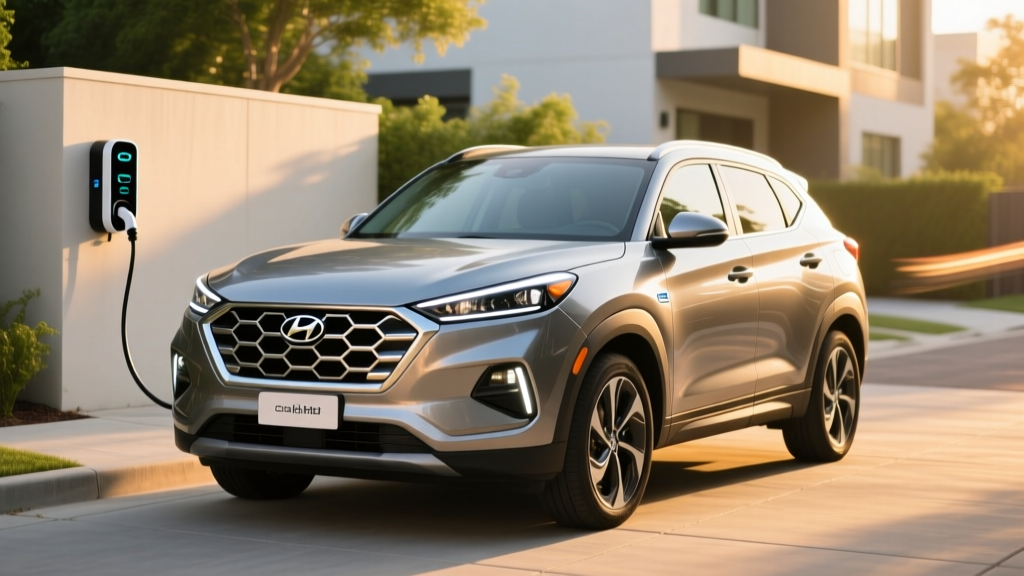
Quick Verdict: The Hyundai Tucson PHEV Bridges the Gap
If you want electric-only commuting without the range anxiety of a full battery-electric vehicle, the 2026 Hyundai Tucson Plug-In Hybrid occupies a practical middle ground. With an EPA-estimated 32 miles of electric-only range, 80 MPGe combined, and a combined 268 horsepower from its turbocharged engine and electric motor, it handles daily errands on electrons and longer road trips on gasoline. Starting at $39,990 before destination, it undercuts many rivals while offering standard all-wheel drive and a comprehensive warranty package.
This guide covers the Tucson PHEV's real-world efficiency, charging logistics, powertrain behavior, and how it stacks up against both conventional hybrids and full EVs — with exact numbers you need to decide.
Hyundai Plug-In Hybrid SUV: HEV vs. PHEV Explained
Hyundai sells the Tucson in three powertrain flavors, and confusing them at the dealership is easy. Here's the breakdown:
| Feature | Tucson Hybrid (HEV) | Tucson Plug-In Hybrid (PHEV) | Tucson EV (if considering) |
|---|---|---|---|
| Plug-in charging required? | No — self-charging via regen & engine | Yes — plug in to maximize EV range | Yes — 100% electric |
| Electric-only range | ~1–2 miles at low speed | 32 miles (EPA) | Full range (200+ mi) |
| Battery size | 1.49 kWh | 13.8 kWh usable | ~77 kWh usable |
| Combined output | 231 hp | 268 hp | ~225 hp |
| Base MSRP (2026) | ~$33,590 | $39,990 | $42,000+ |
| Federal tax credit eligible? | No | Potentially — up to $3,750 (§30D) | Potentially — up to $7,500 |
The conventional Tucson Hybrid never plugs in. It recovers energy during braking and deceleration, storing it in a small battery that assists the engine. The Hyundai plug-in hybrid SUV variant carries a much larger 13.8 kWh battery that you charge from a wall outlet or public charger, enabling genuine zero-tailpipe-emission commuting for most daily drives.
Fuel Economy and Electric-Only Range
| Driving Mode | EPA Estimate | Real-World Expectation |
|---|---|---|
| Electric-only (charge-depleting) | 80 MPGe combined | 72–85 MPGe depending on climate & speed |
| Gas-only (charge-sustaining) | 35 MPG combined | 32–37 MPG (city often exceeds EPA) |
| City (gas mode) | 36 MPG | 35–40 MPG — regen-heavy driving helps |
| Highway (gas mode) | 34 MPG | 30–34 MPG — aerodynamic drag at 75+ mph hurts |
| Electric-only range | 32 miles | 26–30 miles highway; 30–34 miles city in mild weather |
| Total combined range | ~390 miles | 350–400 miles depending on driving mix |
How many MPG does this hybrid get? In charge-sustaining (gas) mode, expect 35 MPG combined per the EPA. In real-world testing, city driving often pushes toward 37–40 MPG thanks to aggressive regenerative braking recapturing energy at stoplights. Highway driving at 75 mph drops that to roughly 30–32 MPG. If your commute falls within the 32-mile electric window and you charge nightly, you may burn gasoline only on weekend road trips.
Real-World Range Note: The EPA's 32-mile electric-only estimate assumes moderate temperatures and mixed driving. In sub-40°F weather, expect a 15–25% reduction — roughly 24–27 miles of EV range — because the battery's internal resistance increases and cabin heating draws significant energy. Preconditioning the cabin while plugged in mitigates this loss.
Powertrain: Engine, Motor, and Combined Output
The 2026 Tucson PHEV pairs a 1.6-liter turbocharged four-cylinder gasoline engine with a permanent-magnet synchronous electric motor integrated into the six-speed automatic transmission. Combined output is 268 horsepower and 271 lb-ft of torque. Hyundai's HTRAC all-wheel drive system is standard on every PHEV trim, using the electric motor to power the rear axle when additional traction is needed.
| Specification | 2026 Hyundai Tucson PHEV |
|---|---|
| Engine | 1.6L turbocharged I4 |
| Electric motor | Permanent-magnet synchronous (front-axle integrated) |
| Combined horsepower | 268 hp |
| Combined torque | 271 lb-ft |
| Transmission | 6-speed automatic |
| Drivetrain | HTRAC AWD (standard) |
| 0–60 mph | ~7.1 seconds (est.) |
| Battery capacity (usable) | 13.8 kWh |
| Battery chemistry | NMC (nickel manganese cobalt) |
| Towing capacity | 2,000 lbs |
| Cargo volume (behind rear seats) | 38.5 cu ft |
The electric motor provides instant torque at low speeds, making the Tucson PHEV feel quicker off the line than its 7.1-second 0–60 time suggests. In EV mode, acceleration is smooth and silent up to about 45 mph before the engine seamlessly engages under harder throttle input.
Charging: Speeds, Connectors, and Home Setup
One of the Tucson PHEV's limitations is its AC-only charging architecture. There is no DC fast-charging capability — a deliberate cost and packaging decision typical of compact PHEVs. Here's what charging looks like:
| Charging Level | Power (kW) | Time (0–100%) | Notes |
|---|---|---|---|
| Level 1 (120V household outlet) | ~1.4 kW | ~10–11 hours | Emergency/trickle — adequate for overnight if battery is partially depleted |
| Level 2 (240V, 32A) | 7.2 kW | ~2 hours | Recommended — full charge during overnight or workday |
| DC Fast Charge | Not supported | N/A | No CCS or NACS DC port |
How far can it go on electric only? The Tucson PHEV delivers 32 EPA-rated miles on battery power alone. For most American commutes — the U.S. Census Bureau reports an average one-way commute of 27.6 miles — this covers a round trip without the engine starting, provided you charge at home overnight.
The 7.2 kW onboard charger is the PHEV's strong suit for Level 2 charging. A full 0–100% replenishment takes roughly two hours on a 240V/32A home charger, meaning you can easily top off during a workday if your employer offers Level 2 stations. The J1772 connector is standard; no adapter is needed for public Level 2 networks like ChargePoint or EVgo.
Home charging setup cost: If you don't already have a 240V outlet near your parking spot, expect to spend $500–$1,800 for a licensed electrician to install a NEMA 14-50 outlet or hardwired Level 2 EVSE, depending on panel capacity and conduit run length. A quality Level 2 charger (Emporia V2, ChargePoint Home Flex, or similar) adds $350–$700.
Pricing, Trims, and Tax Credit Eligibility
The 2026 Tucson Plug-In Hybrid is offered in three trims:
- SEL Convenience: $39,990 MSRP (includes destination)
- Limited: $44,490 MSRP
- SEL Premium (new for 2026): $42,290 MSRP
Every trim includes HTRAC AWD, a 10.25-inch dual-screen infotainment setup, wireless Apple CarPlay/Android Auto, and Hyundai's SmartSense ADAS suite (forward collision-avoidance, lane-keeping assist, blind-spot monitoring, and rear cross-traffic alert). This is IIHS Top Safety Pick-level equipment as standard.
Does the Tucson PHEV qualify for a federal tax credit?
Under current IRS §30D Clean Vehicle Credit rules, the Tucson PHEV may qualify for up to $3,750 — not the full $7,500 available to some BEVs. The credit is split into two halves:
- Battery component requirement ($3,750): Battery components must be manufactured or assembled in North America. Hyundai's sourcing for the Tucson PHEV battery has historically met this threshold, but confirm with your dealer for the specific VIN.
- Critical minerals requirement ($3,750): A percentage of critical minerals must be sourced from the U.S. or a free-trade-agreement country. The Tucson PHEV has typically not met this threshold, limiting the credit to $3,750.
- MSRP cap: SUVs must be under $80,000 — all Tucson PHEV trims qualify.
- Buyer income cap: Modified adjusted gross income must not exceed $150,000 (single), $225,000 (head of household), or $300,000 (joint filing).
- Point-of-sale transfer: You can transfer the credit to the dealer at purchase to reduce your out-of-pocket cost immediately, rather than waiting to claim it on your tax return.
Important: Tax credit eligibility depends on battery sourcing, which can change mid-model-year. Always verify the specific VIN on the fueleconomy.gov credit lookup tool before purchasing, and consult a tax professional for your individual situation.
Battery Warranty, Reliability, and Replacement Cost
Hyundai Hybrid/PHEV Battery Warranty: 10 years / 100,000 miles (whichever comes first) for the high-voltage battery and hybrid-specific components. This is among the longest in the industry and applies to the original owner. For subsequent owners, coverage transfers as 5 years / 60,000 miles.
Is this hybrid reliable and what is battery replacement cost? Hyundai's hybrid powertrain has demonstrated strong reliability in recent model years. The Tucson PHEV's 13.8 kWh NMC battery is relatively small compared to a full EV's pack, which reduces thermal stress and degradation risk. Hyundai's PHEV batteries are designed with a generous buffer — you'll never access 100% of the cells' capacity, which extends cycle life.
Industry data from sources like Consumer Reports and long-term fleet studies suggest PHEV batteries from major manufacturers typically retain 85–90% capacity after 100,000 miles. If replacement is ever needed out of warranty, expect a cost of $4,000–$7,000 for the battery module, plus labor. However, the 10-year/100,000-mile warranty covers the vast majority of ownership for most buyers.
The conventional Tucson Hybrid carries the same 10-year/100,000-mile hybrid battery warranty. Both variants benefit from Hyundai's broader 5-year/60,000-mile bumper-to-bumper and 10-year/100,000-mile powertrain coverage.
Who Should Choose the Tucson PHEV vs. a Full EV or Gas Car?
Choose the Tucson PHEV if:
- Your daily commute is under 35 miles round-trip and you can charge at home overnight
- You take regular road trips (300+ miles) and don't want to plan around DC fast chargers
- You live in an area with limited public charging infrastructure
- You want AWD and SUV practicality without the $50,000+ price tag of most long-range EVs
- You want to reduce fuel consumption 60–80% on weekdays without lifestyle changes
Choose a full BEV (e.g., Hyundai Ioniq 5, Tesla Model Y) if:
- You have reliable home Level 2 charging and your daily driving is under 250 miles
- You want zero tailpipe emissions and minimal maintenance (no oil changes, no engine)
- You qualify for the full $7,500 federal credit on a BEV
- You value instant torque and a lower center of gravity
Choose the conventional Tucson Hybrid (HEV) if:
- You cannot charge at home (apartment, street parking, no garage access)
- You want hybrid efficiency without any plug-in behavior change
- Your budget is closer to $33,000–$36,000
- You drive mostly highway miles where PHEV electric range adds less value
Pros and Cons at a Glance
Pros
- 32 miles EV range covers most daily commutes without gasoline
- 268 hp provides confident merging and passing power
- Standard HTRAC AWD on every trim
- 10-year/100,000-mile hybrid battery warranty
- 7.2 kW onboard charger fills battery in ~2 hours on Level 2
- Comprehensive SmartSense ADAS suite standard
- Potential $3,750 federal tax credit (point-of-sale eligible)
Cons
- No DC fast-charging capability
- Electric range drops to ~24–27 miles in cold weather
- Only $3,750 of the $7,500 federal credit is typically available
- 2,000-lb towing capacity trails some non-hybrid compact SUVs
- Cargo space slightly reduced vs. gas-only Tucson (battery packaging)
- Highway gas MPG (34 EPA) doesn't dramatically beat the conventional hybrid
Frequently Asked Questions
How many MPG does the Hyundai Tucson Plug-In Hybrid get?
The EPA rates the 2026 Tucson PHEV at 35 MPG combined in gas-only (charge-sustaining) mode — 36 city / 34 highway. In real-world driving, city MPG often reaches 37–40 thanks to regenerative braking, while sustained highway driving at 75+ mph may drop to 30–32 MPG. When operating on battery power, it achieves 80 MPGe combined.
How far can the Tucson PHEV go on electric only?
The EPA estimates 32 miles of electric-only range. In real-world conditions, expect 26–30 miles on the highway and 30–34 miles in city driving during mild weather. Cold temperatures (below 40°F) reduce this by 15–25%, yielding roughly 24–27 miles. Total combined range (electric + gas) is approximately 390 miles.
Does the Tucson Plug-In Hybrid qualify for a tax credit?
Under current IRS §30D rules, the Tucson PHEV typically qualifies for $3,750 of the potential $7,500 federal Clean Vehicle Credit, based on meeting the battery-component requirement but not the critical-minerals requirement. Eligibility also depends on buyer income caps ($150K single / $300K joint) and the $80,000 SUV MSRP cap — all Tucson PHEV trims fall well under this. Verify the specific VIN on fueleconomy.gov before purchase. Some states offer additional rebates; check your state energy office for details.
How long does the Tucson PHEV battery last and what does replacement cost?
Hyundai covers the high-voltage battery with a 10-year/100,000-mile warranty. PHEV batteries from major manufacturers typically retain 85–90% capacity after 100,000 miles based on fleet data. Out-of-warranty replacement, if needed, costs approximately $4,000–$7,000 for the battery module plus labor. Given the warranty length, most original owners will never face this expense.
Can the Tucson PHEV use DC fast chargers?
No. The 2026 Tucson Plug-In Hybrid supports AC charging only — Level 1 (120V) at ~1.4 kW and Level 2 (240V) at up to 7.2 kW. There is no CCS or NACS DC fast-charging port. A full charge on a Level 2 home charger takes approximately 2 hours. This is standard for compact PHEVs; DC fast charging is generally reserved for full battery-electric vehicles with much larger battery packs.
Hybrid vs. PHEV vs. EV — which fits my lifestyle?
If you can charge at home and your daily driving is under 35 miles, the PHEV gives you EV-like commuting with gas-car road-trip flexibility. If you cannot charge at home, the conventional hybrid (HEV) delivers strong MPG without any plug-in routine. If you have home charging, rarely drive over 250 miles in a day, and want the lowest operating cost and zero tailpipe emissions, a full BEV like the Ioniq 5 is worth considering — especially if you qualify for the full $7,500 federal credit.
Is the Tucson PHEV good in snow and winter conditions?
Yes. Standard HTRAC AWD provides confident traction in snow and rain, and the PHEV's instant electric torque helps with low-speed grip. However, cold weather reduces electric-only range by 15–25%. Preconditioning the cabin while the vehicle is still plugged in preserves battery energy for driving rather than heating.