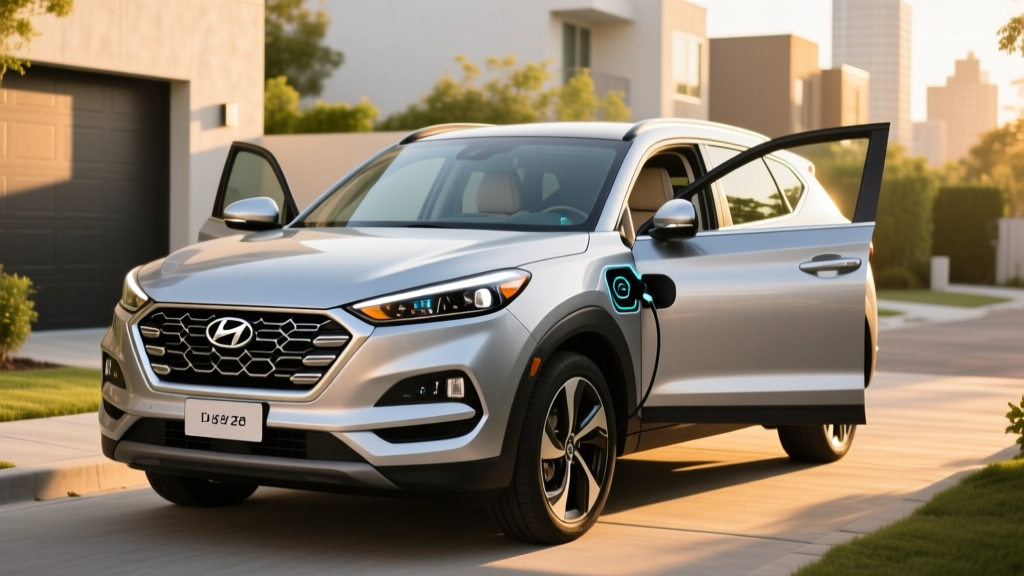
The compact SUV segment is crowded with electrified options, but the 2026 Hyundai Tucson Plug-In Hybrid occupies a specific niche: drivers who want meaningful electric-only commuting range without committing to a full battery-electric vehicle. With an EPA-rated 33 miles of zero-emission driving, 268 combined horsepower, and a starting MSRP around $39,900, the Tucson PHEV targets the buyer whose daily round trip falls under 30 miles but who still needs a gas engine for weekend road trips.
This review breaks down the Tucson PHEV's powertrain, real-world efficiency, charging logistics, tax credit eligibility under current IRS §30D rules, and how it stacks up against both the conventional Tucson Hybrid and full BEV alternatives. We'll also cover the battery warranty and long-term reliability data that hybrid buyers consistently rank as a top purchase concern.
HEV vs PHEV: Which Tucson Hybrid Is Which?
Hyundai sells the Tucson in three powertrain configurations for 2026, and confusing them at the dealership is easy. Here's the distinction:
Tucson Hybrid (HEV)
- No plug required — regenerates energy from braking and engine
- 1.6L turbo + single electric motor, ~231 HP combined
- EPA: 38 city / 38 highway / 38 combined MPG
- Small ~1.5 kWh battery (not externally chargeable)
- No electric-only driving range
- Starting MSRP ~$33,500
- Not eligible for federal EV tax credit
Tucson Plug-In Hybrid (PHEV)
- Plug-in capable — charges from a wall outlet or Level 2 station
- 1.6L turbo + larger electric motor, 268 HP combined
- EPA: 80 MPGe (electric+gas) / 35 MPG combined (gas only)
- 13.8 kWh battery pack (externally chargeable)
- 33 miles EPA electric-only range
- Starting MSRP ~$39,900
- Tax credit eligibility depends on IRS §30D sourcing rules
The conventional HEV is the simpler, more affordable pick if you can't charge at home. The PHEV makes sense only if you have access to a plug — either a standard 120V outlet (Level 1) or a 240V Level 2 charger — and your daily driving stays within that 33-mile electric window most days.
Powertrain and Performance Specs
| Specification | 2026 Tucson PHEV |
|---|---|
| Gas Engine | 1.6L turbocharged 4-cylinder (178 HP) |
| Electric Motor | Permanent-magnet synchronous (98 HP / 195 lb-ft) |
| Combined System Output | 268 HP / 271 lb-ft torque |
| Transmission | 6-speed automatic |
| Drivetrain | HTRAC AWD (standard) |
| Battery Capacity | 13.8 kWh (lithium-ion polymer) |
| EPA Electric-Only Range | 33 miles |
| EPA MPGe (EV mode) | 80 MPGe combined |
| EPA MPG (gas only) | 35 combined (33 city / 37 highway) |
| Total Combined Range | ~420 miles (EV + gas) |
| 0-60 mph | ~7.1 seconds |
| Cargo Volume | 38.7 cu ft (rear seats up) |
| Towing Capacity | 2,000 lbs |
The 268 HP combined output makes the Tucson PHEV the most powerful Tucson variant short of the N Line's tuning. The electric motor delivers its 195 lb-ft of torque instantly from a stop, which gives the PHEV noticeably punchier off-the-line acceleration than the conventional hybrid. The 6-speed automatic is a traditional torque-converter unit — not the dual-clutch found in some earlier Hyundai PHEVs — which trades shift speed for low-speed smoothness, particularly in stop-and-go traffic.
MPGe (miles per gallon equivalent) is the EPA's metric for comparing electric-mode energy consumption to gasoline. At 80 MPGe combined, the Tucson PHEV uses roughly 42 kWh per 100 miles in electric mode. For context, a Tesla Model Y uses about 28 kWh/100mi — PHEVs are inherently less efficient in EV mode because they carry the dead weight of a gas engine and fuel tank.
Electric Range and Charging: What 33 Miles Looks Like in Practice
Real-World Expectation: Plan for 25–30 miles in mixed driving with moderate climate use. In cold weather (below 40°F), expect 20–25 miles due to battery chemistry limitations and cabin heating demand. Highway-only driving at 70+ mph will also reduce range to roughly 22–26 miles. Warm-weather city driving with gentle acceleration can exceed the EPA estimate, reaching 35+ miles.
The 13.8 kWh battery pack provides the Tucson PHEV's 33-mile electric range. That capacity is modest compared to full EVs (which typically carry 60–100 kWh), but it's sufficient for the PHEV's mission: covering a daily commute on electricity while retaining the gas engine for longer trips.
Charging speeds and times:
| Charge Level | Power (kW) | 0–100% Time | Notes |
|---|---|---|---|
| Level 1 (120V household) | ~1.4 kW | ~10 hours | Overnight from a standard outlet; adequate if you drive <30 mi/day |
| Level 2 (240V) | 7.2 kW | ~2 hours | Requires home Level 2 station or public L2; recommended for daily use |
| DC Fast Charge | N/A | N/A | Not supported — no DC fast-charge port on Tucson PHEV |
The lack of DC fast charging is standard for PHEVs in this class — the small battery doesn't justify the added cost and weight of DC hardware. A 7.2 kW Level 2 onboard charger means a full recharge in roughly two hours, which is practical for topping up during a workday at an office charger or overnight at home.
If you're installing a Level 2 home charger, expect to budget $500–$800 for the charger hardware (e.g., ChargePoint Home Flex, Emporia Vue) plus $500–$2,000 for electrician labor depending on your panel capacity and run distance. A 240V / 40-amp circuit is ideal for the Tucson PHEV's 7.2 kW acceptance rate. Always have installation scoped by a licensed electrician — panel upgrades (to 200A service) can add $1,500–$3,000 if your home's electrical panel is at capacity.
Fuel Economy Breakdown: EPA Numbers vs Real-World MPG
| Driving Mode | City | Highway | Combined |
|---|---|---|---|
| EV Mode (MPGe) | 86 MPGe | 74 MPGe | 80 MPGe |
| Gas-Only (MPG) | 33 MPG | 37 MPG | 35 MPG |
Real-world MPG observations: The Tucson PHEV's gas-only fuel economy is a strong point. Once the battery is depleted, the 1.6L turbo and electric motor operate as a conventional hybrid, and 35 MPG combined is competitive with the segment. In practice, PHEV owners who charge regularly may use gasoline only for road trips — meaning annual fuel consumption can drop to 200–400 gallons depending on commute patterns.
When driven primarily in EV mode with regular charging, real-world owners report effective "MPG" figures of 70–100+ MPGe — but this metric is highly individual. If your commute is 15 miles each way and you charge at home nightly, you may burn zero gasoline on weekdays. If you frequently drive 60+ mile days without charging, you'll see the EPA's 35 MPG gas-only figure as your baseline.
According to fueleconomy.gov, the Tucson PHEV's annual fuel cost estimate is approximately $1,350 based on 15,000 miles/year and national average energy prices — roughly $500–$700 less per year than a comparable gas-only compact SUV at current fuel prices.
Battery Warranty, Reliability, and Replacement Cost
10 years / 100,000 miles (whichever comes first) for the high-voltage lithium-ion battery pack. Hyundai guarantees the battery will retain sufficient capacity to deliver meaningful electric range; if capacity drops below a defined threshold (typically ~70% State of Health), Hyundai will repair or replace the pack at no cost to the original owner.
Powertrain Warranty: 10 years / 100,000 miles (engine, transmission, electric motor).
New Vehicle Warranty: 5 years / 60,000 miles bumper-to-bumper.
Battery longevity is the number one concern among first-time hybrid and PHEV buyers, and Hyundai's warranty is among the best in the industry. The 10-year/100,000-mile coverage applies to the original owner and, for 2026 models, may transfer to a second owner (with terms reduced to 5 years/60,000 miles upon transfer — confirm with your dealer).
Real-world degradation data: Hyundai's lithium-ion polymer packs have demonstrated strong longevity in the field. Data from fleet and owner reports on previous-generation Tucson and Ioniq PHEVs show typical capacity retention of 90–95% after 5 years and 60,000 miles. The 13.8 kWh pack is relatively small, which means each charge cycle represents a meaningful depth of discharge, but Hyundai's thermal management system and conservative buffer (you never use the full 13.8 kWh — a top and bottom buffer protects the cells) mitigate accelerated wear.
Battery replacement cost: If the battery fails outside warranty coverage, a replacement pack for the Tucson PHEV currently runs approximately $4,000–$6,500 including labor, based on dealer parts pricing. This is significantly less than a full EV battery replacement ($10,000–$20,000+) because the PHEV pack is small. Given the 10-year warranty and strong real-world durability data, out-of-pocket replacement is uncommon.
The conventional hybrid (HEV) Tucson carries a similar battery warranty structure, though its smaller ~1.5 kWh battery is under less stress and replacement cost is lower (~$2,000–$3,500). Per NHTSA data and consumer reliability surveys, Hyundai's hybrid powertrains have shown no systemic failure patterns in recent model years.
Pricing, Trims, and Federal Tax Credit Eligibility
The 2026 Hyundai Tucson Plug-In Hybrid is offered in two trims:
- SEL Convenience: Starting MSRP ~$39,900 (includes destination)
- Limited: Starting MSRP ~$44,500 (includes destination)
The SEL Convenience trim is well-equipped with a 10.25-inch touchscreen, wireless Apple CarPlay/Android Auto, Hyundai SmartSense safety suite (AEB, lane-keeping, adaptive cruise), heated front seats, and the 7.2 kW onboard charger. The Limited adds leather, a panoramic sunroof, ventilated front seats, a surround-view camera, and Hyundai's Digital Key.
Federal tax credit under IRS §30D: This is where PHEV buyers need to pay close attention. The Tucson Plug-In Hybrid meets the battery capacity requirement (≥7 kWh), but eligibility for the full $7,500 credit depends on three variables that change periodically:
- MSRP cap: SUVs must have an MSRP at or below $80,000 — the Tucson PHEV clears this easily.
- Buyer income cap: Modified adjusted gross income must not exceed $150,000 (single), $225,000 (head of household), or $300,000 (joint filing).
- Battery component and critical mineral sourcing: As of 2026, a percentage of battery components must be manufactured or assembled in North America, and a percentage of critical minerals must be sourced from the U.S. or a free-trade-agreement country. These thresholds tighten annually. The Tucson PHEV's battery sourcing has historically qualified for a partial or full credit, but the exact amount ($3,750 or $7,500) depends on the current-year sourcing percentages.
- Point-of-sale transfer: Under current rules, you can transfer the credit to the dealer at purchase, reducing your out-of-pocket cost immediately rather than waiting for a tax refund.
Because sourcing requirements shift and Hyundai's supply chain evolves, verify current eligibility on IRS.gov or ask your dealer for the latest §30D qualification letter before purchase. Never assume the full $7,500 applies — partial credits ($3,750) are common when one of the two sourcing thresholds is met but not the other.
Who Should Buy the Tucson PHEV vs a Full EV or Gas Car?
Choose the Tucson Plug-In Hybrid if:
- Your daily round-trip commute is 20–35 miles and you can charge at home or work
- You take road trips of 200+ miles several times per year and don't want to plan around charging stops
- You want AWD as standard equipment (not available on all EVs at this price)
- You're not ready to commit to a full EV but want to reduce gasoline consumption by 60–80%
- You value Hyundai's 10-year/100,000-mile powertrain and battery warranty
Choose a full EV (e.g., Hyundai Ioniq 5, Tesla Model Y) if:
- You have reliable home Level 2 charging and rarely drive more than 250 miles in a day
- You want to eliminate gasoline entirely and minimize maintenance (no oil changes, no spark plugs)
- You want faster DC charging (150–350 kW) for road trips
- Lower per-mile energy cost is your top priority (electricity at $0.13/kWh ≈ $0.04/mile vs gas at $3.50/gal ≈ $0.12/mile)
Choose the conventional Tucson Hybrid (HEV) if:
- You cannot charge at home (apartment, street parking, no garage outlet)
- You want hybrid efficiency without the PHEV price premium (~$6,000+ more)
- You drive a consistent mix of city and highway miles and don't want to think about plugging in
The Tucson PHEV's ideal owner charges nightly and commutes under 33 miles — effectively driving an EV Monday through Friday and a hybrid on weekends. That pattern can cut annual gasoline use to 150–250 gallons (from ~500 gallons in a gas-only compact SUV), saving $800–$1,200 per year at current fuel prices. Over a 5-year ownership period, those fuel savings offset much of the PHEV's price premium over the conventional hybrid.
Pros and Cons
Pros
- 33-mile electric range covers most daily commutes
- 268 HP makes it the quickest Tucson variant
- Standard HTRAC AWD
- 10-year/100,000-mile battery and powertrain warranty
- Strong gas-only MPG (35 combined) when battery is depleted
- Practical cargo space (38.7 cu ft) not compromised by battery
- Eligible for partial or full §30D federal tax credit (verify sourcing)
Cons
- No DC fast charging — limited to Level 2 (7.2 kW)
- $6,000+ premium over conventional Tucson Hybrid
- Electric range drops significantly in cold weather (~20–25 mi)
- 6-speed automatic less refined than competitors' e-CVT or DCT options
- Tax credit amount uncertain — depends on current sourcing rules
- Electric-only top speed limited (~84 mph) — engine engages under hard acceleration
Frequently Asked Questions
How many MPG does the Tucson Plug-In Hybrid get?
In electric mode, the Tucson PHEV achieves 80 MPGe combined (86 city / 74 highway). Once the battery is depleted and the vehicle operates as a conventional hybrid, it delivers 35 MPG combined (33 city / 37 highway). Real-world results vary: owners who charge daily and commute under 33 miles use very little gasoline, while those who drive longer distances without charging will see gas-only MPG figures near the EPA estimate.
How far can the Tucson PHEV go on electric power only?
The EPA rates the Tucson PHEV at 33 miles of electric-only range. In real-world conditions, expect 25–30 miles in moderate temperatures with mixed driving. Cold weather (below 40°F) reduces this to approximately 20–25 miles due to battery chemistry and cabin heating demands. Gentle city driving in warm conditions can push past 35 miles.
Does the Tucson Plug-In Hybrid qualify for a tax credit?
The Tucson PHEV may qualify for a partial ($3,750) or full ($7,500) federal tax credit under IRS §30D, depending on current battery component sourcing and critical mineral requirements, your income level, and the vehicle's MSRP (which falls well within the $80,000 SUV cap). Eligibility rules tighten annually, so always verify on IRS.gov before purchasing. The credit can be transferred to the dealer at point of sale to reduce your purchase price directly.
Is the Tucson PHEV reliable, and what does a battery replacement cost?
Hyundai's hybrid and PHEV powertrains have demonstrated strong reliability in recent model years, with no widespread failure patterns reported to NHTSA. The high-voltage battery is covered by a 10-year/100,000-mile warranty. Out-of-warranty replacement costs approximately $4,000–$6,500 including labor, though this is rarely needed given the warranty coverage and observed battery longevity. Real-world data suggests 90–95% capacity retention after 5 years and 60,000 miles.
Do I need a special charger for the Tucson PHEV?
You can charge the Tucson PHEV from a standard 120V household outlet (Level 1, ~1.4 kW), which takes about 10 hours for a full charge — sufficient if you drive under 30 miles daily. For faster charging, a 240V Level 2 home station (7.2 kW) fully recharges the battery in approximately 2 hours. No DC fast-charging capability is included, which is standard for PHEVs. A licensed electrician should evaluate your home's electrical panel before installing a Level 2 charger.
Hybrid vs PHEV vs EV — which is right for me?
If you can charge at home and your daily driving is under 35 miles, the PHEV gives you EV-like daily commuting with gas-engine backup for road trips. If you can charge at home and rarely exceed 250 miles in a day, a full EV offers lower per-mile costs and less maintenance. If you cannot charge at home (apartment living, no garage), the conventional hybrid (HEV) delivers strong fuel economy with no lifestyle changes. The Tucson PHEV is the bridge option — best for drivers who want to electrify their commute without range anxiety on longer trips.
Sources: fueleconomy.gov (EPA range and efficiency data), IRS.gov (§30D clean vehicle credit rules), Hyundai Motor America specifications. All pricing and specifications reflect 2026 model year data and are subject to change. Verify tax credit eligibility with a tax professional and current IRS guidance before purchase.