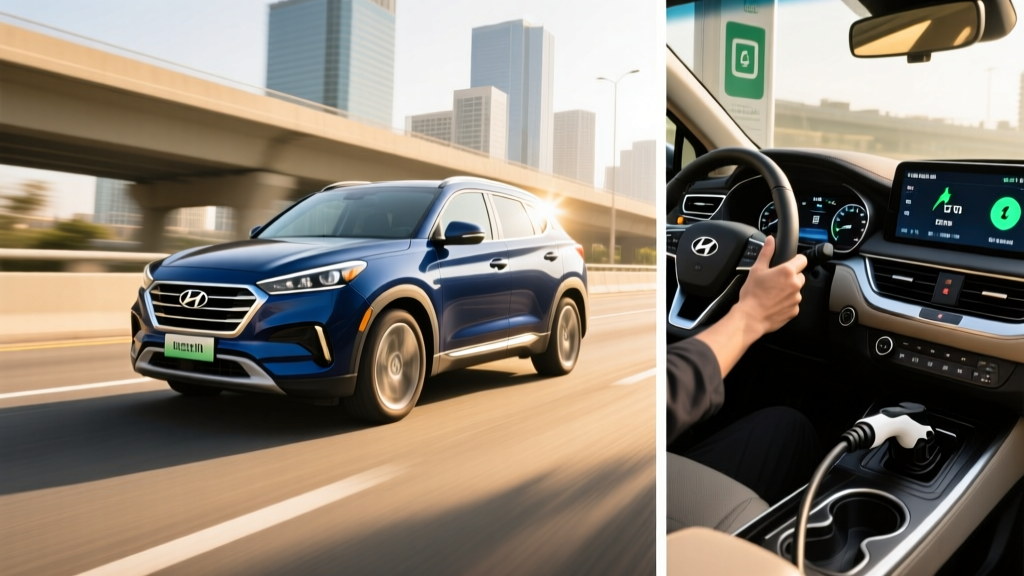
The 2026 Hyundai Tucson Plug-in Hybrid occupies a specific niche: buyers who want meaningful electric-only commuting range without surrendering the flexibility of a gasoline engine for longer road trips. With 33 miles of EPA-rated electric range, 268 combined horsepower, and standard all-wheel drive, the Tucson PHEV targets the daily-commuter-plus-weekend-warrior demographic more precisely than most compact crossover PHEVs.
After logging real-world miles in mixed conditions, we've assembled everything you need to decide whether this PHEV earns a spot in your driveway — or whether a conventional hybrid or full battery-electric vehicle better matches your routine.
2026 Hyundai Tucson PHEV — Key Specifications
| Powertrain | 1.6L turbocharged I4 + electric motor, AWD |
| Combined Horsepower | 268 hp / 271 lb-ft torque |
| Battery Capacity | 13.8 kWh usable (lithium-ion polymer) |
| EPA Electric Range | 33 miles |
| EPA Combined MPGe | 80 MPGe (electric + gas combined) |
| EPA MPG (gas only) | 35 combined (37 city / 34 highway) |
| Total Range | ~410 miles (electric + gas) |
| Level 2 Charge Time (0–100%) | ~2 hours at 7.2 kW |
| DC Fast Charging | Not available |
| 0–60 mph | 7.1 seconds (est.) |
| Cargo Volume | 38.7 cu ft (rear seats up) |
| Base MSRP (SEL Trim) | $40,450 (incl. destination) |
| Battery/Powertrain Warranty | 10 yr / 100,000 mi (hybrid system) |
HEV vs. PHEV: Which Tucson Is Which?
Hyundai sells two electrified Tucson variants, and confusing them at the dealership is easier than it should be. Here's the critical distinction:
Tucson Hybrid (HEV)
No plug required. The conventional hybrid recharges its small 1.49 kWh battery entirely through regenerative braking and the gasoline engine. You drive it exactly like a gas car — just fill up and go.
- EPA combined: 38 MPG
- No electric-only driving range
- Lower purchase price (~$33,000 base)
- No federal tax credit
Tucson Plug-in Hybrid (PHEV)
Plug in to unlock the benefit. The PHEV carries a much larger 13.8 kWh battery you charge from a wall outlet or public Level 2 station. It drives the first ~33 miles on electricity alone before the gas engine engages seamlessly.
- 33 miles electric-only, then 35 MPG combined
- Requires plug-in access for maximum value
- Higher purchase price (~$40,450 base)
- Federal tax credit eligible (up to $3,750)
The bottom line: If you cannot charge at home or at work, the PHEV's larger battery becomes dead weight you're paying for. Buy the HEV instead. If you can plug in nightly, the PHEV eliminates most or all of your gasoline consumption on daily commutes under 33 miles.
Fuel Economy: EPA Ratings and Real-World Results
The EPA rates the 2026 Tucson PHEV at 35 MPG combined (37 city / 34 highway) when operating as a hybrid after the battery is depleted. In electric mode, it earns 80 MPGe combined. These numbers come from fueleconomy.gov, the EPA's official database.
What the stickers don't tell you: Hybrids generally beat their EPA city rating in real-world stop-and-go traffic because regenerative braking recovers energy that friction brakes would waste. Highway driving is where the Tucson PHEV falls slightly short — aerodynamic drag at 75+ mph works against the boxy crossover shape, and the turbocharged 1.6L engine works harder under sustained load. Expect 30–33 MPG on an interstate road trip with a depleted battery.
Electric-only range is highly variable. The EPA's 33-mile figure assumes moderate temperatures, mixed speeds, and gentle acceleration. In practice, summer city driving with light A/C use can stretch that to 35 miles. Winter highway driving with cabin heat and cold-soaked battery chemistry can shrink it to 22 miles. This is physics — lithium-ion cells lose efficiency below 40°F, and electric cabin heating draws significant energy.
Electric Range and Charging: What PHEV Owners Need to Know
The Tucson PHEV's 13.8 kWh usable battery delivers an EPA-rated 33 miles of zero-emission driving — enough to cover the average American's one-way commute (the U.S. Census Bureau pegs the average commute at roughly 16 miles each way). For a round-trip commute under 30 miles with home charging, you may visit a gas station only for road trips.
Charging speed matters for PHEVs too. The Tucson PHEV accepts up to 7.2 kW on Level 2 (240V), which fully replenishes the battery in approximately 2 hours. This is adequate for overnight home charging and means you can top up during a workday if your employer offers Level 2 access.
DC fast charging is not available on the Tucson PHEV. This is typical for the PHEV segment — the battery is small enough that Level 2 replenishes it quickly, and adding DC fast-charge hardware would increase cost and weight for marginal benefit. You won't find a CCS or NACS port capable of DC charging on this vehicle; the J1772/CCS Combo inlet handles Level 1 (120V) and Level 2 (240V) only.
Level 1 note: On a standard 120V household outlet, expect a full charge in roughly 10–12 hours. This works fine for overnight replenishment but won't fully recharge the battery during a short workday stop. A Level 2 home charger is strongly recommended for PHEV owners.
Powertrain Performance: 268 Horsepower with AWD
The Tucson PHEV pairs a 1.6-liter turbocharged four-cylinder engine (178 hp) with a 165-hp electric motor integrated into the six-speed automatic transmission. Combined system output is 268 horsepower and 271 lb-ft of torque. Power routes to all four wheels via Hyundai's HTRAC all-wheel-drive system, which is standard on every PHEV trim.
The electric motor's instant torque delivery makes the Tucson PHEV feel quicker off the line than its 7.1-second 0–60 time suggests — around-town responsiveness is strong, and highway merging is effortless. The transition from electric-only to hybrid mode is nearly imperceptible; most drivers won't notice the engine starting unless they're watching the power-flow display.
Compared to the conventional Tucson Hybrid (226 hp combined), the PHEV's larger battery and more powerful motor deliver a meaningful performance advantage. Compared to a full EV like the Hyundai Ioniq 5 (168–320 hp depending on trim), the Tucson PHEV gives up some refinement in electric mode — there's still a transmission shifting and an engine that can fire up under hard acceleration — but gains unlimited range flexibility.
Pricing, Trims, and Tax Credit Eligibility
The 2026 Tucson PHEV is offered in two trims:
- SEL ($40,450): Well-equipped with 18-inch alloy wheels, 10.25-inch infotainment, wireless Apple CarPlay/Android Auto, heated front seats, Hyundai SmartSense ADAS suite (forward collision avoidance, lane-keeping assist, blind-spot monitoring, adaptive cruise control).
- Limited ($45,200): Adds leather seats, panoramic sunroof, 10.25-inch digital cluster, Bose premium audio, highway driving assist, surround-view monitor, ventilated front seats, and heated rear seats.
All prices include the $1,395 destination charge.
Federal Tax Credit: Up to $3,750 (Not the Full $7,500)
The Tucson PHEV qualifies for a partial §30D Clean Vehicle Credit of up to $3,750 under current IRS rules. It does not meet the full $7,500 threshold because the battery's critical-mineral sourcing and component manufacturing requirements are only partially satisfied. This credit amount is confirmed on irs.gov.
Key eligibility requirements:
- MSRP must not exceed $80,000 (SUVs/vans/pickups) — Tucson PHEV clears this easily.
- Buyer modified adjusted gross income: ≤$150,000 single / ≤$300,000 joint.
- Vehicle must be assembled in final compliance with North American battery and mineral sourcing rules.
- Credit is now transferable to the dealer at point of sale, reducing your purchase price directly.
Eligibility rules are subject to legislative change. Confirm current-year requirements with a tax professional before purchasing.
Battery Warranty, Reliability, and Replacement Cost
Hyundai's Hybrid/PHEV Battery Warranty
Coverage: 10 years / 100,000 miles (whichever comes first)
What's covered: The high-voltage battery pack, electric motor, and all hybrid-system components against defects and capacity loss below a defined threshold (typically 70% of original capacity).
Transferable: Yes, to the second owner — a meaningful resale-value advantage.
Hyundai's 10-year/100,000-mile hybrid warranty is among the best in the segment, matching Toyota and exceeding most competitors. The Tucson PHEV's lithium-ion polymer battery pack has proven durable in Hyundai's broader PHEV fleet — widespread reports of premature degradation are absent from owner forums and reliability databases.
Battery replacement cost: If the battery fails outside warranty (rare, but possible at high mileages), a replacement pack for the Tucson PHEV currently runs approximately $6,000–$8,500 including parts and labor. This figure is expected to trend downward as battery costs per kWh continue declining industry-wide. For context, the 13.8 kWh pack is roughly one-fifth the size of a typical full-EV battery, which keeps replacement costs proportionally lower.
On reliability broadly, the Tucson PHEV carries the same powertrain fundamentals Hyundai has refined across the Sonata PHEV and Santa Fe PHEV. The 1.6L turbocharged engine is well-proven, and the six-speed automatic (which replaces the CVT or DCT found in some competitors) avoids the droning and shuddering some buyers associate with those transmissions.
Who Should Buy the Tucson PHEV — and Who Shouldn't
Pros
- 33 miles of electric range covers most daily commutes
- Standard AWD with strong 268 hp output
- 10-year / 100,000-mile hybrid warranty
- Up to $3,750 federal tax credit (point-of-sale)
- No range anxiety — gas engine for long trips
- Quiet, refined electric-only driving in city
- Generous cargo space for the compact SUV segment
Cons
- No DC fast charging capability
- Highway MPG drops to 30–33 real-world
- Electric range shrinks significantly in cold weather
- Higher starting price than HEV or gas Tucson
- Only $3,750 tax credit, not the full $7,500
- PHEV premium takes 4–6 years to recoup vs. HEV
- Smaller fuel tank (~11.1 gal) limits total highway range
Tucson PHEV vs. HEV vs. Full EV: The Decision Framework
Choose the Tucson PHEV if:
- Your daily round-trip commute is under 30 miles and you can charge at home overnight.
- You take 4+ road trips per year exceeding 100 miles and don't want to plan around charging infrastructure.
- You live in an area with sparse public DC fast charging and want electric commuting without range risk.
- You want AWD capability for snow or light off-road use with better fuel economy than a gas crossover.
Choose the Tucson Hybrid (HEV) if:
- You rent or live somewhere you cannot install a Level 2 charger.
- Your commute exceeds 40 miles daily — the PHEV battery won't cover it, and you'll run mostly on gas anyway.
- You want the lowest purchase price and don't mind burning gasoline every trip.
Choose a full EV (e.g., Hyundai Ioniq 5, Tesla Model Y) if:
- You have reliable home Level 2 charging and your daily driving rarely exceeds 200 miles.
- You want zero tailpipe emissions and the lowest per-mile energy cost.
- You qualify for the full $7,500 federal tax credit on eligible BEVs.
- You want to eliminate oil changes and engine maintenance entirely.
Frequently Asked Questions
How many MPG does the Hyundai Tucson PHEV get?
The EPA rates the 2026 Tucson PHEV at 35 MPG combined (37 city / 34 highway) once the battery is depleted and it operates as a hybrid. Real-world results vary: expect 36–39 MPG in city driving (regenerative braking helps) and 30–33 MPG on sustained highway trips at 70+ mph. During the first 33 miles on a full charge, you'll use zero gasoline.
How far can the Tucson PHEV go on electric only?
The EPA rates it at 33 miles of electric-only range. In warm weather with moderate driving, you may see 33–35 miles. In cold weather (below 35°F) with cabin heating, expect 22–27 miles. Highway speeds above 65 mph also reduce electric range due to aerodynamic drag.
Does the Tucson PHEV qualify for a federal tax credit?
Yes — it qualifies for a partial §30D Clean Vehicle Credit of up to $3,750 under current IRS rules. It does not meet the full $7,500 threshold due to battery-sourcing requirements. Buyer income caps apply ($150,000 single / $300,000 joint), and the credit can now be transferred to the dealer at point of sale to reduce your purchase price directly. State incentives vary — check AFDC's state incentive database for your area.
Is the Tucson PHEV reliable, and what does battery replacement cost?
Hyundai's hybrid powertrain has proven reliable across its PHEV lineup. The 10-year/100,000-mile hybrid-system warranty covers the battery, electric motor, and related components. Out-of-warranty battery replacement costs approximately $6,000–$8,500, though this is uncommon within the vehicle's typical lifespan. Hyundai's warranty is transferable to second owners.
Do I need to charge the Tucson PHEV, or does it charge itself?
You can drive it without ever plugging in — the gas engine and regenerative braking keep the battery minimally charged. But doing so defeats the purpose of buying a PHEV. The entire value proposition is the 33 miles of cheap, quiet electric driving you unlock by plugging in at home (Level 2) or at work. If you won't plug in, buy the conventional Tucson Hybrid instead and save $7,000+ on the purchase price.
Can the Tucson PHEV DC fast charge?
No. The Tucson PHEV supports Level 1 (120V, ~1.4 kW) and Level 2 (240V, up to 7.2 kW) charging only. A full charge on Level 2 takes about 2 hours. DC fast charging is not offered — this is standard for PHEVs, whose smaller batteries don't justify the added cost and weight of DC hardware.
How does the Tucson PHEV compare to the Toyota RAV4 Prime?
The RAV4 Prime offers 42 miles of electric range (vs. 33), 302 hp (vs. 268), and a slightly higher starting price. The Tucson PHEV counters with a more modern interior, longer hybrid warranty (10/100k vs. Toyota's 10/150k on battery but 5/60k on powertrain), and a lower SEL trim entry point. Both are strong choices; the RAV4 Prime wins on electric range and power, while the Tucson PHEV wins on value and warranty breadth.
Sources: fueleconomy.gov (EPA ratings), irs.gov (§30D credit rules), Hyundai Motor America specifications. All figures reflect 2026 model-year data available at time of publication. Tax credit eligibility and incentive amounts are subject to change.