Hyundai Tucson Hybrid Reliability: What Buyers Need to Know
The Hyundai Tucson has been one of the best-selling compact SUVs in the U.S., and its hybrid variants give buyers a way to cut fuel costs without the range compromises of a full battery-electric vehicle. But as with any hybrid, the central question goes beyond fuel economy: how reliable is the system over 5, 8, or 10 years, and what happens if the battery needs replacement?
This guide covers the 2026 Hyundai Tucson Hybrid (HEV) and Tucson Plug-in Hybrid (PHEV) — their real-world MPG, powertrain durability, battery warranty protections, and whether either version qualifies for federal tax credits under current IRS §30D rules.
HEV vs. PHEV: Understanding the Two Tucson Hybrids
Hyundai sells the Tucson in two electrified forms, and confusing them is a common buyer mistake. Here's the fundamental difference:
Conventional Hybrid (HEV)
- No plug required — the battery charges via regenerative braking and the gasoline engine
- Small battery (~1.5 kWh) assists the engine for better MPG
- Cannot drive on electric power alone at meaningful speeds or distances
- Lower purchase price, simpler ownership (no home charger needed)
Plug-in Hybrid (PHEV)
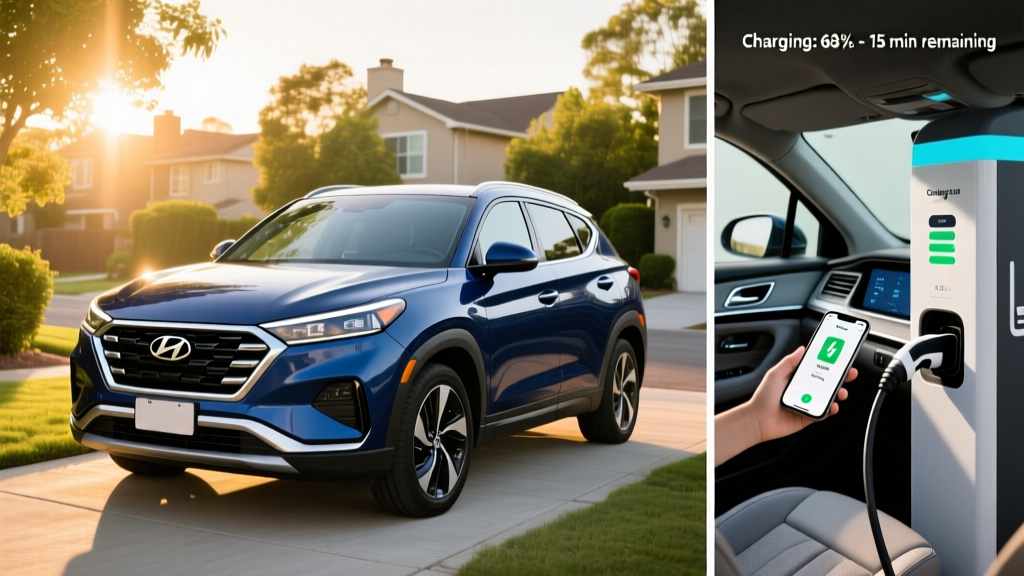
- Must be plugged in to access full electric-only range
- Larger battery (~13.8 kWh usable) enables 30+ miles of zero-gas driving
- Can be charged at home (Level 1 or Level 2) but cannot DC fast charge
- Higher purchase price; may qualify for federal tax credit
If you never want to think about charging, the HEV is the right call. If you have home charging access and a short commute, the PHEV lets you drive most weekdays on electricity while retaining the gas engine for road trips.
Fuel Economy: EPA MPG and Real-World Results
The Tucson Hybrid's fuel economy is where it earns its keep. Here are the EPA-estimated figures for both variants:
| Metric | Tucson Hybrid (HEV) | Tucson Plug-in Hybrid (PHEV) |
|---|---|---|
| City MPG | 38 MPG | 35 MPG (gas engine) |
| Highway MPG | 38 MPG | 35 MPG (gas engine) |
| Combined MPG | 38 MPG | 35 MPG (gas engine) |
| MPGe (PHEV electric mode) | N/A | 80 MPGe |
| Electric-only range | N/A | 33 miles |
| Total range (gas + electric) | ~490 miles | ~420 miles |
Real-world MPG vs. EPA: Conventional hybrids like the Tucson HEV tend to match or exceed their EPA city estimates in stop-and-go traffic because regenerative braking recovers more energy at lower speeds. On the highway, however, expect slightly lower numbers — around 34–36 MPG at sustained 70+ mph speeds, especially with all-wheel drive engaged. In cold weather (below 30°F), fuel economy drops roughly 10–15% due to engine warm-up cycles and reduced battery efficiency.
The PHEV's 33-mile electric-only range (EPA-estimated) is realistic for moderate-temperature city driving. In winter, expect closer to 25–28 miles before the gasoline engine kicks in. Once the battery is depleted, the PHEV operates as a conventional hybrid, though its slightly lower MPG (35 combined vs. the HEV's 38) reflects the added weight of the larger battery pack.
Powertrain Specs: What's Under the Hood
| Specification | Tucson Hybrid (HEV) | Tucson Plug-in Hybrid (PHEV) |
|---|---|---|
| Engine | 1.6L turbocharged 4-cylinder | 1.6L turbocharged 4-cylinder |
| Electric motor | 47.7 kW (64 hp) | 66.9 kW (90 hp) |
| Combined system output | 232 hp / 271 lb-ft torque | 268 hp / 271 lb-ft torque |
| Transmission | 6-speed automatic | 6-speed automatic |
| Drivetrain | AWD (standard) | AWD (standard) |
| 0–60 mph | ~7.1 seconds | ~6.8 seconds |
| Traction battery (usable) | ~1.5 kWh (Li-ion) | ~13.8 kWh (Li-ion polymer) |
| Level 2 charging time (PHEV) | N/A | ~2 hours (7.2 kW onboard charger) |
| DC fast charging (PHEV) | N/A | Not supported |
Both powertrains pair a turbocharged 1.6-liter engine with an electric motor integrated into the transmission housing. The PHEV's larger motor (90 hp vs. 64 hp) gives it a noticeably stronger electric-only acceleration feel, and the combined 268 hp makes it the quickest Tucson variant short of the N Line performance model.
One note on PHEV charging: the Tucson PHEV uses a standard J1772 connector for Level 1 (120V household outlet, ~8 hours for a full charge) or Level 2 (240V, ~2 hours). It does not support DC fast charging — this is typical for PHEVs in this class, since the small battery makes DCFC infrastructure cost-prohibitive.
Hyundai Tucson Hybrid Reliability: Battery and Powertrain Longevity
Reliability is the top concern for hybrid buyers, and it breaks down into two categories: general vehicle reliability and hybrid-specific component durability.
General reliability: The current-generation Tucson (introduced for the 2022 model year) has shown average to slightly above-average reliability in surveys from Consumer Reports and J.D. Power. The 1.6L turbocharged engine and 6-speed automatic transmission are proven components shared across Hyundai's lineup, including the Elantra and Sonata hybrids, which have demonstrated strong long-term durability.
Hybrid battery reliability: Hyundai's hybrid battery packs have a strong track record. The company has been building hybrids since the 2011 Sonata Hybrid, and widespread battery failures in Hyundai hybrids are uncommon. The lithium-ion cells used in both the HEV and PHEV Tucson are designed for shallow cycling — the HEV battery, in particular, rarely charges above 60% or below 40% state of charge, which dramatically extends cell life.
Hyundai Hybrid Battery Warranty
- Hybrid/EV battery: 10 years / 100,000 miles (whichever comes first)
- Hybrid system components: 10 years / 100,000 miles (motor, inverter, onboard charger)
- Powertrain warranty: 10 years / 100,000 miles (engine, transmission)
- New vehicle limited warranty: 5 years / 60,000 miles
- Capacity retention threshold: Hyundai typically covers the hybrid battery if it drops below ~70% of original capacity within the warranty period
This 10-year/100,000-mile hybrid battery warranty is one of the strongest in the industry — Toyota covers its hybrid batteries for 10 years/150,000 miles on newer models, but Hyundai's overall package (including the hybrid system components and powertrain) is comprehensive and competitive.
Battery replacement cost: If the hybrid battery fails outside of warranty, replacement costs for the Tucson HEV battery typically range from $2,000 to $3,500 (parts and labor). The PHEV's larger battery is more expensive — estimated at $4,500 to $6,500. However, given the 10-year warranty and the proven longevity of Hyundai's hybrid cells, most owners will never face this cost. Individual module replacement (rather than the full pack) may also be possible at lower cost.
Pricing, Trims, and Federal Tax Credit Eligibility
| Trim | Tucson Hybrid MSRP | Tucson PHEV MSRP |
|---|---|---|
| Blue (base) | ~$34,460 | N/A |
| SEL Convenience | ~$36,710 | ~$40,940 |
| Limited | ~$41,160 | ~$46,590 |
| N Line | N/A | ~$44,140 |
Prices shown are approximate 2026 MSRP including destination charge. Verify current pricing at Hyundai's official site.
Does the Tucson Hybrid qualify for a federal tax credit?
Tucson HEV (conventional hybrid): No. The federal §30D clean vehicle credit applies only to plug-in electric vehicles with a battery capacity of at least 7 kWh. Conventional hybrids do not qualify.
Tucson PHEV: Eligibility depends on several factors under current IRS rules:
- MSRP cap: SUVs must have an MSRP at or below $80,000 — all Tucson PHEV trims qualify
- Buyer income cap: Modified AGI must not exceed $150,000 (single), $225,000 (head of household), or $300,000 (joint filers)
- Battery sourcing: The vehicle must meet critical minerals and battery component requirements that phase in annually through 2032 — verify current-year compliance on IRS.gov §30D guidance
- Point-of-sale transfer: Buyers can transfer the credit to the dealer at purchase, reducing the upfront cost rather than waiting for a tax refund
- Assembly: The Tucson is assembled in South Korea, which may affect eligibility depending on current-year commercial-use and sourcing rules
Because battery sourcing requirements tighten each year and the Tucson PHEV is built outside North America, verify eligibility with your dealer and a tax professional before purchase. The credit amount, if eligible, can be up to $7,500 but is not guaranteed for every buyer or every model year.
Who Should Choose the Tucson Hybrid vs. a PHEV or Full EV?
Choose the Tucson HEV If:
- You want better MPG without changing your fueling habits
- You don't have access to home or workplace charging
- You want the lowest purchase price among Tucson electrified models
- You regularly drive long distances and don't want to plan around charging
- You live in an area with limited public charging infrastructure
Choose the Tucson PHEV If:
- You have reliable Level 2 home charging (garage or driveway)
- Your daily commute is under 30 miles round-trip
- You want to drive mostly on electricity but need gas-engine flexibility for road trips
- You may qualify for the §30D tax credit, offsetting the higher MSRP
- You want the quickest Tucson variant (268 hp combined)
Consider a full EV (like the Hyundai Ioniq 5) if: You drive under 250 miles daily, have home charging, want zero tailpipe emissions, and are ready to forgo the gas engine entirely. Full EVs have lower per-mile fuel costs and less maintenance, but require more upfront planning for road trips.
Frequently Asked Questions
How many MPG does the Hyundai Tucson Hybrid get in real-world driving?
The EPA rates the Tucson HEV at 38 MPG combined (38 city/38 highway). In real-world mixed driving, most owners report 35–40 MPG depending on conditions. City driving with frequent stops often yields higher numbers thanks to regenerative braking. Sustained highway driving above 70 mph typically returns 34–36 MPG. Cold weather reduces efficiency by 10–15%.
How far can the Tucson PHEV go on electric power alone?
The EPA estimates 33 miles of electric-only range for the Tucson PHEV. In warm weather with moderate acceleration, you may see 30–35 miles. In cold weather or with aggressive driving, expect 25–28 miles before the gas engine engages. Once the battery depletes, the PHEV functions as a conventional hybrid at approximately 35 MPG combined.
Is the Hyundai Tucson Hybrid reliable long-term?
Hyundai's hybrid powertrains have demonstrated strong reliability over more than a decade of production. The 10-year/100,000-mile hybrid battery and system warranty provides substantial protection. Major hybrid component failures are rare, and the 1.6L turbo engine is a proven design shared across multiple Hyundai models. The Tucson specifically has earned average to above-average reliability scores from major consumer testing organizations.
What does it cost to replace the Tucson Hybrid battery?
Out-of-warranty replacement for the Tucson HEV battery runs approximately $2,000–$3,500. The PHEV's larger battery costs roughly $4,500–$6,500. However, Hyundai's 10-year/100,000-mile warranty covers battery defects and significant capacity loss, and real-world data shows Hyundai hybrid batteries frequently last well beyond the warranty period without needing replacement.
Does the Tucson Hybrid require plug-in charging?
No. The conventional Tucson Hybrid (HEV) charges its small battery entirely through regenerative braking and the gasoline engine — you never plug it in. Only the Tucson Plug-in Hybrid (PHEV) requires plugging in to access its 33-mile electric-only range. If you don't plug in a PHEV, it still functions as a regular hybrid, but you lose the efficiency and cost benefits of electric-only driving.
Which is more reliable: Tucson Hybrid or Tucson PHEV?
Both share the same 1.6L turbo engine and 6-speed automatic transmission, so mechanical reliability is similar. The PHEV's larger battery and more powerful electric motor add complexity but also come with the same 10-year/100,000-mile warranty. The HEV has fewer electrified components overall, which marginally reduces the number of potential failure points — but there is no significant reliability gap between the two in practice.
Sources: EPA fuel economy data via fueleconomy.gov, Hyundai USA official specifications, IRS §30D clean vehicle credit guidance at irs.gov.