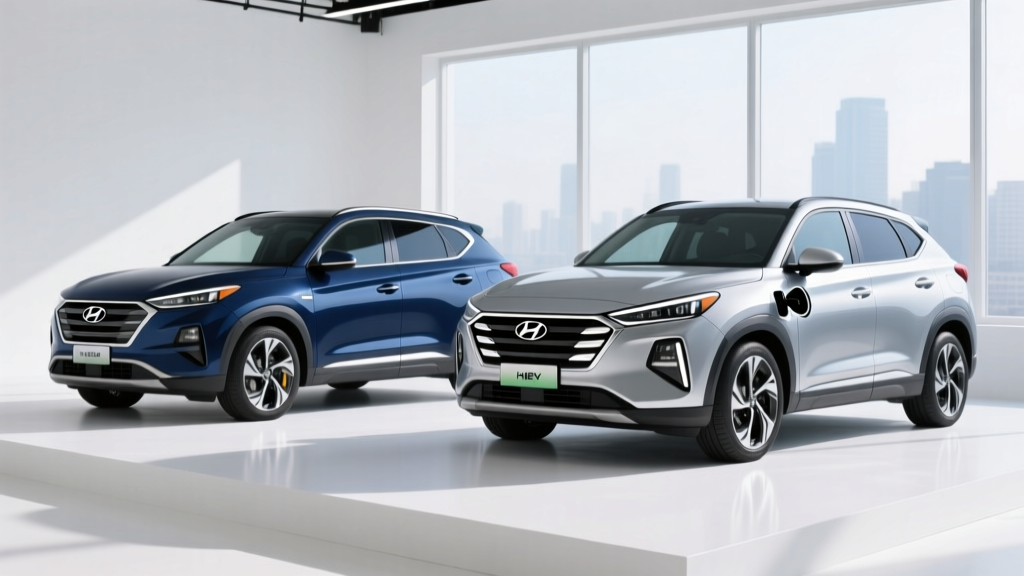
If you're shopping for a compact SUV that sips fuel without requiring a lifestyle change around charging, the Hyundai Tucson hybrid lineup deserves a long look. Hyundai offers the Tucson in two electrified flavors: a conventional hybrid (HEV) that never needs plugging in, and a plug-in hybrid (PHEV) that can handle most daily commutes on electricity alone. Both share the same practical cabin, strong safety ratings, and Hyundai's generous warranty — but they serve very different drivers.
This guide breaks down the 2026 Hyundai Tucson Hybrid and Tucson PHEV with exact EPA numbers, real-world efficiency expectations, powertrain specs, pricing, and tax-credit eligibility so you can pick the right one.
Hyundai Tucson HEV vs PHEV: What's the Difference?
Before we get into the numbers, let's clear up the fundamental distinction — it's the single most important decision you'll make here.
Tucson Hybrid (HEV)
- No plug required. The battery charges via regenerative braking and the gasoline engine.
- Smaller battery: ~1.49 kWh lithium-ion pack.
- How it saves fuel: The electric motor assists the gas engine during acceleration and enables electric-only driving at low speeds.
- Best for: Drivers who want better MPG without changing their fueling habits.
Tucson Plug-In Hybrid (PHEV)
- Plug-in capable. Charges from a wall outlet or charging station for electric-only driving.
- Larger battery: 13.8 kWh usable lithium-ion pack.
- How it saves fuel: Delivers 33 miles of zero-gas driving before the hybrid system takes over seamlessly.
- Best for: Drivers with home charging and commutes under ~30 miles who want EV-like daily driving with gas-car road-trip freedom.
Neither version requires you to plug in to operate — the PHEV simply works as a regular hybrid once its electric range is depleted. But if you never plug in the PHEV, you're carrying dead battery weight and paying a premium for capability you're not using.
Fuel Economy: EPA MPG and Real-World Numbers
Here's how the two Tucson electrified models stack up on the EPA cycle, per fueleconomy.gov:
| Metric | Tucson Hybrid (HEV) AWD | Tucson PHEV AWD |
|---|---|---|
| City MPG | 38 MPG | 35 MPG (charge-sustaining) |
| Highway MPG | 38 MPG | 35 MPG (charge-sustaining) |
| Combined MPG | 38 MPG | 35 MPG (charge-sustaining) |
| Combined MPGe (PHEV electric mode) | N/A | 80 MPGe |
| Electric-only range | N/A | 33 miles |
| Total range (gas + electric) | ~430 miles | ~400+ miles |
| Fuel tank | 11.1 gal | 11.1 gal |
Real-World MPG: What to Actually Expect
Hybrids have a well-documented tendency to exceed their EPA city ratings in stop-and-go driving because regenerative braking recaptures energy that a gas car wastes as heat. In real-world testing, the Tucson Hybrid routinely returns 40-42 MPG in city driving during mild weather. Highway driving at 70+ mph typically drops to 33-36 MPG, since the electric motor contributes less at sustained high speeds and aerodynamic drag dominates.
For the PHEV, your real-world fuel consumption depends entirely on your commute. A driver with a 20-mile round trip and nightly home charging might go weeks without visiting a gas station. A driver who never plugs in will see roughly 33-35 MPG — slightly worse than the HEV due to the heavier battery pack.
Powertrain Specs: Horsepower, Engine, and Motors
| Specification | Tucson Hybrid (HEV) | Tucson PHEV |
|---|---|---|
| Engine | 1.6L turbocharged I-4 | 1.6L turbocharged I-4 |
| Engine output | 178 hp / 195 lb-ft | 178 hp / 195 lb-ft |
| Electric motor | 47.7 kW (64 hp) | 66.9 kW (90 hp) |
| Combined system output | 226 hp / 258 lb-ft | 261 hp / 258 lb-ft |
| Transmission | 6-speed automatic | 6-speed automatic |
| Drivetrain | AWD (standard) | AWD (standard, HTRAC) |
| 0-60 mph (est.) | ~7.5 sec | ~6.8 sec |
| Towing capacity | 2,000 lbs | 2,000 lbs |
The PHEV's larger, more powerful electric motor gives it a meaningful acceleration advantage — 261 combined horsepower makes it the quickest Tucson variant short of the (now-discontinued) N Line performance tune. Both models use a conventional 6-speed automatic rather than a CVT, which gives a more natural driving feel and avoids the rubber-band effect some hybrid buyers dislike.
PHEV Battery, Charging, and Electric-Only Range
The Tucson PHEV's 13.8 kWh usable lithium-ion battery pack sits beneath the rear seats and cargo floor, preserving interior space. Here's what you need to know about charging it:
| Charging Method | Power | Time (0-100%) | Notes |
|---|---|---|---|
| Level 1 (120V household outlet) | ~1.4 kW | ~10 hours | Overnight on a standard plug; adequate for daily top-ups |
| Level 2 (240V home charger) | ~7.2 kW | ~2 hours | Recommended; full charge well before bedtime |
| DC fast charging | Not supported | N/A | No CCS or NACS port — Level 2 max |
Critical note: The Tucson PHEV does not support DC fast charging. This is typical for plug-in hybrids in this class — the battery is small enough that Level 2 replenishes it quickly, and adding DC fast-charge hardware would increase cost and weight for minimal benefit. If you need public fast-charging capability, you're looking at a full EV, not a PHEV.
The charge port uses a standard J1772 connector for Level 1 and Level 2 AC charging, compatible with every public Level 2 station in the U.S.
Pricing, Trims, and Tax Credit Eligibility
| Model / Trim | 2026 MSRP (est.) | Federal Tax Credit |
|---|---|---|
| Tucson Hybrid Blue | $34,490 | Not eligible (§30D requires plug-in) |
| Tucson Hybrid SEL Convenience | $37,290 | Not eligible |
| Tucson Hybrid Limited | $41,090 | Not eligible |
| Tucson PHEV SEL | $40,790 | Up to $3,750* |
| Tucson PHEV Limited | $45,590 | Up to $3,750* |
*Federal tax credit amounts and eligibility under IRS §30D depend on battery component sourcing and critical-mineral requirements, buyer income caps ($150K single / $300K joint), and the $80,000 MSRP cap for SUVs. The Tucson PHEV qualifies for up to $3,750 depending on current battery-sourcing compliance. The conventional Tucson Hybrid does not qualify for the federal clean vehicle credit because it is not a plug-in vehicle. Always confirm eligibility with a tax professional before purchasing — rules change and individual situations vary.
The point-of-sale transfer option allows qualifying buyers to apply the credit as an immediate discount at the dealership rather than waiting for a tax refund, effectively reducing the PHEV's out-of-pocket cost closer to the HEV's price.
Reliability, Battery Warranty, and Replacement Cost
Hyundai Hybrid/PHEV Battery Warranty
- Hybrid battery: 10 years / 100,000 miles (original owner)
- Hybrid system components: 10 years / 100,000 miles
- New vehicle warranty: 5 years / 60,000 miles
- Powertrain warranty: 10 years / 100,000 miles
Hyundai's hybrid battery warranty is among the longest in the industry, matching or exceeding Toyota's 10-year coverage. The warranty covers the battery against defects and capacity loss below a manufacturer-defined threshold.
How Long Will the Battery Last?
Hyundai's hybrid and PHEV battery packs are designed for the life of the vehicle. The HEV's 1.49 kWh pack undergoes shallow charge-discharge cycles (it never fully depletes or fully charges), which dramatically extends cell longevity. Real-world data from Hyundai's hybrid lineup — including the Ioniq Hybrid and Sonata Hybrid — shows minimal degradation over 100,000+ miles.
The PHEV's 13.8 kWh pack sees deeper cycles but still benefits from a substantial buffer (the car reserves a portion of total capacity to prevent deep discharge). Most owners will never need a battery replacement, but out-of-warranty costs for a PHEV battery pack typically run $4,000-$6,500 including labor, based on current Hyundai parts pricing. The HEV's smaller battery is proportionally less expensive to replace, typically $2,000-$3,500.
According to IIHS, the Tucson continues to earn top safety ratings, which supports long-term ownership confidence alongside the powertrain warranty.
Who Should Buy the Tucson Hybrid vs. PHEV vs. Full EV?
Choose the Tucson Hybrid (HEV) if:
- You don't have access to home or workplace charging
- You want maximum simplicity — just fill up at any gas station
- Your budget is under $38,000 and you want the best MPG per dollar
- You drive a mix of city and highway and want consistent ~38 MPG
Choose the Tucson PHEV if:
- You can install a Level 2 charger at home or charge at work
- Your daily round-trip commute is under 30 miles
- You want EV-like daily driving but take road trips where charging infrastructure is uncertain
- You want the quickest Tucson (261 hp) and can leverage the federal tax credit
Choose a full EV (like the Hyundai Ioniq 5) if:
- You have reliable home charging and your trips rarely exceed 250 miles
- You want to eliminate gasoline costs and maintenance entirely
- You qualify for the full $7,500 federal EV tax credit
- You're ready to plan around DC fast charging on road trips
Tucson Hybrid Pros
- 38 MPG combined — excellent for an AWD compact SUV
- No charging infrastructure needed
- Lower starting price than the PHEV
- Strong 10-year/100,000-mile battery warranty
- Spacious cargo area and rear seats
- Smooth 6-speed automatic (no CVT drone)
Tucson Hybrid Cons
- No federal tax credit eligibility
- Highway MPG drops to low-to-mid 30s at 75+ mph
- 226 hp is adequate but not thrilling
- No electric-only commuting capability
Tucson PHEV Pros
- 33 miles electric-only covers most commutes
- 261 hp — quickest Tucson available
- Federal tax credit up to $3,750 (eligibility varies)
- Seamless transition to hybrid mode on longer trips
- Standard HTRAC AWD with multiple terrain modes
Tucson PHEV Cons
- ~$6,000 price premium over the HEV
- No DC fast charging — Level 2 only
- Electric range drops to ~22-25 miles in freezing weather
- Worthless premium if you can't plug in regularly
- Slightly lower cargo volume due to larger battery
Frequently Asked Questions
How many MPG does the Hyundai Tucson Hybrid get?
The 2026 Hyundai Tucson Hybrid AWD is EPA-rated at 38 MPG city, 38 MPG highway, and 38 MPG combined. In real-world city driving with frequent stops, owners commonly report 40-42 MPG thanks to aggressive regenerative braking. Highway cruising at 70-80 mph typically yields 33-36 MPG.
How far can the Tucson PHEV go on electric only?
The EPA rates the Tucson PHEV at 33 miles of electric-only range. In moderate temperatures with mixed city/suburban driving, expect 28-30 real-world miles. Cold weather (below 32°F) and sustained highway speeds can reduce this to 22-25 miles. Once the battery is depleted, the PHEV operates as a conventional hybrid at approximately 35 MPG.
Does the Hyundai Tucson Hybrid qualify for a tax credit?
The conventional Tucson Hybrid (HEV) does not qualify for the federal §30D clean vehicle credit — that credit is reserved for plug-in vehicles. The Tucson PHEV may qualify for up to $3,750 depending on battery-sourcing compliance, your income (capped at $150K single / $300K joint), and the vehicle's MSRP falling under the $80,000 SUV cap. Check the latest IRS guidance and confirm with a tax professional before purchase.
Is the Hyundai Tucson Hybrid reliable?
Hyundai's hybrid powertrain has demonstrated strong reliability across its model range. The Tucson Hybrid and PHEV are backed by a 10-year/100,000-mile hybrid battery and component warranty — one of the longest in the industry. The 1.6L turbocharged engine and 6-speed automatic are proven components shared across the Hyundai-Kia lineup. Long-term battery degradation in Hyundai hybrids has been minimal based on fleet and owner data.
What does a Hyundai Tucson hybrid battery replacement cost?
Out-of-warranty replacement for the Tucson HEV battery pack typically costs $2,000-$3,500. The PHEV's larger 13.8 kWh battery runs $4,000-$6,500 including labor. However, most owners will never need a replacement — Hyundai's 10-year/100,000-mile warranty covers defects and significant capacity loss, and the shallow-cycling design of hybrid batteries is engineered for 150,000+ mile lifespans.
Can I charge the Tucson PHEV at a public charging station?
Yes, but only at Level 2 (AC) public stations using the standard J1772 connector. The Tucson PHEV does not have a DC fast-charging port, so you cannot use CCS, NACS, or CHAdeMO fast chargers. A full Level 2 charge takes approximately 2 hours at 7.2 kW. For most PHEV owners, overnight home charging on a 240V Level 2 unit is the primary and most convenient charging method.
Hybrid vs PHEV vs EV — which Tucson should I get?
If you lack home charging access, the HEV is the clear choice — it requires zero infrastructure and delivers 38 MPG. If you have home charging and a sub-30-mile commute, the PHEV offers the best of both worlds: daily electric driving with gas-engine freedom for road trips. If you're ready to go fully electric and your lifestyle supports it, look at the Hyundai Ioniq 5 or Kia EV6 instead — but the Tucson Hybrid and PHEV are the pragmatic middle ground for buyers who aren't ready to commit to a pure EV.