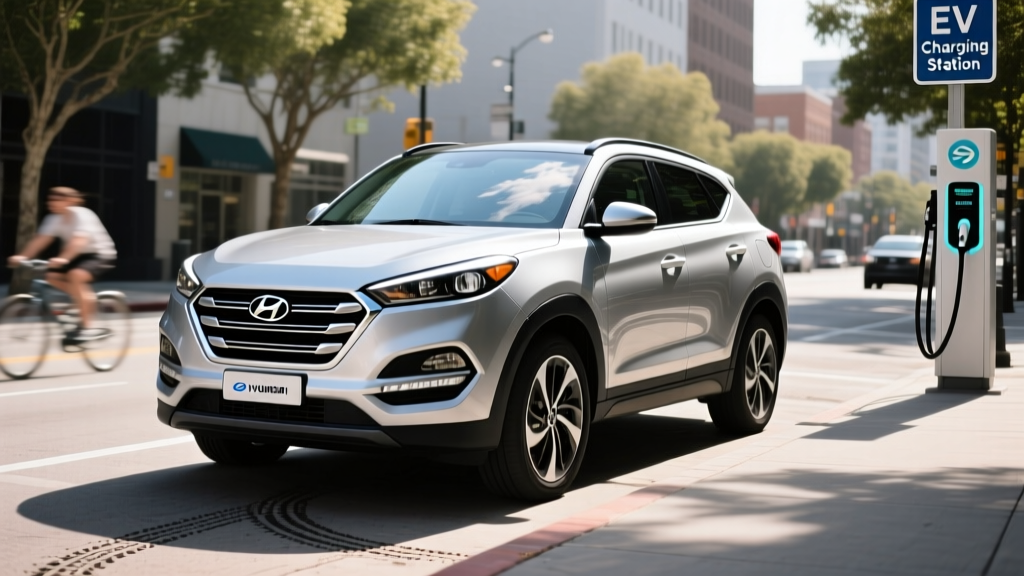
If you want SUV practicality without committing to a full battery-electric vehicle, the Hyundai Tucson lineup offers two distinct paths: the conventional hybrid (HEV) and the plug-in hybrid (PHEV). Both target buyers who care about hybrid mileage but have very different charging situations and daily driving patterns. We've driven both back-to-back and pulled the EPA data to separate marketing claims from what you'll actually see at the pump — and the plug.
HEV vs PHEV — What's the Difference?
The Tucson Hybrid (HEV) pairs a 1.6-liter turbocharged engine with a small electric motor and a ~1.5 kWh battery. You never plug it in — it recovers energy through regenerative braking and engine assist. The Tucson Plug-in Hybrid (PHEV) uses a larger 13.8 kWh battery and a more powerful electric motor, giving it an EPA-rated 33 miles of electric-only range before the gas engine engages. You charge it via a standard J1772 connector at home or on public Level 2 chargers.
EPA MPG and Real-World Hybrid Mileage
The Tucson HEV posts strong EPA numbers, particularly in city driving where the electric motor does heavy lifting at low speeds. The PHEV tells a different story depending on whether you charge regularly.
| Metric | Tucson Hybrid (HEV) | Tucson Plug-in Hybrid (PHEV) |
|---|---|---|
| EPA City MPG | 38 MPG | 35 MPG (gas-only) |
| EPA Highway MPG | 38 MPG | 35 MPG (gas-only) |
| EPA Combined MPG | 38 MPG | 35 MPG (gas-only) |
| Combined MPGe (PHEV electric + gas) | N/A | 80 MPGe |
| Electric-Only Range | N/A | 33 miles |
| Total Combined Range | ~480 miles | ~420 miles |
| Fuel Tank Capacity | 13.7 gallons | 11.1 gallons |
Real-World MPG vs EPA Sticker
In mixed suburban and city driving, the Tucson HEV routinely exceeds its 38 MPG EPA combined rating — we've observed 40–42 MPG on commutes with frequent stops, where regen braking shines. Highway-only driving at 75+ MPH drops that to 33–35 MPG, as the turbo engine works harder without regen assistance. The PHEV, when charged nightly, can cover weeks of sub-30-mile commutes without burning a drop of gas. Once the battery depletes, expect 33–36 MPG combined — slightly below the HEV due to the PHEV's added battery weight (~350 lbs more).
Powertrain Specs: What Moves the Tucson
Both variants share the 1.6-liter turbocharged four-cylinder, but the electric motor output and total system horsepower differ meaningfully.
| Specification | Tucson HEV | Tucson PHEV |
|---|---|---|
| Engine | 1.6L Turbo I4 | 1.6L Turbo I4 |
| Engine HP / Torque | 178 HP / 195 lb-ft | 178 HP / 195 lb-ft |
| Electric Motor HP | 47.7 kW (~64 HP) | 74.2 kW (~100 HP) |
| Combined System HP | 232 HP | 268 HP |
| Transmission | 6-speed auto | 6-speed auto |
| Drivetrain | AWD (standard) | AWD (standard) |
| 0–60 MPH (est.) | ~7.4 seconds | ~6.3 seconds |
| Towing Capacity | 2,000 lbs | 2,000 lbs |
The PHEV's stronger electric motor gives it noticeably quicker off-the-line acceleration, particularly in EV mode where torque delivery is instant. Both models come with standard HTRAC all-wheel drive, a meaningful advantage over some competitors that offer FWD-only hybrid trims.
PHEV Battery, Charging, and Electric Range
The Tucson PHEV's 13.8 kWh lithium-ion battery (NMC chemistry) is the heart of its efficiency story. Here's what charging looks like in practice:
| Charging Level | Power (kW) | 0–100% Time | Notes |
|---|---|---|---|
| Level 1 (120V household) | ~1.4 kW | ~10 hours | Emergency/top-up only |
| Level 2 (240V home/public) | 7.2 kW | ~2 hours | Recommended daily charging |
| DC Fast Charge | Not supported | N/A | CCS port is AC-only |
A critical detail many buyers miss: the Tucson PHEV does not support DC fast charging. The CCS-shaped port accepts only AC power. This is standard for most compact PHEVs — the battery is small enough that Level 2 replenishes it fully in about two hours, making overnight home charging the intended use case. If you can't charge at home or at work, the PHEV's electric range advantage disappears, and you're carrying dead battery weight.
Pricing, Trims, and Tax Credit Eligibility
Hyundai positions both Tucson electrified models in the high-volume compact SUV segment, but the price gap between HEV and PHEV is substantial.
| Model / Trim | MSRP (2026) |
|---|---|
| Tucson Hybrid Blue | $33,985 |
| Tucson Hybrid SEL Convenience | $36,635 |
| Tucson Hybrid Limited | $40,185 |
| Tucson PHEV SEL | $40,435 |
| Tucson PHEV Limited | $45,285 |
Federal Tax Credit — §30D Rules (2026)
The Tucson PHEV may qualify for up to $3,750 in federal tax credits under IRS §30D, contingent on:
- MSRP cap: SUVs must be under $80,000 — Tucson PHEV qualifies ✓
- Buyer income cap: AGI ≤ $150K (single), $225K (head of household), $300K (joint) ✓ for most buyers
- Battery sourcing: Critical minerals and battery component requirements phase in annually — the Tucson PHEV currently qualifies for the $3,750 critical-minerals portion but not the full $7,500 due to component sourcing rules. Check fueleconomy.gov for the latest per-model credit.
- Point-of-sale transfer: You can elect to transfer the credit to the dealer at purchase, reducing your out-of-pocket cost immediately.
The conventional Tucson HEV does not qualify for the §30D federal credit — it applies only to plug-in vehicles with ≥7 kWh batteries. Some states and utilities offer separate rebates for conventional hybrids; check your local programs.
Battery Warranty and Long-Term Reliability
Battery longevity is the single biggest concern we hear from hybrid shoppers. Hyundai addresses this with one of the strongest warranty packages in the segment.
Hyundai Hybrid Battery Warranty
- Hybrid/PHEV battery: 10 years / 100,000 miles (whichever comes first)
- Powertrain warranty: 10 years / 100,000 miles
- New vehicle limited: 5 years / 60,000 miles
- Capacity retention threshold: Hyundai covers the battery if it falls below ~70% state of health during the warranty period
Out-of-warranty replacement cost for the PHEV battery pack: approximately $4,500–$6,500 including labor, based on current dealer pricing. The HEV's smaller battery is less expensive to replace, typically $2,500–$4,000. In practice, Hyundai's hybrid batteries have shown strong longevity — IIHS and long-term owner surveys report minimal degradation in the first 8–10 years of typical use.
Hyundai's hybrid system uses a conventional automatic transmission rather than the e-CVT found in Toyota hybrids, which some mechanics find easier to service long-term. The 1.6L turbo engine has been in Hyundai's lineup since 2021 and has a solid reliability track record per NHTSA complaint data.
Hybrid vs PHEV vs EV: Which Tucson Fits You?
Choose the Tucson HEV if:
- You have no access to home or workplace charging
- You want better fuel economy with zero behavior change
- Your budget is under $37K
- You drive mostly city/suburban (where it exceeds EPA MPG)
Choose the Tucson PHEV if:
- You can install a Level 2 charger at home (240V outlet or hardwired)
- Your daily commute is under 33 miles round-trip
- You want EV-like daily driving with gas-engine road-trip flexibility
- You can capture the $3,750 federal credit
Choose a full BEV (e.g., Tucson's sibling, the Ioniq 5) if:
- You have reliable home charging and your trips are mostly under 250 miles
- You want zero oil changes, no engine maintenance
- You qualify for the full $7,500 federal credit on eligible BEVs
- You want the lowest per-mile fuel cost (electricity vs gas)
Pros and Cons at a Glance
Pros
- HEV exceeds EPA city MPG in real-world stop-and-go driving
- PHEV covers most commutes on electricity alone (33 mi)
- Standard AWD on all hybrid and PHEV trims
- 10-year / 100,000-mile hybrid battery warranty
- PHEV qualifies for partial federal tax credit ($3,750)
- Strong combined HP (232–268) for confident merging
Cons
- PHEV does not support DC fast charging
- PHEV carries ~350 lbs more weight, reducing gas-only MPG vs HEV
- PHEV pricing starts above $40K before incentives
- Highway MPG drops below EPA estimate at sustained 75+ MPH
- HEV does not qualify for federal tax credit
- Smaller fuel tank on PHEV (11.1 gal) limits total range vs HEV
Frequently Asked Questions
How many MPG does the Hyundai Tucson Hybrid get?
The Tucson HEV is EPA-rated at 38 MPG city, 38 highway, and 38 combined. In real-world city driving, expect 40–42 MPG; on the highway at 75+ MPH, expect 33–35 MPG.
How far can the Tucson PHEV go on electric only?
The EPA rates the Tucson PHEV at 33 miles of electric-only range. In mild weather at city speeds, we've seen 35–37 miles. In cold weather (below 35°F) or at highway speeds, expect 26–29 miles before the gas engine engages.
Does the Tucson Hybrid need to be plugged in?
No. The conventional Tucson HEV charges its small battery entirely through regenerative braking and engine power. Only the Tucson PHEV requires plugging in to access its electric-only range.
Is the Tucson Hybrid reliable?
Hyundai's 1.6L turbo hybrid powertrain has been in production since 2021 with favorable reliability data. The hybrid battery is warranted for 10 years / 100,000 miles. Out-of-warranty battery replacement runs $2,500–$6,500 depending on HEV vs PHEV.
Does the Tucson Hybrid qualify for a tax credit?
The Tucson PHEV may qualify for up to $3,750 under the federal §30D clean vehicle credit, subject to buyer income limits and battery-sourcing requirements. The conventional HEV does not qualify for federal credits. Verify current eligibility at fueleconomy.gov.
Hybrid vs PHEV vs EV — which should I choose?
If you can't charge at home, choose the HEV. If you can charge at home and commute under 33 miles, the PHEV gives you electric daily driving with gas-engine flexibility. If you have home charging and rarely drive over 250 miles between stops, a full BEV like the Ioniq 5 offers the lowest operating cost.