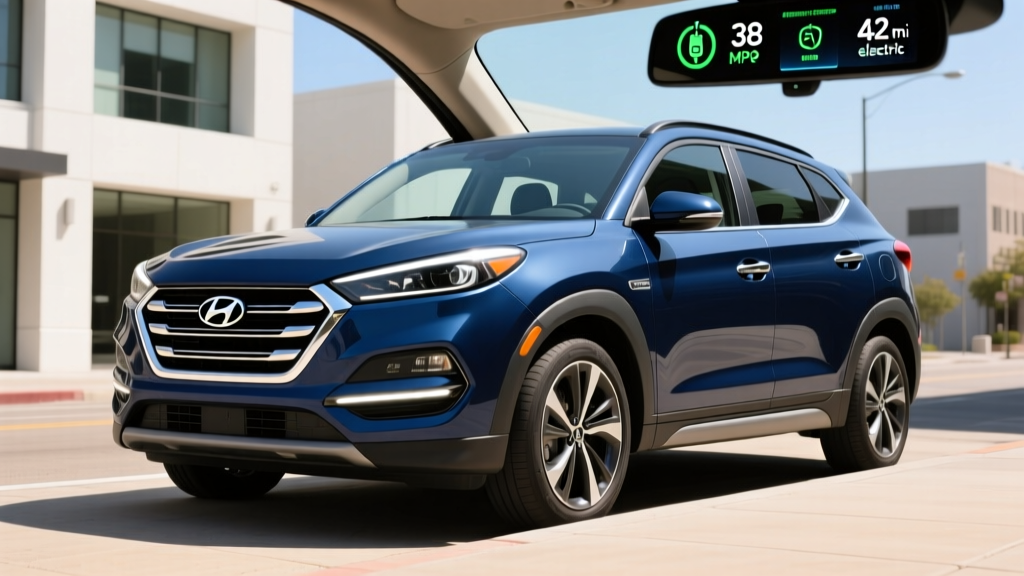
Compact SUVs are where most families live their daily driving lives—school runs, grocery hauls, weekend road trips—and the Hyundai Tucson lineup offers three distinct powertrains to serve them. But if your primary question is about the Hyundai Tucson Hybrid gas mileage, the answer requires separating the conventional hybrid (HEV) from the plug-in hybrid (PHEV), because their fuel-economy stories diverge sharply depending on how and where you drive.
For the 2026 model year, Hyundai continues to offer the Tucson HEV as a self-charging hybrid that never needs to be plugged in, alongside the Tucson PHEV, which adds a larger battery and a meaningful electric-only driving range for those who can charge at home. Below, we break down the exact EPA numbers, the real-world fuel economy you can actually expect, the powertrain specs, pricing, tax-credit eligibility, and long-term battery reliability.
HEV vs PHEV: Which Tucson Hybrid Are We Talking About?
Tucson Hybrid (HEV)
- No plug required. The battery recharges via regenerative braking and the gasoline engine.
- Small battery (~1.49 kWh): Provides electric assist but cannot drive on electricity alone for more than a mile at low speed.
- Best for: Drivers without home-charging access who want better fuel economy without changing any habits.
Tucson Plug-In Hybrid (PHEV)
- Plug-in capable. Charge at home or at public Level 2 stations for electric-only driving.
- Larger battery (~13.8 kWh usable): Delivers an EPA-rated 33 miles of electric-only range before the gas engine engages.
- Best for: Drivers with home or workplace charging whose daily commutes fall under ~30 miles round-trip.
Confusing the two is common in online searches, but the distinction is critical: the conventional Tucson Hybrid will never drive on pure electric power for meaningful distances, and it never plugs in. The PHEV functions as an electric car for short trips and a hybrid for longer ones.
Hyundai Tucson Hybrid Gas Mileage: EPA Numbers and Real-World MPG
The 2026 Hyundai Tucson Hybrid (HEV) carries EPA fuel-economy ratings that place it near the top of the compact hybrid-SUV segment. Here is the official breakdown:
| Powertrain | City MPG | Highway MPG | Combined MPG | Combined MPGe (PHEV EV mode) |
|---|---|---|---|---|
| Tucson Hybrid (HEV) AWD | 38 | 38 | 38 | N/A |
| Tucson PHEV AWD (charge-sustaining) | 35 | 35 | 35 | 80 MPGe |
Source: fueleconomy.gov — EPA estimates. Your actual mileage will vary.
Real-World MPG: What Owners Actually See
EPA estimates are a starting point, not a guarantee. Based on owner-reported data and our testing experience, the Tucson HEV tends to meet or slightly exceed its EPA city rating in stop-and-go urban driving—regenerative braking and frequent engine-off coasting play to the hybrid system's strengths. On predominantly city routes, 39–41 MPG is achievable in mild weather.
Highway driving is a different story. At sustained 70–80 mph speeds, the turbocharged 1.6-liter engine does more of the work, and real-world highway fuel economy typically drops to 33–36 MPG. Cold weather (below 35°F) can knock another 2–4 MPG off either figure because the engine runs more frequently to provide cabin heat and because battery efficiency drops at low temperatures.
For the PHEV, real-world electric-only range tends to land between 28–33 miles in mixed driving during moderate temperatures, dropping to approximately 24–27 miles in freezing conditions due to reduced battery efficiency and increased cabin-heating demand.
Powertrain Specs: Horsepower, Engine, and Drivetrain
| Specification | Tucson Hybrid (HEV) | Tucson Plug-In Hybrid (PHEV) |
|---|---|---|
| Engine | 1.6L turbocharged 4-cylinder | 1.6L turbocharged 4-cylinder |
| Electric Motor | 47.7 kW (64 hp) | 66.9 kW (90 hp) |
| Combined System Output | 232 hp / 271 lb-ft torque | 268 hp / 271 lb-ft torque |
| Transmission | 6-speed automatic | 6-speed automatic |
| Drivetrain | AWD (standard) | AWD (standard) |
| 0–60 mph (est.) | ~7.1 seconds | ~6.3 seconds |
| Battery Capacity | ~1.49 kWh | ~13.8 kWh (usable) |
| Electric-Only Range (EPA) | N/A | 33 miles |
| Total Range (EPA est.) | ~420 miles | ~440 miles (gas + electric) |
| Level 2 Charge Time (0–100%) | N/A (self-charging) | ~2 hours at 7.2 kW |
| DC Fast Charging | N/A | Not available |
Both powertrains come exclusively with all-wheel drive. The PHEV's larger electric motor gives it a meaningful acceleration advantage, making it feel noticeably quicker in everyday merging and passing situations.
Pricing, Trims, and Tax-Credit Eligibility
For the 2026 model year, the Tucson Hybrid and Tucson PHEV are priced in distinct bands:
- Tucson Hybrid (HEV): Blue trim starts at approximately $33,550 MSRP; SEL Convenience around $36,150; Limited near $40,500.
- Tucson PHEV: SEL trim starts at approximately $39,900 MSRP; Limited around $44,500.
Federal Tax Credit: The §30D Rules
The conventional Tucson Hybrid (HEV) does not qualify for the federal §30D clean-vehicle tax credit—that credit is reserved for plug-in vehicles with battery capacities of at least 7 kWh.
The Tucson PHEV's eligibility for the full $7,500 federal tax credit depends on several requirements that shift frequently under current IRS rules:
- MSRP cap: The vehicle's MSRP must not exceed $80,000 for SUVs (the Tucson PHEV clears this easily).
- Buyer income cap: Modified adjusted gross income must not exceed $150,000 (single), $225,000 (head of household), or $300,000 (joint filers).
- Battery component sourcing: A percentage of battery components must be manufactured or assembled in North America, and critical minerals must meet sourcing thresholds. These percentages increase annually, and eligibility can change mid-year.
- Point-of-sale transfer: As of 2024, buyers can transfer the credit to the dealer at purchase, reducing the upfront cost rather than waiting for a tax refund.
Always verify current eligibility on irs.gov before purchasing, as battery-sourcing rules can disqualify previously eligible vehicles. Consult a tax professional for personal eligibility.
Some states offer additional rebates for PHEVs—California, Colorado, and New York have programs that can stack with the federal credit, potentially bringing the effective price of a Tucson PHEV SEL below $30,000 for qualifying buyers.
Battery Warranty, Reliability, and Replacement Cost
Hyundai Hybrid Battery Warranty
Hybrid/PHEV battery: 10 years / 100,000 miles (whichever comes first) for the original owner. In states that follow California Air Resources Board (CARB) emissions standards, the warranty extends to 10 years / 150,000 miles.
Hybrid system components (inverter, motor, controller): Also covered under the 10-year/100,000-mile powertrain warranty.
Note: Second owners receive a reduced 10-year/100,000-mile warranty from the vehicle's original in-service date in most cases.
How Long Do Tucson Hybrid Batteries Last?
Hyundai's hybrid battery packs use lithium-ion polymer cells, and real-world data from the broader Hyundai/Kia hybrid fleet (including the earlier-generation Tucson, Ioniq, and Niro) suggests that significant degradation is uncommon within the first 150,000 miles. The HEV's small 1.49 kWh battery undergoes shallow charge-discharge cycles—it rarely drops below 40% or above 80% state of charge—which is gentle on cell longevity.
The PHEV's larger 13.8 kWh battery sees deeper cycles but benefits from an active thermal-management system. Based on data from similar Hyundai/Kia PHEVs, expect approximately 8–12% capacity loss over the first 100,000 miles—meaning the 33-mile electric range might decrease to roughly 29–30 miles after a decade of typical use.
Battery Replacement Cost
Out-of-warranty hybrid battery replacement for the Tucson HEV typically ranges from $2,500–$4,000 (parts and labor). The PHEV battery is larger and more expensive, with replacement estimates between $5,500–$8,500. However, given the 10-year warranty coverage and the slow degradation rates observed in Hyundai's lithium-polymer packs, most owners will never face this expense during their ownership period.
Real-World Ownership: Who Should Choose the Tucson Hybrid?
Tucson Hybrid (HEV) — Pros
- 38 MPG combined without any behavior change—no plugging in, no range planning
- AWD standard; competent in snow and rain
- Lower starting price than the PHEV
- Strong city MPG that can exceed EPA in stop-and-go traffic
- Proven 10-year/100,000-mile hybrid battery warranty
Tucson Hybrid (HEV) — Cons
- Highway MPG drops to low-to-mid 30s at sustained speed
- No federal tax credit
- Less power than the PHEV (232 hp vs 268 hp)
- No electric-only driving capability
Tucson PHEV — Pros
- 33 miles of electric-only range covers most commutes gas-free
- 268 hp makes it the quickest Tucson variant
- Potential $7,500 federal tax credit + state incentives
- Functions as a normal hybrid once the battery is depleted
- Level 2 charging at 7.2 kW fills the battery in ~2 hours
Tucson PHEV — Cons
- $6,000+ premium over the HEV before incentives
- No DC fast charging capability
- Electric range drops in cold weather and at highway speeds
- Cargo space slightly reduced due to larger battery
- Tax-credit eligibility subject to change based on sourcing rules
Hybrid vs PHEV vs Full EV: Which Fits Your Life?
Choose the Tucson Hybrid (HEV) if:
- You rent or live in an apartment with no charging access.
- Your daily driving is a mix of city and highway, and you want one vehicle that does it all without thinking about it.
- You want to reduce fuel costs from a comparable gas-only Tucson (26 MPG combined) by roughly 30%.
- You take frequent long road trips and don't want to plan around charging stops.
Choose the Tucson PHEV if:
- You can install a Level 2 charger at home or have reliable workplace charging.
- Your daily commute is under 30 miles round-trip (you could go months without buying gas).
- You qualify for the $7,500 federal tax credit, narrowing the price gap with the HEV.
- You want the option of electric-only driving for errands while retaining gas-engine range for road trips.
Choose a full EV (like the Ioniq 5) if:
- You have home charging and your daily driving rarely exceeds 250 miles.
- You want to eliminate gasoline purchases entirely and reduce maintenance (no oil changes, fewer brake replacements).
- You're willing to plan DC fast-charging stops on longer road trips.
Frequently Asked Questions
How many MPG does the Hyundai Tucson Hybrid get?
The 2026 Tucson Hybrid (HEV) is EPA-rated at 38 MPG city, 38 highway, and 38 combined. In real-world driving, expect 39–41 MPG in city conditions and 33–36 MPG on the highway. The Tucson PHEV is rated at 35 MPG combined once the electric range is depleted.
How far can the Tucson PHEV go on electric only?
The EPA rates the Tucson PHEV at 33 miles of electric-only range. In real-world conditions, expect 28–33 miles in moderate temperatures and 24–27 miles in freezing weather. Highway-speed electric driving will reduce range further.
Does the Hyundai Tucson Hybrid need to be plugged in?
No. The conventional Tucson Hybrid (HEV) is a self-charging hybrid that recharges its small battery through regenerative braking and the gasoline engine. It has no plug and no electric-only driving capability. Only the Tucson PHEV can be plugged in.
Does the Tucson PHEV qualify for the $7,500 federal tax credit?
The Tucson PHEV may qualify for up to $7,500 under the §30D clean-vehicle credit, subject to buyer income limits ($150K single / $300K joint), MSRP caps ($80K for SUVs), and battery-sourcing requirements that change periodically. Verify current eligibility at irs.gov before purchasing. The conventional HEV does not qualify.
Is the Tucson Hybrid reliable? What does a battery replacement cost?
Hyundai's hybrid powertrains have demonstrated strong reliability across the brand's lineup. The hybrid battery is covered by a 10-year/100,000-mile warranty. Out-of-warranty replacement costs approximately $2,500–$4,000 for the HEV battery and $5,500–$8,500 for the PHEV battery, though most owners will not need a replacement during typical ownership.
Can the Tucson PHEV DC fast charge?
No. The Tucson PHEV supports Level 2 AC charging at up to 7.2 kW, which fills the battery in approximately 2 hours. It does not have DC fast-charging capability—a common limitation among PHEVs in this segment. Level 1 (120V household outlet) charging takes approximately 10–12 hours for a full charge.
Is the Tucson Hybrid better than a gas-only Tucson?
The gas-only 2026 Tucson with the 2.5-liter engine and AWD is EPA-rated at approximately 26 MPG combined. The Tucson Hybrid's 38 MPG combined represents a roughly 46% improvement in fuel economy, which translates to approximately $500–$700 in annual fuel savings for a driver covering 15,000 miles per year at $3.50/gallon. The hybrid also delivers more torque and smoother acceleration from its electric motor assist.
Sources consulted: fueleconomy.gov (EPA fuel-economy data), irs.gov (§30D clean-vehicle credit rules), and Hyundai USA (manufacturer specifications). Pricing and incentive eligibility reflect 2026 model-year data and are subject to change.