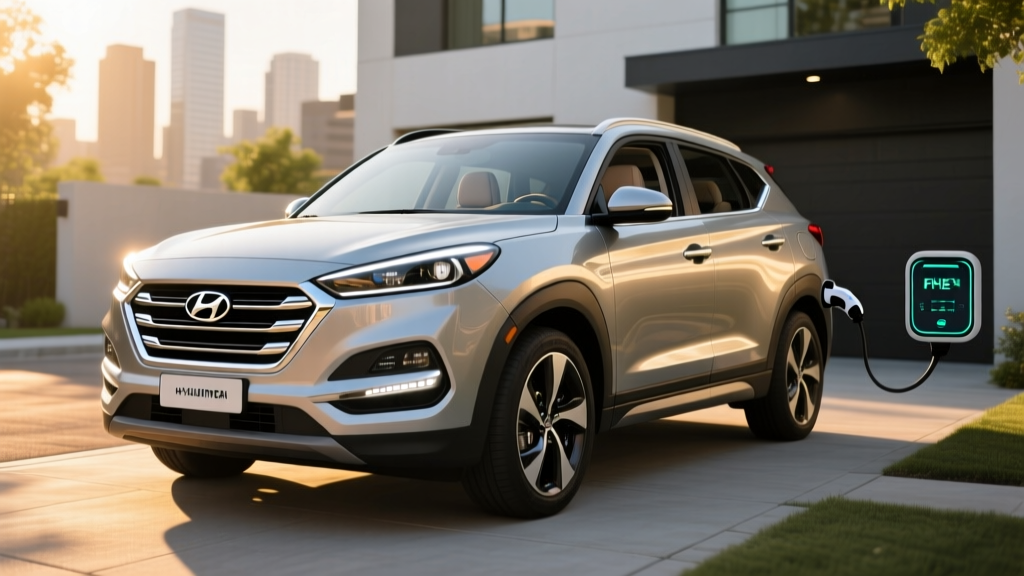
The compact hybrid SUV segment is crowded, but the 2026 Hyundai Tucson Hybrid continues to make a compelling case by offering two distinct electrified flavors: a conventional hybrid (HEV) that requires no plug, and a plug-in hybrid (PHEV) that delivers meaningful electric-only commuting range. Both share the Tucson's practical cabin and strong warranty, but their powertrains serve very different daily routines. Here's everything you need to know — exact MPG figures, electric range, pricing, and which version actually fits your life.
HEV vs PHEV: Which Tucson Hybrid Are We Talking About?
Hyundai sells the Tucson in two electrified forms, and confusing them is the most common buyer mistake. Let's separate them clearly:
| Attribute | Tucson Hybrid (HEV) | Tucson Plug-In Hybrid (PHEV) |
|---|---|---|
| Plugs in? | No — self-charging via regenerative braking and engine | Yes — charges via Level 1/Level 2 AC; no DC fast charging |
| Battery size | 1.49 kWh (small buffer) | 13.8 kWh usable (lithium-ion polymer) |
| Electric-only driving | Brief low-speed EV mode only (~1 mi) | EPA-estimated 33 miles on battery alone |
| Total range | ~440 miles (full tank) | ~400+ miles (electric + full tank) |
| Combined HP | 231 hp | 268 hp |
| Best for | No home charging access; want better MPG without lifestyle change | Home charger available; short commute you want to run on electricity |
The HEV is a drop-in replacement for a gas car — you fuel up and go. The PHEV rewards owners who can charge at home or work with an overnight top-up that covers most daily driving on electricity alone.
Fuel Economy: Real-World MPG vs EPA Estimates
Hyundai rates the 2026 Tucson Hybrid at 38 MPG combined (37 city / 38 highway) for the Blue and SEL Convenience trims, according to fueleconomy.gov. The more-equipped Limited trim drops slightly to 37 MPG combined (35 city / 38 highway) due to added weight from features like the panoramic sunroof and larger wheels.
| Trim | City MPG | Highway MPG | Combined MPG |
|---|---|---|---|
| Blue / SEL Convenience | 37 | 38 | 38 |
| Limited | 35 | 38 | 37 |
Real-World MPG: What to Actually Expect
Hybrids often outperform their EPA city rating in stop-and-go driving, where regenerative braking recovers energy that gas cars waste as heat. In mixed suburban and city driving, owners routinely report 38–42 MPG on the Blue trim. Highway-only trips at 75+ MPH tend to land closer to 33–36 MPG — aerodynamic drag is the enemy of every SUV, hybrid or not.
Cold weather (below 35°F) reduces fuel economy by roughly 5–8% as the engine runs more frequently to provide cabin heat and warm the catalytic converter. This is normal hybrid behavior, not a defect.
PHEV Electric Range and Charging Details
The 2026 Tucson PHEV carries a 13.8 kWh battery pack that the EPA rates at 33 miles of electric-only range. That's enough to cover the average American one-way commute (roughly 16 miles each way per Census data) entirely on electricity — meaning many PHEV owners burn almost no gasoline on weekdays.
When the battery depletes, the PHEV operates as a conventional hybrid, returning an EPA-estimated 35 MPG combined in hybrid mode. Total combined range (electric + gasoline) exceeds 400 miles.
| Charging Spec | Tucson PHEV |
|---|---|
| Battery capacity | 13.8 kWh (usable) |
| Onboard charger | 7.2 kW AC |
| Level 1 (120V) charge time | ~12 hours (0–100%) |
| Level 2 (240V) charge time | ~2 hours (0–100%) |
| DC fast charging | Not available |
| Charge connector | J1772 (standard AC) |
A critical detail: the Tucson PHEV does not support DC fast charging. This is typical for PHEVs in this class — the smaller battery doesn't justify the added cost and weight of DC hardware. Level 2 overnight charging fully replenishes the pack in about two hours, which is all most owners need.
Powertrain and Performance
Both Tucson hybrids pair a turbocharged 1.6-liter four-cylinder engine with an electric motor, routed through a 6-speed automatic transmission to standard all-wheel drive (HTRAC). The key difference is output:
- HEV: 231 combined horsepower (180 hp engine + 64 hp motor). 0–60 MPH in approximately 7.5 seconds.
- PHEV: 268 combined horsepower (180 hp engine + 98 hp motor). 0–60 MPH in approximately 7.0 seconds.
The PHEV's extra electric motor output gives it noticeably stronger off-the-line acceleration, and the instant electric torque makes both versions feel quicker in city driving than their 0–60 times suggest. The 6-speed automatic is a deliberate choice by Hyundai — it avoids the droning "rubber-band" sensation common in CVT-equipped competitors like the Toyota RAV4 Hybrid.
Pricing, Trims, and Tax Credit Eligibility
The 2026 Tucson Hybrid starts at $34,990 (including destination) for the Blue trim. Here's the lineup:
- Blue: $34,990 — 38 MPG combined, cloth seats, 8-inch touchscreen
- SEL Convenience: ~$37,500 — 38 MPG, leatherette, power liftgate, dual-zone climate
- Limited: ~$41,000 — 37 MPG, panoramic roof, Bose audio, ventilated front seats
The 2026 Tucson PHEV starts at approximately $40,250 for the SEL trim and reaches roughly $44,500 for the Limited.
Federal Tax Credit: What Applies?
Tucson HEV: Does not qualify for the federal §30D Clean Vehicle Credit. That credit is reserved for plug-in vehicles with at least 7 kWh of battery capacity.
Tucson PHEV: Eligibility for up to $3,750 under §30D depends on battery component and critical-mineral sourcing requirements that shift annually. Per IRS guidelines, the PHEV must meet MSRP caps ($80,000 for SUVs — the Tucson clears this easily), buyer income limits ($300,000 joint / $150,000 single), and North American final assembly (the Tucson is assembled in Montgomery, Alabama). The critical-minerals and battery-component thresholds determine whether you receive $3,750, the full $7,500, or nothing — consult a tax professional and check the latest IRS eligible-vehicle list at the time of purchase. Point-of-sale transfer is available if eligible.
Some states offer additional rebates for PHEVs (California's CVRP, for example), but these vary by jurisdiction and income. Check your state energy office for current programs.
Battery Warranty, Reliability, and Replacement Cost
Hybrid/PHEV Battery Warranty: Hyundai covers the high-voltage battery for 10 years / 100,000 miles (whichever comes first) in all 50 states. In California Air Resources Board (CARB) states, Hyundai extends the hybrid system warranty to 10 years / 150,000 miles under emissions-related coverage.
Powertrain Warranty: The engine, transmission, and hybrid-specific components (inverter, motor) are covered for 5 years / 60,000 miles under the standard powertrain warranty, with extended coverage in CARB states.
How Long Will the Battery Last?
Modern lithium-ion hybrid batteries rarely fail catastrophically. Instead, they slowly lose capacity over time. Hyundai's battery management system (BMS) uses a conservative charge buffer — the 13.8 kWh "usable" figure in the PHEV already excludes a top and bottom buffer to protect longevity. Real-world data from earlier-generation Tucson Hybrids and the Ioniq Hybrid suggests 10–15% capacity loss over 10 years under normal use, which translates to roughly 28 miles of electric range instead of 33 on an older PHEV — still functional.
Full battery replacement, should it be needed out of warranty, currently runs approximately $4,000–$6,000 for the HEV pack and $8,000–$12,000 for the PHEV pack, including labor. These costs have been trending downward as battery production scales.
Reliability Track Record
Hyundai's 1.6L turbo hybrid powertrain has proven solid since its introduction. The Tucson Hybrid holds favorable ratings from major reliability trackers, and Hyundai's 10-year/100,000-mile hybrid battery warranty remains one of the strongest in the industry — matching Toyota's coverage and exceeding most competitors. The IIHS has rated the Tucson a Top Safety Pick when equipped with specific headlights.
Who Should Choose the Tucson Hybrid vs a Full EV or Gas Car?
Reasons to Choose It
- 38 MPG combined (HEV) with zero lifestyle change — no plug needed
- 33-mile electric commute possible (PHEV) with home charging
- Standard AWD across all trims
- 10-year/100,000-mile battery warranty
- Strong 268 hp (PHEV) — no performance penalty for efficiency
- Practical 38.7 cu ft cargo space behind rear seats
- Competitive starting price under $35,000 (HEV)
Trade-Offs to Consider
- PHEV does not support DC fast charging
- Limited trim drops to 37 MPG (HEV) — sunroof and wheels cost you efficiency
- HEV does not qualify for federal tax credit
- PHEV electric range (33 mi) falls short of the Toyota RAV4 Prime (42 mi)
- Cabin materials lag slightly behind the Mazda CX-50 Hybrid
- PHEV cargo space slightly reduced vs HEV due to larger battery
The Decision Framework
Choose the Tucson HEV if: You don't have access to home or workplace charging, you want better fuel economy without thinking about it, and you want a sub-$35,000 AWD SUV with a strong warranty.
Choose the Tucson PHEV if: You can install a Level 2 charger at home, your daily round-trip commute is under 30 miles, and you want to run most weekday driving on electricity while keeping gas-powered road-trip flexibility.
Choose a full EV (like the Ioniq 5) instead if: You have reliable home charging, your daily driving is predictable, you want zero tailpipe emissions, and you're ready to eliminate gas station visits entirely.
Stick with a gas-only Tucson if: You drive very low annual miles (under 8,000), the hybrid premium doesn't pay back within your ownership timeline, or you simply prefer the lowest upfront cost.
Frequently Asked Questions
How many MPG does the 2026 Hyundai Tucson Hybrid get?
The EPA rates the Tucson Hybrid at 37 city / 38 highway / 38 combined MPG on the Blue and SEL Convenience trims. The Limited trim returns 35/38/37 MPG. In real-world city driving, many owners exceed the EPA city figure thanks to regenerative braking.
How far can the Tucson PHEV go on electric only?
The EPA estimates 33 miles of electric-only range on a full charge. Real-world results vary: mild-weather city driving with light HVAC use can stretch this to 35+ miles, while cold-weather highway driving with heat running may drop it to 24–27 miles.
Does the 2026 Tucson Hybrid qualify for a tax credit?
The conventional HEV does not qualify for any federal tax credit. The PHEV may qualify for up to $3,750 under §30D, depending on battery sourcing requirements, your income (under $300,000 joint / $150,000 single), and the MSRP cap (under $80,000 for SUVs — the Tucson qualifies). Rules change periodically; verify on IRS.gov before purchasing and consult a tax professional.
Is the Tucson Hybrid reliable, and what does battery replacement cost?
Hyundai's hybrid powertrain has demonstrated strong reliability since its introduction. The battery is covered for 10 years/100,000 miles. Out-of-warranty replacement costs approximately $4,000–$6,000 (HEV) or $8,000–$12,000 (PHEV). Most hybrid batteries outlast the vehicle itself with gradual capacity loss rather than sudden failure.
Do I need to plug in the Tucson Hybrid?
No. The conventional Tucson HEV charges its small battery through regenerative braking and the gasoline engine — you never plug it in. Only the Tucson PHEV requires (and benefits from) plugging in to access its 33-mile electric range.
Hybrid vs PHEV vs full EV — which is right for me?
If you can't charge at home, the HEV is your best electrified option. If you can charge at home and commute under 35 miles round-trip, the PHEV gives you EV-like daily driving with road-trip flexibility. If you have home charging, predictable routines, and want zero gas use, a full EV like the Hyundai Ioniq 5 eliminates fuel costs entirely — but requires more upfront planning for longer trips.