Quick Verdict: Which Hyundai SUV Hybrid Fits You?
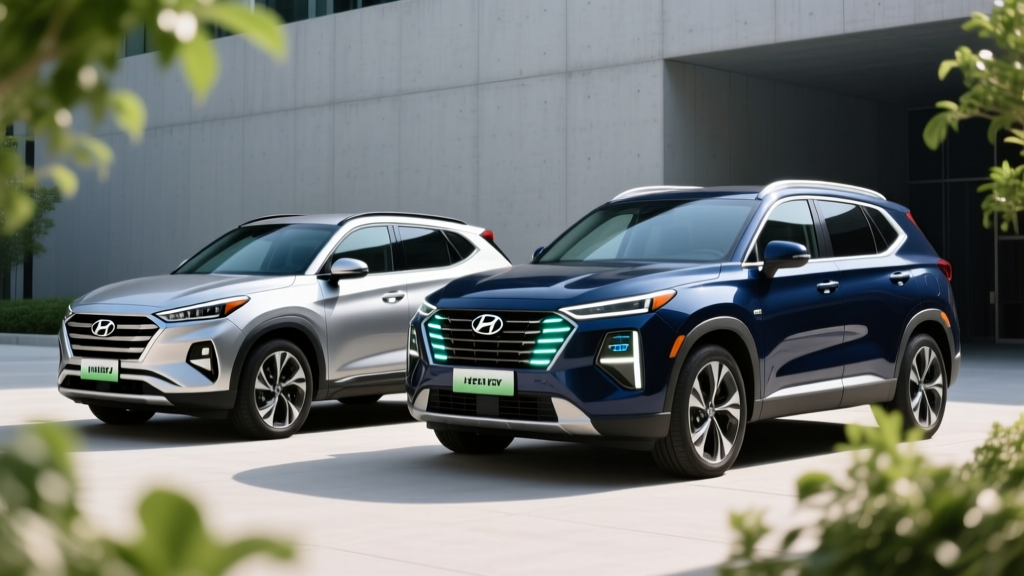
If you're researching Hyundai SUV hybrids in 2026, you have four strong options spanning two body styles and two powertrain philosophies. The Tucson Hybrid delivers outstanding city MPG without ever needing a plug. The Tucson Plug-in Hybrid adds roughly 33 miles of electric-only commuting before the gas engine kicks in. The Santa Fe Hybrid offers three-row practicality with hybrid efficiency, while the Santa Fe Plug-in Hybrid pairs that space with a meaningful electric-only buffer for daily driving.
This guide breaks down exact EPA figures, real-world expectations, powertrain specs, pricing, and tax-credit eligibility so you can choose the right one without guesswork.
Hyundai's Hybrid SUV Lineup at a Glance
| Model | Type | EPA Combined MPG | EV-Only Range | Combined HP | Starting MSRP |
|---|---|---|---|---|---|
| Tucson Hybrid | HEV | 38 MPG | N/A | 232 hp | ~$34,950 |
| Tucson Plug-in Hybrid | PHEV | 35 MPG / 80 MPGe | ~33 mi | 268 hp | ~$40,400 |
| Santa Fe Hybrid | HEV | 36 MPG | N/A | 232 hp | ~$41,500 |
| Santa Fe Plug-in Hybrid | PHEV | 33 MPG / 76 MPGe | ~31 mi | 268 hp | ~$47,500 |
Source: fueleconomy.gov and Hyundai USA specifications for 2026 model year. Prices reflect base trims including destination; actual pricing varies by dealer and region.
HEV vs PHEV: What's the Difference?
Conventional Hybrid (HEV): The Tucson Hybrid and Santa Fe Hybrid use a small battery (roughly 1.5 kWh) charged entirely by regenerative braking and the gasoline engine. You never plug in. The electric motor assists the engine during acceleration and enables electric-only driving at very low speeds, but the primary energy source is gasoline. Think of it as a significantly more efficient gas car.
Plug-in Hybrid (PHEV): The Tucson PHEV and Santa Fe PHEV carry a much larger battery (13.8 kWh) that you can charge via a wall outlet or Level 2 charger. This gives you 30–33 miles of electric-only driving — enough for most daily commutes — before the turbocharged gas engine seamlessly takes over for longer trips. Total combined range exceeds 400 miles.
The core trade-off: HEVs are simpler and cheaper with no charging requirement. PHEVs give you an EV-like daily commute if you can charge at home, with a gas backup for road trips. If you can't charge at home or at work, a PHEV's larger battery becomes dead weight, and the HEV is the smarter buy.
Fuel Economy Breakdown: EPA vs Real-World MPG
| Model | City MPG | Highway MPG | Combined MPG | Real-World Expectation |
|---|---|---|---|---|
| Tucson Hybrid | 38 | 38 | 38 | 36–42 MPG (city-favors-high) |
| Tucson PHEV (gas mode) | 33 | 37 | 35 | 33–38 MPG |
| Santa Fe Hybrid | 36 | 35 | 36 | 33–39 MPG |
| Santa Fe PHEV (gas mode) | 31 | 35 | 33 | 30–36 MPG |
Hyundai's turbocharged 1.6-liter hybrid powertrain tends to overdeliver in city driving, where regenerative braking and electric-motor assist do the most work. Owners who drive predominantly in stop-and-go traffic often report beating the EPA city figure by 2–4 MPG. Highway driving at sustained 75+ MPH speeds is where these SUVs dip slightly below sticker, as aerodynamic drag dominates and the electric assist becomes less impactful.
For the PHEV models, the combined MPG figure applies only after the electric range is depleted. During electric-only operation, you're using zero gasoline — the MPGe rating (80 for Tucson PHEV, 76 for Santa Fe PHEV) reflects that mixed energy use on a gasoline-equivalent scale.
PHEV Electric Range, Battery, and Charging
Both Hyundai PHEV SUVs use a 13.8 kWh lithium-ion polymer battery pack paired with a 74 kW (99 hp) electric motor integrated into the six-speed automatic transmission.
| Spec | Tucson PHEV | Santa Fe PHEV |
|---|---|---|
| Battery Capacity | 13.8 kWh | 13.8 kWh |
| EPA Electric-Only Range | ~33 miles | ~31 miles |
| Total Combined Range | ~420 miles | ~410 miles |
| Level 1 Charge (120V, 12A) | ~11 hours (0–100%) | ~11 hours (0–100%) |
| Level 2 Charge (240V, 32A) | ~2 hours (0–100%) | ~2 hours (0–100%) |
| DC Fast Charging | Not supported | Not supported |
| Charge Port | J1772 | J1772 |
Important: Neither Hyundai PHEV supports DC fast charging. Charging is limited to Level 1 (standard 120V outlet) and Level 2 (240V home or public charger). For daily use, a Level 2 home charger is strongly recommended — it fully replenishes the battery in roughly 2 hours, meaning you can top off during evening hours without thinking about it. On Level 1 alone, an overnight charge adds approximately 12–15 miles of electric range, which may suffice for short commutes but won't fully recharge the pack.
Cold weather reduces electric-only range by roughly 15–25%, depending on cabin heating demands. In sub-freezing temperatures, expect 24–27 miles from the Tucson PHEV and 23–26 from the Santa Fe PHEV before the engine engages.
Powertrain Specs: What's Under the Hood
All four Hyundai SUV hybrids share the same foundational powertrain architecture: a turbocharged 1.6-liter four-cylinder engine mated to an electric motor and a six-speed automatic transmission. Hyundai uses a conventional torque-converter automatic rather than a CVT, which gives more natural acceleration feel and avoids the rubber-band effect some hybrid CVTs produce.
| Component | HEV (Tucson & Santa Fe) | PHEV (Tucson & Santa Fe) |
|---|---|---|
| Engine | 1.6L Turbo GDI, 178 hp | 1.6L Turbo GDI, 178 hp |
| Electric Motor | 47 kW (63 hp) | 74 kW (99 hp) |
| Combined System Output | 232 hp / 271 lb-ft | 268 hp / 271 lb-ft |
| Transmission | 6-speed automatic | 6-speed automatic |
| Drivetrain | AWD (HTRAC) | AWD (HTRAC) |
| 0–60 MPH (est.) | ~7.5 sec | ~7.0 sec |
| Towing Capacity | 2,000 lbs | 2,000 lbs |
The PHEV's larger, more powerful electric motor gives it a meaningful acceleration advantage, particularly in the 0–30 MPH range where electric torque is instant. Both variants come standard with Hyundai's HTRAC all-wheel drive, which uses the rear-mounted electric motor to send torque to the rear axle as needed.
Pricing and Tax Credit Eligibility
| Model | Base MSRP (2026) | Top Trim MSRP | Federal Tax Credit |
|---|---|---|---|
| Tucson Hybrid Blue | ~$34,950 | ~$42,500 (Limited) | Not eligible (§30D BEV/FCEV only) |
| Tucson PHEV SE | ~$40,400 | ~$48,000 (Limited) | Up to $7,500* (eligibility varies) |
| Santa Fe Hybrid SE | ~$41,500 | ~$49,500 (Calligraphy) | Not eligible (§30D BEV/FCEV only) |
| Santa Fe PHEV SEL | ~$47,500 | ~$54,000 (Limited) | Up to $7,500* (eligibility varies) |
*Federal §30D tax credit for PHEVs: Under current IRS rules, plug-in hybrids with a battery capacity of at least 7 kWh can qualify for up to $7,500 in federal tax credits, but eligibility hinges on three factors that change frequently:
- Battery component sourcing: A percentage of battery components must be manufactured or assembled in North America (threshold increases annually).
- Critical minerals: A percentage of critical minerals must be sourced from the U.S. or free-trade-agreement partners.
- Buyer income caps: Modified AGI must not exceed $150,000 (single), $225,000 (head of household), or $300,000 (joint).
- MSRP caps: SUVs must have an MSRP at or below $80,000 — all Hyundai PHEV SUVs clear this threshold.
- Point-of-sale transfer: As of 2024+, eligible buyers can transfer the credit to the dealer for an immediate price reduction at purchase.
Conventional hybrids (HEV) do not qualify for the §30D federal credit, which is reserved for plug-in vehicles. Check IRS.gov's clean vehicle credits page for the latest sourcing requirements before purchasing, as these rules have shifted multiple times since 2023.
Some states offer additional rebates for PHEVs (California's CVRP, for example, though program funding and eligibility vary). Check your state energy office for current programs.
Battery Warranty, Reliability, and Replacement Costs
Hyundai Hybrid/PHEV Battery Warranty:
- Standard coverage: 10 years / 100,000 miles (whichever comes first) for the hybrid battery pack and hybrid-system components.
- Capacity retention threshold: Hyundai covers the battery if capacity drops below approximately 70% of original capacity during the warranty period.
- Original owner vs subsequent owner: The 10/100k warranty applies to the original owner. For second owners in most states, coverage steps down to 5 years / 60,000 miles unless the vehicle was certified pre-owned through Hyundai.
Hyundai's hybrid system has proven reliable in real-world use. The 1.6T engine and six-speed automatic are conventional components with well-understood failure modes, and the hybrid battery operates within a conservative state-of-charge window (typically 20–80% for HEVs) that minimizes degradation stress. Most hybrid batteries in modern Hyundai SUVs are expected to last 150,000–200,000+ miles before significant capacity loss.
If replacement is eventually needed outside warranty, a Hyundai hybrid battery pack typically costs $2,500–$4,500 (parts and labor) depending on the model and whether you go through a dealer or an independent hybrid specialist. PHEV battery replacement runs higher — approximately $5,000–$8,000 — due to the larger 13.8 kWh pack. For context, these figures are comparable to a major transmission repair on a conventional vehicle.
According to IIHS, both the Tucson and Santa Fe have earned top safety ratings, and Hyundai's hybrid components don't introduce new failure points beyond what the battery warranty covers.
Decision Framework: HEV, PHEV, or Full EV?
Choose a Hyundai HEV (Tucson Hybrid or Santa Fe Hybrid) if:
- You can't charge at home (apartment, street parking, no garage outlet access).
- You want maximum simplicity — no plug, no new electrical work, no charging apps.
- Your budget is tighter and you want the lowest entry price.
- You drive a mix of city and highway with no predictable short-commute pattern.
Choose a Hyundai PHEV (Tucson PHEV or Santa Fe PHEV) if:
- You can install a Level 2 charger at home or have reliable workplace charging.
- Your daily round-trip commute is under 30 miles — you'll rarely burn gas on weekdays.
- You want EV-like daily driving but need gas flexibility for road trips or rural travel.
- You may qualify for the federal tax credit, narrowing the price gap with the HEV.
Consider a full BEV (like the Ioniq 5) instead if:
- Your daily driving is under 250 miles and you have home charging.
- You want to eliminate gasoline entirely and minimize maintenance (no oil changes, no engine).
- You qualify for the full $7,500 federal credit on a BEV and your state offers additional EV incentives.
Pros and Cons of Hyundai's Hybrid SUVs
Pros
- Strong real-world city MPG that often beats EPA estimates
- AWD standard on all hybrid trims — no FWD-only base model
- Six-speed automatic avoids CVT drone; natural driving feel
- 10-year/100,000-mile hybrid battery warranty (original owner)
- PHEV electric range covers most daily commutes
- Competitive pricing vs Toyota RAV4 Hybrid and Honda CR-V Hybrid
Cons
- PHEV models do not support DC fast charging
- HEV models receive no federal tax credit
- Highway MPG dips slightly at sustained 75+ MPH speeds
- Cargo space slightly reduced in PHEV due to larger battery pack
- PHEV availability can be limited at some dealers — may require ordering
Frequently Asked Questions
How many MPG does the Hyundai Tucson Hybrid get?
The 2026 Tucson Hybrid is EPA-rated at 38 MPG city, 38 highway, and 38 combined. In real-world city driving with frequent stops and regenerative braking, owners commonly report 39–42 MPG. Highway-only trips at 75+ MPH tend to return 34–36 MPG. The Santa Fe Hybrid rates slightly lower at 36 combined due to its larger, heavier body.
How far can the Tucson PHEV go on electric only?
The Tucson Plug-in Hybrid delivers an EPA-estimated 33 miles of electric-only range. In mild weather (50–75°F) at city speeds, you may stretch this to 35–37 miles. In cold weather with cabin heating, expect 24–27 miles. The Santa Fe PHEV rates at approximately 31 miles electric-only under the same conditions.
Does the Hyundai Tucson Hybrid need to be plugged in?
No. The Tucson Hybrid (HEV) charges its battery entirely through regenerative braking and the gasoline engine. You fuel it like a conventional car. Only the Tucson Plug-in Hybrid (PHEV) benefits from being plugged in — and it still drives normally as a hybrid if you skip charging.
Is the Hyundai hybrid system reliable?
Hyundai's hybrid powertrain has demonstrated strong reliability since its introduction. The 10-year/100,000-mile hybrid battery warranty is among the best in the industry and reflects Hyundai's confidence in long-term durability. The conventional mechanical components (turbocharged engine, six-speed automatic) are well-proven. Independent reliability surveys from Consumer Reports and J.D. Power have generally rated Hyundai's hybrid systems as average to above-average.
What does it cost to replace a Hyundai hybrid battery?
Out-of-warranty replacement for a Hyundai HEV battery typically costs $2,500–$4,500 including labor. PHEV battery replacement runs $5,000–$8,000 due to the larger pack. Most hybrid batteries last 150,000–200,000+ miles, and Hyundai's 10-year/100,000-mile warranty covers premature degradation. Many owners never need a replacement.
Does the Hyundai Tucson PHEV qualify for a tax credit?
The Tucson PHEV and Santa Fe PHEV may qualify for up to $7,500 under the IRS §30D clean vehicle credit, depending on battery-sourcing requirements, your income, and the vehicle's MSRP (all Hyundai PHEVs fall under the $80,000 SUV cap). Conventional hybrids (HEV) do not qualify. Check IRS.gov for current eligibility rules, as sourcing thresholds change annually. The credit can be transferred to the dealer at point of sale for an immediate price reduction.
Hyundai Tucson Hybrid vs Toyota RAV4 Hybrid?
The RAV4 Hybrid rates at 39–41 MPG combined depending on trim (per fueleconomy.gov), slightly edging the Tucson Hybrid's 38 MPG. However, the Tucson offers more standard horsepower (232 vs 219), a more upscale interior in higher trims, and a longer hybrid battery warranty (10yr/100k vs Toyota's 10yr/150k for the battery but 5yr/60k for hybrid components on some model years). The RAV4 Hybrid also tends to have better dealer availability. Both are strong choices — test-drive both and compare what your local dealers have in stock.