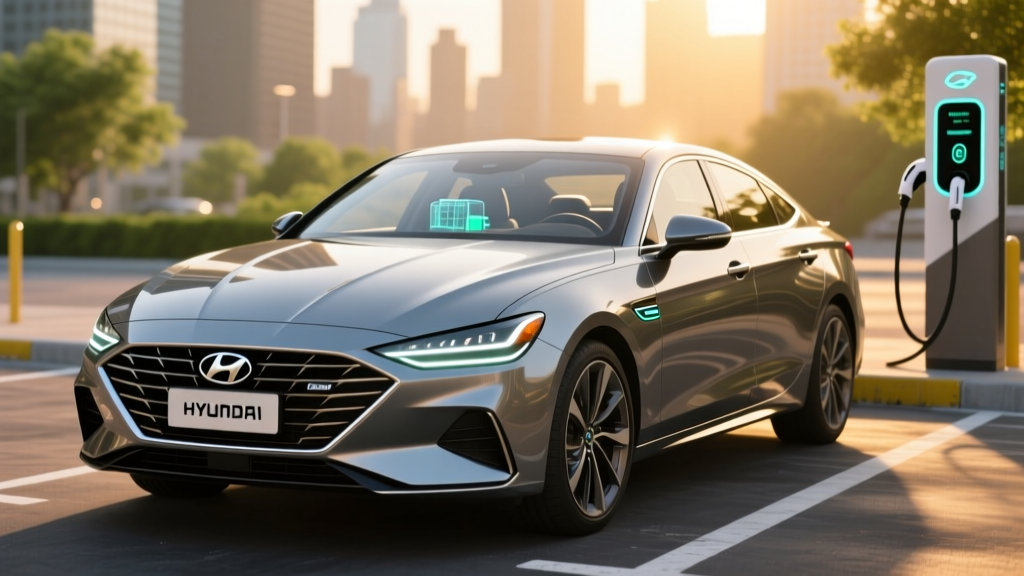
The midsize sedan segment has thinned considerably, but the Hyundai Sonata Hybrid remains a compelling option for buyers who want electrified efficiency without plugging in or worrying about range. For 2026, the Sonata Hybrid continues with a proven 2.0-liter gasoline engine paired with an electric motor, delivering class-leading fuel economy that regularly exceeds its EPA estimates in real-world city driving. This guide covers every number you need — from MPG to MSRP to battery warranty — to decide whether the Sonata Hybrid fits your garage.
HEV vs PHEV: Which Sonata Electrified Model Exists?
Before diving into specs, it is critical to understand what the Sonata Hybrid actually is. The current-generation Sonata is offered as a conventional hybrid electric vehicle (HEV). Hyundai discontinued the Sonata Plug-In Hybrid (PHEV) in the U.S. market after the 2019 model year, and as of 2026, there is no plug-in variant available.
| Feature | HEV (Sonata Hybrid) | PHEV (Discontinued) |
|---|---|---|
| Plug-in charging required? | No — self-charging via regenerative braking and engine | Yes — plug in for electric-only miles |
| Battery size | ~1.6 kWh (small buffer) | ~9.8 kWh (larger pack) |
| Electric-only driving | Brief low-speed EV mode only | ~27 miles (2019 model) |
| Federal tax credit | Not eligible under §30D | Was eligible (program expired for that generation) |
| Current availability (2026) | Yes — in production | No — discontinued in U.S. |
If you specifically want a plug-in hybrid midsize sedan from Hyundai, you would need to look at the used market for a 2019 Sonata PHEV or consider competitors like the Toyota Prius Prime. The 2026 Sonata Hybrid is purely an HEV — no plug, no charging cable, no range anxiety.
Fuel Economy: EPA Ratings and Real-World MPG
The headline number for the 2026 Hyundai Sonata Hybrid is its EPA-estimated fuel economy, which ranks among the best in the midsize sedan class. According to fueleconomy.gov, the ratings break down as follows:
| Trim | City MPG | Highway MPG | Combined MPG |
|---|---|---|---|
| Blue (base) | 50 | 54 | 52 |
| SEL / Limited | 44 | 51 | 47 |
The Blue trim achieves its 52 MPG combined thanks to lighter 16-inch wheels, reduced accessory load, and optimized aerodynamics. Stepping up to the SEL or Limited trims with 17- or 18-inch wheels and additional features drops the combined rating to 47 MPG — still excellent, but a meaningful 5 MPG gap.
With a 13.2-gallon fuel tank and 52 MPG combined, the Sonata Hybrid Blue can theoretically travel over 680 miles between fill-ups — a figure that eliminates range anxiety entirely and beats most full EVs on total range.
Powertrain: Engine, Motor, and Combined Output
The 2026 Sonata Hybrid uses Hyundai's Smartstream G2.0 HEV powertrain, a parallel hybrid system that can drive the wheels with the gasoline engine, the electric motor, or both simultaneously.
| Specification | Value |
|---|---|
| Gasoline engine | 2.0L inline-4, Atkinson cycle |
| Engine output | 150 hp @ 6,000 rpm / 139 lb-ft torque |
| Electric motor output | 39 kW (52 hp) / 151 lb-ft torque |
| Combined system output | 192 hp |
| Transmission | 6-speed automatic (no CVT) |
| Drivetrain | Front-wheel drive |
| 0–60 mph (est.) | ~7.5 seconds |
| Hybrid battery | ~1.6 kWh lithium-ion polymer |
| Fuel tank capacity | 13.2 gallons |
| Drive modes | Smart, Eco, Normal, Sport |
A notable engineering choice: Hyundai uses a conventional 6-speed automatic transmission rather than the CVT or e-CVT found in most competitors (including the Toyota Camry Hybrid). The result is more natural-feeling acceleration without the "rubber band" drone associated with CVTs. The trade-off is marginally less seamless power delivery during engine-to-motor transitions, though most drivers will not notice this in daily commuting.
The 192 combined horsepower puts the Sonata Hybrid ahead of the Toyota Camry Hybrid (208 hp combined for the AWD variant, 200 hp for FWD) in terms of electric motor contribution, though total system outputs are comparable. Acceleration is adequate for merging and passing, if not sporty — this is an efficiency-first sedan.
Pricing, Trims, and Tax Credit Eligibility
The 2026 Hyundai Sonata Hybrid is offered in three trims. Pricing below reflects MSRP before destination charges:
| Trim | MSRP (est.) | Key Features |
|---|---|---|
| Blue | $30,950 | 16" wheels, 12.3" digital cluster, 12.3" infotainment, wireless CarPlay/Android Auto, SmartSense safety suite |
| SEL | $33,550 | 17" wheels, heated front seats, wireless charging pad, blind-spot cameras, leatherette seating |
| Limited | $37,950 | 18" wheels, panoramic sunroof, ventilated front seats, leather, head-up display, Bose premium audio, Highway Driving Assist |
Federal and State Tax Credits
Under current IRS §30D Clean Vehicle Credit rules, conventional hybrids (HEVs) do not qualify for the federal $7,500 tax credit. That credit is reserved for battery electric vehicles (BEVs) and plug-in hybrids (PHEVs) that meet specific battery capacity, critical mineral sourcing, and battery component manufacturing requirements.
The Sonata Hybrid also does not qualify for the used clean vehicle credit (§25E) for the same reason — it lacks plug-in capability.
Some states and local utilities offer rebates for conventional hybrids, though these are increasingly rare as incentive programs shift toward BEVs and PHEVs. Check your state energy office and local utility for current programs, as these vary by jurisdiction and change frequently.
Battery Warranty, Lifespan, and Replacement Cost
Battery longevity is consistently the top concern among hybrid shoppers. Here is what Hyundai provides:
The Sonata Hybrid's ~1.6 kWh battery is small compared to a full EV's 60–100 kWh pack, and it operates within a narrow state-of-charge window (roughly 40–80% SoC) managed by the vehicle's battery management system. This shallow cycling dramatically reduces degradation. Real-world data from Hyundai's hybrid fleet shows that most hybrid batteries retain sufficient capacity well beyond 150,000 miles, with gradual capacity loss rather than sudden failure.
Out-of-Warranty Replacement Cost
If the hybrid battery does require replacement outside warranty coverage, expect to pay between $2,000 and $3,500 for a new OEM battery pack plus installation at a dealership. Independent hybrid specialists and refurbished battery options can reduce this to $1,200–$2,000. Given the 10-year/100,000-mile warranty coverage and the proven longevity of Hyundai's hybrid systems, most owners will never face this expense.
The rest of the hybrid system — including the electric motor, inverter, and 6-speed transmission — is also covered under the 10-year/100,000-mile powertrain warranty.
Reliability, Safety, and Driver Assistance
The Sonata Hybrid benefits from a mature powertrain with years of iterative refinement. Hyundai's Smartstream hybrid system has been in production across multiple models since 2019, and major reliability databases show few systemic issues. The 2.0L Atkinson-cycle engine is under-stressed relative to its displacement, which favors longevity.
For safety, the 2026 Sonata Hybrid comes standard with Hyundai SmartSense, which includes:
- Forward Collision-Avoidance Assist with pedestrian and cyclist detection
- Lane Keeping Assist and Lane Following Assist
- Blind-Spot Collision-Avoidance Assist
- Rear Cross-Traffic Collision-Avoidance Assist
- Safe Exit Assist
- Driver Attention Warning
The Limited trim adds Highway Driving Assist, which combines adaptive cruise control with lane centering for semi-automated highway driving. Note that this is an SAE Level 2 driver-assistance system — the driver must remain attentive and keep hands on the wheel at all times. This is not autonomous or "self-driving" capability.
Check IIHS and NHTSA for the latest crash-test ratings when available.
Who Should Choose the Sonata Hybrid vs a Full EV or Gas Car?
Choose the Hyundai Sonata Hybrid if:
- You cannot install a home Level 2 charger (apartment, street parking, no garage)
- You drive 15,000+ miles per year and want to minimize fuel costs without behavioral changes
- You regularly take long road trips and do not want to plan around charging stops
- You live in an area with limited DC fast-charging infrastructure
- You want a midsize sedan with a large trunk (16.0 cu ft) and comfortable rear seat
- Your budget is $31,000–$38,000 and you do not qualify for or want to rely on EV tax credits
Choose a full EV (e.g., Tesla Model 3, Hyundai Ioniq 6) instead if:
- You have reliable home Level 2 charging access
- Your daily commute is under 60 miles round-trip
- You want to eliminate gasoline entirely and reduce maintenance (no oil changes, fewer brake replacements due to regen)
- You qualify for the $7,500 federal EV tax credit, which can make a BEV comparably priced
- You want the lowest per-mile energy cost (electricity at $0.13/kWh ≈ $0.04/mile vs gasoline at $3.50/gal ≈ $0.07/mile at 52 MPG)
Choose a conventional gas car instead if:
- Your annual mileage is under 8,000 miles (the hybrid premium takes longer to recoup)
- You prioritize the lowest possible purchase price over long-term fuel savings
- You plan to own the vehicle for fewer than 3 years
The Sonata Hybrid's sweet spot is the high-mileage commuter without home charging access. At 52 MPG combined, a driver covering 20,000 miles annually would use approximately 385 gallons per year — roughly $1,350 at $3.50/gallon. A comparable gas-only midsize sedan at 30 MPG combined would consume 667 gallons, or about $2,335. That is nearly $1,000 in annual fuel savings, recouping the hybrid's price premium over a gas Sonata in approximately 3 years.
Pros, Cons, and the Bottom Line
Pros
- 52 MPG combined (Blue trim) — class-leading
- Real-world city MPG often exceeds EPA estimates
- 680+ mile total range per tank
- 10-year / 100,000-mile hybrid battery warranty
- 6-speed automatic (no CVT drone)
- Spacious trunk (16.0 cu ft) and rear seat
- Comprehensive standard safety suite
- No plug-in charging required
Cons
- No AWD option (Camry Hybrid offers AWD)
- Higher trims drop to 47 MPG combined
- No federal tax credit eligibility
- Modest 192 hp — adequate, not quick
- PHEV variant discontinued — no plug-in option
- Some road noise at highway speeds
- Hybrid premium over gas Sonata adds ~$3,000–$4,000
Frequently Asked Questions
How many MPG does the Hyundai Sonata Hybrid get?
The 2026 Sonata Hybrid Blue achieves an EPA-estimated 50 city / 54 highway / 52 combined MPG. The SEL and Limited trims are rated at 44 city / 51 highway / 47 combined. Real-world city driving often yields 53–58 MPG thanks to regenerative braking, while sustained highway speeds above 75 mph may return slightly below the EPA highway estimate.
Does the Sonata Hybrid need to be plugged in?
No. The 2026 Sonata Hybrid is a conventional hybrid (HEV), not a plug-in hybrid. It charges its small battery pack through regenerative braking and the gasoline engine. You simply fill it with gasoline like any other car. Hyundai discontinued the plug-in Sonata PHEV in the U.S. after 2019.
How far can the Sonata Hybrid go on electric only?
The conventional Sonata Hybrid can operate in EV mode for very short distances (typically under 1 mile) at low speeds (under 25 mph), such as creeping through a parking lot or in stop-and-go traffic. It is not designed for meaningful electric-only driving. If electric-only range is a priority, you would need a PHEV like the Toyota Prius Prime (44 miles electric-only) or a full BEV.
Is the Hyundai Sonata Hybrid reliable?
The Sonata Hybrid uses a mature, well-tested powertrain with Hyundai's Smartstream hybrid system. The 2.0L Atkinson-cycle engine is under-stressed, and the lithium-ion hybrid battery operates within a narrow charge window to maximize longevity. Hyundai backs the hybrid battery with a 10-year/100,000-mile warranty (10 years/150,000 miles in CARB states), and real-world data shows most hybrid batteries last well beyond 150,000 miles without significant degradation.
What does a Sonata Hybrid battery replacement cost?
Out-of-warranty replacement of the hybrid battery pack costs approximately $2,000–$3,500 at a Hyundai dealership, or $1,200–$2,000 through independent hybrid specialists using refurbished packs. However, given the generous 10-year/100,000-mile warranty and the proven longevity of the system, most owners will never need a battery replacement.
Does the Hyundai Sonata Hybrid qualify for any tax credit?
No. Under current IRS §30D rules, the federal clean vehicle tax credit applies only to battery electric vehicles (BEVs) and plug-in hybrids (PHEVs) that meet battery sourcing and capacity requirements. The Sonata Hybrid is a conventional HEV and does not qualify for the $7,500 federal credit or the $4,000 used-EV credit. Some state or utility rebates for hybrids may exist — check your local programs, as these vary by jurisdiction.
How does the Sonata Hybrid compare to the Toyota Camry Hybrid?
The Camry Hybrid offers slightly higher combined horsepower (200 hp FWD, 208 hp AWD) and is available with all-wheel drive, which the Sonata Hybrid lacks. The Sonata Hybrid Blue edges ahead on EPA combined MPG (52 vs the Camry Hybrid's 52 combined on the LE trim — essentially tied). Both offer 10-year hybrid battery warranties. The Sonata's 6-speed automatic provides more natural acceleration feel than the Camry's e-CVT. Pricing is comparable, with both starting around $30,000–$31,000.
Should I buy the Sonata Hybrid or a full electric vehicle?
If you have home charging access, drive under 60 miles daily, and qualify for the $7,500 federal EV tax credit, a full EV like the Hyundai Ioniq 6 or Tesla Model 3 will offer lower per-mile energy costs and reduced maintenance. If you lack home charging, regularly drive long distances, live in a charging-desert area, or simply want a car that works exactly like a gas car but uses half the fuel, the Sonata Hybrid is the pragmatic choice.