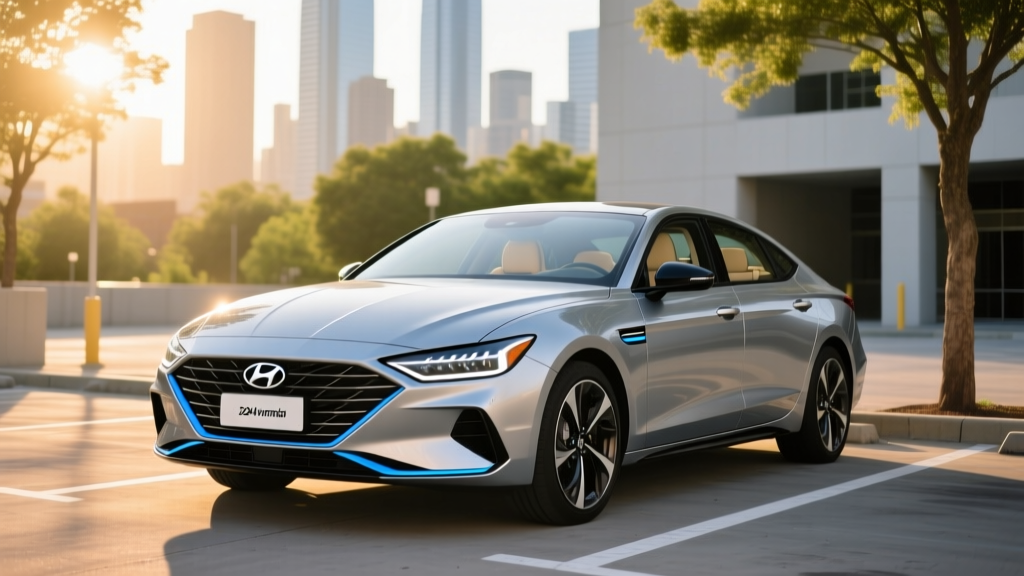
The midsize sedan segment has thinned considerably as buyers flock to crossovers, but the 2024 Hyundai Sonata Hybrid makes a compelling case for sticking with a car. Built on Hyundai's third-generation TMED-II (Transmission-Mounted Electric Device) hybrid architecture, it pairs a 2.0-liter four-cylinder with a 39 kW electric motor integrated into a six-speed automatic — no CVT drone, no range anxiety, no plug required. For buyers who want electric-like efficiency without altering their fueling habits, the Sonata Hybrid occupies a precise niche.
This review breaks down what the EPA numbers mean in real-world driving, how the powertrain behaves, what the battery warranty actually covers, and whether the Sonata Hybrid outperforms its plug-in and full-EV alternatives for your specific situation.
2024 Hyundai Sonata Hybrid: Powertrain & Specs at a Glance
Before diving into efficiency, here is the complete hardware picture. The Sonata Hybrid uses a parallel hybrid system — both the gasoline engine and electric motor can drive the wheels independently or together, managed through a conventional six-speed automatic transmission rather than a power-split device or CVT.
| Specification | Value |
|---|---|
| Powertrain Type | Parallel HEV (no plug-in) |
| Engine | 2.0L GDI 4-cylinder (Smartstream G2.0 HEV) |
| Engine Output | 150 hp / 139 lb-ft torque |
| Electric Motor | 39 kW (52 hp) / 151 lb-ft torque |
| Combined System Output | 192 hp / 271 lb-ft torque |
| Transmission | 6-speed automatic (TMED-II) |
| Hybrid Battery | 1.76 kWh lithium-ion (nominal) |
| Drivetrain | Front-wheel drive |
| 0–60 mph (est.) | ~7.6 seconds |
| Curb Weight | ~3,490 lbs |
| Cargo Volume | 15.1 cu ft |
| Base MSRP (Blue trim) | $30,250 (incl. destination) |
| SEL MSRP | $32,400 |
| Limited MSRP | $36,900 |
The 1.76 kWh battery is small by plug-in or full-EV standards, but that is by design. Conventional hybrids use the battery as a buffer — capturing regenerative braking energy, enabling engine-off coasting, and providing electric torque fill during acceleration. You never plug it in; the gasoline engine and regen braking keep it charged.
EPA Fuel Economy vs. Real-World MPG
Hyundai rates the 2024 Sonata Hybrid at 44 mpg city / 51 mpg highway / 47 mpg combined for the Blue (base) trim, and 45/46/44 mpg combined for the heavier SEL and Limited trims (which add equipment and larger 17-inch wheels). These figures come from fueleconomy.gov (EPA).
| Trim | City | Highway | Combined |
|---|---|---|---|
| Blue | 44 mpg | 51 mpg | 47 mpg |
| SEL | 45 mpg | 46 mpg | 44 mpg |
| Limited | 45 mpg | 46 mpg | 44 mpg |
Real-world expectations: Hybrids typically exceed their EPA city estimates in stop-and-go traffic because regenerative braking recovers more energy at lower speeds. On predominantly city routes, owners commonly report 48–52 mpg in warm weather. Highway efficiency is where hybrids lose their advantage — at sustained 70–80 mph speeds, the electric motor contributes less, and aerodynamic drag dominates. Expect 42–46 mpg on flat interstate runs at 70 mph, dropping to 38–41 mpg in cold weather (below 35°F) when the engine runs more frequently for cabin heat and battery conditioning.
For a 14-gallon fuel tank, real-world range lands between 550 and 650 miles depending on driving mix — competitive with diesels and far exceeding most gasoline-only midsize sedans.
HEV vs. PHEV vs. Full EV: Which Powertrain Fits You?
Hyundai discontinued the Sonata Plug-in Hybrid after the 2019 model year in the US market. The 2024 Sonata Hybrid is exclusively a conventional HEV. This matters because buyers sometimes confuse the two. Here is how the three electrified powertrain types compare:
HEV (Conventional Hybrid) — Sonata Hybrid
No plug. No electric-only range. The small battery recharges via engine and regen braking. Ideal for: drivers without home charging access, those who take frequent long road trips, and buyers who want lower fuel costs with zero behavioral change. Efficiency: 44–47 mpg combined.
PHEV (Plug-In Hybrid) — e.g., Toyota Prius Prime, Hyundai Tucson PHEV
Plugs in. 25–44 miles electric-only. A larger battery (typically 10–18 kWh) enables short commutes on electricity alone before the gas engine engages. Ideal for: drivers with home Level 2 charging who commute under 40 miles round-trip but still need road-trip flexibility. Requires a plug to realize full value.
BEV (Full Battery Electric) — e.g., Tesla Model 3, Hyundai Ioniq 6
No gas engine. 250–360+ miles range. Pure electric. Ideal for: drivers with reliable home or workplace charging who want the lowest per-mile fuel cost, minimal maintenance, and zero tailpipe emissions. Requires charging infrastructure planning for road trips.
The Sonata Hybrid is the right pick if you lack home charging, regularly drive more than 300 miles between fill-ups, or want the lowest-complexity path to better fuel economy. If you have a garage with a 240V outlet and a short commute, a PHEV or BEV will deliver lower operating costs.
Driving Impressions: How the TMED-II Powertrain Behaves
The Sonata Hybrid's six-speed automatic sets it apart from competitors like the Toyota Camry Hybrid and Honda Accord Hybrid, both of which use e-CVT (planetary gearset) transmissions. The result is more conventional shift feel — you sense distinct gear changes rather than a rubber-band drone under acceleration.
The 39 kW electric motor provides meaningful low-end torque fill, making the Sonata Hybrid feel responsive from a stop despite its 192 combined horsepower. The transition between electric-only motoring (at low speeds and light loads) and engine engagement is well-managed; the engine start is noticeable but not jarring. Active Sound Design pipes a subtle, synthetic engine note through the speakers under hard acceleration — divisive among enthusiasts but effective at masking the four-cylinder's natural harshness.
Regenerative braking offers multiple levels adjustable via steering-wheel paddles. In the highest regen setting, you can approach one-pedal-like driving in city traffic, though the car will not come to a complete stop without touching the brake pedal (unlike true one-pedal BEVs).
Hybrid Battery Warranty & Long-Term Reliability
Battery longevity is the top concern for first-time hybrid buyers. Hyundai addresses this with one of the industry's strongest warranty packages:
2024 Sonata Hybrid Battery & Powertrain Warranty
- Hybrid Battery: 10 years / 100,000 miles (whichever comes first)
- Hybrid System Components (motor, inverter, converter): 10 years / 100,000 miles
- Powertrain (engine, transmission): 10 years / 100,000 miles
- New Vehicle Limited: 5 years / 60,000 miles
- Capacity Retention Threshold: Hyundai replaces the hybrid battery if it falls below approximately 70% of original capacity within the warranty period (confirm with dealer for exact terms)
Source: Hyundai USA Warranty
Real-world degradation context: Unlike BEV batteries that cycle deeply (0–100% SoC), hybrid batteries operate in a narrow state-of-charge window — typically 40–80% SoC — managed by the hybrid control unit. This shallow cycling dramatically reduces lithium-ion degradation. Toyota Prius taxis have exceeded 300,000 miles on original hybrid batteries. Hyundai's TMED-II system uses similar management strategies. Out-of-warranty hybrid battery replacement for the Sonata Hybrid runs approximately $2,500–$4,000 at a dealership, though refurbished units from third-party suppliers cost $1,200–$2,000 plus installation.
According to IIHS, the 2024 Sonata (including the Hybrid variant) earned Top Safety Pick status when equipped with specific headlights, reflecting strong crash-test performance that complements the powertrain's long-term value proposition.
Pricing, Trims & Tax Credit Eligibility
The 2024 Hyundai Sonata Hybrid starts at $30,250 for the Blue trim (including $1,150 destination). That positions it roughly $2,000–$3,000 above a comparably equipped Toyota Camry Hybrid LE ($29,495 base) but below most plug-in hybrids and all full EVs in the midsize segment.
| Trim | MSRP | Key Additions |
|---|---|---|
| Blue | $30,250 | 16" alloys, 12.3" digital cluster, 8" touchscreen, wireless CarPlay/Android Auto, SmartSense ADAS suite |
| SEL | $32,400 | 17" alloys, 12.3" infotainment w/ navigation, heated front seats, proximity key, blind-spot cameras |
| Limited | $36,900 | Leather, ventilated front seats, Bose 12-speaker audio, panoramic sunroof, Highway Driving Assist, Digital Key 2 |
Federal Tax Credit: Does the Sonata Hybrid Qualify?
The 2024 Hyundai Sonata Hybrid does not qualify for the federal §30D Clean Vehicle Credit (up to $7,500). Under current IRS rules, the §30D credit applies only to plug-in electric vehicles (BEVs and PHEVs) with a minimum battery capacity of 7 kWh and external charging capability. Conventional hybrids like the Sonata Hybrid have been excluded from this credit since the Energy Policy Act of 2005 phase-out structure.
Some states offer separate incentives for conventional hybrids, though these have become rare as policy focuses on plug-in vehicles. Check your state's energy office or department of revenue for current programs — a few states (e.g., Colorado, Maryland) have offered modest hybrid rebates or tax deductions in prior years, but availability varies annually.
Who Should Buy the 2024 Sonata Hybrid — And Who Shouldn't
✓ Choose the Sonata Hybrid If:
- You drive 15,000+ miles/year and want fuel savings without plug-in infrastructure
- Your commute is mixed city/highway with frequent stop-and-go segments
- You want a proven, low-complexity hybrid with a 10-year powertrain warranty
- You take regular road trips where charging-desert risk is a concern
- You prefer a traditional driving feel (six-speed auto) over e-CVT drone
✗ Look Elsewhere If:
- You have home charging and a sub-30-mile commute (a BEV or PHEV delivers lower per-mile cost)
- You want electric-only silent driving for neighborhood or garage use
- You prioritize maximum cargo space (SUV/crossover hybrids like the Tucson Hybrid offer more)
- You need all-wheel drive (the Sonata Hybrid is FWD only; consider the Camry Hybrid AWD or Tucson Hybrid AWD)
- You want federal tax credits (only BEVs and PHEVs currently qualify for §30D)
Frequently Asked Questions
How many MPG does the 2024 Hyundai Sonata Hybrid get?
The Blue trim achieves 44 city / 51 highway / 47 combined mpg per the EPA. The SEL and Limited trims rate at 45 city / 46 highway / 44 combined mpg. In real-world mixed driving, expect 43–50 mpg depending on conditions, with city-heavy routes yielding the best results.
Does the Sonata Hybrid need to be plugged in?
No. The 2024 Sonata Hybrid is a conventional HEV. The 1.76 kWh battery charges exclusively through regenerative braking and the gasoline engine. There is no plug, no charging port, and no electric-only driving range to manage. You fuel it exactly like a regular gasoline car.
Is the 2024 Sonata Hybrid reliable, and what does battery replacement cost?
Hyundai's hybrid system has proven reliable in fleet and consumer use, backed by a 10-year / 100,000-mile hybrid battery and powertrain warranty. The battery operates in a shallow charge window that minimizes degradation. If replacement is needed out of warranty, expect $2,500–$4,000 at a dealership or $1,200–$2,000 for a refurbished unit plus labor.
Does the Sonata Hybrid qualify for any tax credit?
The 2024 Sonata Hybrid does not qualify for the federal §30D Clean Vehicle Credit, which is limited to plug-in vehicles (BEVs and PHEVs). Some states may offer minor hybrid incentives — check your state's energy or revenue department for current availability.
How does the Sonata Hybrid compare to the Toyota Camry Hybrid?
The Camry Hybrid rates slightly higher on the EPA combined cycle (44–52 mpg depending on trim) and offers available AWD, which the Sonata Hybrid lacks. The Sonata Hybrid counters with a longer standard warranty (10yr/100k vs. Toyota's 10yr/150k hybrid battery but 5yr/60k powertrain), a more conventional six-speed automatic feel, and Hyundai's digital interior tech. Both are strong choices; the decision often comes down to AWD needs and brand preference.
Can I get the Sonata Hybrid with all-wheel drive?
No. The 2024 Sonata Hybrid is front-wheel drive only. If AWD is essential, consider the Toyota Camry Hybrid (available AWD), Hyundai Tucson Hybrid (standard AWD), or Honda Accord Hybrid (FWD only, similar to Sonata).