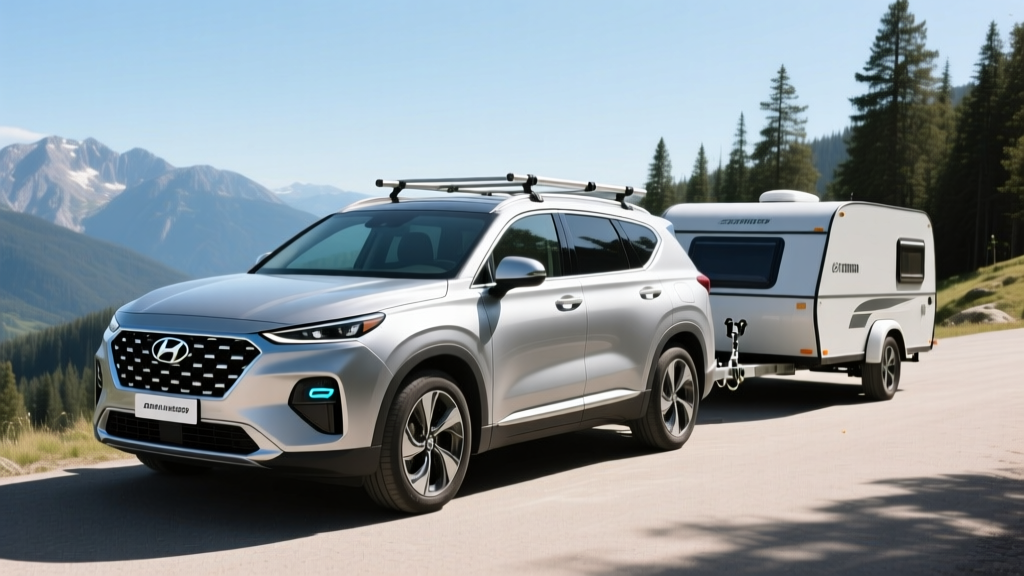
Midsize three-row SUV buyers who want hybrid efficiency without sacrificing utility face a narrow field. The 2026 Hyundai Santa Fe Hybrid occupies a specific niche: a standard hybrid (HEV) that can tow a small camper, boat, or utility trailer while returning mid-30s MPG in daily driving. But how does its towing rating stack up, and does the plug-in hybrid (PHEV) variant match it? Here is the complete, number-driven breakdown.
Hyundai Santa Fe Hybrid Towing Capacity: The Exact Numbers
The 2026 Hyundai Santa Fe Hybrid (HEV) carries an EPA-estimated maximum towing capacity of 3,500 pounds when properly equipped with the factory tow package. This rating applies across all hybrid trims — SEL Premium, Limited, and Calligraphy — provided the integrated trailer hitch and wiring harness are installed.
That 3,500-lb figure is meaningful for the segment. It covers a single-axle utility trailer loaded with landscaping equipment, a pair of personal watercraft, or a lightweight travel trailer in the 13-to-16-foot range. It does not cover a full-size enclosed car hauler or a large boat on a tandem-axle trailer — for those, you need a body-on-frame SUV rated for 5,000+ pounds.
| Specification | HEV (Standard Hybrid) | PHEV (Plug-In Hybrid) |
|---|---|---|
| Max Towing Capacity | 3,500 lbs | 3,500 lbs (est.) |
| Combined Horsepower | 232 hp | 261 hp |
| Engine | 1.6L Turbo 4-cyl | 1.6L Turbo 4-cyl |
| Electric Motor | 47.7 kW (64 hp) | 74 kW (99 hp) |
| Transmission | 6-speed automatic | 6-speed automatic |
| Drivetrain | AWD (HTRAC) | AWD (HTRAC) |
| Battery (traction) | 1.49 kWh (sealed) | 13.8 kWh usable |
| EPA Combined MPG | 35 MPG | 33 MPG (hybrid mode) |
| EPA City / Highway | 35 city / 34 hwy | 33 city / 33 hwy |
| Electric-Only Range (PHEV) | N/A | ~30 miles |
| MSRP (base trim) | ~$39,500 | ~$44,500 |
Important towing note: The 3,500-lb rating assumes the use of Hyundai's factory tow hitch with integrated wiring. Aftermarket hitches may not meet the same structural validation. Towing also reduces fuel economy — expect a drop to roughly 22–26 MPG combined when pulling near the maximum rating on flat terrain, and lower in hilly conditions.
HEV vs PHEV: Which Santa Fe Hybrid Fits Your Needs?
Hyundai offers the Santa Fe in two electrified flavors, and confusing them is a common buyer mistake. Here is the core distinction:
| Factor | Santa Fe HEV | Santa Fe PHEV |
|---|---|---|
| Plugs in to charge? | No — charges via regen and engine | Yes — plug in for EV range |
| Electric-only driving | Brief, low-speed assist only | ~30 miles at full highway speed |
| Home charging needed? | No | Recommended for max benefit |
| Battery size | 1.49 kWh | 13.8 kWh usable |
| Level 2 charge time | N/A | ~3.5 hours (240V, 32A) |
| DC fast charging | N/A | No DC fast charge capability |
| Federal tax credit | Not eligible (§30D is BEV/PHEV only) | Up to $7,500 (subject to eligibility) |
| Best for | Drivers without home charging access | Commuters with short EV-range trips + home charger |
The HEV is a self-charging system. You fill it with gas and drive — the small battery recovers energy from braking and coasting. The PHEV has a substantially larger battery you can charge from a wall outlet or Level 2 home charger, giving you roughly 30 miles of pure electric driving before the gasoline engine engages. Once that electric range is depleted, the PHEV operates as a conventional hybrid at ~33 MPG combined.
Both variants carry the same 3,500-lb towing capacity, as the chassis, cooling, and drivetrain structural ratings are shared. However, towing with the PHEV will deplete the electric battery faster, so expect the gasoline engine to engage almost immediately under load.
Fuel Economy: EPA Ratings and Real-World MPG
| Driving Cycle | HEV | PHEV (charge-sustaining) | PHEV (MPGe, EV mode) |
|---|---|---|---|
| City | 35 MPG | 33 MPG | 79 MPGe |
| Highway | 34 MPG | 33 MPG | 76 MPGe |
| Combined | 35 MPG | 33 MPG | 78 MPGe |
Hybrids typically outperform their EPA city estimates in stop-and-go traffic because regenerative braking recovers more energy at low speeds. In real-world suburban driving with frequent stops, owners of the Santa Fe Hybrid commonly report 36–38 MPG on the city cycle. Highway efficiency is more fixed — expect 31–33 MPG at sustained 70–75 mph cruising, as aerodynamic drag dominates and the electric motor contributes less.
For the PHEV variant, the economics depend entirely on your daily mileage. If your round-trip commute is under 30 miles and you charge nightly, you may use gasoline only on weekend road trips. If you drive 60 miles daily without midday charging, the PHEV's advantage over the HEV narrows significantly, and the HEV's lower purchase price becomes harder to justify against.
Source: fueleconomy.gov — 2026 Hyundai Santa Fe Hybrid
Towing in Practice: What 3,500 Pounds Actually Looks Like
To put the Santa Fe Hybrid's towing capacity into practical terms, here is what 3,500 pounds covers — and what it doesn't:
- 4×8 enclosed utility trailer, loaded: ~1,800–2,500 lbs — well within limits
- Pop-up camper (13–14 ft): ~2,000–3,000 lbs — comfortable margin
- Two jet skis on a dual trailer: ~1,800–2,200 lbs — no issue
- 16-ft aluminum fishing boat + trailer: ~2,500–3,200 lbs — near upper limit, check tongue weight
- Hard-sided travel trailer (17+ ft): ~3,500–5,000 lbs — exceeds or maxes rating, not recommended
- Horse trailer (single horse): ~2,800–3,800 lbs — borderline, verify loaded weight
Tongue weight matters. Hyundai specifies a maximum tongue weight of approximately 350 lbs (10% of max trailer weight). Exceeding this compresses the rear suspension, degrades steering response, and can trigger the stability control system. Use a weight-distributing hitch if your trailer's tongue weight approaches this limit.
When towing, the hybrid system's regenerative braking provides modest assistance on downhill grades, but the Santa Fe Hybrid does not have a dedicated tow/haul drive mode like some body-on-frame competitors. Select "Sport" mode for firmer shift mapping and more aggressive throttle response when merging onto highways with a trailer.
Powertrain Deep Dive: How the Hybrid System Delivers 232 HP
The Santa Fe HEV pairs a 1.6-liter turbocharged four-cylinder gasoline engine with a 47.7 kW (64 hp) electric motor sandwiched between the engine and a conventional 6-speed automatic transmission. Combined system output is 232 horsepower and 271 lb-ft of torque.
The PHEV version uses the same 1.6L turbo engine but pairs it with a more powerful 74 kW (99 hp) electric motor and a 13.8 kWh usable battery pack, producing a combined 261 horsepower and 271 lb-ft of torque. The additional electric output gives the PHEV noticeably stronger off-the-line acceleration, which is relevant when merging onto highways with a loaded trailer.
Both variants use Hyundai's HTRAC all-wheel-drive system, which can redirect torque front-to-rear based on traction conditions. AWD is standard on all Santa Fe Hybrid trims — a critical factor for towing stability in wet or icy conditions.
Battery Warranty, Lifespan, and Replacement Costs
Hyundai Hybrid & PHEV Battery Warranty:
- Hybrid/EV battery: 10 years / 100,000 miles (whichever comes first)
- Capacity retention threshold: Battery is warrantied if it falls below 70% of original capacity during the warranty period
- Hybrid system components: 10 years / 100,000 miles (motor, inverter, converter)
- Original owner vs. transferable: Full 10-year/100k coverage applies to the original owner; second owners receive 10 years/100,000 miles from original in-service date
Hyundai's 10-year hybrid battery warranty is among the strongest in the segment. For context, Toyota covers its hybrid batteries for 10 years/150,000 miles, while most competitors offer 8 years/100,000 miles.
Real-world degradation data for Hyundai's hybrid battery packs suggests capacity loss of 8–12% over 100,000 miles in normal use. The 1.49 kWh HEV battery is small and cycled shallowly (it rarely charges above 80% or discharges below 20%), which significantly extends cell life. The 13.8 kWh PHEV battery sees deeper cycles but benefits from active thermal management.
Replacement cost estimates (out of warranty):
- HEV battery pack: $2,500–$3,800 (parts + labor)
- PHEV battery pack: $6,000–$9,500 (parts + labor)
These figures are based on current dealer pricing and may vary by region. Individual module replacement (rather than the full pack) is sometimes possible on the HEV, reducing cost further.
Pricing, Trims, and Tax Credit Eligibility
The 2026 Hyundai Santa Fe Hybrid is offered in three trims:
- SEL Premium: ~$39,500 MSRP — base hybrid trim, includes AWD, heated seats, 12.3" infotainment
- Limited: ~$43,500 MSRP — adds leather, panoramic sunroof, Highway Driving Assist 2
- Calligraphy: ~$47,500 MSRP — top trim, Nappa leather, premium audio, surround-view monitor
Adding the factory tow package (hitch + harness) typically costs $450–$650 as a dealer-installed accessory, or may be included in certain trim packages.
Federal Tax Credit for the Santa Fe PHEV (§30D):
- The HEV does not qualify for the §30D federal tax credit — this credit applies only to plug-in electric vehicles (BEVs and PHEVs)
- The PHEV may qualify for up to $7,500, but eligibility depends on multiple factors:
- Buyer AGI must not exceed $150,000 (single) / $300,000 (joint filing)
- Vehicle MSRP must not exceed $80,000 (SUVs/vans/pickups)
- Battery components and critical minerals must meet phased-in domestic sourcing thresholds (increasing yearly through 2030)
- Credit can now be transferred to the dealer at point of sale as an immediate price reduction
- Always verify current eligibility at IRS.gov — sourcing rules change annually
For the HEV, there is no federal purchase incentive, though some states and utilities offer rebates for hybrid vehicles — check your local programs. The PHEV's potential $7,500 credit can meaningfully close the price gap with the HEV if you qualify, effectively bringing a Limited PHEV close to HEV pricing after incentives.
Who Should Choose the Santa Fe Hybrid — And Who Shouldn't?
Choose the Santa Fe HEV if:
- You don't have access to home or workplace charging
- You want hybrid efficiency with zero behavior change — just fill up and drive
- You need 3-row seating and occasional towing under 3,500 lbs
- You want the lowest purchase price in the hybrid lineup
Choose the Santa Fe PHEV if:
- Your daily driving is under 30 miles round-trip and you can charge at home (Level 2, 240V)
- You want to minimize gasoline use on weekdays while keeping gas-engine range for weekend trips
- You qualify for the §30D tax credit, which can offset the PHEV's higher MSRP
- You value the extra 29 hp from the larger electric motor for towing and acceleration
Choose a full BEV instead if:
- You have reliable home charging and your daily driving is under 250 miles
- You don't need to tow more than 1,500–2,000 lbs (most BEVs in this class have lower tow ratings)
- You want to eliminate gasoline entirely and minimize maintenance (no oil changes, fewer moving parts)
- Your state offers additional BEV-only incentives on top of the federal credit
Choose a gas-only SUV instead if:
- You regularly tow over 4,000 lbs (the non-hybrid Santa Fe is rated for 3,500 lbs as well, but competitors like the Toyota 4Runner or Ford Explorer offer 5,000+ lbs)
- You drive primarily long highway miles at sustained high speeds, where hybrid advantages diminish
Pros — Santa Fe Hybrid
- 35 MPG combined in a 3-row AWD SUV is genuinely efficient
- 3,500-lb towing covers most light-duty trailer needs
- 10-year/100k-mile hybrid battery warranty reduces long-term risk
- Strong real-world city MPG (often exceeds EPA in stop-and-go)
- PHEV variant eligible for up to $7,500 federal credit
Cons — Santa Fe Hybrid
- No DC fast charging on PHEV (limits road-trip EV-mode utility)
- Tongue weight limit (~350 lbs) restricts heavier small trailers
- No dedicated tow/haul driving mode
- HEV receives no federal tax credit
- Towing drops fuel economy to low-to-mid 20s
Frequently Asked Questions
How many MPG does the Hyundai Santa Fe Hybrid get?
The EPA rates the 2026 Santa Fe HEV at 35 MPG city, 34 MPG highway, and 35 MPG combined. In real-world city driving with frequent stops, many owners report 36–38 MPG thanks to aggressive regenerative braking. Highway cruising at 70+ mph typically yields 31–33 MPG.
How far can the Santa Fe PHEV go on electric only?
The EPA estimates approximately 30 miles of electric-only range on a full charge. This range is achievable at mixed speeds including moderate highway driving. Cold weather (below 32°F) can reduce EV range by 15–25%, bringing it closer to 22–25 miles in winter conditions.
Does the Santa Fe Hybrid qualify for any tax credit?
The standard hybrid (HEV) does not qualify for the federal §30D tax credit. The plug-in hybrid (PHEV) may qualify for up to $7,500 depending on your income, the vehicle's MSRP, and battery component sourcing requirements. Always verify current eligibility on IRS.gov before purchasing.
Is the Santa Fe Hybrid reliable, and what does a battery replacement cost?
Hyundai's hybrid powertrain has demonstrated strong reliability in the Tucson Hybrid and Sonata Hybrid, which share similar architecture. The hybrid battery is warrantied for 10 years/100,000 miles. Out-of-warranty replacement costs approximately $2,500–$3,800 for the HEV and $6,000–$9,500 for the PHEV.
Can the Santa Fe Hybrid tow a small camper?
Yes — with its 3,500-lb rating, the Santa Fe Hybrid can tow most pop-up campers, small teardrop trailers, and lightweight hard-sided campers under 16 feet. Verify the loaded trailer weight and tongue weight (max ~350 lbs) before hitching.
Does the Santa Fe PHEV support DC fast charging?
No. The Santa Fe PHEV charges via Level 1 (120V, ~12 hours for a full charge) or Level 2 (240V, ~3.5 hours). There is no DC fast charging port. This is typical for PHEVs — the smaller battery makes DC charging infrastructure less critical, but it means you cannot quickly top up on road trips.
Hybrid vs PHEV vs EV — which Santa Fe should I buy?
If you lack home charging, choose the HEV. If you have a short commute and can charge nightly, the PHEV offers near-EV daily driving with gas-engine backup and may qualify for a $7,500 credit. If your commute is under 250 miles, you charge at home, and you rarely tow, a full BEV (like the Hyundai Ioniq 5) offers lower running costs and zero tailpipe emissions.