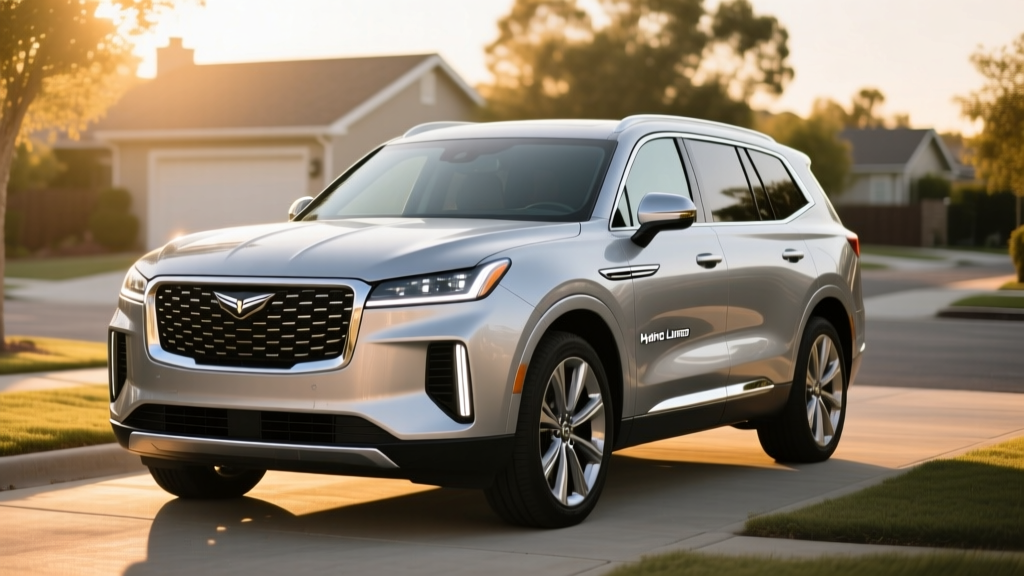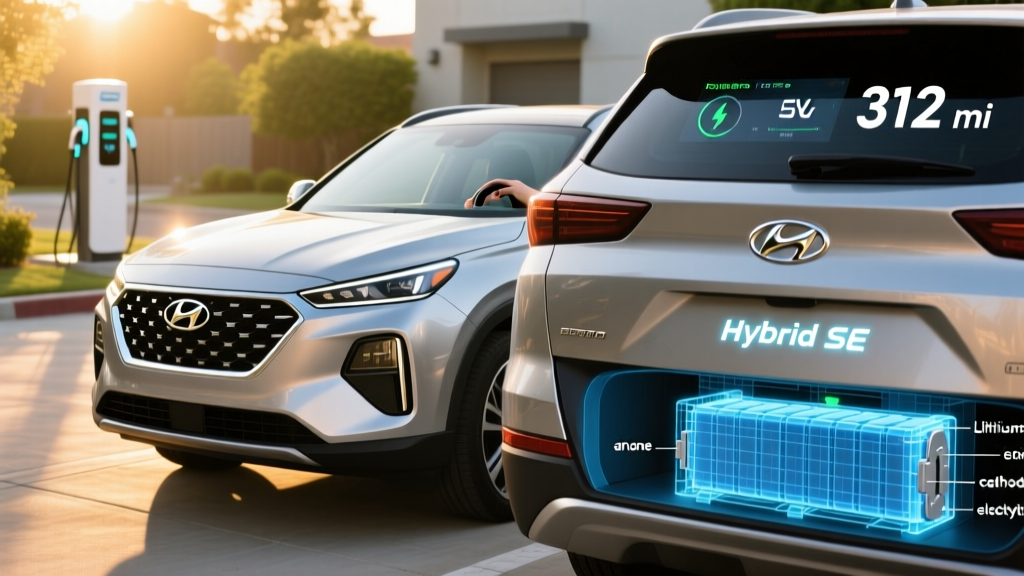
The 2026 Hyundai Santa Fe Hybrid SE occupies a specific niche: a three-row midsize SUV that sips fuel without requiring a charger, a plug, or any change to your daily routine. For buyers who want electrified efficiency but lack home charging access—or who regularly take long road trips where EV infrastructure remains spotty—the Santa Fe Hybrid delivers a compelling compromise. Here's a deep dive into what this base-trim hybrid actually offers, with real numbers and no marketing fluff.
Quick Verdict: Who the Santa Fe Hybrid SE Is For
The Santa Fe Hybrid SE targets families who need three rows, want to cut fuel costs significantly versus a gas-only SUV, and aren't ready to commit to a full battery-electric vehicle. At a starting MSRP of $38,950 (including destination), it undercuts many PHEV and EV competitors while delivering an EPA-estimated 36 MPG combined. It does not qualify for the federal §30D EV tax credit—because it's a conventional hybrid, not a plug-in—but its lower purchase price and strong fuel economy often produce a lower total cost of ownership over five years anyway.
| Spec | Value |
|---|---|
| EPA Fuel Economy (City / Hwy / Combined) | 36 / 35 / 36 MPG |
| Powertrain | 1.6L Turbo GDI 4-cyl + electric motor |
| Combined Horsepower | 232 HP |
| Combined Torque | 271 lb-ft |
| Transmission | 6-speed automatic |
| Drivetrain | AWD (standard on all trims) |
| Hybrid Battery | 1.49 kWh lithium-ion (self-charging HEV) |
| 0–60 MPH | ~7.8 seconds (est.) |
| Towing Capacity | 2,000 lbs |
| Cargo Volume (behind 3rd / 2nd / 1st row) | 14.5 / 41.6 / 79.6 cu ft |
| Base MSRP (SE AWD) | $38,950 |
| Federal Tax Credit (§30D) | Not eligible (HEV, not PHEV/BEV) |
| Hybrid Battery Warranty | 10 years / 100,000 miles |
HEV vs. PHEV: Understanding What You're Buying
Hyundai sells the Santa Fe in three powertrain flavors for 2026: a conventional gas turbo-four, a conventional hybrid (HEV), and a plug-in hybrid (PHEV). The SE trim is available only as the HEV. Understanding the difference matters because it changes everything about how you fuel the vehicle.
| Factor | Santa Fe Hybrid (HEV) | Santa Fe Plug-In Hybrid (PHEV) |
|---|---|---|
| Plug-in Charging Required? | No — refuels at any gas station | Yes — plug in to unlock EV-only range |
| Electric-Only Range | ~0.5–1 mile at very low speeds | ~33 miles EPA (on higher trims) |
| Battery Size | 1.49 kWh | 13.8 kWh |
| Combined Horsepower | 232 HP | 261 HP |
| Federal Tax Credit | None | Up to $7,500 (if eligible under §30D) |
| Starting MSRP | $38,950 (SE) | ~$47,950 (SEL Premium) |
| Best For | No home charger, long trips, simplicity | Home charger, short daily commute |
The bottom line: If you can charge at home and your daily round-trip commute is under 30 miles, the PHEV lets you drive most days on electricity alone. If you lack reliable charging access, frequently drive long distances, or simply don't want to think about plugging in, the HEV is the smarter pick—and the SE trim makes it the most affordable entry point.
Fuel Economy: EPA Numbers and Real-World MPG
According to fueleconomy.gov, the 2026 Hyundai Santa Fe Hybrid AWD earns an EPA estimate of 36 MPG city / 35 MPG highway / 36 MPG combined. That's a meaningful improvement over the gas-only Santa Fe turbo-four, which returns roughly 24 MPG combined—a 50% gain in efficiency.
| Powertrain | City MPG | Highway MPG | Combined MPG |
|---|---|---|---|
| 2.5L Turbo Gas (AWD) | 20 | 28 | 24 |
| 1.6L Turbo Hybrid (AWD) | 36 | 35 | 36 |
| 1.6L Turbo PHEV (AWD) | 33 MPG (gas) / 79 MPGe (elec) | — | 33 MPG / 79 MPGe |
Real-World MPG: What Owners Actually See
Hybrids like the Santa Fe HEV tend to match or even exceed their EPA city estimate in stop-and-go driving because regenerative braking recovers energy that a gas car wastes as heat. In mixed suburban driving with moderate traffic, expect to see 35–38 MPG. On long highway trips at 75+ MPH, efficiency drops slightly—typically to 32–34 MPG—because the electric motor contributes less at sustained high speeds and aerodynamic drag dominates.
In cold weather (below 30°F), expect a 5–10% reduction in fuel economy. The engine runs more frequently to provide cabin heat and maintain operating temperature, reducing the time it can shut off at stops. This is far less severe than the 20–40% range loss a full EV experiences in cold weather, but it's worth noting if you live in northern climates.
EPA Combined: 36 MPG | Real-world suburban: 35–38 MPG | Highway cruising: 32–34 MPG | Cold weather (sub-30°F): 32–34 MPG combined
Powertrain Deep Dive: 232 HP Turbo-Hybrid System
The Santa Fe Hybrid pairs a 1.6-liter turbocharged GDI four-cylinder engine (producing 178 HP and 195 lb-ft of torque on its own) with a 47.7 kW (64 HP) electric motor integrated into the transmission housing. Combined system output is 232 HP and 271 lb-ft of torque, routed through a 6-speed automatic transmission to Hyundai's HTRAC all-wheel-drive system.
This is not a continuously variable transmission (CVT) like the Toyota Highlander Hybrid uses. The 6-speed automatic delivers more natural shift feel and better highway passing response, though it sacrifices a fraction of efficiency versus a CVT in some conditions. The electric motor fills in torque at low RPMs, eliminating the turbo lag you'd feel in a conventional turbo-four and providing smooth, linear acceleration from a stop.
The 1.49 kWh lithium-ion battery pack is small by EV standards—by design. It stores energy recovered during braking and deceleration, then deploys it to assist acceleration or power the electric motor alone at very low speeds (parking lots, traffic crawls). You never plug it in; the system manages charge automatically.
Pricing, Trims, and Tax Credit Eligibility
The 2026 Hyundai Santa Fe Hybrid is offered in three trims, with the SE serving as the value-oriented entry point:
- SE AWD: $38,950 — 12.3-inch dual displays, wireless Apple CarPlay/Android Auto, SmartSense safety suite, cloth seats, 18-inch alloy wheels
- SEL Premium AWD: ~$42,500 — leatherette seats, power liftgate, roof rails, upgraded interior lighting
- Limited AWD: ~$46,950 — Nappa leather, panoramic sunroof, head-up display, premium audio, ventilated front seats
Federal Tax Credit: Does the Santa Fe Hybrid Qualify?
No. The conventional Santa Fe Hybrid (HEV) does not qualify for the IRS §30D Clean Vehicle Credit. That credit is reserved for battery-electric vehicles (BEVs) and plug-in hybrids (PHEVs) that meet battery sourcing, critical minerals, MSRP cap, and buyer income requirements. Since the HEV has no plug-in capability and a battery far below the §30D minimum capacity threshold, it's ineligible.
However, the Santa Fe PHEV (available in SEL Premium and Limited trims only) may qualify for up to $7,500 under §30D, depending on your income, the vehicle's battery component sourcing, and current-year IRS rules. If the PHEV qualifies and you can claim the credit, the effective price gap between the Hybrid SE and the PHEV narrows considerably. Consult a tax professional to verify eligibility for your specific situation.
- Vehicle must be a BEV or PHEV with ≥7 kWh battery capacity
- MSRP cap: $80,000 for SUVs, vans, pickups; $55,000 for sedans
- Buyer AGI limits: $300K joint / $225K head of household / $150K single
- Battery components and critical minerals must meet phased sourcing thresholds
- Credit can be transferred to dealer at point of sale for an upfront price reduction
- Conventional hybrids (HEVs) like the Santa Fe Hybrid SE are NOT eligible
Reliability, Battery Lifespan, and Warranty Coverage
Hybrid battery longevity is consistently the top concern among first-time hybrid buyers. Here's the data: Hyundai's hybrid systems have proven durable across multiple model generations. The Tucson Hybrid and Sonata Hybrid, which share the same 1.6T hybrid architecture, have accumulated hundreds of thousands of real-world fleet miles with very low battery failure rates.
10 years / 100,000 miles (whichever comes first) for the hybrid battery pack and all hybrid-system components including the electric motor, inverter, and regenerative braking system. This is one of the longest hybrid warranties in the industry and applies to the original owner. Subsequent owners receive 10 years/100,000 miles from the vehicle's original in-service date under Hyundai's transferable powertrain warranty.
If the hybrid battery does eventually need replacement outside of warranty, expect a cost in the range of $2,500–$4,000 including labor at a Hyundai dealership. However, modern lithium-ion hybrid batteries are engineered for 15+ years of service in the relatively gentle charge/discharge cycles of an HEV (the battery never fully depletes or fully charges, which dramatically extends cycle life). Most hybrid batteries outlast the vehicle itself.
According to IIHS, the Santa Fe has earned top safety ratings, and Hyundai's SmartSense suite—standard even on the SE—includes forward collision-avoidance assist, blind-spot monitoring, lane-keeping assist, rear cross-traffic alert, and adaptive cruise control with stop-and-go capability.
Santa Fe Hybrid vs. Competitors: How It Stacks Up
| Spec | Hyundai Santa Fe Hybrid SE | Toyota Highlander Hybrid LE | Kia Sorento Hybrid LX |
|---|---|---|---|
| EPA Combined MPG | 36 | 35 | 35 |
| Combined HP | 232 | 243 | 227 |
| Drivetrain | AWD (standard) | AWD (standard) | AWD (standard) |
| Third Row | Yes | Yes | Yes (tight) |
| Cargo (behind 3rd row) | 14.5 cu ft | 16.1 cu ft | 12.6 cu ft |
| Starting MSRP | $38,950 | $42,320 | $38,390 |
| Hybrid Battery Warranty | 10 yr / 100K mi | 10 yr / 150K mi | 10 yr / 100K mi |
| Towing Capacity | 2,000 lbs | 3,500 lbs | 2,000 lbs |
The Santa Fe Hybrid SE delivers the best combined MPG in this group and undercuts the Highlander Hybrid on price by over $3,000. The Highlander wins on towing (3,500 lbs vs. 2,000) and offers slightly more cargo space, but costs more and returns 1 MPG less. The Kia Sorento Hybrid is the closest competitor—nearly identical mechanically, as both share the Hyundai Motor Group platform—but the Santa Fe offers a more squared-off design with better third-row headroom.
Who Should Choose the Santa Fe Hybrid SE?
- Choose the Santa Fe Hybrid SE if: you want three rows, AWD, and 36 MPG without ever plugging in; you don't have reliable home charging; you take frequent road trips; you want the lowest entry price in the Santa Fe Hybrid lineup.
- Choose the Santa Fe PHEV instead if: you have Level 2 home charging and a daily commute under 33 miles; you want to drive most weekdays on electricity alone; you qualify for the §30D tax credit, which narrows the price gap significantly.
- Choose a full EV (e.g., Hyundai Ioniq 5, Tesla Model Y) if: you have reliable home charging, rarely drive more than 250 miles in a single day, want zero tailpipe emissions, and want access to the full $7,500 federal tax credit.
- Stick with the gas Santa Fe if: your annual mileage is very low (under 8,000 miles/year), where the fuel savings of a hybrid won't offset the higher purchase price within your ownership timeline.
- 36 MPG combined — best in its three-row SUV segment
- Standard AWD across all trims
- No plug-in required — zero lifestyle change vs. gas car
- 10-year/100,000-mile hybrid battery warranty
- Competitive pricing at $38,950 base
- Strong standard safety suite (SmartSense)
- Turbo-hybrid torque feels punchy around town
- No federal tax credit eligibility (HEV)
- Third row is tight for adults on long trips
- 2,000-lb towing capacity trails the Highlander Hybrid
- Highway MPG drops at speeds above 75 MPH
- SE trim uses cloth seats (upgrade requires higher trim)
- No DC fast charging capability (not applicable to HEV)
Frequently Asked Questions
How many MPG does the Hyundai Santa Fe Hybrid SE get?
The 2026 Hyundai Santa Fe Hybrid SE earns an EPA estimate of 36 MPG city, 35 MPG highway, and 36 MPG combined. In real-world suburban driving, owners commonly report 35–38 MPG. Highway-only driving at high speeds may return 32–34 MPG.
Does the Santa Fe Hybrid need to be plugged in?
No. The Santa Fe Hybrid is a conventional hybrid (HEV). It charges its small battery through regenerative braking and the gasoline engine. You simply fill up at a gas station as you would with any other car. Only the Santa Fe Plug-In Hybrid (PHEV) requires plugging in to access its ~33-mile electric-only range.
How far can the Santa Fe Hybrid drive on electric power alone?
The conventional hybrid (HEV) can creep on electric power alone for roughly 0.5–1 mile at very low speeds (under 25 MPH), such as in a parking lot or heavy traffic. It is not designed for meaningful electric-only driving. If you want to drive on electricity for extended distances, you need the PHEV variant, which offers approximately 33 miles of EPA-rated electric-only range.
Is the Hyundai Santa Fe Hybrid reliable?
Hyundai's 1.6L turbo-hybrid powertrain has demonstrated strong reliability across the Tucson Hybrid, Sonata Hybrid, and Santa Fe Hybrid since its introduction. The hybrid battery is warranted for 10 years or 100,000 miles. Replacement cost, if needed outside warranty, typically falls between $2,500 and $4,000. In practice, most hybrid batteries last the life of the vehicle.
Does the Santa Fe Hybrid qualify for any tax credits?
The conventional Santa Fe Hybrid (HEV) does not qualify for the federal §30D Clean Vehicle Credit, which is reserved for plug-in vehicles (BEVs and PHEVs). Some states and local utilities offer rebates for hybrid purchases—check your state energy office or utility provider. The Santa Fe PHEV may qualify for up to $7,500 under §30D, subject to income, MSRP, and battery-sourcing requirements. See IRS guidance on the Clean Vehicle Credit for current rules.
What is the difference between the Santa Fe Hybrid SE and higher trims?
The powertrain is identical across all Santa Fe Hybrid trims (SE, SEL Premium, Limited). The SE includes the full SmartSense safety suite, dual 12.3-inch displays, wireless smartphone integration, and 18-inch wheels. Higher trims add luxury features like leather upholstery, a panoramic sunroof, head-up display, and premium audio—but the 36 MPG combined rating and 232 HP output remain the same.
Hybrid vs. PHEV vs. EV — which should I choose?
If you lack home charging or regularly drive 300+ miles in a day, choose the hybrid (HEV). If you have home charging and a short commute but want gas-engine flexibility for road trips, choose the PHEV. If you have home charging, rarely exceed 250 miles daily, and want the lowest per-mile fuel cost plus full tax credit eligibility, choose a BEV. The Santa Fe Hybrid SE is ideal for the first scenario: maximum simplicity with strong efficiency.