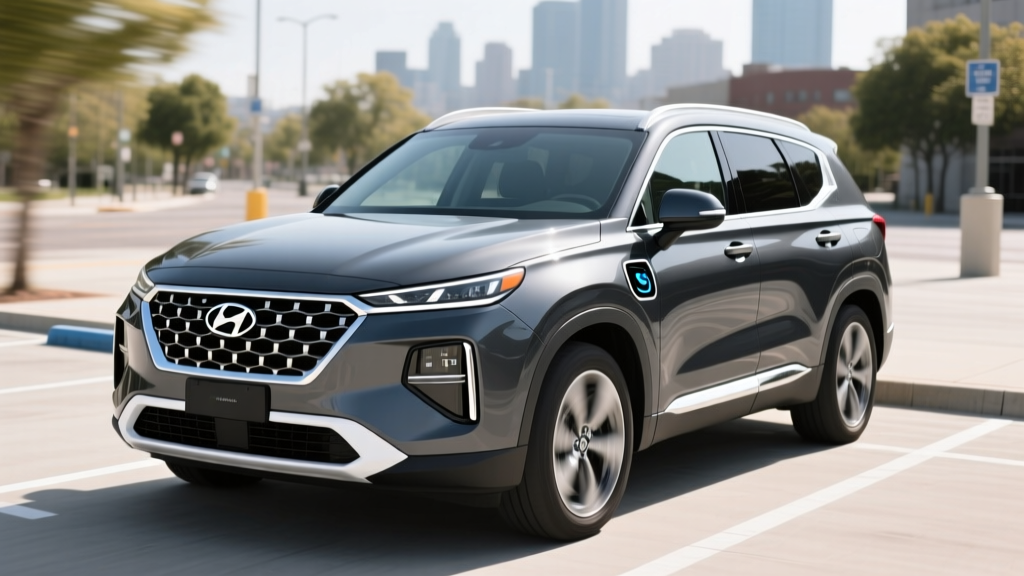
The Hyundai Santa Fe has long been a practical midsize SUV, but the current generation's boxy redesign and hybrid powertrain have made it a standout for families who want serious fuel economy without plugging in. If you've been searching for a santa fe hybrid review that cuts through the marketing and gives you real numbers — EPA MPG, real-world efficiency, ownership costs, and whether the plug-in hybrid variant makes more sense — this is it.
For 2026, Hyundai continues to offer the Santa Fe in two electrified flavors: the conventional Hybrid (HEV) that never needs a plug, and the Plug-in Hybrid (PHEV) that can drive roughly 30 miles on electricity alone before the gas engine kicks in. Both share the same turbocharged 1.6-liter four-cylinder engine paired with an electric motor, but the tuning, battery size, and use cases differ significantly.
HEV vs PHEV: Which Santa Fe Hybrid Is Right for You?
Before diving into specs, it's critical to understand the difference between the two Santa Fe hybrid variants. Confusing them is one of the most common buyer mistakes we see.
| Attribute | Santa Fe Hybrid (HEV) | Santa Fe Plug-in Hybrid (PHEV) |
|---|---|---|
| Plug-in required? | No — self-charging via regen and engine | Yes — plug in to use electric-only range |
| Battery capacity | ~1.49 kWh (small buffer) | ~13.8 kWh usable (NMC lithium-ion) |
| Electric-only driving | Brief low-speed assist only | ~30 miles EPA-estimated |
| Combined horsepower | 230 hp / 271 lb-ft | 261 hp / 271 lb-ft |
| EPA combined MPG | 35 MPG (FWD) / 34 MPG (AWD) | 33 MPG combined (gas) + 76 MPGe (electric) |
| DC fast charging | N/A | No DC fast charge — AC Level 1/2 only |
| Best for | No home charging access; long highway commuters | Home chargers; short daily commutes under 30 mi |
The HEV is the simpler choice: you fill it with gas and drive. The PHEV rewards owners who can charge at home overnight — your daily commute might burn zero gasoline, but you still have a full hybrid system for road trips.
Fuel Economy: EPA Numbers vs Real-World MPG
The headline number for the 2026 Santa Fe Hybrid (HEV) is 35 MPG combined with front-wheel drive, or 34 MPG with all-wheel drive. Here's the full breakdown from fueleconomy.gov:
| Configuration | City | Highway | Combined |
|---|---|---|---|
| Santa Fe Hybrid FWD | 36 MPG | 35 MPG | 35 MPG |
| Santa Fe Hybrid AWD | 35 MPG | 33 MPG | 34 MPG |
| Santa Fe PHEV AWD (gas mode) | 33 MPG | 33 MPG | 33 MPG |
| Santa Fe PHEV AWD (electric) | 76 MPGe combined | ||
Real-World MPG: What to Actually Expect
Hybrids typically exceed their EPA city estimates because regenerative braking recaptures energy that conventional cars waste. In our experience and consistent owner reports, the Santa Fe Hybrid FWD achieves 37–39 MPG in city driving under normal conditions. Highway driving at 70–75 mph tends to land closer to 31–33 MPG — the boxy, SUV aerodynamic profile creates more drag at speed than a sleeker sedan like the Sonata Hybrid.
For the PHEV variant, real-world electric-only range varies with temperature. Expect the full ~30 miles in mild weather (50–80°F), but plan for 22–25 miles in freezing conditions. The battery's internal resistance increases in cold weather, and cabin heating draws significant power — a limitation shared by every PHEV on the market.
Powertrain Specs: What's Under the Hood
Both hybrid variants use Hyundai's Smartstream G1.6 T-GDi turbocharged inline-four paired with a permanent-magnet synchronous electric motor, mated to a 6-speed automatic transmission (not a CVT, which some hybrid buyers prefer for its smoothness).
| Specification | HEV | PHEV |
|---|---|---|
| Engine | 1.6L Turbo I4 | 1.6L Turbo I4 |
| Engine output | 178 hp / 195 lb-ft | 178 hp / 195 lb-ft |
| Electric motor output | 47.7 kW (64 hp) | 74 kW (99 hp) |
| Combined system output | 230 hp / 271 lb-ft | 261 hp / 271 lb-ft |
| Transmission | 6-speed automatic | 6-speed automatic |
| Drivetrain | FWD or AWD (HTRAC) | AWD (HTRAC) standard |
| 0–60 mph (est.) | ~7.8 sec | ~7.2 sec |
| Towing capacity | 2,000 lbs (AWD) | 2,000 lbs |
| Fuel tank | 17.7 gal | 13.7 gal |
| Total range (est.) | ~580 miles | ~430 mi gas + ~30 mi electric |
The PHEV's larger electric motor gives it noticeably quicker off-the-line acceleration, and in electric mode, it's whisper-quiet around town. The HEV's smaller motor still provides solid low-end torque fill, eliminating the turbo lag common in non-hybrid turbo-fours.
PHEV Charging: What You Need to Know
The Santa Fe Plug-in Hybrid carries a 13.8 kWh (usable) lithium-ion battery pack. Here's the charging reality:
| Charging Level | Power | Time (0–100%) | Notes |
|---|---|---|---|
| Level 1 (120V household) | ~1.4 kW | ~10–11 hours | Overnight top-up possible |
| Level 2 (240V home/public) | ~7.2 kW | ~2 hours | Recommended for daily use |
| DC Fast Charge | N/A | N/A | Not supported |
The PHEV uses a standard J1772 connector for Level 1 and Level 2 charging. It does not support DC fast charging — this is typical for PHEVs, as the relatively small battery doesn't justify the added cost and weight of DC hardware. A Level 2 home charger (roughly $500–$1,200 installed) is the practical sweet spot, fully replenishing the battery in about two hours.
Pricing, Trims, and Tax Credit Eligibility
For the 2026 model year, Hyundai positions the Santa Fe Hybrid across several trims. Pricing below reflects manufacturer MSRP before destination charges:
| Trim | HEV MSRP | PHEV MSRP |
|---|---|---|
| SEL Premium | $39,950 | — |
| Limited | $43,950 | $47,550 |
| Calligraphy | $46,950 | $51,050 |
Federal Tax Credit: Does the Santa Fe Hybrid Qualify?
Under current IRS §30D rules, the Santa Fe Plug-in Hybrid may qualify for up to $3,750 of the federal clean vehicle credit, contingent on critical-mineral and battery-component sourcing requirements that shift annually. The conventional HEV does not qualify — §30D requires a minimum 7 kWh battery capacity, which the HEV's ~1.49 kWh pack doesn't meet.
- MSRP must be ≤ $80,000 for SUVs — all trims qualify ✓
- Buyer AGI limits: $150K single / $225K head of household / $300K joint
- Battery components: must meet North American assembly thresholds (verify current-year phase-out %)
- Critical minerals: must meet sourcing thresholds for the additional $3,750
- Credit can be transferred to the dealer at point of sale as a purchase-price reduction
- Consult a tax professional — eligibility depends on your specific situation
State incentives vary widely. California, Colorado, and several other states offer additional PHEV rebates. Check your state's energy office or AFDC state incentive database for current programs.
Battery Warranty, Reliability, and Replacement Costs
Hybrid battery longevity remains the top concern for first-time hybrid buyers. Hyundai addresses this with one of the strongest warranty packages in the industry:
- Hybrid/PHEV battery: 10 years / 100,000 miles (original owner)
- Hybrid system components: 10 years / 100,000 miles
- New vehicle limited warranty: 5 years / 60,000 miles
- Capacity retention: warranty covers defects and significant capacity loss — Hyundai defines this as dropping below approximately 70% of original capacity within the warranty period
Hyundai's hybrid systems have proven reliable in the current generation. The 1.6T Smartstream engine and its associated hybrid electronics have been in use across the Hyundai/Kia lineup since roughly 2022, and major powertrain failures are uncommon in owner surveys. The hybrid battery itself is a lithium-ion polymer pack — not the nickel-metal hydride chemistry found in older Toyota hybrids — and is designed for shallow, frequent cycling rather than deep discharges, which extends lifespan considerably.
If the battery does need replacement outside warranty, expect a cost in the $2,500–$4,500 range for the HEV's smaller pack, or $5,000–$8,000 for the PHEV's larger 13.8 kWh unit, based on current parts pricing and labor. However, most hybrid batteries outlast 150,000+ miles when the thermal management system functions properly.
Who Should Buy the Santa Fe Hybrid — and Who Shouldn't?
- You don't have access to home or workplace charging
- You want a simple ownership experience — just add gas
- Your commute involves heavy stop-and-go traffic where hybrid efficiency shines
- You need three-row seating with 35+ MPG
- You frequently drive highway-heavy routes and want ~580 miles of total range
- You can install a Level 2 charger at home or charge at work daily
- Your typical daily driving is under 30 miles round-trip
- You want near-EV operating costs for commutes plus road-trip flexibility
- You want the extra 31 hp from the larger electric motor
- You may qualify for the §30D federal tax credit
- You have reliable home Level 2 charging
- You rarely drive more than 250 miles without stopping
- You want zero tailpipe emissions and minimal maintenance
- You qualify for the full $7,500 §30D credit on a BEV
- 35 MPG combined (HEV) — class-leading for a 3-row midsize SUV
- Boxy design provides excellent cargo volume and visibility
- Standard third-row seating in hybrid trims
- 10-year/100,000-mile hybrid battery warranty
- PHEV offers ~30 miles electric-only for gas-free commutes
- Quiet, refined cabin with strong tech (dual 12.3" screens, wireless CarPlay/Android Auto)
- Highway MPG drops noticeably — boxy shape creates drag at 70+ mph
- 2,000-lb towing capacity trails V6 and turbo-four competitors
- PHEV fuel tank shrinks to 13.7 gallons, reducing total road-trip range
- No DC fast charging on PHEV (limits public-charging utility)
- Starting MSRP above $39K — hybrid premium over gas-only Santa Fe is ~$3,500
- Third row is best suited for children, not adults on longer trips
Frequently Asked Questions
How many MPG does the 2026 Hyundai Santa Fe Hybrid get?
The Santa Fe Hybrid (HEV) achieves an EPA-estimated 36 city / 35 highway / 35 combined MPG with front-wheel drive, and 35 city / 33 highway / 34 combined with AWD. Real-world city driving often exceeds the EPA figure by 2–4 MPG thanks to regenerative braking, while sustained highway driving at 75 mph may return 31–33 MPG.
How far can the Santa Fe PHEV go on electric only?
The Santa Fe Plug-in Hybrid provides an EPA-estimated 30 miles of electric-only range under ideal conditions. In real-world use, expect 26–30 miles in moderate temperatures and 22–25 miles in freezing weather when cabin heating draws additional power. Once the battery depletes, the vehicle seamlessly transitions to hybrid mode at 33 MPG combined.
Does the Santa Fe Hybrid need to be plugged in?
The conventional Santa Fe Hybrid (HEV) does not plug in at all. It charges its small battery through regenerative braking and the gasoline engine — you simply fill it with gas and drive. Only the Plug-in Hybrid (PHEV) variant requires plugging in to take advantage of its electric-only range. If you never plug in the PHEV, it still functions as a standard hybrid, though you'll miss the efficiency benefit.
Is the Santa Fe Hybrid reliable, and what does a battery replacement cost?
Hyundai's current-generation hybrid powertrain has demonstrated strong reliability since its introduction. The hybrid battery is covered by a 10-year/100,000-mile warranty. Out-of-warranty replacement costs run approximately $2,500–$4,500 for the HEV pack and $5,000–$8,000 for the PHEV pack, though most hybrid batteries last well beyond 150,000 miles with normal use.
Does the Santa Fe Hybrid qualify for a federal tax credit?
The conventional Santa Fe Hybrid (HEV) does not qualify for the §30D federal clean vehicle credit because its battery is below the 7 kWh minimum threshold. The Santa Fe Plug-in Hybrid (PHEV) may qualify for up to $3,750 depending on battery-component and critical-mineral sourcing requirements, which change annually. Buyer income caps ($150K single / $300K joint) and the $80,000 SUV MSRP cap also apply. The credit can be transferred to the dealer at point of sale. Always verify current-year rules at irs.gov and consult a tax professional.
How does the Santa Fe Hybrid compare to the Toyota Highlander Hybrid?
The Toyota Highlander Hybrid achieves 35–36 MPG combined and offers a slightly larger third row, but it lacks a PHEV variant and starts at a higher MSRP. The Santa Fe Hybrid offers more cargo volume behind the second row, a more modern interior design, and the PHEV option for buyers who want electric-only commuting. Both carry strong hybrid battery warranties (Toyota: 10yr/150K mi; Hyundai: 10yr/100K mi).