Quick Verdict: A Boxy Three-Row Hybrid That Actually Delivers
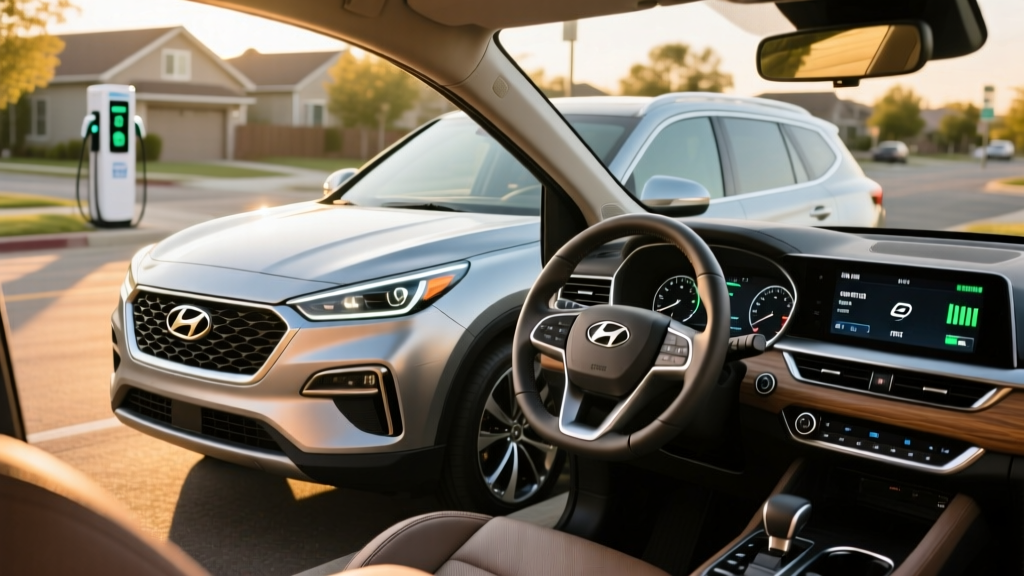
The 2025 Hyundai Santa Fe Hybrid occupies a specific niche: a boxy, design-forward three-row midsize SUV that runs on a conventional hybrid powertrain without requiring a plug. With an EPA-estimated 36 MPG combined and 232 combined horsepower, it targets families who want electrified efficiency without range anxiety or charging infrastructure dependence. For 2025, Hyundai also offers the Santa Fe Plug-in Hybrid (PHEV) variant, which adds 30 miles of electric-only range and eligibility for a partial federal tax credit. This guide covers both, with precise data to help you decide which version — if either — fits your driving pattern.
The Santa Fe Hybrid (HEV) is a conventional hybrid. It charges its small battery through regenerative braking and the gasoline engine. You never plug it in. The Santa Fe Plug-in Hybrid (PHEV) carries a larger battery that you charge from a wall outlet or public charger, enabling roughly 30 miles of pure electric driving before the gas engine engages. Both use the same 1.6L turbocharged four-cylinder engine, but their electric motor sizing, battery capacity, and pricing differ significantly.
Fuel Economy: EPA Numbers and Real-World MPG
Fuel economy is the primary reason buyers cross-shop hybrids. The 2025 Santa Fe Hybrid posts strong EPA figures that, in our experience, tend to be conservative in city driving — a common trait among Hyundai/Kia hybrid systems that favor aggressive regenerative braking in stop-and-go traffic.
| Metric | HEV (Hybrid) | PHEV (Plug-in Hybrid) |
|---|---|---|
| City MPG | 35 MPG | — (electric in city) |
| Highway MPG | 34 MPG | — |
| Combined MPG | 36 MPG | 33 MPG (gas-only mode) |
| Combined MPGe (PHEV) | — | 79 MPGe |
| Electric-Only Range | N/A | 30 miles |
| Total Range | ~600+ miles | ~590+ miles |
| Fuel Tank | 17.7 gal | 15.9 gal |
Real-world MPG reality check: In mixed suburban and city driving, the HEV variant frequently returns 37–39 MPG on the trip computer, thanks to the hybrid system's ability to shut off the engine at stops and coast on electric power. Highway-only driving at 75+ mph drops efficiency to roughly 31–33 MPG — the boxy exterior design creates meaningful aerodynamic drag at speed. Cold-weather driving (below 30°F) typically shaves 2–4 MPG off combined figures as the engine runs longer to heat the cabin and maintain battery temperature. Source: fueleconomy.gov.
For the PHEV, the 30-mile electric-only range is best understood as a daily commute eliminator. If your round-trip commute is under 30 miles and you charge nightly, you may burn gasoline only on longer weekend trips. Once the battery depletes, the PHEV operates as a conventional hybrid at 33 MPG combined — slightly lower than the HEV due to the added weight of the larger battery pack.
Powertrain and Performance Specs
Both the HEV and PHEV share Hyundai's Smartstream 1.6-liter turbocharged GDI four-cylinder engine, but electric motor output and total system horsepower differ.
| Specification | HEV | PHEV |
|---|---|---|
| Engine | 1.6L Turbo GDI I-4 | 1.6L Turbo GDI I-4 |
| Engine HP | 178 hp | 178 hp |
| Electric Motor | 47.7 kW (64 hp) | 74 kW (99 hp) |
| Combined System HP | 232 hp | 268 hp |
| Combined Torque | 271 lb-ft | 271 lb-ft |
| Transmission | 6-speed automatic | 6-speed automatic |
| Drivetrain | AWD standard | AWD standard |
| 0–60 mph (est.) | ~7.6 sec | ~7.0 sec |
| Towing Capacity | 2,000 lbs | 2,000 lbs |
The 232 hp combined output in the HEV provides confident highway merging and passing. The electric motor fills in torque at low RPMs, eliminating the turbo lag common in non-hybrid turbocharged engines. The PHEV's larger 74 kW motor adds 36 more system horsepower, making it noticeably quicker off the line and more capable of sustained electric-only highway driving. Both use a traditional 6-speed automatic rather than a CVT, which gives a more natural acceleration feel that many buyers prefer.
PHEV Battery, Charging, and Electric Range
The Santa Fe PHEV carries a 13.8 kWh lithium-ion polymer battery pack (usable capacity approximately 11.5 kWh) positioned under the cargo floor. This pack enables the EPA-rated 30 miles of electric-only range at speeds up to roughly 75 mph — meaning you can use electric mode on the highway, not just in the city.
| Charging Method | Power | Full Charge Time |
|---|---|---|
| Level 1 (120V household outlet) | ~1.4 kW | ~11 hours |
| Level 2 (240V home/public charger) | ~7.2 kW | ~2 hours |
| DC Fast Charging | Not supported | — |
Critical note: The Santa Fe PHEV does not support DC fast charging. This is standard for most PHEVs in this class — the battery is too small to justify the cost and thermal management complexity of DC hardware. A Level 2 home charger is strongly recommended; charging on a standard 120V outlet overnight will not fully replenish the battery if you drive the full 30-mile electric range daily.
The HEV variant requires no charging infrastructure whatsoever. Its 1.5 kWh battery is charged entirely through regenerative braking and engine-driven generation. You fuel it like any conventional vehicle.
Pricing, Trims, and Tax Credit Eligibility
The 2025 Santa Fe Hybrid and PHEV are priced at a noticeable premium over the gas-only Santa Fe, but the fuel savings and standard AWD help justify the gap over a typical ownership period.
| Trim | HEV MSRP | PHEV MSRP |
|---|---|---|
| SEL Premium | $40,495 | — |
| Limited | $44,495 | $48,495 |
| Calligraphy | $47,495 | $52,495 |
The Santa Fe HEV (conventional hybrid) does not qualify for the federal §30D Clean Vehicle Credit. That credit applies only to plug-in electric vehicles with a battery capacity of at least 7 kWh.
The Santa Fe PHEV may qualify for up to $7,500, but eligibility depends on multiple IRS requirements:
- Buyer AGI must not exceed $150,000 (single) / $300,000 (joint)
- Vehicle MSRP must not exceed $80,000 (SUVs) — all Santa Fe PHEV trims clear this cap
- Battery critical minerals and component sourcing must meet phased-in thresholds for the model year
- Credit can be transferred to the dealer as a point-of-sale discount
Check current eligibility at irs.gov or confirm with your tax professional before purchasing. Sourcing requirements tighten annually, and a vehicle eligible in early 2025 may have different status later in the year.
Many states offer additional rebates or HOV lane access for PHEVs. California's Clean Vehicle Rebate Project (CVRP), for instance, has historically offered up to $1,000–$1,500 for qualifying PHEVs, though funding varies. Check your state's energy office or AFDC state incentives database for current local programs.
Battery Warranty, Reliability, and Replacement Costs
- Hybrid/EV Battery: 10 years / 100,000 miles (whichever comes first)
- Powertrain: 10 years / 100,000 miles
- New Vehicle Limited: 5 years / 60,000 miles
- Battery capacity retention: Hyundai warrants that the hybrid/PHEV battery will maintain at least 70% of original capacity during the warranty period
Hyundai's 10-year/100,000-mile hybrid battery warranty is among the best in the segment, matched only by Kia (same corporate parent) and exceeding Toyota's 10-year/150,000-mile coverage only in mileage. In practice, Hyundai/Kia hybrid batteries have demonstrated strong longevity. The 1.5 kWh HEV battery and 13.8 kWh PHEV battery are both lithium-ion polymer cells with conservative charge/discharge buffers — the system never uses the full capacity, which significantly extends cycle life.
Battery replacement cost (out of warranty): If a hybrid battery does fail outside the warranty window, replacement costs for Hyundai/Kia hybrid packs typically range from $2,000 to $4,500 including labor, depending on whether you source OEM or refurbished cells. The PHEV pack, being larger, trends toward the higher end of that range. For context, most hybrid batteries in this chemistry and size class last 150,000–200,000+ miles before degradation becomes noticeable.
The 2025 Santa Fe is too new for long-term reliability data specific to this generation. However, Hyundai's hybrid systems (shared across the Tucson Hybrid, Sonata Hybrid, and Santa Fe) have accumulated millions of real-world miles. The primary reliability concern historically has been with the hybrid control software and inverter cooling — not the battery cells themselves. Hyundai addressed most early-generation issues by the third generation of this powertrain, which powers the 2025 models.
Who Should Buy the Santa Fe Hybrid vs. a Full EV or Gas SUV?
Choose the HEV If:
- You lack access to home or workplace charging
- Your daily driving exceeds 40 miles regularly
- You want three rows without a $50K+ price tag
- You take frequent road trips and don't want to plan around chargers
- You want AWD for snow/rain without the complexity of plug-in charging
Choose the PHEV If:
- Your daily commute is under 30 miles round-trip
- You can install a Level 2 charger at home (~$500–$1,200 install cost)
- You want to drive mostly electric on weekdays and take gas-powered road trips on weekends
- You qualify for the federal §30D credit (up to $7,500 at point of sale)
- You want HOV lane access in states like CA, CO, or NY
Skip Both — Consider a Full EV If:
- You have reliable home Level 2 charging
- Your daily driving is under 250 miles
- You want zero tailpipe emissions and minimal maintenance
- You qualify for the full $7,500 federal credit on a qualifying BEV
- Models like the Hyundai Ioniq 5, Kia EV9, or Tesla Model Y fit your space needs
Skip Both — Consider Gas-Only If:
- You drive fewer than 8,000 miles/year (fuel savings won't offset hybrid premium)
- You tow over 3,500 lbs regularly (hybrid towing is limited to 2,000 lbs)
- You need the lowest possible purchase price and the gas Santa Fe fits your budget
The math on fuel savings: At 36 MPG combined vs. the gas-only Santa Fe AWD at roughly 24 MPG combined, and assuming 15,000 miles/year at $3.50/gallon, the HEV saves approximately $1,070 per year in fuel. Over a 5-year ownership period, that's roughly $5,350 — enough to offset most of the hybrid premium over the base gas model. The PHEV saves even more if you charge nightly and stay within electric range on most days.
Pros and Cons at a Glance
✓ Pros
- 36 MPG combined is excellent for a three-row AWD SUV
- Boxy design provides genuine third-row usability and cargo volume (40.5 cu ft behind 2nd row)
- Standard AWD on all hybrid trims — no FWD penalty
- 10-year/100,000-mile hybrid battery warranty
- PHEV variant eligible for up to $7,500 federal credit
- Quiet, refined hybrid powertrain with no CVT drone
- Strong standard safety tech (forward collision, blind spot, rear cross-traffic)
✗ Cons
- Highway MPG drops noticeably above 70 mph (aero penalty from boxy shape)
- Hybrid premium over gas model is $4,000–$6,000 depending on trim
- PHEV does not support DC fast charging
- 2,000-lb towing capacity is low for the segment (Kia Telluride tows 5,000 lbs)
- HEV does not qualify for any federal tax credit
- Third row is best suited for children, not adults on long trips
- No spare tire on PHEV (tire repair kit only, due to battery placement)
Frequently Asked Questions
How many MPG does the 2025 Hyundai Santa Fe Hybrid get?
The EPA rates the 2025 Santa Fe Hybrid at 35 city / 34 highway / 36 combined MPG. In real-world suburban driving with moderate stop-and-go traffic, owners commonly report 37–39 MPG. Highway-only driving at 75+ mph typically yields 31–33 MPG due to the vehicle's boxy aerodynamic profile.
How far can the Santa Fe PHEV go on electric only?
The EPA rates the Santa Fe Plug-in Hybrid at 30 miles of electric-only range. In warm weather at moderate speeds (under 55 mph), you may see 32–34 miles. In cold weather (below freezing) or at sustained highway speeds, expect 24–27 miles before the gasoline engine engages.
Does the Santa Fe Hybrid qualify for a federal tax credit?
The conventional Santa Fe Hybrid (HEV) does not qualify for the federal §30D Clean Vehicle Credit — that credit is reserved for plug-in vehicles. The Santa Fe Plug-in Hybrid (PHEV) may qualify for up to $7,500, subject to buyer income limits, battery sourcing requirements, and MSRP caps. Verify current eligibility at irs.gov or with a tax professional before purchasing.
Is the Hyundai Santa Fe Hybrid reliable?
Hyundai's current-generation hybrid powertrain has accumulated millions of miles across multiple models (Tucson, Sonata, Santa Fe) with no widespread systemic failures. The 10-year/100,000-mile hybrid battery warranty provides strong protection. Long-term reliability data specific to the redesigned 2024–2025 Santa Fe generation will take 2–3 more years to fully establish, but the underlying hybrid components are proven.
What does it cost to replace the hybrid battery?
Out of warranty, a Hyundai Santa Fe hybrid battery replacement typically costs $2,000–$4,500 including labor, depending on OEM vs. refurbished sourcing. The PHEV battery, being larger (13.8 kWh vs. 1.5 kWh), costs toward the higher end. Most hybrid batteries in this class last 150,000–200,000+ miles. Hyundai's 10-year/100,000-mile warranty covers premature degradation below 70% capacity.
Can I charge the Santa Fe Hybrid at home?
The conventional HEV requires no charging — it generates electricity through regenerative braking and the engine. The PHEV charges from a standard 120V outlet (Level 1, ~11 hours for a full charge) or a 240V Level 2 home charger (~2 hours). For daily PHEV use, a Level 2 installation is strongly recommended. The PHEV does not support DC fast charging.
How does the Santa Fe Hybrid compare to the Toyota Highlander Hybrid?
The Toyota Highlander Hybrid posts 35–36 MPG combined (similar to the Santa Fe HEV) but offers slightly more third-row space and a longer track record. The Santa Fe Hybrid counters with a more modern interior, standard AWD across all trims (the Highlander Hybrid also offers AWD), a more distinctive design, and available PHEV option. The Highlander Hybrid starts slightly lower in price. Both carry 10-year hybrid battery warranties. If third-row adult comfort is paramount, test-sit in both — the Highlander has a slight edge there.