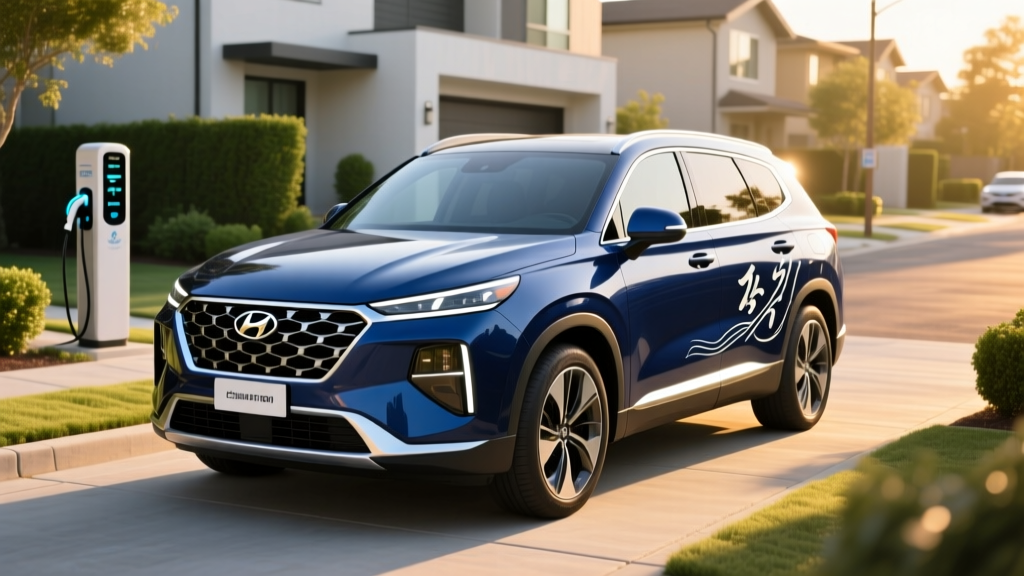
The 2026 Hyundai Santa Fe Calligraphy Hybrid sits at the top of the Santa Fe lineup, pairing a turbocharged hybrid powertrain with premium interior materials and a distinctive boxy design. For buyers who want three-row SUV practicality without the charging commitment of a full EV, this conventional hybrid (HEV) offers a compelling middle ground. Here is the data-driven breakdown of what you actually get for the money.
Quick Verdict: Who the Santa Fe Calligraphy Hybrid Is For
The Santa Fe Calligraphy Hybrid targets families who want a loaded three-row SUV with strong city fuel economy, all-wheel drive, and zero lifestyle changes — no home charger needed, no range planning required. The Calligraphy trim adds Nappa leather, a head-up display, Hyundai's Digital Key, and remote smart parking assist on top of the hybrid powertrain. If you drive primarily in city and suburban conditions, this is where the hybrid system earns its keep. If your daily commute is under 30 miles and you have home charging access, the plug-in hybrid variant (covered below) may serve you better.
HEV vs PHEV: Which Santa Fe Hybrid Fits Your Life?
Hyundai offers the Santa Fe in both a conventional hybrid (HEV) and a plug-in hybrid (PHEV) configuration. The distinction matters enormously for your daily routine and total cost of ownership.
| Attribute | Santa Fe Hybrid (HEV) | Santa Fe Plug-In Hybrid (PHEV) |
|---|---|---|
| Plugs in? | No — self-charging via regen and engine | Yes — Level 2 AC charging |
| Battery size | ~1.5 kWh (small buffer) | 18.1 kWh usable |
| Electric-only range | Not applicable | EPA est. 31 miles |
| Combined horsepower | 230 HP | 268 HP |
| EPA combined MPG / MPGe | 36 MPG combined | 79 MPGe (elec+gas) / 33 MPG (gas-only) |
| DC fast charging | No | No (AC only) |
| Level 2 charge time (0-100%) | N/A | ~3 hr 40 min at 7.2 kW |
| Federal tax credit (§30D) | Not eligible | Up to $7,500 (eligibility varies) |
| Starting MSRP (Calligraphy) | ~$48,900 | ~$52,650 |
The short version: The HEV is simpler and cheaper upfront but ineligible for the federal EV tax credit. The PHEV costs more but can run purely on electricity for most daily errands and may qualify for up to $7,500 in federal credits, effectively narrowing the price gap. Check current IRS §30D rules for income caps, MSRP limits, and battery-sourcing requirements before assuming eligibility.
Fuel Economy: EPA Numbers vs Real-World MPG
The 2026 Santa Fe Calligraphy Hybrid carries EPA ratings of 35 MPG city / 38 MPG highway / 36 MPG combined, per fueleconomy.gov. That is strong for a three-row, 4,500-pound AWD SUV.
| Driving Condition | EPA Estimate | Real-World Expectation |
|---|---|---|
| City | 35 MPG | 36-39 MPG (regen-heavy routes can exceed EPA) |
| Highway (70 mph) | 38 MPG | 32-35 MPG (aero drag and boxy shape hurt at speed) |
| Combined | 36 MPG | 34-37 MPG (depends on city/highway mix) |
| Cold weather (below 30°F) | — | 30-33 MPG (engine runs more for cabin heat) |
Like most hybrids, the Santa Fe HEV actually tends to exceed its EPA city rating in stop-and-go traffic, where regenerative braking recovers energy constantly. Highway driving is the opposite story — the boxy, upright design creates significant aerodynamic drag above 65 mph, and the engine carries the full load without electric assist benefit. On a 400-mile highway road trip at 75 mph, expect closer to 31-33 MPG. In cold weather, fuel economy drops further because the gasoline engine must run continuously to provide cabin heat, reducing the electric motor's contribution.
Powertrain, Performance, and Drivetrain Specs
| Specification | 2026 Santa Fe Calligraphy Hybrid |
|---|---|
| Engine | 1.6L turbocharged inline-4 |
| Electric motor | 47.7 kW permanent-magnet synchronous |
| Combined system output | 230 HP / 271 lb-ft torque |
| Transmission | 6-speed automatic |
| Drivetrain | HTRAC AWD (standard on Calligraphy) |
| 0-60 mph | ~7.8 seconds |
| Towing capacity | 2,000 lbs (braked) |
| Curb weight | ~4,515 lbs |
| Cargo (behind 3rd row) | 14.5 cu ft |
| Cargo (3rd row folded) | 40.5 cu ft |
| Cargo (all rows folded) | 79.6 cu ft |
The 1.6-liter turbo four is paired with a 47.7 kW electric motor integrated into the transmission housing. Combined output of 230 HP provides adequate acceleration for merging and passing, though the 7.8-second 0-60 time won't feel sporty. The HTRAC all-wheel-drive system uses a conventional mechanical rear driveshaft rather than a dedicated rear electric motor, which is simpler and proven but means the rear wheels are not independently torque-controlled the way some EV AWD systems manage. Towing is limited to 2,000 pounds — enough for a small utility trailer or a pair of dirt bikes, but not a boat or camper.
Calligraphy Trim: What You Get for ~$48,900
The Calligraphy is the top-tier Santa Fe trim, and in 2026 it includes:
- Nappa leather seating surfaces with quilted door panels
- Heated and ventilated front seats, heated rear seats, heated steering wheel
- Head-up display (HUD)
- Dual 12.3-inch panoramic curved displays
- Hyundai Digital Key 2 (phone-as-key via NFC/UWB)
- Remote Smart Parking Assist (moves the SUV in/out of tight spots while you stand outside)
- Highway Driving Assist 2 (Level 2 ADAS with lane-centering and adaptive cruise)
- Blind-spot view monitor and surround-view camera
- 12-speaker Bose premium audio
- 20-inch alloy wheels
At approximately $48,900 MSRP (including destination), the Calligraphy Hybrid is priced against luxury-leaning three-row SUVs like the Kia Sorento Hybrid SX Prestige and the Mazda CX-70 PHEV. The destination charge adds roughly $1,395. There are no standalone packages on Calligraphy — it is fully loaded from the factory, with only color selection as a variable.
Tax Credits and Incentives: HEV vs PHEV
This is where the HEV/PHEV distinction has real financial consequences:
- Santa Fe Hybrid (HEV): Does NOT qualify for the federal §30D Clean Vehicle Credit. Conventional hybrids are excluded — only BEVs and PHEVs with sufficient battery capacity are eligible.
- Santa Fe Plug-In Hybrid (PHEV): May qualify for up to $7,500 under §30D, but eligibility depends on: buyer AGI income caps ($150K single / $300K joint), MSRP cap ($80K for SUVs — the Santa Fe PHEV clears this), and critical mineral/battery component sourcing requirements that shift annually.
- Point-of-sale transfer: If eligible, the PHEV credit can be transferred to the dealer at purchase, reducing your out-of-pocket cost immediately rather than waiting for a tax refund.
- State incentives: Vary widely by jurisdiction. Some states (CA, CO, NY) offer additional rebates for PHEVs; most do not offer incentives for conventional HEVs. Check your state energy office for current programs.
For a buyer on the fence between the HEV and PHEV Calligraphy, the potential $7,500 federal credit on the PHEV nearly closes the ~$3,750 MSRP gap between the two powertrains. If you qualify, the PHEV is the mathematically superior choice — you pay roughly the same net price but gain 31 miles of electric-only driving and 268 HP instead of 230.
Battery Warranty, Reliability, and Replacement Cost
Hyundai Hybrid/PHEV Battery Warranty: 10 years / 100,000 miles (whichever comes first) for the original owner. This covers the high-voltage hybrid battery against defects and capacity loss below a defined threshold. In states that follow California emissions warranty rules (CARB states), coverage extends to 10 years / 150,000 miles. The conventional 12V battery carries a separate 3-year/36,000-mile warranty. Hyundai's overall vehicle warranty is 5 years / 60,000 miles bumper-to-bumper and 10 years / 100,000 miles powertrain.
Hyundai's hybrid systems have proven reliable across the Tucson, Sonata, and Santa Fe lineups over multiple model years. The 1.6T hybrid powertrain uses a conventional 6-speed automatic rather than a CVT or e-CVT, which some buyers prefer for its familiar shift feel and long-term serviceability. The high-voltage battery in the HEV is small (~1.5 kWh) and operates within a narrow state-of-charge window, which significantly reduces degradation stress compared to a full EV battery.
Should the hybrid battery require replacement outside of warranty — uncommon before 150,000+ miles based on current field data — expect a cost between $2,500 and $4,000 for the HEV battery pack, and $5,000 to $8,000 for the PHEV's larger 18.1 kWh pack. These figures include parts and labor at a dealership. Independent hybrid specialists may offer refurbished packs at lower cost. For context, most hybrid batteries outlast the vehicle itself when operated within normal parameters.
Santa Fe Hybrid vs PHEV vs Full EV: Decision Framework
Choose the Santa Fe Hybrid (HEV) if:
- You cannot install a home charger (apartment, street parking, no garage)
- You take frequent long road trips and don't want to plan around charging stops
- You want the lowest purchase price and simplest ownership experience
- Your daily driving exceeds 60+ miles, making PHEV electric range insufficient
Choose the Santa Fe Plug-In Hybrid (PHEV) if:
- You have Level 2 home charging and a commute under 30 miles round-trip
- You qualify for the §30D federal tax credit (effectively making the PHEV similar in net cost)
- You want to drive on electricity most weekdays but need gas flexibility for weekend trips
- You value the extra 38 HP (268 vs 230)
Choose a full EV (e.g., Hyundai Ioniq 5, Kia EV9) if:
- You have reliable home charging and your daily driving is under 250 miles
- You want the lowest per-mile energy cost (~$0.04/mile on home electricity vs ~$0.14/mile on gas)
- You want zero tailpipe emissions and minimal maintenance (no oil changes, fewer moving parts)
- You qualify for the full $7,500 federal credit plus any state EV incentives
Pros and Cons
Pros
- 36 MPG combined is excellent for a 3-row AWD SUV
- City MPG often exceeds EPA in real-world stop-and-go driving
- Calligraphy trim is fully loaded — no expensive add-on packages
- 10-year/100,000-mile hybrid battery warranty is among the best
- No charging infrastructure required — fill up at any gas station
- Spacious cargo area with flat-folding second and third rows
Cons
- Highway MPG drops noticeably above 70 mph due to boxy aero
- Not eligible for the federal §30D tax credit (HEV)
- 2,000-lb towing limit is low for the class
- Calligraphy trim starts near $49K — significant upfront cost
- Third row is tight for adults on longer trips
- No DC fast charging option (PHEV variant limited to AC charging)
Frequently Asked Questions
How many MPG does the 2026 Hyundai Santa Fe Calligraphy Hybrid get?
The EPA rates it at 35 MPG city / 38 MPG highway / 36 MPG combined. In real-world driving, expect 36-39 MPG in city conditions and 31-35 MPG on the highway, depending on speed and terrain. Cold weather reduces these figures by roughly 10-15%.
Does the Santa Fe Hybrid need to be plugged in?
No. The conventional hybrid (HEV) charges its small battery through regenerative braking and the gasoline engine. You never plug it in — you simply refuel at a gas station like any other car. Only the Plug-In Hybrid (PHEV) variant requires or benefits from plugging in.
Does the Santa Fe Calligraphy Hybrid qualify for any tax credit?
The conventional hybrid does not qualify for the federal §30D Clean Vehicle Credit. The PHEV variant may qualify for up to $7,500, subject to buyer income limits, MSRP caps, and battery-sourcing rules. Consult a tax professional and review current IRS guidance before purchasing.
Is the hybrid battery reliable, and what does replacement cost?
Hyundai's hybrid batteries have a strong reliability record, backed by a 10-year/100,000-mile warranty. Replacement outside of warranty typically costs $2,500-$4,000 for the HEV pack, but most hybrid batteries last well beyond 150,000 miles under normal use.
How far can the Santa Fe PHEV go on electric only?
The Santa Fe Plug-In Hybrid has an EPA-estimated 31 miles of electric-only range. That covers most daily commutes and errands without using gasoline. Once the battery depletes, it operates as a conventional hybrid at an EPA-rated 33 MPG combined.
How does the Santa Fe Hybrid compare to the Toyota Highlander Hybrid?
The Highlander Hybrid achieves 35 MPG combined (slightly less than the Santa Fe's 36) and offers more third-row space and a higher 5,000-lb towing capacity. However, the Santa Fe Calligraphy offers a more premium interior, more standard tech features, and a lower starting price at the top trim. The Highlander Hybrid also lacks a PHEV option. Both are strong choices — the decision comes down to whether you prioritize interior luxury and PHEV availability (Santa Fe) or towing and third-row room (Highlander).
What safety ratings does the Santa Fe Hybrid have?
The 2026 Santa Fe carries standard Hyundai SmartSense with forward collision avoidance, lane-keeping assist, blind-spot collision avoidance, and rear cross-traffic alert. The Calligraphy trim adds Highway Driving Assist 2 (Level 2 ADAS). Check NHTSA and IIHS for the latest crash-test ratings as they are updated throughout the model year.