Hyundai's three-row SUV lineup received a significant powertrain expansion for 2026: the Palisade now offers a hybrid variant alongside its conventional V6. For families who need maximum passenger and cargo capacity but want to cut fuel costs without range anxiety or plug-in dependence, the Hyundai Palisade Hybrid enters a small but growing segment of electrified three-row haulers. This guide covers everything from the Palisade Hybrid's towing capacity and real-world MPG to battery warranty and how it stacks up against PHEV and full-EV alternatives.
HEV vs PHEV: Which Palisade Are We Talking About?
Before diving into specs, it's critical to understand what Hyundai actually offers. For the 2026 model year, the Palisade is available as a conventional hybrid (HEV). It is not a plug-in hybrid (PHEV) — meaning there is no charge port, no electric-only driving mode, and no home charging requirement. The hybrid system charges its small battery through regenerative braking and the gasoline engine, just like a Toyota Highlander Hybrid.
| Feature | Palisade Hybrid (HEV) | Plug-In Hybrid (PHEV) — e.g., Kia Sorento PHEV |
|---|---|---|
| Plug-in charging? | No — self-charging | Yes — 120V/240V outlet |
| Electric-only range | None (motor assists engine) | Typically 30-40 mi |
| Battery size | ~1.5 kWh (small buffer) | ~13-18 kWh |
| Federal tax credit (§30D) | Not eligible | Up to $7,500 (if eligible) |
| Best for | Drivers without home charging access | Drivers with home chargers and short commutes |
If you're searching for a Hyundai three-row plug-in hybrid, the closest option in the Hyundai-Kia family is the Kia Sorento PHEV, which offers about 32 miles of electric-only range but seats only six or seven and has lower towing capacity. The Palisade Hybrid is strictly a self-charging HEV.
2026 Palisade Hybrid Towing Capacity and Powertrain Specs
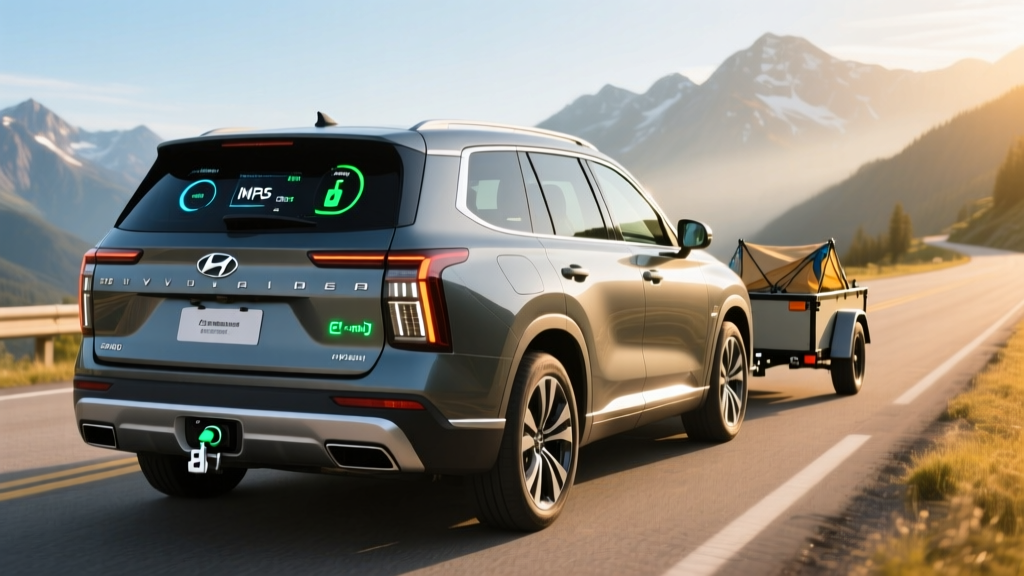
The headline number for many three-row SUV buyers is towing. The 2026 Hyundai Palisade Hybrid is rated for a maximum towing capacity of 3,500 pounds when properly equipped with the factory tow package. This matches the conventional gas-only V6 Palisade (when the gas model is equipped without the optional heavy-duty tow prep) but falls short of body-on-frame competitors like the Ford Explorer Hybrid (5,000 lb) or the Toyota Grand Highlander Hybrid (also 3,500 lb on the standard hybrid, 5,000 lb on the Hybrid MAX).
| Powertrain | 2.5L turbocharged 4-cylinder + electric motor (HEV) |
| Combined Horsepower | ~329 hp (estimated, system combined) |
| Combined Torque | ~400 lb-ft (estimated) |
| Transmission | 6-speed automatic |
| Drivetrain | AWD standard |
| Max Towing Capacity | 3,500 lb (with tow package) |
| Seating | 7 or 8 passengers |
| Cargo (behind 3rd row) | ~21 cu ft |
| Cargo (max, all rows folded) | ~87 cu ft |
| Starting MSRP | ~$48,500 (SEL trim, est.) |
What 3,500 lb gets you in practice: a small boat on a single-axle trailer, a pair of jet skis, a lightweight camping trailer (under 3,000 lb dry), or a utility trailer loaded with landscaping materials. It will not handle a large travel trailer, a horse trailer, or a heavy car-hauler. If you need 5,000+ lb towing from a three-row, you'll need to look at the Ford Explorer, Jeep Grand Cherokee L, or a body-on-frame SUV.
MPG and Real-World Fuel Economy
The primary reason to choose the Palisade Hybrid over the gas V6 is fuel savings. The conventional 3.8L V6 Palisade achieves an EPA-estimated 22 MPG combined (19 city / 24 highway) with AWD. The hybrid powertrain improves on that substantially.
| Powertrain | City MPG | Highway MPG | Combined MPG |
|---|---|---|---|
| Palisade Hybrid AWD | 33 | 30 | 33 |
| Palisade Gas V6 AWD | 19 | 24 | 22 |
| Toyota Grand Highlander Hybrid AWD | 36 | 32 | 34 |
Source: fueleconomy.gov — EPA estimates. Actual mileage varies by driving conditions.
Annual fuel cost savings: At 15,000 miles per year and $3.40/gallon regular unleaded, the gas V6 Palisade costs roughly $2,318/year in fuel. The hybrid at 33 MPG combined drops that to approximately $1,545/year — a savings of about $773 annually. Over a typical 7-year ownership period, that's roughly $5,400 in fuel savings, which largely offsets the hybrid's price premium over the gas model.
Hybrid Battery, Warranty, and Long-Term Reliability
Hybrid battery longevity is the top concern for buyers considering their first electrified vehicle. Here's what you need to know about the Palisade Hybrid's battery system.
The Palisade Hybrid uses a relatively small ~1.5 kWh lithium-ion battery pack — far smaller than a full EV's 70-100 kWh pack or even a PHEV's 13-18 kWh pack. This battery is not designed for standalone electric driving; it buffers energy from regenerative braking and assists the engine during acceleration. Because it's small and operates in a narrow state-of-charge window (typically 40-60%), degradation is minimal.
Hyundai's hybrid system has proven reliable across the Tucson Hybrid, Santa Fe Hybrid, and Sonata Hybrid lineups. The brand's conventional hybrid architecture uses a transmission-mounted electric motor (rather than an e-CVT like Toyota), which some drivers prefer for its more natural shift feel. The 2.5L turbo engine paired with the hybrid system is shared with other Hyundai-Kia products and has accumulated significant real-world mileage data.
Pricing, Trims, and Tax Credit Eligibility
The 2026 Palisade Hybrid is positioned as a premium family hauler. Here's the estimated pricing structure:
- SEL Hybrid: ~$48,500 MSRP
- Limited Hybrid: ~$54,000 MSRP
- Calligraphy Hybrid: ~$58,500 MSRP
Note: Prices are estimates based on Hyundai's pricing trajectory and may vary at launch. Always confirm with your dealer and Hyundai's official newsroom.
For buyers specifically seeking a tax-credit-eligible three-row vehicle, the options are limited to PHEVs and BEVs: the Kia EV9 (BEV, up to $7,500 credit if eligible), the Jeep Grand Cherokee 4xe (PHEV), or the Volvo XC90 Recharge (PHEV). None of these match the Palisade's combination of 8-passenger seating, 3,500-lb towing, and no-plug convenience.
Who Should Choose the Palisade Hybrid — and Who Shouldn't
✓ Choose the Palisade Hybrid If:
- You need 7-8 seats and 3,500-lb towing but want better fuel economy than a gas V6
- You don't have access to home or workplace charging (no plug needed)
- You drive mostly city/suburban routes where hybrid MPG shines
- You want Hyundai's 10yr/100k hybrid warranty peace of mind
- You tow a small boat, jet skis, or light camper on weekends
✗ Look Elsewhere If:
- You need 5,000+ lb towing (consider Ford Explorer or a truck-based SUV)
- You want electric-only commuting (you need a PHEV or BEV)
- You want the federal $7,500 tax credit (HEVs don't qualify)
- You mostly drive highway miles at 80+ mph (hybrid advantage shrinks)
- You want third-row adults on long trips (the Grand Highlander offers more 3rd-row legroom)
Palisade Hybrid vs. the Three-Row Competition
The Palisade Hybrid competes in a narrow band of electrified three-row SUVs. Here's how the key alternatives compare:
| Vehicle | Type | Combined MPG / MPGe | Towing | Seats | Starting MSRP |
|---|---|---|---|---|---|
| Hyundai Palisade Hybrid | HEV | 33 MPG | 3,500 lb | 7-8 | ~$48,500 |
| Toyota Grand Highlander Hybrid | HEV | 34 MPG | 3,500 lb | 7-8 | ~$47,000 |
| Toyota Grand Highlander Hybrid MAX | HEV | 27 MPG | 5,000 lb | 7 | ~$54,000 |
| Kia Sorento PHEV | PHEV | 79 MPGe / 34 MPG | 2,000 lb | 6 | ~$52,000 |
| Kia EV9 | BEV | 88 MPGe | 5,000 lb | 6-7 | ~$56,000 |
| Mazda CX-90 PHEV | PHEV | 56 MPGe / 25 MPG | 3,500 lb | 6-7 | ~$51,000 |
Key takeaways: The Grand Highlander Hybrid edges out the Palisade Hybrid by 1 MPG combined and offers slightly more third-row space, but the Palisade counters with more premium interior materials at the Calligraphy trim and Hyundai's class-leading warranty. If towing is your priority and you want hybrid efficiency, the Grand Highlander Hybrid MAX's 5,000-lb rating is compelling — but it sacrifices fuel economy (27 MPG) and is limited to 7 seats. If you have home charging and a short commute, the Sorento PHEV or CX-90 PHEV could save more fuel on daily drives — but both give up seating capacity and some cargo space.
Real-World Towing and Efficiency: What to Expect
Towing with any hybrid changes the efficiency picture dramatically. When pulling a loaded 3,000-lb trailer, expect the Palisade Hybrid's fuel economy to drop to roughly 15-18 MPG depending on terrain, speed, and wind. This is typical for unibody SUVs in this class — the hybrid system's advantage essentially disappears under heavy tow loads because the engine is doing nearly all the work.
For context, the gas V6 Palisade drops to a similar 14-17 MPG while towing. The hybrid's fuel economy advantage applies primarily to unloaded daily driving — which, for most owners, represents 90%+ of their miles. If you tow every weekend all summer, your annual average MPG will be lower than the EPA sticker, but you'll still save significantly versus the gas model during the other 48 weeks of the year.
Towing tip: Use the Palisade's integrated trailer brake controller (available with the tow package) for any trailer over 1,500 lb. The hybrid's regenerative braking system works in conjunction with the friction brakes, and a trailer brake controller ensures the trailer's brakes share the load rather than overworking the SUV's brake system.
Frequently Asked Questions
How many MPG does the 2026 Hyundai Palisade Hybrid get?
The EPA estimates the Palisade Hybrid at 33 MPG combined (33 city / 30 highway). Real-world highway driving at 75+ mph typically yields 28-30 MPG, while city driving can exceed the EPA estimate thanks to frequent regenerative braking. Cold weather may reduce these figures by 5-10%.
Can the Palisade Hybrid drive on electric power alone?
Only for very short, low-speed maneuvers (e.g., creeping through a parking lot). The Palisade Hybrid is a conventional HEV with a small ~1.5 kWh battery — it cannot sustain electric-only driving at road speeds. If you want meaningful electric-only range, you need a PHEV or BEV.
Does the Palisade Hybrid qualify for a federal tax credit?
No. The federal §30D clean vehicle tax credit applies only to plug-in vehicles (BEVs and PHEVs). Conventional hybrids like the Palisade Hybrid are not eligible. Some states may offer separate hybrid incentives — check with your state's energy office or a tax professional for current programs.
Is the Palisade Hybrid's battery reliable, and what does replacement cost?
Hyundai covers the hybrid battery for 10 years / 100,000 miles. Based on data from Hyundai's Tucson and Santa Fe Hybrid models (and comparable Toyota hybrids), these small HEV battery packs routinely last 150,000+ miles without failure. If replacement is needed post-warranty, expect to pay approximately $2,500 to $4,000 at a dealership.
How does the Palisade Hybrid compare to a full EV like the Kia EV9?
The Kia EV9 offers zero tailpipe emissions, 5,000-lb towing, lower per-mile "fuel" cost (electricity vs gas), and potential §30D tax credit eligibility. However, the EV9 costs more upfront, seats only 6-7, requires access to charging infrastructure, and loses range in cold weather. The Palisade Hybrid is the pragmatic choice if you lack reliable charging access, regularly tow, or frequently drive 400+ mile trips where EV charging stops add significant time.
What can the Palisade Hybrid's 3,500-lb towing capacity actually pull?
At 3,500 lb, you can tow a small fishing boat on a single-axle trailer (~2,500 lb), a pair of personal watercraft (~1,800 lb total), a lightweight teardrop or pop-up camper (~2,000-3,000 lb dry), or a utility trailer with landscaping equipment. It cannot handle large travel trailers, car haulers, or horse trailers — those typically require 5,000+ lb capacity.
For the latest EPA figures, consult fueleconomy.gov. For current federal tax credit rules, see the IRS clean vehicle credits page. For safety ratings, check NHTSA and IIHS as test results become available for the 2026 model year.