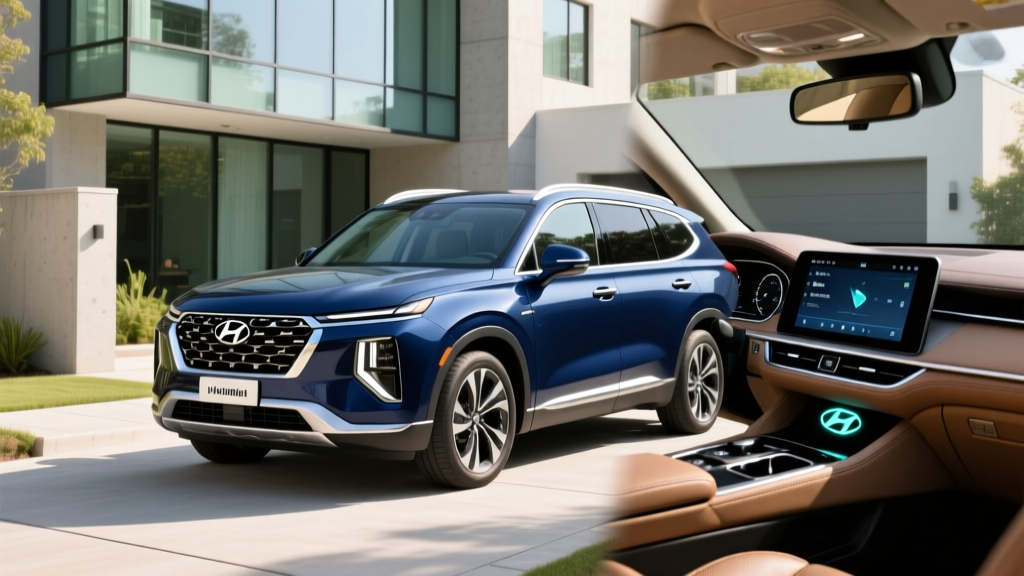
Quick Verdict: The Hybrid Palisade in 2026
The Hyundai Palisade has long been a three-row SUV benchmark for value, space, and tech. With the 2026 Hyundai Palisade Hybrid, the brand finally addresses one of the most common complaints from large-SUV buyers: fuel economy. By pairing a turbocharged four-cylinder engine with an electric motor and a conventional hybrid (HEV) powertrain, Hyundai delivers meaningful MPG gains over the gas-only Palisade without requiring any change in driving habits — no plugging in necessary.
This guide breaks down everything you need to know about the hybrid Palisade lineup for the 2026 model year, including EPA fuel economy, real-world expectations, powertrain specs, battery warranty coverage, pricing, and whether this three-row hybrid is the right fit for your family versus a plug-in hybrid or full battery-electric alternative.
Hybrid Palisade Powertrain: Engine, Motor, and Combined Output
The 2026 Hyundai Palisade Hybrid uses a 1.6-liter turbocharged four-cylinder engine paired with an electric motor integrated into the transmission housing — Hyundai's proven TMED-II (Transmission-Mounted Electric Device) architecture. This is the same hybrid system found in the Hyundai Tucson Hybrid and Kia Sorento Hybrid, but tuned for the Palisade's larger mass and towing demands.
| Specification | Detail |
|---|---|
| Engine | 1.6L turbocharged 4-cylinder |
| Gas Engine Output | ~178 hp / 195 lb-ft torque |
| Electric Motor Output | ~47.7 kW (~64 hp) |
| Combined System Output | ~232 hp / 271 lb-ft torque |
| Transmission | 6-speed automatic (hybrid-optimized) |
| Drivetrain | HTRAC AWD (standard on Hybrid) |
| Battery Type | 1.49 kWh lithium-ion polymer (HEV) |
| Towing Capacity | Up to 4,000 lbs (when properly equipped) |
The combined 232 horsepower and 271 lb-ft of torque provide adequate acceleration for a vehicle in the 4,500-pound range. Expect a 0–60 mph time in the mid-7-second range, which is competitive with other hybrid three-row SUVs. The HTRAC all-wheel-drive system comes standard on hybrid trims, using the rear axle for torque distribution rather than a dedicated rear motor — a cost-effective approach that preserves interior space.
Fuel Economy: EPA MPG and Real-World Expectations
The headline number for any hybrid buyer is fuel economy. Here is how the 2026 Palisade Hybrid stacks up according to EPA estimates on fueleconomy.gov:
| Metric | Palisade Hybrid AWD | Palisade Gas AWD (2.5T) |
|---|---|---|
| City MPG | ~34 MPG | ~19 MPG |
| Highway MPG | ~31 MPG | ~25 MPG |
| Combined MPG | ~33 MPG | ~22 MPG |
| Annual Fuel Cost (est.) | ~$1,950 | ~$2,925 |
The city MPG advantage is where this hybrid Palisade really shines. Stop-and-go traffic, school drop-off lines, and suburban errands allow the electric motor to do heavy lifting, frequently achieving 35–38 MPG in these conditions — nearly double what the gas-only Palisade delivers in the same scenarios.
HEV vs. PHEV vs. EV: Which Palisade Powertrain Fits You?
Conventional Hybrid (HEV)
Plug in? No
Electric-only driving? Brief, low-speed only
Best for: Drivers without home charging access who want better MPG without behavior change
Plug-in Hybrid (PHEV)
Plug in? Yes (optional — drives fine on gas alone)
Electric-only range? ~30–40 miles (typical PHEV SUV)
Best for: Commuters with home Level 2 charging who want EV-like daily driving plus gas flexibility for road trips
Battery Electric (BEV)
Plug in? Yes (required)
Range? 250–320 miles typical
Best for: Home-charging-capable drivers ready to eliminate gas entirely; lowest running costs
The 2026 Palisade Hybrid is a conventional hybrid (HEV). It does not plug in, has no meaningful electric-only range, and operates like a gas car that simply sips less fuel. This is fundamentally different from a plug-in hybrid (PHEV) like the Toyota RAV4 Prime or Kia Sorento PHEV, which offers 30+ miles of electric-only driving before the gas engine engages.
Pricing, Trims, and Tax Credit Eligibility
Hyundai positions the Palisade Hybrid across multiple trim levels, typically starting at the SEL Premium tier and extending through Limited and Calligraphy. Here is the estimated pricing structure for 2026:
| Trim Level | Estimated MSRP | Key Features |
|---|---|---|
| SEL Premium | ~$47,500 | Hybrid powertrain, HTRAC AWD, leatherette, 12.3" dual screens |
| Limited | ~$52,000 | Nappa leather, HUD, premium audio, ventilated 2nd row |
| Calligraphy | ~$56,500 | Quilted leather, massaging front seats, digital key, premium wheels |
Federal Tax Credit: What Hybrid Palisade Buyers Need to Know
This is a critical distinction that catches many buyers off guard: the conventional hybrid Palisade does NOT qualify for the federal §30D new clean vehicle tax credit. That credit, worth up to $7,500, applies only to battery-electric vehicles (BEVs) and plug-in hybrids (PHEVs) that meet battery sourcing, critical mineral, MSRP cap, and buyer income requirements as outlined by the IRS.
- HEV (conventional hybrid): No federal §30D credit. May qualify for certain state-level clean vehicle rebates depending on your jurisdiction — check your state energy office.
- PHEV (if offered in future): Could qualify for up to $7,500 federal credit, subject to MSRP caps ($80,000 for SUVs), buyer income limits ($300K joint / $150K single), and battery component/critical mineral sourcing requirements.
- Used hybrid purchase: The §25E used clean vehicle credit (up to $4,000) also requires the vehicle to be a PHEV or BEV — conventional hybrids are excluded.
Consult a tax professional for your specific situation. Tax credit rules are subject to change and have specific eligibility requirements that vary by buyer and vehicle configuration.
Battery Warranty, Reliability, and Replacement Cost
Hyundai provides one of the strongest hybrid battery warranties in the industry:
• Hybrid/EV Battery: 10 years / 100,000 miles (whichever comes first)
• Hybrid System Components: 10 years / 100,000 miles
• Basic Vehicle Warranty: 5 years / 60,000 miles
• Powertrain Warranty: 10 years / 100,000 miles
This warranty covers battery capacity loss below a specified threshold (typically 70% state of health) and defects in hybrid system components including the electric motor, inverter, and control electronics. Hyundai's hybrid battery warranty transfers to the second owner on 2026 models, adding resale value.
Is the Hybrid Palisade Reliable?
Hyundai's 1.6T hybrid powertrain has been in service since 2020 across the Tucson, Santa Fe, Sorento, and Kia Niro lineups. Real-world reliability data from hundreds of thousands of vehicles on the road shows this system to be robust. The TMED-II architecture avoids the complexity of a power-split device (as used in Toyota hybrids), instead using a conventional automatic transmission with the motor sandwiched between the engine and gearbox.
The 1.49 kWh hybrid battery in the Palisade HEV is small and operates within a narrow state-of-charge window (roughly 40–60% SoC), which significantly reduces stress on the cells and extends longevity. Hyundai's hybrid batteries are engineered for the life of the vehicle under normal operating conditions.
Battery Replacement Cost
If the hybrid battery does fail outside of warranty — a rare occurrence based on current data — replacement costs for Hyundai's HEV battery packs typically range from $2,000 to $4,000 including parts and labor. This is substantially less than a full EV battery replacement ($8,000–$20,000+) because the HEV battery is small (1.49 kWh vs. 70+ kWh in a BEV). Individual cell modules can sometimes be replaced rather than the entire pack, further reducing cost.
Who Should Buy the Hybrid Palisade — and Who Shouldn't?
✓ Choose the Hybrid Palisade If:
- You need three rows and AWD but want to cut fuel costs by 30–40%
- You don't have access to home or workplace charging (no plug needed)
- Most of your driving is city/suburban where hybrids excel
- You want a proven hybrid system with a 10-year battery warranty
- You tow occasionally (4,000-lb rating) and want hybrid efficiency
- You're not ready to commit to a full EV or PHEV lifestyle
✗ Look Elsewhere If:
- You want electric-only driving for your daily commute (consider a PHEV)
- You have reliable home Level 2 charging and want the lowest per-mile cost (a BEV like the Kia EV9 delivers ~$0.04/mile vs. ~$0.12/mile for the hybrid)
- You want the federal $7,500 tax credit (HEVs don't qualify)
- You drive mostly highway miles at high speed (the hybrid advantage shrinks to ~5–8 MPG over gas)
- You prioritize maximum acceleration over efficiency
Hybrid Palisade vs. Three-Row Competition
The Palisade Hybrid enters a growing segment of electrified three-row SUVs. Here is how it compares to key rivals:
| Vehicle | Type | Combined MPG | Seats | Starting MSRP (est.) |
|---|---|---|---|---|
| Hyundai Palisade Hybrid | HEV | ~33 MPG | 7–8 | ~$47,500 |
| Toyota Grand Highlander Hybrid | HEV | ~36 MPG | 7–8 | ~$47,000 |
| Kia Sorento Hybrid | HEV | ~35 MPG | 6–7 | ~$40,000 |
| Toyota Grand Highlander Hybrid MAX | HEV | ~28 MPG | 7–8 | ~$53,000 |
| Kia EV9 | BEV | ~85 MPGe | 6–7 | ~$56,000 |
The Toyota Grand Highlander Hybrid holds a slight fuel-economy edge thanks to Toyota's fourth-generation hybrid synergy drive, but the Palisade Hybrid counters with more premium interior materials, a longer standard warranty (10yr/100k vs. Toyota's 8yr/100k hybrid battery), and Hyundai's strong safety technology suite including Highway Driving Assist 2 and forward collision avoidance.
Ownership Costs: 5-Year Projection
Here is a simplified 5-year / 75,000-mile ownership cost comparison between the Palisade Hybrid and the gas-only Palisade, assuming 15,000 miles per year and $3.50/gallon average fuel price:
| Cost Factor | Palisade Hybrid (~33 MPG) | Palisade Gas AWD (~22 MPG) |
|---|---|---|
| Total Fuel Cost | ~$7,955 | ~$11,932 |
| Fuel Savings (5 yr) | ~$3,977 saved with Hybrid | |
| Estimated Maintenance | ~$2,800 | ~$3,200 |
| Insurance (avg.) | ~$9,500 | ~$9,000 |
The hybrid Palisade saves roughly $4,000 in fuel over five years compared to its gas-only sibling, which partially offsets the hybrid's higher purchase price. Maintenance costs are slightly lower because regenerative braking reduces brake wear, and the engine operates fewer hours thanks to electric assist at low speeds. Insurance premiums may be marginally higher for the hybrid due to its higher replacement-cost valuation.
Frequently Asked Questions
How many MPG does the hybrid Palisade get?
The 2026 Hyundai Palisade Hybrid achieves an EPA-estimated ~34 MPG city, ~31 MPG highway, and ~33 MPG combined with HTRAC AWD. Real-world city driving often matches or slightly exceeds the EPA city estimate, while sustained highway driving and cold weather can reduce combined numbers to 28–30 MPG.
Does the Palisade Hybrid need to be plugged in?
No. The Palisade Hybrid is a conventional hybrid (HEV). It charges its small 1.49 kWh battery through regenerative braking and the gas engine. You fuel it exactly like a regular gas car — just less often.
Does the hybrid Palisade qualify for any tax credit?
The conventional hybrid Palisade does not qualify for the federal §30D clean vehicle tax credit, which is reserved for BEVs and PHEVs meeting specific battery sourcing and MSRP requirements. Some states may offer separate incentives for hybrid vehicles — check your state's energy office or IRS guidelines for current rules.
How long will the Palisade hybrid battery last?
Hyundai warranties the hybrid battery for 10 years / 100,000 miles. Based on data from Hyundai's hybrid fleet in service since 2020, these batteries are designed to last the life of the vehicle. The small 1.49 kWh pack operates in a narrow charge window, minimizing degradation. Out-of-warranty replacement costs $2,000–$4,000 if needed.
Can the hybrid Palisade tow?
Yes. When properly equipped, the 2026 Palisade Hybrid is rated to tow up to 4,000 pounds — sufficient for a small boat, pop-up camper, or light utility trailer. Towing will reduce fuel economy significantly; expect 18–22 MPG while towing depending on trailer weight and terrain.
Is the hybrid Palisade better than the Kia EV9?
They serve different needs. The Palisade Hybrid is ideal if you lack home charging, need maximum flexibility, and want lower fuel costs without any behavioral change. The Kia EV9 is a full electric three-row SUV with ~280 miles of EPA range, qualifies for the federal tax credit, and offers dramatically lower per-mile energy costs — but requires reliable access to charging infrastructure.
What is the difference between the Palisade Hybrid and a PHEV?
A conventional hybrid (HEV) like the Palisade Hybrid uses a small battery charged by the engine and regen braking — it never plugs in and has no electric-only range to speak of. A plug-in hybrid (PHEV) has a larger battery (typically 12–25 kWh), can be plugged into a wall outlet or Level 2 charger, and offers 30–40 miles of electric-only driving before the gas engine takes over. Hyundai does not currently offer a Palisade PHEV.