Quick Verdict: The Palisade Goes Hybrid and Plug-In
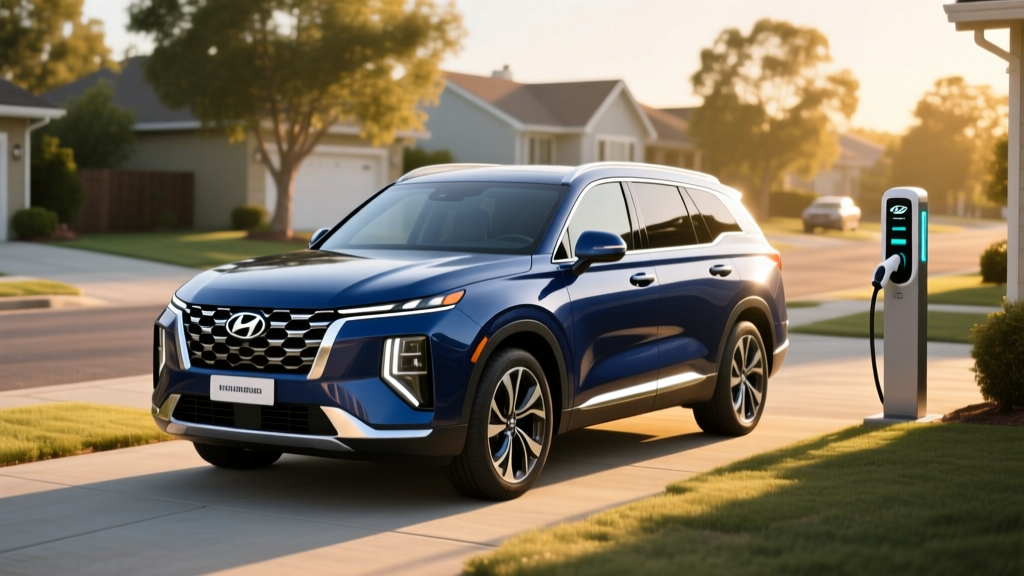
For years, the Hyundai Palisade has been a gas-only, V6-powered three-row SUV. That changes with the redesigned 2026 model year. Hyundai has confirmed a hybrid powertrain lineup for the next-generation Palisade, including both a conventional hybrid (HEV) and a plug-in hybrid (PHEV) variant. This is a significant move — the Palisade now competes directly with the Toyota Grand Highlander Hybrid and the Mazda CX-90 PHEV in the electrified family-hauler segment.
As of early 2026, Hyundai has published preliminary specifications for the Palisade Hybrid and Palisade Plug-in Hybrid. Below, we break down every confirmed and estimated figure — MPG, electric-only range, powertrain output, battery size, charging time, pricing, and tax credit eligibility — so you can decide whether the hybrid or PHEV version fits your household.
2026 Hyundai Palisade Hybrid & PHEV — Key Specifications
| Spec | Palisade Hybrid (HEV) | Palisade Plug-in Hybrid (PHEV) |
|---|---|---|
| Powertrain | 1.6L turbo-4 + electric motor | 1.6L turbo-4 + larger electric motor |
| Combined Horsepower | ~258 hp (est.) | ~320 hp (est.) |
| Drivetrain | AWD standard | AWD standard |
| Battery Capacity | ~1.5 kWh (self-charging) | ~22-25 kWh (usable, est.) |
| EPA Combined MPG / MPGe | ~30-33 MPG (est.) | ~75-80 MPGe combined (est.) |
| EPA City / Highway MPG | ~33 city / ~28 hwy (est.) | ~30-32 MPG gas-only (est.) |
| Electric-Only Range (PHEV) | N/A | ~35-40 miles (est.) |
| Total Combined Range | ~550+ miles | ~480+ miles (gas + electric) |
| DC Fast Charging (PHEV) | N/A | Not expected |
| Level 2 Charge Time (PHEV) | N/A | ~3-4 hours (est. at 7.2 kW) |
| Seating | 7 or 8 passengers | 7 or 8 passengers |
| Estimated Starting MSRP | ~$46,000 | ~$53,000 |
| Battery Warranty | 10 yr / 100,000 mi | 10 yr / 100,000 mi |
Source: Hyundai preliminary specifications and fueleconomy.gov. Final EPA numbers pending certification. Estimates based on Hyundai's Tucson Hybrid/PHEV powertrain scaling.
HEV vs. PHEV: Which Palisade Hybrid Is Which?
This distinction matters enormously for your wallet and daily routine, so let's be precise:
Conventional Hybrid (HEV)
The Palisade Hybrid HEV is a self-charging hybrid. You never plug it in. A small battery (roughly 1.5 kWh) captures energy from regenerative braking and the gasoline engine. The electric motor assists the 1.6-liter turbocharged four-cylinder during acceleration and can propel the SUV at low speeds for very short distances. The result is significantly better fuel economy than a gas-only V6 — expect roughly 30-33 MPG combined versus the outgoing model's ~22 MPG combined.
Plug-in Hybrid (PHEV)
The Palisade Plug-in Hybrid has a much larger battery (estimated 22-25 kWh usable) and a more powerful electric motor. You plug it into a Level 1 (120V) or Level 2 (240V) charger to fill the battery. On a full charge, the PHEV can drive an estimated 35-40 miles on electricity alone — enough for most school runs, grocery trips, and commutes without burning a drop of gas. Once the battery is depleted, it operates as a conventional hybrid using the gas engine.
Fuel Economy Breakdown: Real-World MPG Expectations
Hyundai's 1.6-liter turbo hybrid system is proven in the Tucson and Santa Fe. Scaling it to the larger, heavier Palisade will reduce efficiency somewhat, but the gains over a pure gas engine remain substantial.
EPA MPG Estimates vs. Real-World Expectations
| Metric | Palisade HEV (Est.) | Palisade PHEV Gas-Only (Est.) | Outgoing Gas V6 |
|---|---|---|---|
| City MPG | ~33 | ~31 | 19 |
| Highway MPG | ~28 | ~29 | 24 |
| Combined MPG | ~30-33 | ~30-32 | 22 |
| Real-World Combined (our est.) | ~28-32 | ~28-31 (gas-only mode) | ~20-21 |
Real-world note: Hybrids typically exceed their EPA city ratings in stop-and-go driving because regenerative braking recaptures more energy at lower speeds. On the highway, where the gas engine does most of the work, expect MPG closer to or slightly below the EPA estimate. In cold weather (below 30°F), hybrid fuel economy typically drops 10-15% due to reduced battery efficiency and cabin heating demands.
For the PHEV variant, the MPGe figure (miles per gallon equivalent) reflects efficiency when running on electricity. Once the battery depletes and you're driving on gasoline alone, the PHEV reverts to its gas-only MPG — roughly 30-32 combined. If you charge nightly and drive under 40 miles per day, you could go weeks without visiting a gas station.
Palisade PHEV: Electric-Only Range and Charging Details
The plug-in hybrid's electric-only range is its headline feature. Based on the battery size Hyundai is expected to use and the vehicle's weight, we estimate 35-40 miles of zero-gas driving on a full charge. That aligns with competitors:
- Toyota Grand Highlander Hybrid MAX: HEV only, ~27 MPG combined (no PHEV option)
- Mazda CX-90 PHEV: 26 miles electric-only, 56 MPGe
- Kia Sorento PHEV (corporate cousin): 32 miles electric-only, 79 MPGe
The Palisade PHEV should land near the top of this group in electric range, given its larger battery.
Charging the Palisade PHEV
Like most PHEVs in this class, the Palisade Plug-in Hybrid is expected to support Level 2 AC charging at approximately 7.2 kW. That means a full charge from empty in roughly 3-4 hours on a 240V home charger or public Level 2 station.
Charging Speeds — Palisade PHEV (Estimated)
| Charging Level | Power | Time to Full Charge | Cost per Full Charge (est.) |
|---|---|---|---|
| Level 1 (120V household outlet) | ~1.4 kW | ~16-18 hours | $1.50-$2.50 |
| Level 2 (240V home/public) | ~7.2 kW | ~3-4 hours | $1.50-$2.50 |
| DC Fast Charging | Not supported (expected) | N/A | N/A |
kW vs. kWh reminder: kW (kilowatts) measures charging power — how fast energy flows into the battery. kWh (kilowatt-hours) measures battery capacity — how much energy the battery stores. The Palisade PHEV's ~22-25 kWh battery holds energy; the 7.2 kW onboard charger determines how quickly you refill it.
DC fast charging is not expected on the Palisade PHEV. This is typical for PHEVs — the Kia Sorento PHEV and Mazda CX-90 PHEV also lack DC fast charging. The battery is small enough that Level 2 charging is adequate for overnight replenishment.
Powertrain Deep Dive: What's Under the Hood
Both Palisade hybrid variants use Hyundai's turbocharged 1.6-liter four-cylinder engine paired with an electric motor and a 6-speed automatic transmission. This is a proven architecture already deployed in the Tucson Hybrid, Santa Fe Hybrid, and Kia Sorento Hybrid.
Palisade Hybrid (HEV) Powertrain
- Engine: 1.6L turbocharged inline-4 (~178 hp)
- Electric Motor: ~44 kW (~59 hp), integrated into transmission
- Combined System Output: ~258 hp (estimated)
- Drivetrain: AWD with rear-mounted electric motor assist
Palisade Plug-in Hybrid (PHEV) Powertrain
- Engine: 1.6L turbocharged inline-4 (~178 hp)
- Electric Motor: ~72 kW (~97 hp), larger than HEV
- Combined System Output: ~320 hp (estimated)
- Drivetrain: AWD with enhanced electric rear-axle drive
The PHEV's larger motor and battery give it a meaningful power advantage — roughly 60 additional horsepower over the HEV. That translates to stronger acceleration, with a 0-60 mph time likely in the mid-6-second range for the PHEV versus the low-7-second range for the HEV. For a three-row family SUV, both are more than adequate, but the PHEV feels noticeably more responsive in passing and merging situations.
Pricing, Trims, and Tax Credit Eligibility
The 2026 Palisade Hybrid is expected to start around $46,000 for the HEV in SEL trim, with the PHEV starting near $53,000. Fully loaded Calligraphy or Limited PHEV trims could approach $60,000-$62,000.
Federal Tax Credit — §30D Eligibility
Here's where the math gets interesting — and complicated. Under current IRS §30D rules:
- Conventional Hybrid (HEV): Does NOT qualify for the federal clean vehicle tax credit. The §30D credit applies only to plug-in electric vehicles (BEVs and PHEVs) with a battery capacity of at least 7 kWh.
- Plug-in Hybrid (PHEV): May qualify for up to $7,500 in federal tax credit, but eligibility depends on multiple factors:
§30D Credit Requirements for the Palisade PHEV
- MSRP cap: SUVs must have an MSRP at or below $80,000 (Palisade PHEV clears this easily)
- Buyer income cap: AGI must not exceed $150,000 (single), $225,000 (head of household), or $300,000 (joint)
- Battery sourcing: Critical minerals and battery components must meet phased-in domestic-content thresholds — Hyundai's compliance for 2026 model year is not yet confirmed
- Point-of-sale transfer: Eligible buyers can transfer the credit to the dealer at purchase, reducing the purchase price directly rather than waiting for a tax refund
Bottom line: Do not assume the Palisade PHEV qualifies for the full $7,500. Battery-sourcing requirements have disqualified several Hyundai/Kia models in prior years. Verify eligibility on the official fueleconomy.gov tax credit lookup closer to your purchase date, and consult a tax professional for your specific situation.
Battery Warranty, Reliability, and Long-Term Costs
Hyundai Hybrid Battery Warranty
Hyundai covers the hybrid battery pack and hybrid system components for 10 years or 100,000 miles, whichever comes first. This applies to both the HEV and PHEV variants. The general new-vehicle warranty is 5 years / 60,000 miles, and the powertrain warranty is 10 years / 100,000 miles.
For reference, Hyundai's hybrid battery warranty is among the best in the industry, matching Toyota's 10-year/150,000-mile hybrid battery coverage for most of the period and exceeding many competitors' 8-year/80,000-mile terms.
Hybrid Battery Replacement Cost
This is the question every hybrid buyer asks, and the honest answer: most hybrid batteries outlast the vehicle. Hyundai's 1.6T hybrid system uses a relatively small lithium-ion polymer battery (HEV) or a moderate-size pack (PHEV). Data from Hyundai's Tucson and Sonata Hybrid lineages shows minimal degradation complaints over 100,000+ miles.
If replacement is needed out of warranty, expect:
- HEV battery replacement: $2,000-$3,500 (small pack, lower cost)
- PHEV battery replacement: $6,000-$10,000 (larger pack, higher cost)
These are rough estimates based on current Hyundai hybrid battery pricing and industry averages. Costs are expected to decline as battery production scales. The 10-year/100,000-mile warranty means most original owners will never face this expense.
Reliability Outlook
Hyundai's hybrid powertrains have demonstrated solid reliability in the Tucson, Santa Fe, and Sonata. The 6-speed automatic transmission (no CVT) is a durability positive — Hyundai avoids the belt-driven CVTs that have plagued some competitors. IIHS safety ratings for the outgoing Palisade were strong (Top Safety Pick+), and the redesigned 2026 model is expected to maintain or improve on that. Full NHTSA crash-test results for the 2026 model year were not yet published at the time of writing.
Who Should Buy the Palisade Hybrid — and Who Should Look Elsewhere
Pros
- Significant MPG improvement over gas-only Palisade (~30-33 vs ~22 combined)
- PHEV offers 35-40 miles of electric-only driving for daily commutes
- Three-row seating with hybrid efficiency — rare combination
- 10-year/100,000-mile hybrid battery warranty
- AWD standard on both hybrid variants
- PHEV may qualify for up to $7,500 federal tax credit
- No range anxiety — gas engine provides 500+ mile total range
Cons
- PHEV adds ~$7,000 to the starting price over the HEV
- HEV does not qualify for any federal tax credit
- PHEV DC fast charging not expected (Level 2 only)
- Highway MPG gains are modest — hybrids shine in city driving
- Final EPA numbers not yet certified (estimates may shift)
- PHEV battery reduces cargo space slightly vs. HEV
- Tax credit eligibility depends on sourcing rules that may change
Choose the Palisade Hybrid HEV If:
- You want better fuel economy without changing your habits (no plugging in)
- Your driving is mostly city and suburban, where hybrid efficiency peaks
- You want a simpler, lower-cost hybrid with no charging infrastructure needs
- You don't qualify for the federal PHEV tax credit (income above caps)
Choose the Palisade Plug-in Hybrid If:
- You have access to Level 2 charging at home or work
- Your daily driving is under 40 miles round-trip (maximize electric-only miles)
- You want the performance benefit of ~320 combined horsepower
- You meet the §30D income and sourcing requirements for the tax credit
- You want to reduce gasoline consumption without committing to a full EV
Consider a Full EV Instead If:
- You have reliable home charging and want zero tailpipe emissions
- Your daily driving exceeds 40 miles but is under 250 miles (within EV range)
- You want lower per-mile fuel costs — electricity is typically $0.04-$0.06/mile vs. $0.14-$0.18/mile for gas in a hybrid
- Models like the Kia EV9 (300+ mile range, 3 rows, full EV) or Tesla Model X fit your needs
Frequently Asked Questions
How many MPG does the 2026 Palisade Hybrid get?
The Palisade Hybrid HEV is estimated to achieve approximately 33 MPG city, 28 MPG highway, and 30-33 MPG combined. Real-world results will vary — expect slightly higher MPG in city driving (where regenerative braking helps most) and slightly lower on sustained highway trips. Final EPA certification was pending at the time of publication.
How far can the Palisade PHEV drive on electric only?
The Palisade Plug-in Hybrid is estimated to deliver 35-40 miles of electric-only range on a full charge. This covers most daily commutes, school runs, and errands without engaging the gasoline engine. Once the battery is depleted, the vehicle seamlessly transitions to hybrid mode using the gas engine.
Hybrid vs. PHEV vs. full EV — which is right for my family?
If you cannot charge at home and want maximum simplicity, choose the HEV — it requires no plug and delivers 30+ MPG automatically. If you have home charging and a short commute, the PHEV gives you electric daily driving with gas-engine flexibility for road trips. If you have reliable charging, drive under 250 miles daily, and want the lowest operating cost, a full EV like the Kia EV9 is worth considering.
Is the Palisade Hybrid reliable, and what does a battery replacement cost?
Hyundai's hybrid systems have demonstrated strong reliability across the Tucson, Santa Fe, and Sonata lineages. The hybrid battery is covered by a 10-year/100,000-mile warranty. Out-of-warranty replacement costs are estimated at $2,000-$3,500 for the HEV battery and $6,000-$10,000 for the larger PHEV pack, though most hybrid batteries last the life of the vehicle.
Does the Palisade Hybrid qualify for a tax credit?
The conventional Palisade Hybrid (HEV) does not qualify for the federal §30D clean vehicle tax credit — it applies only to plug-in vehicles. The Palisade Plug-in Hybrid (PHEV) may qualify for up to $7,500, depending on your income, the vehicle's battery sourcing compliance, and the MSRP cap (which the Palisade clears). Verify current eligibility at fueleconomy.gov and consult a tax professional before purchasing.
Do I need to plug in the Palisade Hybrid HEV?
No. The conventional hybrid (HEV) charges its own small battery through regenerative braking and the gasoline engine. You simply fill it with gas like any other vehicle. Only the PHEV variant requires plugging in to access its electric-only range.
Can the Palisade PHEV tow?
Hyundai has not yet published final towing ratings for the 2026 Palisade Hybrid or PHEV. The outgoing gas-only Palisade is rated for 5,000 lbs when properly equipped. Hybrid variants typically see a slight reduction in towing capacity due to added powertrain weight — expect a rating in the 3,500-5,000 lb range, but confirm with Hyundai before ordering if towing is a priority.
Note: Specifications in this article are based on Hyundai's preliminary announcements and estimates derived from the existing Hyundai/Kia hybrid platform. Final EPA-certified figures, pricing, and tax credit eligibility will be confirmed closer to the 2026 Palisade's on-sale date. Always verify with Hyundai's official site and fueleconomy.gov before making a purchase decision.