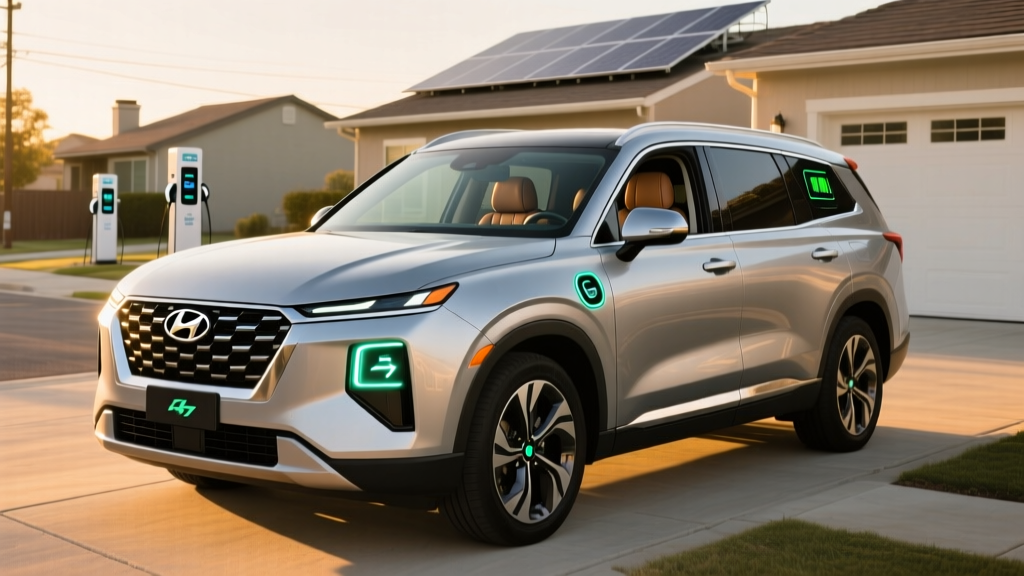
The 2026 Hyundai Palisade Hybrid: A Three-Row Family Hauler Goes Electrified
Hyundai's flagship SUV gets a significant powertrain update for the 2026 model year. The redesigned Palisade now offers a hybrid option alongside the conventional turbocharged four-cylinder, targeting families who need three rows of seating but want to cut fuel costs without committing to a full battery-electric vehicle. With the midsize hybrid SUV segment heating up — Toyota's Grand Highlander Hybrid and Kia's Sorento Hybrid both competing fiercely — the Palisade Hybrid arrives with a turbocharged hybrid system and, in select trims, a plug-in hybrid variant that adds genuine electric-only commuting capability.
This guide breaks down the exact EPA fuel economy figures, powertrain specifications, battery warranty coverage, real-world efficiency expectations, and federal tax credit eligibility so you can determine whether the Palisade Hybrid fits your family's driving pattern.
HEV vs PHEV: Which Palisade Hybrid Is Which?
Hyundai offers the 2026 Palisade in two electrified configurations. Understanding the distinction is essential before comparing trims or calculating fuel savings.
| Feature | Palisade Hybrid (HEV) | Palisade Plug-in Hybrid (PHEV) |
|---|---|---|
| Drivetrain | 1.6L Turbo Hybrid | 1.6L Turbo PHEV |
| Needs to be plugged in? | No — self-charging via regenerative braking and engine | Yes — plug in to access electric-only range |
| Electric-only range | N/A (motor assists engine) | EPA est. 30 miles |
| Battery capacity | 1.65 kWh (lithium-ion) | 17.8 kWh (lithium-ion) |
| DC fast charging | No | No (Level 2 AC only) |
| Combined HP | 232 hp | 268 hp |
| Best for | Families who can't charge at home | Commute-heavy households with home Level 2 |
The conventional hybrid (HEV) requires zero change in behavior. You fill it with gas, and the hybrid system automatically manages the electric motor and engine for maximum efficiency. The plug-in hybrid (PHEV) rewards owners who install a Level 2 home charger with roughly 30 miles of electric-only driving — enough for most daily school runs and commutes — before the gasoline engine engages as a series-parallel hybrid.
Fuel Economy: EPA MPG Breakdown
Fuel economy is the headline reason buyers cross-shop hybrids. Here's what the EPA rates for the 2026 Palisade Hybrid lineup, per fueleconomy.gov:
| Powertrain | City MPG | Highway MPG | Combined MPG | MPGe (PHEV electric mode) |
|---|---|---|---|---|
| Palisade HEV (AWD) | 31 | 28 | 30 | N/A |
| Palisade PHEV (AWD, hybrid mode) | 29 | 27 | 28 | 79 MPGe |
Real-World MPG vs. EPA Estimates
Hybrid vehicles frequently exceed their EPA city ratings in stop-and-go traffic because regenerative braking recaptures energy that a conventional vehicle wastes as heat. In mixed suburban driving with moderate stoplights, expect the Palisade HEV to deliver 31–33 mpg — slightly above its EPA combined rating.
Highway driving tells a different story. At sustained 75–80 mph speeds, the Palisade's boxy three-row aerodynamics and 4,600+ lb curb weight work against efficiency. Expect highway-only trips to return 25–27 mpg for the HEV, roughly 1–3 mpg below the EPA sticker. Cold weather (below 40°F) further reduces efficiency by 10–15% due to cabin heating demands and reduced battery efficiency — a pattern consistent across all hybrids.
For PHEV owners who charge nightly, the effective fuel economy during the electric-only window is measured in MPGe (miles per gallon equivalent). The 79 MPGe rating reflects the energy content of electricity vs. gasoline. Once the battery depletes, the PHEV reverts to its 28 mpg combined hybrid-mode rating.
Powertrain and Performance Specifications
| Specification | Palisade HEV | Palisade PHEV |
|---|---|---|
| Engine | 1.6L turbocharged 4-cylinder | 1.6L turbocharged 4-cylinder |
| Engine output | 178 hp / 195 lb-ft | 178 hp / 195 lb-ft |
| Electric motor | 47.7 kW (64 hp) | 74 kW (99 hp) |
| Combined system output | 232 hp | 268 hp |
| Transmission | 6-speed automatic | 6-speed automatic |
| Drivetrain | AWD (standard) | AWD (standard) |
| 0–60 mph (est.) | ~7.8 sec | ~7.1 sec |
| Towing capacity | 4,000 lbs | 3,500 lbs |
| Battery (traction) | 1.65 kWh lithium-ion | 17.8 kWh lithium-ion |
Both powertrains use Hyundai's Smartstream 1.6-liter turbocharged engine paired with an electric motor integrated into the transmission housing. The PHEV's larger motor and battery deliver noticeably stronger low-end torque, making it the more responsive option for merging and passing. The HEV's 4,000-lb towing capacity gives it a practical edge for boat or small-trailer duty — the PHEV's heavier battery pack reduces its rating to 3,500 lbs.
PHEV Electric-Only Range and Charging
The Palisade PHEV's 17.8 kWh battery delivers an EPA-estimated 30 miles of electric-only range. In real-world commuting with moderate climate control usage, expect 26–32 miles depending on temperature and terrain. Preconditioning the cabin while still plugged in (using the Hyundai app) preserves battery charge for actual driving.
| Charging Method | Power | 0–100% Time | Notes |
|---|---|---|---|
| Level 1 (120V household outlet) | ~1.4 kW | ~12 hours | Emergency/trickle only |
| Level 2 (240V home charger) | 7.2 kW (onboard charger max) | ~2.5 hours | Recommended for daily use |
| DC fast charging | Not supported | N/A | CCS port is AC-only |
The Palisade PHEV does not support DC fast charging. This is typical for plug-in hybrids in this class — the relatively small battery doesn't justify the cost and weight of DC fast-charge hardware. For PHEV ownership to make financial sense, you need reliable overnight Level 2 charging at home. A 240V home charger installation typically costs $500–$1,500 depending on panel proximity and local permit requirements.
Pricing, Trims, and Tax Credit Eligibility
The 2026 Palisade Hybrid lineup starts at approximately $45,500 MSRP for the HEV SEL trim and climbs to roughly $57,000 for a fully loaded PHEV Limited. Exact pricing varies by dealer and destination charges.
| Trim | Powertrain | MSRP (est.) |
|---|---|---|
| SEL | HEV | $45,500 |
| Limited | HEV | $51,000 |
| SEL | PHEV | $51,500 |
| Limited | PHEV | $57,000 |
Federal Tax Credit: §30D Eligibility
The Palisade PHEV may qualify for a partial federal tax credit under IRS §30D, but eligibility depends on several factors that change periodically:
- MSRP cap: SUVs must have an MSRP at or below $80,000 — all Palisade PHEV trims qualify.
- Buyer income cap: Modified AGI must not exceed $150,000 (single) or $300,000 (joint).
- Battery sourcing: Critical minerals and battery components must meet phased-in domestic sourcing thresholds. As of 2026, these requirements are stringent and may reduce the credit to a partial amount or disqualify certain build months.
- Point-of-sale transfer: Eligible buyers can transfer the credit to the dealer for an immediate price reduction at purchase, per IRS guidance.
The conventional HEV does not qualify for the §30D new clean vehicle credit — it lacks the minimum 7 kWh battery capacity threshold. However, the HEV's lower purchase price may offset this advantage over a five-year ownership period.
Always verify current eligibility on the IRS qualified vehicles list before purchasing. Battery sourcing rules tighten annually, and a model that qualifies in January may not qualify in July of the same year. Consult a tax professional for your specific situation.
Battery Warranty, Reliability, and Replacement Cost
Hyundai Hybrid/PHEV Battery Warranty: 10 years / 100,000 miles (whichever comes first), covering defects and capacity loss below a specified threshold. The standard powertrain warranty covers 10 years / 100,000 miles. This is among the strongest hybrid battery warranties in the segment, matching Hyundai's industry-leading coverage. Source: Hyundai USA Warranty.
Hyundai's hybrid systems have demonstrated strong reliability since their introduction in the Ioniq and Sonata Hybrid. The 1.6L turbo-hybrid architecture is now in its second generation, with proven durability data from hundreds of thousands of units in the field.
If the traction battery does require out-of-warranty replacement (typically 12–15+ years into ownership), expect costs of approximately $2,500–$4,000 for the HEV's smaller pack and $5,000–$8,000 for the PHEV's larger 17.8 kWh unit. These are estimates based on current Hyundai hybrid battery pricing and may vary by region and labor rates. Hybrid battery failure before 150,000 miles remains uncommon based on industry data.
Is the Palisade Hybrid Reliable?
Hyundai's hybrid powertrains carry a strong track record, though the 2026 Palisade's redesigned platform is new. First-year models sometimes carry minor software and integration bugs. The 10-year/100,000-mile battery warranty provides substantial protection regardless. Check NHTSA.gov for any active recalls or technical service bulletins as they emerge throughout the model year.
Palisade Hybrid vs. Full EV vs. Gas: Which Fits Your Household?
Choose the Palisade HEV if:
- You can't install a home charger (apartment, street parking, no garage)
- You regularly tow 3,500–4,000 lbs
- You take frequent 400+ mile road trips and don't want to plan charging stops
- You want a lower purchase price and simpler ownership
Choose the Palisade PHEV if:
- You have a garage or driveway where a Level 2 charger can be installed
- Your daily driving is under 30 miles round-trip (school, commute, errands)
- You want near-EV running costs on weekdays with gas flexibility for weekend road trips
- You want the stronger 268 hp powertrain
Choose a full EV (e.g., Kia EV9, Tesla Model X) if:
- You have home charging and your trips rarely exceed 250 miles
- You want zero tailpipe emissions and minimal maintenance (no oil changes, no transmission fluid)
- You qualify for the full $7,500 federal tax credit
- You're comfortable with public DC fast charging on road trips
For families whose driving is 80% local and 20% road trip, the PHEV is the bridge solution — electric commuting without range anxiety on longer hauls. For those who drive 40+ miles daily or take weekly long trips, the HEV's simplicity and 30 mpg combined make it the pragmatic choice.
Pros, Cons, and Final Verdict
Pros
- 30 mpg combined (HEV) is exceptional for a 4,600-lb three-row SUV
- 30 miles of electric-only range (PHEV) covers most daily commutes
- 10-year/100,000-mile battery warranty — best in class
- 4,000-lb towing (HEV) beats most hybrid competitors
- AWD standard on all trims
- Spacious third row and cargo area retained vs. gas model
Cons
- Highway mpg drops to 25–27 under sustained 75+ mph driving
- No DC fast charging on PHEV — limits electric utility on road trips
- PHEV towing reduced to 3,500 lbs
- HEV does not qualify for §30D federal tax credit
- Higher MSRP than gas-only Palisade (~$3,500–$5,000 premium)
- First model year on new platform — potential early-production quirks
The 2026 Hyundai Palisade Hybrid earns its place as one of the most efficient three-row SUVs on the market. The HEV variant is the volume pick — straightforward, no-plug-needed efficiency with strong towing capacity. The PHEV is the enthusiast's hybrid choice for households with charging access and shorter commutes. Either way, the 10-year battery warranty and proven Hyundai hybrid architecture make both variants a defensible long-term buy.
Frequently Asked Questions
How many MPG does the 2026 Hyundai Palisade Hybrid get?
The Palisade HEV is EPA-rated at 31 city / 28 highway / 30 combined mpg. The PHEV rates 29/27/28 mpg in hybrid mode after the battery depletes, plus 79 MPGe in electric mode. Real-world city driving often yields 31–33 mpg for the HEV thanks to regenerative braking, while highway-only driving at 75+ mph typically returns 25–27 mpg.
How far can the Palisade PHEV go on electric only?
The EPA estimates 30 miles of electric-only range. Real-world results vary from 26 miles (cold weather, hilly terrain, heavy climate use) to 32 miles (mild weather, flat suburban roads). Preconditioning the cabin while plugged in extends usable range.
Does the Palisade Hybrid qualify for a tax credit?
The PHEV may qualify for a partial or full federal tax credit under §30D, depending on battery sourcing compliance, buyer income (under $300,000 joint), and MSRP (under $80,000 for SUVs). The conventional HEV does not qualify — it lacks the minimum battery capacity. Verify current eligibility at IRS.gov before purchasing.
Is the Palisade Hybrid reliable, and what does battery replacement cost?
Hyundai's hybrid systems have a strong reliability track record. The traction battery is covered by a 10-year/100,000-mile warranty. Out-of-warranty replacement is estimated at $2,500–$4,000 for the HEV battery and $5,000–$8,000 for the PHEV battery. Failure before 150,000 miles is uncommon based on fleet data.
Do I need to plug in the Palisade Hybrid?
No — the conventional HEV charges its own small battery through regenerative braking and the gasoline engine. You never plug it in. Only the PHEV variant benefits from being plugged into a Level 2 home charger to access its 30-mile electric-only range.
How does the Palisade Hybrid compare to the Toyota Grand Highlander Hybrid?
The Grand Highlander Hybrid rates 36 mpg combined (FWD) or 34 mpg (AWD) — slightly higher than the Palisade's 30 mpg AWD. However, the Palisade offers a PHEV option the Grand Highlander lacks, plus Hyundai's longer 10-year/100,000-mile battery warranty vs. Toyota's 10-year/150,000-mile hybrid battery coverage. The choice comes down to whether you prioritize maximum MPG (Toyota) or PHEV flexibility and a stronger warranty package (Hyundai).