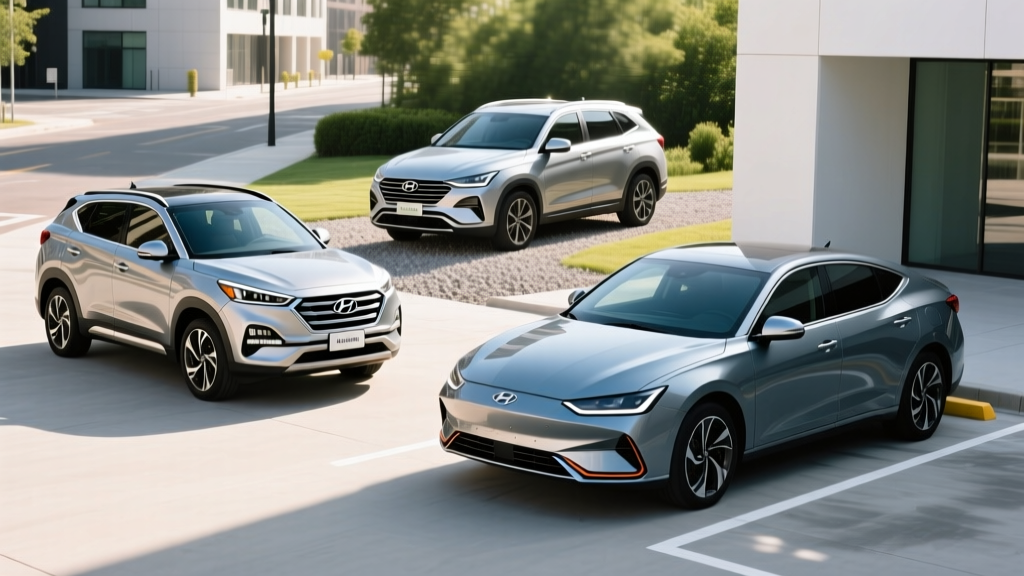
If you're searching for a Hyundai hybrid car in 2026, you have more options than most buyers realize. Hyundai now offers hybrid powertrains across three of its best-selling vehicles — the Elantra sedan, Tucson compact SUV, and Santa Fe midsize SUV — and several of them come in both conventional hybrid (HEV) and plug-in hybrid (PHEV) flavors. That means you can choose a setup that prioritizes simplicity and low upfront cost, or one that lets you commute on electricity alone for 30+ miles before the gas engine kicks in.
This guide breaks down every current Hyundai hybrid and PHEV model with exact EPA fuel economy figures, real-world MPG observations, powertrain specs, battery warranties, pricing, and federal tax credit eligibility. Whether you're trying to dodge rising gas prices, cut tailpipe emissions, or simply avoid the charging-infrastructure headache of a full EV, this is the data you need to pick the right Hyundai hybrid.
Hyundai's Hybrid Lineup at a Glance: HEV vs PHEV Explained
Before we get to specific models, it's critical to understand the difference between Hyundai's two hybrid architectures. Confusing them is the most common mistake hybrid shoppers make.
Conventional Hybrid (HEV)
- No plug required. The battery recharges through regenerative braking and the gasoline engine.
- Small battery (typically 1.5–2.0 kWh) — enough to assist the engine and enable brief electric-only driving at low speeds.
- Goal: Maximize fuel economy with zero behavior change. You fuel up at a gas station like normal.
- Models: Elantra Hybrid, Tucson Hybrid, Santa Fe Hybrid.
Plug-In Hybrid (PHEV)
- Plugs in to charge. A larger battery (13.8–18.0 kWh) stores enough energy for 30–40+ miles of electric-only driving.
- Gas engine as backup. Once the battery depletes, the vehicle operates as a conventional hybrid — no range anxiety.
- Goal: Electric commuting with gas-powered road-trip flexibility.
- Models: Tucson PHEV, Santa Fe PHEV.
Key rule: A conventional HEV never needs to be plugged in. If you don't have access to a home charger or workplace outlet, stick with the HEV. If you can plug in nightly, the PHEV's electric-only range can eliminate most of your gasoline use.
2026 Elantra Hybrid: The MPG Champion
The Elantra Hybrid is Hyundai's most fuel-efficient vehicle and one of the most efficient non-plug-in cars sold in the U.S. It pairs a 1.6-liter GDI four-cylinder engine with an electric motor and a 6-speed automatic transmission — no CVT here, which gives it a more natural driving feel than some competitors.
| Spec | Elantra Hybrid Blue | Elantra Hybrid Limited |
|---|---|---|
| Combined Horsepower | 139 hp | |
| Engine | 1.6L GDI 4-cyl + electric motor | |
| Transmission | 6-speed automatic | |
| Battery | 1.32 kWh lithium-ion polymer | |
| EPA City MPG | 54 | 49 |
| EPA Highway MPG | 58 | 52 |
| EPA Combined MPG | 56 | 50 |
| 0–60 mph | ~9.2 sec (est.) | |
| Starting MSRP | ~$29,650 | ~$33,400 |
| Federal Tax Credit | Not eligible (§30D requires plug-in capability) | |
Real-World MPG: Better Than the Sticker?
Hybrids often exceed their EPA estimates in city driving, where regenerative braking recovers the most energy. In mixed suburban commuting, owners regularly report 55–60 MPG in the Blue trim. Highway driving at 75+ mph is where the Elantra Hybrid's efficiency dips slightly — expect 48–52 MPG in real-world highway cruising. Cold weather (below freezing) can knock 3–5 MPG off combined figures due to increased engine runtime for cabin heating.
2026 Tucson Hybrid and Tucson PHEV: The Compact SUV Sweet Spot
The Tucson is Hyundai's best-selling SUV, and the hybrid variants are the ones most buyers should consider. The conventional Tucson Hybrid delivers meaningful fuel savings over the gas-only model, while the Tucson PHEV adds genuine electric-only commuting capability.
| Model | City MPG | Highway MPG | Combined MPG | EV-Only Range | Combined HP |
|---|---|---|---|---|---|
| Tucson Hybrid (AWD) | 38 | 38 | 38 | N/A | 232 hp |
| Tucson PHEV (AWD) | 35 (hybrid mode) | 35 | 35 | 33 mi | 268 hp |
Tucson PHEV: Battery, Charging, and Electric Range
The Tucson PHEV uses an 18.0 kWh lithium-ion polymer battery (approximately 13.8 kWh usable) paired with a 1.6-liter turbocharged GDI engine. Here's what you need to know about charging:
- Level 1 (120V household outlet): ~10–12 hours for a full charge. Feasible for overnight if your daily commute is short.
- Level 2 (240V home charger, 7.2 kW onboard charger): ~2.5–3 hours from empty to full. This is the recommended home charging method.
- DC fast charging: Not available. The Tucson PHEV does not support DC fast charging — a limitation shared with most PHEVs in this segment.
The EPA rates the Tucson PHEV at 33 miles of electric-only range. In real-world conditions with moderate temperatures and suburban speeds, expect 28–35 miles. Highway-speed electric-only driving at 70 mph will reduce that to roughly 22–25 miles. In cold weather (below 32°F), plan for 20–25 miles of EV range due to battery efficiency loss and cabin heating demand.
Hyundai Hybrid & PHEV Battery Warranty
All Hyundai hybrid and PHEV models carry one of the best battery warranties in the industry:
- Hybrid/PHEV battery: 10 years / 100,000 miles (whichever comes first)
- Hybrid system components (motor, inverter, etc.): 10 years / 100,000 miles
- Capacity retention threshold: Hyundai replaces or repairs the battery if it falls below approximately 70% of original capacity during the warranty period
- Transferability: The 10-year warranty applies to the original owner; second owners receive 5 years / 60,000 miles on most components
For reference, a hybrid battery replacement outside of warranty typically costs $2,500–$4,000 for HEV models and $5,000–$8,000 for PHEV models (parts and labor). However, Hyundai's lithium-ion polymer packs have shown strong longevity — most hybrid owners never need a replacement within normal ownership cycles.
2026 Santa Fe Hybrid and Santa Fe PHEV: Three-Row Efficiency
The redesigned Santa Fe offers standard third-row seating and available hybrid powertrains — a rare combination. If you need family-hauling space but want to avoid the fuel cost of a body-on-frame SUV, the Santa Fe hybrid lineup deserves a serious look.
| Spec | Santa Fe Hybrid (AWD) | Santa Fe PHEV (AWD) |
|---|---|---|
| Engine | 1.6L turbo GDI + electric motor | 1.6L turbo GDI + electric motor |
| Combined Horsepower | 232 hp | 268 hp |
| Transmission | 6-speed automatic | 6-speed automatic |
| Battery | 1.49 kWh Li-ion polymer | 18.0 kWh Li-ion polymer |
| EPA Combined MPG | 34 | 33 (hybrid mode) / 79 MPGe (EV+gas) |
| EPA City / Highway | 35 / 32 | 33 / 33 (hybrid mode) |
| Electric-Only Range | N/A | 31 mi |
| Total Range (gas + electric) | ~530 mi | ~470 mi |
| Level 2 Charge Time (full) | N/A | ~2.5–3 hrs (7.2 kW) |
| DC Fast Charging | N/A | No |
| Starting MSRP | ~$42,200 | ~$47,900 |
The Santa Fe PHEV's 31-mile electric range is enough to cover the average American's one-way commute, according to fueleconomy.gov data. Combined with its 14.8-gallon fuel tank, total range exceeds 470 miles — meaning you could drive from New York to Washington, D.C., on a single tank plus a full charge, with margin to spare.
Federal Tax Credits: Which Hyundai Hybrids Qualify?
This is where the distinction between HEV and PHEV matters most for your wallet.
- Conventional Hybrids (Elantra Hybrid, Tucson Hybrid, Santa Fe Hybrid): Do NOT qualify for the federal §30D Clean Vehicle Credit. The IRS requires plug-in capability with a minimum battery capacity of 7 kWh.
- Tucson PHEV: May qualify for up to $3,750 (partial credit) depending on battery component and critical mineral sourcing requirements under current IRS §30D rules. Full $7,500 credit eligibility depends on sourcing compliance, which changes periodically.
- Santa Fe PHEV: Same §30D eligibility framework as Tucson PHEV — up to $3,750–$7,500 depending on current-year sourcing rules.
Important caveats for PHEV credit eligibility:
- Income caps: Modified AGI must not exceed $150,000 (single), $225,000 (head of household), or $300,000 (joint).
- MSRP caps: SUVs/vans must be under $80,000; sedans under $55,000. Both Tucson and Santa Fe PHEVs fall under the SUV cap.
- Point-of-sale transfer: As of 2024, eligible buyers can transfer the credit to the dealer at purchase, reducing the sale price immediately rather than waiting for a tax refund.
- Sourcing rules change: Battery component and critical mineral requirements tighten annually. Always verify current-year eligibility on irs.gov or with a tax professional before purchasing.
Hybrid vs PHEV vs Full EV: Which Hyundai Fits Your Life?
Choose a Hyundai HEV (Elantra/Tucson/Santa Fe Hybrid) if:
- You have no access to home or workplace charging
- You want maximum fuel savings with zero behavior change
- Your budget is tighter and you don't want the PHEV price premium ($3,000–$6,000 more)
- You drive mostly city/suburban miles where hybrids shine (50+ MPG in the Elantra)
Choose a Hyundai PHEV (Tucson/Santa Fe PHEV) if:
- You can install a Level 2 charger at home or plug in at work nightly
- Your daily round-trip commute is under 30–35 miles (you'll rarely use gas)
- You take occasional road trips and don't want to plan around charging stations
- You want to reduce gasoline consumption dramatically without full EV commitment
Choose a full EV (e.g., Ioniq 5, Ioniq 6) if:
- You have reliable home Level 2 charging
- Your daily driving is under 200 miles and you're comfortable with public DC fast charging for road trips
- You want the lowest per-mile fuel cost (~$0.04–$0.06/mile on home electricity vs $0.12–$0.15/mile in a hybrid)
- You want to qualify for the full $7,500 federal tax credit
Pricing, Ownership Costs, and Value
Hyundai's hybrid lineup carries a price premium over gas-only equivalents, but the fuel savings close the gap over time. Here's a rough 5-year ownership comparison assuming 15,000 miles/year and $3.50/gallon gas:
| Cost Factor | Tucson Gas (AWD) | Tucson Hybrid | Tucson PHEV |
|---|---|---|---|
| Base MSRP (approx.) | $33,000 | $37,500 | $42,500 |
| Fuel cost (5 yrs) | $9,800 | $6,900 | $3,800* |
| Fed. tax credit | $0 | $0 | Up to $3,750 |
| Net 5-yr cost (purchase + fuel − credit) | $42,800 | $44,400 | $42,550 |
*PHEV fuel cost assumes 70% of driving on electricity at $0.14/kWh and 30% on gasoline.
The PHEV's effective cost nearly matches the gas model over five years, especially with the tax credit applied at point of sale. The HEV sits in between — you pay more upfront but save steadily at the pump without any charging infrastructure investment.
Reliability and Long-Term Battery Health
Hyundai's hybrid systems have proven reliable across multiple model generations. The brand's hybrid powertrains use a conventional 6-speed automatic rather than a CVT, which some owners and mechanics consider more durable and less expensive to service long-term.
Key reliability notes:
- Hybrid battery degradation: Hyundai's lithium-ion polymer packs are engineered with conservative charge buffers (you never use 100% of the pack). Most owners report minimal degradation over 5–8 years of ownership.
- Brake wear: Regenerative braking significantly reduces wear on friction brakes. Many hybrid owners report original brake pads lasting 80,000+ miles.
- IIHS safety: The Tucson and Santa Fe have earned strong ratings from the Insurance Institute for Highway Safety, with Top Safety Pick designations on recent models.
- Maintenance: Hybrids require the same routine maintenance as gas cars (oil changes, coolant, cabin filters) but with less brake wear and no transmission-fluid concerns on the sealed 6-speed units.
Frequently Asked Questions
How many MPG does the Hyundai Elantra Hybrid get?
The 2026 Elantra Hybrid Blue achieves an EPA-estimated 54 city / 58 highway / 56 combined MPG. The Limited trim, with its larger wheels and additional equipment, drops to 49 city / 52 highway / 50 combined. Real-world city driving often exceeds EPA estimates by 2–4 MPG thanks to aggressive regenerative braking in stop-and-go traffic.
How far can the Tucson PHEV go on electric only?
The EPA rates the Tucson PHEV at 33 miles of electric-only range. In real-world suburban driving at moderate temperatures, expect 28–35 miles. Highway-speed EV driving and cold weather will reduce this to 20–25 miles. The Santa Fe PHEV is rated at 31 miles with similar real-world variance.
Do Hyundai conventional hybrids need to be plugged in?
No. The Elantra Hybrid, Tucson Hybrid, and Santa Fe Hybrid are conventional (self-charging) hybrids. Their small batteries recharge through regenerative braking and the gasoline engine. You fuel them at a gas station exactly like a regular car. Only the Tucson PHEV and Santa Fe PHEV require plug-in charging to access electric-only range.
Is the Hyundai hybrid battery expensive to replace?
Outside of warranty, a Hyundai HEV battery replacement typically costs $2,500–$4,000, while a PHEV battery runs $5,000–$8,000. However, Hyundai covers hybrid and PHEV batteries for 10 years / 100,000 miles, and these packs rarely fail within that period. Most hybrid owners will sell or trade the vehicle before any battery replacement is needed.
Does any Hyundai hybrid qualify for the federal tax credit?
Only the PHEV models (Tucson PHEV and Santa Fe PHEV) are eligible for the federal §30D Clean Vehicle Credit, and the amount varies — currently up to $3,750–$7,500 depending on battery sourcing compliance. Conventional hybrids (HEVs) do not qualify for any federal purchase credit. Always check current IRS rules before buying, as sourcing requirements tighten annually.
Hyundai hybrid vs Toyota hybrid — which is better?
Toyota pioneered hybrid technology and still leads in some segments (the Prius achieves up to 57 combined MPG). However, Hyundai hybrids offer competitive fuel economy, a more conventional driving feel (6-speed automatic vs Toyota's eCVT), and one of the best hybrid battery warranties in the industry (10yr/100k vs Toyota's 10yr/150k on the battery alone). The right choice depends on the specific model and trim you're comparing.
Pros of Hyundai's Hybrid Lineup
- Class-leading fuel economy in the Elantra Hybrid (56 combined MPG)
- PHEV models offer genuine 30+ mile electric-only range for commuting
- Industry-leading 10-year/100,000-mile hybrid battery warranty
- 6-speed automatic (no CVT drone) across the lineup
- Santa Fe PHEV combines three-row seating with plug-in capability — rare in the segment
- Standard AWD on Tucson and Santa Fe hybrid models
Cons to Consider
- PHEV models carry a $5,000–$6,000 premium over HEV equivalents
- No DC fast charging on PHEVs (Level 2 only, ~3 hours full charge)
- Conventional hybrids do not qualify for federal tax credits
- Electric-only range drops noticeably in cold weather and at highway speeds
- Elantra Hybrid acceleration (139 hp, ~9.2 sec 0–60) is adequate, not quick
- PHEV cargo space slightly reduced vs gas models due to larger battery placement