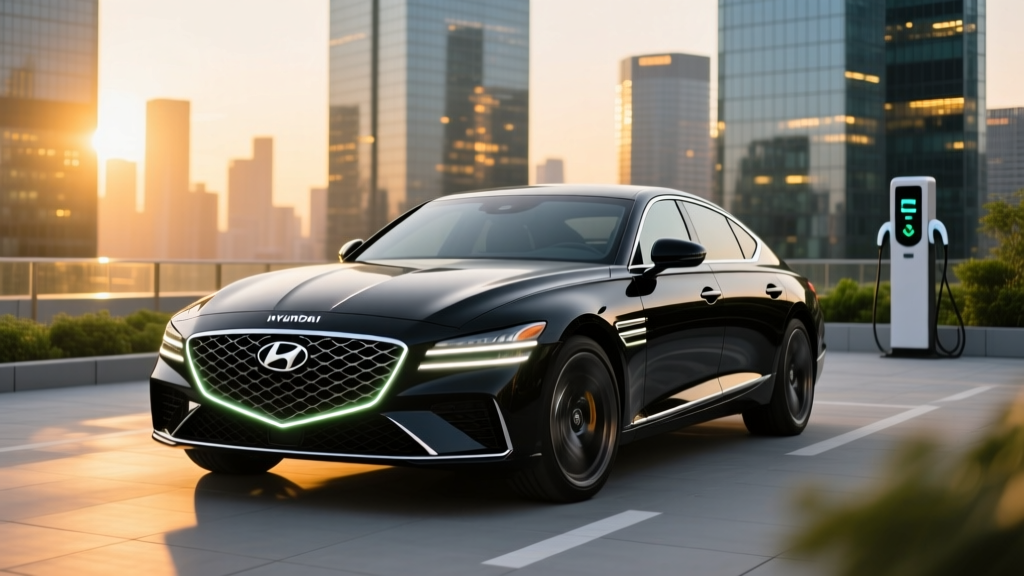
If you've searched for a "Hyundai Genesis hybrid," you're likely looking at the Genesis G80 Electrified — the luxury sedan from Hyundai's premium brand that bridges the gap between a traditional gas-powered executive car and a full battery-electric vehicle. But the naming can be confusing, and the powertrain landscape for the G80 has shifted significantly heading into the 2026 model year. This guide cuts through the confusion with exact specs, real-world efficiency data, tax credit eligibility, and a clear verdict on who should consider this sedan.
Genesis G80 Powertrain Lineup: HEV vs PHEV vs EV Explained
Genesis (Hyundai's luxury division) does not currently sell a conventional hybrid (HEV) version of the G80 in the United States. The G80 lineup for 2026 includes:
- G80 2.5T — Turbocharged gas-only (2.5L I4, 300 HP)
- G80 3.5T — Twin-turbo V6 gas-only (375 HP)
- G80 PHEV — Plug-in hybrid (2.5L turbo + electric motor)
- G80 Electrified — Full battery-electric (dual motor AWD)
HEV (Not Available)
No plug needed. Charges via regenerative braking. Toyota Camry Hybrid style. Not offered for G80.
PHEV (Available)
Plugs in for ~25 miles electric-only, then operates as a hybrid. 18.8 kWh battery. Gas engine kicks in seamlessly.
Full EV (Available)
No gas engine. 87.2 kWh battery, 282 mi EPA range. Requires charging infrastructure.
The distinction matters enormously for your daily routine and wallet. A PHEV lets you commute on electricity while keeping a gas tank for road trips. A full EV eliminates gas entirely but demands reliable charging access. A conventional HEV — which the G80 doesn't offer — would give you modest MPG gains without any plug.
2026 Genesis G80 PHEV: MPG, Electric Range, and Powertrain Specs
The G80 PHEV pairs a 2.5-liter turbocharged inline-four with an electric motor integrated into the transmission. Here's the full spec breakdown based on EPA data and Genesis specifications:
| Specification | Value |
|---|---|
| Combined Horsepower | 367 HP (engine + motor) |
| Engine | 2.5L turbocharged I4 (304 HP gas) |
| Electric Motor | 100 kW (134 HP) integrated |
| Battery Capacity | 18.8 kWh (usable ~15.5 kWh) |
| Battery Chemistry | NMC (Nickel Manganese Cobalt) |
| EPA Electric-Only Range | 25 miles |
| EPA MPGe (Electric + Gas) | 35 MPGe combined |
| EPA MPG (Gas Only, Charge-Depleted) | 25 city / 28 hwy / 26 combined |
| Total Combined Range | ~440 miles (electric + gas) |
| Level 2 Charging (240V) | ~2.5 hours (0-100%) at 7.2 kW |
| DC Fast Charging | Not supported |
| Drivetrain | AWD (standard) |
| 0-60 mph | ~5.8 seconds |
| Base MSRP (Advanced trim) | $66,550 |
Real-World MPG vs EPA Estimates
The EPA rates the G80 PHEV at 26 MPG combined once the battery is depleted. In real-world driving, expect that number to hold fairly steady on highway trips — PHEVs in charge-depleted mode behave like conventional hybrids, and the G80's 8-speed automatic with integrated motor is well-tuned for efficiency cruising. Around town with a depleted battery, you may see 27-29 MPG thanks to regenerative braking recapturing energy at low speeds.
The 25-mile electric-only range is best suited for short commutes. If your round-trip commute is under 20 miles and you charge nightly, you'll burn almost no gasoline on weekdays. On a 300-mile road trip, however, the electric range becomes negligible — you'll operate in gas-only mode for roughly 92% of the drive.
2026 Genesis G80 Electrified: The Full-EV Alternative
For buyers ready to ditch gasoline entirely, the G80 Electrified replaces the engine with a dual-motor AWD system and an 87.2 kWh battery pack. Here's how it compares:
| Attribute | G80 PHEV | G80 Electrified |
|---|---|---|
| Powertrain | 2.5T I4 + electric motor | Dual motor AWD (no engine) |
| Combined HP | 367 HP | 365 HP |
| Battery | 18.8 kWh | 87.2 kWh |
| EPA Range (Electric) | 25 mi (+ gas tank) | 282 mi |
| MPGe / MPG | 35 MPGe / 26 MPG gas | 91 MPGe combined |
| DC Fast Charge | Not supported | Up to 350 kW (10-80% ~22 min) |
| 0-60 mph | ~5.8 sec | ~4.9 sec |
| Base MSRP | $66,550 | $79,850 |
| Fed. Tax Credit (§30D) | Up to $3,750* | Up to $7,500* |
*Tax credit amounts depend on battery sourcing, buyer income, and MSRP caps under current IRS §30D rules. See the tax credit section below.
Charging the G80 PHEV: What You Need at Home
One of the most common misconceptions about PHEVs is that they require special charging infrastructure. The G80 PHEV charges on a standard 120V household outlet (Level 1), though slowly — expect roughly 8-9 hours for a full charge from empty, which is fine for overnight top-ups given the small 18.8 kWh battery.
For faster replenishment, a Level 2 home charger (240V) fills the battery in approximately 2.5 hours at 7.2 kW. This is the sweet spot for PHEV owners: plug in when you get home, and the battery is full well before morning. Unlike full EVs, PHEVs do not require DC fast charging — and the G80 PHEV does not support it.
| Level | Power (kW) | 0-100% Time | Miles of EV Range Added/Hour |
|---|---|---|---|
| Level 1 (120V outlet) | ~1.4 kW | ~8-9 hours | ~3 mi/hr |
| Level 2 (240V, 32A) | 7.2 kW | ~2.5 hours | ~10 mi/hr |
| DC Fast Charge | N/A | Not supported | N/A |
Home charging cost: At the US average electricity rate of ~$0.16/kWh, fully charging the G80 PHEV's usable 15.5 kWh costs roughly $2.48. That gives you 25 miles of electric driving — about $0.10 per mile, compared to $0.17-0.22/mile on premium gasoline (at $3.80/gal and 26 MPG).
Federal Tax Credit Eligibility for the Genesis G80
The federal EV tax credit under IRS §30D applies differently to PHEVs and full EVs, and eligibility has tightened significantly. Here's what applies to the 2026 Genesis G80 lineup:
- MSRP Cap: Sedans must have an MSRP under $55,000 to qualify. The G80 PHEV ($66,550) and G80 Electrified ($79,850) both exceed this cap, which disqualifies them from the full §30D new-vehicle credit.
- Income Cap: Buyer AGI must not exceed $150,000 (single) / $300,000 (joint).
- Battery Sourcing: Critical minerals and battery components must meet phased-in domestic/free-trade-partner sourcing thresholds.
- Point-of-Sale Transfer: Eligible credits can be transferred to the dealer at purchase as an upfront discount.
Battery Warranty, Reliability, and Replacement Cost
Hybrid and PHEV battery longevity is a top concern for buyers spending $65,000+ on a luxury sedan. Genesis backs the G80 PHEV's high-voltage battery with one of the strongest warranties in the segment:
- High-Voltage Battery: 10 years / 100,000 miles (capacity retention above 70%)
- Hybrid System Components: 10 years / 100,000 miles
- Basic Vehicle Warranty: 5 years / 60,000 miles
- Powertrain Warranty: 10 years / 100,000 miles
Genesis (Hyundai) has a strong track record with hybrid battery reliability. The NMC cells in the G80 PHEV are conservatively managed — the usable capacity buffer (~3.3 kWh of the 18.8 kWh total is locked out) prevents deep cycling that accelerates degradation. Based on Hyundai's hybrid fleet data across the Sonata PHEV and Tucson PHEV, expect less than 5% capacity loss over the first 5 years under normal use.
If replacement is needed out of warranty, a G80 PHEV battery pack is estimated at $4,000-$6,500 for parts and labor — significantly less than a full EV battery replacement ($12,000-$18,000 for the G80 Electrified's 87.2 kWh pack). The smaller battery is one of the PHEV's hidden long-term cost advantages.
G80 PHEV vs Full EV vs Gas: Which Should You Choose?
Choose the G80 PHEV If:
- Your daily commute is under 25 miles round-trip
- You can charge at home (even a 120V outlet works)
- You take regular road trips and don't want to plan around chargers
- You want luxury sedan comfort with lower fuel costs on weekdays
- You're not ready to commit to full electric
Choose the G80 Electrified (Full EV) If:
- You have reliable home Level 2 charging
- Your daily driving exceeds 25 miles (the PHEV's electric range)
- You want zero tailpipe emissions and lower per-mile fuel cost
- You value DC fast charging for road trips (350 kW capable)
- You plan to keep the car 8+ years (fewer moving parts)
Choose the Gas G80 2.5T If:
- You can't charge at home or at work
- You want the lowest purchase price ($50,050 base)
- You drive fewer than 8,000 miles/year (fuel savings won't offset PHEV premium)
- You prefer proven simplicity with no high-voltage system
Look Elsewhere (Non-Genesis HEV) If:
- You want a self-charging hybrid with no plug (G80 doesn't offer HEV)
- Budget is under $45,000 (consider Lexus ES 300h, Toyota Crown)
- You prioritize maximum MPG over luxury (Camry Hybrid gets 52 MPG)
5-Year Cost of Ownership Estimate
Here's how the G80 PHEV stacks up against the gas-only G80 2.5T over 5 years and 60,000 miles, assuming 12,000 miles/year, $3.80/gal premium, and $0.16/kWh electricity:
| Cost Category | G80 PHEV | G80 2.5T (Gas) |
|---|---|---|
| Purchase Price (MSRP) | $66,550 | $50,050 |
| Fuel/Energy (5 yrs) | ~$5,800 | ~$9,900 |
| Maintenance (5 yrs) | ~$2,800 | ~$3,200 |
| Insurance (5 yrs est.) | ~$12,500 | ~$11,000 |
| Total (excl. tax credit) | ~$87,650 | ~$74,150 |
The PHEV saves roughly $4,100 on fuel over 5 years, but carries a $16,500 higher purchase price. The math only works in your favor if you value the electric driving experience, qualify for lease-based incentives, or plan to keep the vehicle well beyond 5 years where fuel savings compound and the gas engine's maintenance costs rise.
Frequently Asked Questions
How many MPG does the Hyundai Genesis hybrid get?
The 2026 Genesis G80 PHEV achieves an EPA-rated 25 city / 28 highway / 26 combined MPG when operating on gasoline alone (battery depleted). When factoring in electric-only driving, the combined rating is 35 MPGe. Real-world city driving with regenerative braking can push gas-only MPG to 27-29 in stop-and-go traffic.
How far can the G80 PHEV go on electric only?
The EPA rates the G80 PHEV at 25 miles of electric-only range. Real-world results vary: expect 22-23 miles in mild conditions, 18-20 miles in cold weather, and 17-19 miles at sustained highway speeds above 70 mph. Once depleted, the gas engine engages seamlessly.
Is the Genesis G80 hybrid reliable?
Genesis (Hyundai) has built a strong hybrid reliability record over the past decade. The G80 PHEV's powertrain uses proven components from the Hyundai Motor Group, and the 10-year/100,000-mile hybrid battery warranty provides long-term security. IIHS and NHTSA safety ratings for the G80 platform have been consistently strong.
What does a Genesis hybrid battery replacement cost?
Out-of-warranty replacement for the G80 PHEV's 18.8 kWh battery is estimated at $4,000-$6,500 including labor. The G80 Electrified's larger 87.2 kWh pack would cost $12,000-$18,000. However, with Genesis's 10-year/100,000-mile warranty and conservative battery management, most owners will never face this expense.
Does the Genesis G80 hybrid qualify for a tax credit?
Under current IRS §30D rules, the G80 PHEV and G80 Electrified both exceed the $55,000 sedan MSRP cap, which disqualifies them from the federal new clean vehicle credit. However, leasing may unlock savings through the §45W commercial credit loophole, where the lessor claims the credit and passes it through as a lease reduction. Always verify current eligibility on irs.gov and consult a tax professional.
Is there a conventional (non-plug-in) hybrid Genesis G80?
No. Genesis does not offer a self-charging HEV version of the G80 in the US market. The lineup includes gas-only (2.5T, 3.5T), plug-in hybrid (PHEV), and full electric (Electrified) variants. If you want a luxury midsize hybrid sedan that never needs plugging in, consider the Lexus ES 300h (44 MPG combined) or the BMW 5 Series PHEV as alternatives.