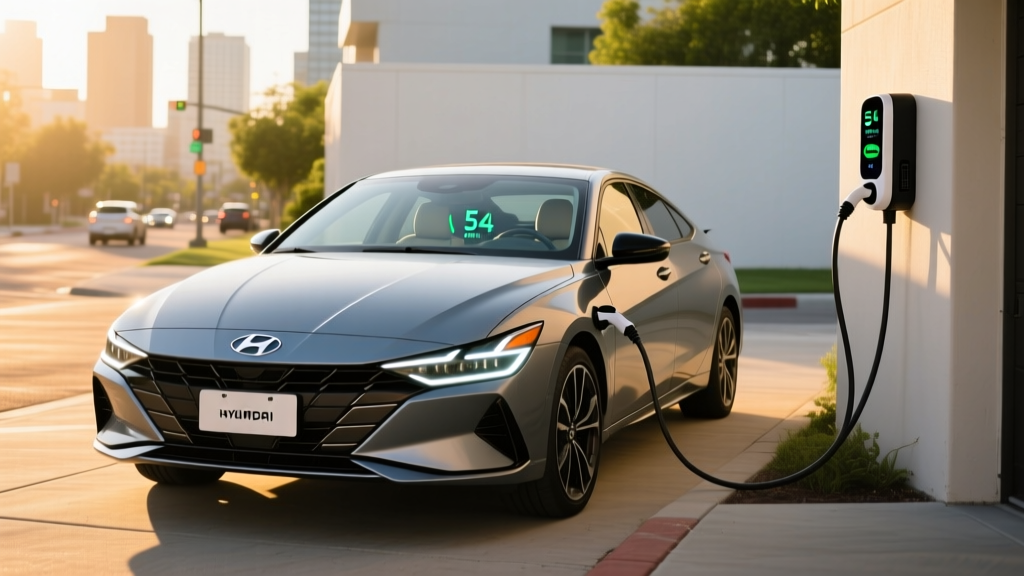
The Hyundai Elantra Hybrid occupies a specific niche: maximum fuel economy without plugging in, at a sub-$30,000 starting price. For 2026, Hyundai continues the sixth-generation Elantra Hybrid with the same proven 1.6-liter parallel-hybrid powertrain, but with minor trim and feature updates. If you've been searching for Hyundai Elantra Hybrid MPG data that goes beyond the sticker, this guide covers the EPA numbers, real-world expectations, powertrain details, ownership costs, and whether this HEV makes more sense than a PHEV or full EV for your driving pattern.
Hyundai Elantra Hybrid MPG: EPA Estimates and Real-World Results
The headline number for the Elantra Hybrid is its EPA-rated fuel economy, which varies slightly by trim due to wheel size and curb weight. The Blue trim — Hyundai's efficiency-focused base model — achieves the highest ratings, while the Limited trim sacrifices a few MPG for larger wheels and additional equipment.
| Trim | City MPG | Highway MPG | Combined MPG | Fuel Tank (gal) | Total Range (mi) |
|---|---|---|---|---|---|
| Blue | 54 | 58 | 56 | 11.1 | ~622 |
| SEL | 51 | 55 | 53 | 11.1 | ~588 |
| Limited | 49 | 52 | 50 | 11.1 | ~555 |
Source: EPA Fuel Economy Guide
This is a key advantage of conventional hybrids over plug-in vehicles in certain use cases: the Elantra Hybrid's efficiency is remarkably consistent without requiring any behavioral changes, home charging infrastructure, or route planning.
Powertrain Specs: Engine, Motor, and Combined Output
The Elantra Hybrid uses Hyundai's Smartstream G1.6 hybrid powertrain, a parallel-hybrid system where both the gasoline engine and electric motor can drive the front wheels — either independently or together. This is not a series hybrid (where the engine only generates electricity) nor a range-extended EV.
| Specification | Value |
|---|---|
| Engine | 1.6L GDI 4-cylinder Atkinson-cycle |
| Engine Power | 104 hp @ 5,700 rpm / 109 lb-ft torque |
| Electric Motor | 36 kW (48 hp) permanent-magnet synchronous |
| Combined System Output | 139 hp / 195 lb-ft torque |
| Transmission | 6-speed dual-clutch automatic (6DCT) |
| Hybrid Battery | 1.56 kWh lithium-ion polymer |
| Drivetrain | Front-wheel drive |
| 0-60 mph | ~8.6 seconds (manufacturer est.) |
| Curb Weight | ~3,017 lbs (Blue) / ~3,152 lbs (Limited) |
The 6-speed dual-clutch transmission is a deliberate choice over the CVTs found in the Toyota Prius and Honda Accord Hybrid. The DCT delivers more natural shift feel and avoids the "rubber-band" drone under hard acceleration, though the trade-off is slightly less seamless low-speed transitions. In practice, Hyundai's calibration is smooth, and most drivers won't notice the shifts during normal commuting.
The 1.56 kWh battery pack is small by electrified-vehicle standards — this is intentional. A conventional hybrid (HEV) battery is sized for short bursts of electric assist, regenerative braking capture, and brief low-speed EV mode, not for sustained electric-only driving. The pack charges entirely through regenerative braking and engine-driven generation. You cannot plug in the Elantra Hybrid.
HEV vs PHEV vs EV: Which Electrified Powertrain Fits You?
Buyers cross-shopping the Elantra Hybrid often wonder whether a plug-in hybrid or full battery-electric vehicle would serve them better. The answer depends on three factors: home charging access, daily mileage, and budget.
HEV (Elantra Hybrid)
- No plug-in required
- 50-56 MPG combined
- ~550-620 mi total range
- Lower purchase price
- No home charger needed
- No federal tax credit (§30D)
Best for: Apartment dwellers, high-mileage commuters, drivers without charging access, budget-conscious buyers
PHEV (e.g., Prius Prime)
- 35-45 mi electric-only range
- Plug in at home for daily EV driving
- Gas engine for long trips
- Mid-range purchase price
- Requires Level 1 or 2 charging
- May qualify for §30D credit
Best for: Homeowners with garage/outlet, sub-40-mi commutes, occasional road trippers
BEV (e.g., Ioniq 6)
- 250-360 mi EPA range
- Zero tailpipe emissions
- Lowest fuel/maintenance cost
- Highest purchase price
- Requires reliable charging access
- Eligible for up to $7,500 §30D
Best for: Home-charging-capable drivers, urban/suburban commuters, lowest TCO seekers
The Elantra Hybrid wins on simplicity and upfront cost. If you can't charge at home and don't want to think about charging logistics, an HEV is the correct choice. If you have a garage with a 120V or 240V outlet and a short commute, a PHEV lets you drive on electricity most days while retaining gas-engine flexibility for longer trips.
2026 Elantra Hybrid Pricing by Trim
| Trim | MSRP | Key Features |
|---|---|---|
| Blue | $26,250 | 16" aero wheels, 8" display, wireless CarPlay/Android Auto, SmartSense safety suite |
| SEL | $28,900 | 17" alloy wheels, heated front seats, smart cruise control w/ stop-and-go, dual-zone climate |
| Limited | $31,550 | 18" alloy wheels, leather seats, 10.25" dual screens, Bose audio, Highway Driving Assist, sunroof |
The Blue trim offers the best MPG and the lowest price — a rare combination where the base model is also the most efficient. The SEL and Limited add comfort and technology features but cost 2-6 MPG combined due to larger wheels, heavier curb weight, and increased rolling resistance.
Does the Elantra Hybrid Qualify for Federal Tax Credits?
No. Under current IRS §30D rules, the federal clean vehicle credit applies only to plug-in electric vehicles (BEVs and PHEVs) with battery packs of at least 7 kWh and specific critical-mineral and battery-component sourcing requirements. The Elantra Hybrid's 1.56 kWh battery and lack of plug-in capability make it ineligible for the §30D credit. Source: IRS Clean Vehicle Credits.
Some states and local utilities offer rebates for conventional hybrids, though these are less common and typically smaller ($500-$1,500) than EV incentives. Check your state energy office or utility provider for current programs, as these vary by jurisdiction and change frequently.
Battery Warranty, Reliability, and Replacement Cost
Hybrid battery longevity is consistently the top concern for prospective HEV buyers. Hyundai addresses this with one of the strongest warranty packages in the segment.
- Hybrid Battery: 10 years / 100,000 miles (original owner); 10 years / 100,000 miles (transferable to second owner in most states — California-emissions states extend to 15 years/150,000 miles)
- Hybrid System Components: 10 years / 100,000 miles (inverter, motor, controller)
- Powertrain: 10 years / 100,000 miles
- New Vehicle: 5 years / 60,000 miles
- Roadside Assistance: 5 years / unlimited miles
Hyundai's hybrid batteries have demonstrated strong longevity in real-world use. The lithium-ion polymer pack in the current-generation Elantra Hybrid uses a conservative state-of-charge window (the battery management system prevents full 0% or 100% usage), which significantly reduces degradation. Independent data from fleet operators and high-mileage owners shows less than 10% capacity loss at 150,000 miles in most cases.
If the hybrid battery does require replacement outside of warranty, expect to pay between $2,000 and $3,500 for a new OEM pack including labor. Refurbished or remanufactured packs are available from third-party suppliers for $1,200-$2,000. However, given the 10-year/100,000-mile warranty and the proven track record of Hyundai's hybrid system, most owners will never face this expense.
For reliability ratings, the Elantra Hybrid consistently scores above average in its class. The IIHS has awarded the Elantra sedan line top safety ratings when equipped with LED projector headlights (available on SEL and Limited). Source: IIHS Vehicle Ratings.
Driving Impressions and Efficiency in Practice
The Elantra Hybrid prioritizes efficiency over sportiness, but it doesn't feel punishing to drive. The 139 combined horsepower is adequate for merging and passing, though the 0-60 mph time of approximately 8.6 seconds places it behind turbocharged competitors. The electric motor's instant torque (available from 0 rpm) gives the car a responsive feel around town that the horsepower figure alone doesn't convey.
Regenerative braking is adjustable through three levels via steering-wheel paddles. Level 1 feels like mild engine braking, while Level 3 provides strong deceleration that approaches one-pedal driving in city traffic — though it won't bring the car to a complete stop like a full EV. Most drivers settle on Level 2 for daily commuting.
The cabin is quiet at low speeds (where the electric motor handles propulsion), and the transition between electric and gasoline power is well-managed. Wind and tire noise become noticeable above 65 mph, which is typical for the compact sedan segment.
Elantra Hybrid vs. the Competition
| Metric | Hyundai Elantra Hybrid Blue | Toyota Prius LE | Honda Accord Hybrid Sport |
|---|---|---|---|
| EPA Combined MPG | 56 | 57 | 44 |
| Combined HP | 139 | 194 | 204 |
| 0-60 mph | ~8.6 sec | ~7.2 sec | ~7.0 sec |
| Starting MSRP | $26,250 | $28,350 | $34,050 |
| Hybrid Battery Warranty | 10 yr / 100k mi | 10 yr / 150k mi | 8 yr / 100k mi |
| Cargo Volume | 14.2 cu ft | 23.8 cu ft (hatch) | 16.7 cu ft |
| Federal Tax Credit | None | None | None |
The Prius edges out the Elantra Hybrid by 1 MPG combined and offers hatchback versatility, but starts $2,100 higher. The Accord Hybrid delivers significantly more power and interior space but sacrifices 12 MPG combined and costs nearly $8,000 more. The Elantra Hybrid's advantage is its combination of strong fuel economy, low starting price, and generous warranty — making it the value pick in the segment.
Pros and Cons at a Glance
Pros
- 56 MPG combined (Blue) — among the highest of any non-plug-in vehicle
- Sub-$27,000 starting price with strong standard equipment
- 10-year/100,000-mile hybrid battery warranty
- Natural-feeling 6-speed DCT (no CVT drone)
- 620+ mile total range — fewer fuel stops on road trips
- No charging infrastructure required
Cons
- Modest 139 hp — not a performance-oriented sedan
- Smaller trunk than hatchback rivals (14.2 cu ft)
- No federal tax credit eligibility
- Limited trim sacrifices 6 MPG for features and style
- EV mode is very short-range (under 1 mile at low speeds)
- Rear-seat headroom is tight for passengers over 6'2"
Frequently Asked Questions
How many MPG does the 2026 Hyundai Elantra Hybrid actually get?
The EPA rates the Blue trim at 54 city / 58 highway / 56 combined MPG. In real-world mixed driving, most owners report 50-54 MPG combined. City driving often exceeds the EPA estimate thanks to regenerative braking, while sustained highway driving at 75+ mph typically yields 48-52 MPG. Cold weather reduces economy by roughly 10-15%.
Do I need to plug in the Elantra Hybrid to charge it?
No. The Elantra Hybrid is a conventional hybrid (HEV), not a plug-in hybrid. The 1.56 kWh battery charges through regenerative braking and the gasoline engine. There is no charge port and no electric-only driving beyond very short low-speed maneuvers. You fuel it exactly like a conventional gasoline car.
How long will the Elantra Hybrid battery last?
Hyundai warranties the hybrid battery for 10 years or 100,000 miles (15 years/150,000 miles in California-emissions states). Real-world data from Hyundai's hybrid fleet shows minimal degradation — typically under 10% capacity loss at 150,000 miles. Many Hyundai and Kia hybrid taxis have exceeded 200,000 miles on the original battery pack.
What does it cost to replace the hybrid battery?
Out-of-warranty replacement costs $2,000-$3,500 for a new OEM battery pack including labor. Third-party refurbished packs cost $1,200-$2,000. Given the warranty coverage and demonstrated longevity, most original owners will never need a replacement.
Does the Elantra Hybrid qualify for any tax credits?
The Elantra Hybrid does not qualify for the federal §30D clean vehicle credit, which requires plug-in capability and a minimum 7 kWh battery. Some state and utility programs offer smaller hybrid rebates ($500-$1,500), but availability varies by location. Consult your state energy office for current programs.
Should I get the Elantra Hybrid or the Elantra PHEV?
Hyundai discontinued the Elantra PHEV for the US market after the 2023 model year. If you want a plug-in hybrid in Hyundai's lineup, the Tucson PHEV and Santa Fe PHEV are current options. For a compact PHEV sedan, consider the Toyota Prius Prime (40-44 mi electric-only range, ~$33,000 MSRP).
Is the Elantra Hybrid good for highway road trips?
Yes. With 620+ miles of total range (Blue trim), you'll stop for fuel less often than in most gasoline cars. Highway MPG settles around 48-52 at 70-75 mph. The 6-speed DCT keeps engine RPM low at cruising speed, and the cabin is reasonably quiet. The SmartSense safety suite includes adaptive cruise control with stop-and-go and lane-centering assist on SEL and Limited trims.
How does the Elantra Hybrid compare to a full EV like the Ioniq 6?
The Ioniq 6 offers 316-361 miles of EPA range, zero tailpipe emissions, and lower per-mile energy costs — but starts around $37,500 (before the potential $7,500 federal credit) and requires home or public charging access. The Elantra Hybrid costs less upfront, needs no charging infrastructure, and is the pragmatic choice for drivers who lack reliable charging, drive over 400 miles between stops regularly, or want the simplest ownership experience.
Who Should Buy the Elantra Hybrid?
The 2026 Hyundai Elantra Hybrid is the right vehicle if you want maximum fuel economy with zero lifestyle changes — no plug, no range planning, no charging-app management. It's ideal for:
- Apartment and condo residents who lack home charging access
- High-mileage commuters (15,000+ miles/year) who benefit most from 50+ MPG
- Budget-conscious buyers who want hybrid efficiency under $27,000
- Rideshare and delivery drivers who need low operating costs and maximum uptime
- First-time hybrid buyers transitioning from a conventional gas car
If you have home charging access and a commute under 40 miles, a PHEV or BEV will deliver lower per-mile energy costs and the option of zero-emission daily driving. But if simplicity, low upfront cost, and proven reliability are your priorities, the Elantra Hybrid Blue at 56 MPG combined is one of the most efficient non-plug-in vehicles on the market — and at $26,250, it's difficult to beat on value.