The Hyundai Elantra Hybrid has carved out a distinct niche among compact sedans: it delivers exceptional fuel economy without the plug-in complexity or the price premium of a full battery-electric vehicle. But buyers researching this car often start with a specific question — what is the Hyundai Elantra Hybrid interior actually like to live with every day? This review covers the cabin, the powertrain, real-world MPG, battery longevity, and how this conventional hybrid (HEV) stacks up against PHEV and EV alternatives in 2026.
Quick Verdict: Who Should Buy the Elantra Hybrid?
The 2026 Elantra Hybrid is a conventional hybrid electric vehicle (HEV), not a plug-in. It charges its own small battery through regenerative braking and the gasoline engine — you never plug it in. This makes it ideal for drivers who want maximum fuel savings without changing their refueling habits, apartment dwellers who lack home charging access, or anyone covering long highway miles where a full EV's range would require careful planning.
Choose the Elantra Hybrid (HEV) if:
- You want 50+ MPG without ever plugging in
- You lack access to Level 2 home or workplace charging
- Your budget is under $30,000 and you want low total cost of ownership
- You take frequent road trips exceeding 400 miles
Consider a PHEV or full EV instead if:
- You have reliable Level 2 charging and want electric-only commuting
- You want to eliminate gasoline use for daily driving entirely
- You qualify for the federal §30D tax credit (PHEVs/EVs only — HEVs are excluded)
HEV vs PHEV vs EV: Where Does the Elantra Hybrid Fit?
Before diving into specs, it's critical to understand what the Elantra Hybrid is — and isn't. Hyundai previously offered an Elantra PHEV (plug-in hybrid), but that variant was discontinued after the 2023 model year. The current Elantra Hybrid sold in 2026 is strictly a conventional HEV.
| Feature | HEV (Elantra Hybrid) | PHEV (e.g., Toyota Prius Prime) | BEV (e.g., Hyundai Ioniq 6) |
|---|---|---|---|
| Plug-in charging? | No | Yes | Yes |
| Electric-only range | 0 miles (motor assists only) | 35–45 miles typical | 270–360 miles typical |
| Gasoline engine? | Yes | Yes | No |
| Federal tax credit | Not eligible | Up to $7,500 (with caveats) | Up to $7,500 (with caveats) |
| Total range | ~550+ miles | ~500+ miles combined | 270–360 miles |
| Best for | No-plug convenience | Short EV commute + road trips | Full electric, home charging |
EPA Fuel Economy: Real-World MPG Breakdown
Fuel efficiency is the Elantra Hybrid's headline act. Here are the official EPA figures from fueleconomy.gov for the 2026 model year:
| Trim | City MPG | Highway MPG | Combined MPG |
|---|---|---|---|
| Blue (base hybrid) | 53 | 56 | 54 |
| SEL / Limited | 49 | 52 | 50 |
The Blue trim's 54 MPG combined is among the highest of any non-plug-in compact sedan sold in the U.S. — rivaling and in some conditions exceeding the Toyota Prius. The SEL and Limited trims drop slightly due to larger 17-inch alloy wheels, additional weight from features like leather seats and a sunroof, and a more aggressive transmission tune.
Real-World MPG: What to Actually Expect
Hybrids frequently exceed their EPA city ratings in stop-and-go driving because regenerative braking recovers energy that a gas car wastes as heat. In mixed suburban and city driving, owners regularly report 52–58 MPG in the Blue trim. On sustained highway trips at 75+ mph, expect the number to settle closer to 46–50 MPG — hybrids lose their city advantage at high steady speeds where the engine runs continuously.
In cold weather (below 35°F), expect a 5–10% MPG reduction due to the engine running longer to reach operating temperature and cabin heating demands. This is far less severe than the 20–30% range loss a full EV experiences in the same conditions.
Powertrain Specs: 139 HP Hybrid System
| Engine | 1.6L GDI 4-cylinder Atkinson-cycle |
| Engine output | 104 hp @ 5,700 rpm / 109 lb-ft torque |
| Electric motor | 36 kW (48 hp) permanent-magnet synchronous |
| Combined system output | 139 hp / 195 lb-ft torque |
| Transmission | 6-speed dual-clutch automatic (DCT) |
| Hybrid battery | 1.56 kWh lithium-ion polymer |
| Drivetrain | Front-wheel drive |
| 0–60 mph | ~8.2 seconds |
| Fuel tank | 11.1 gallons |
| Total estimated range | ~550–600 miles |
The 6-speed DCT is a deliberate choice by Hyundai over the continuously variable transmissions (CVTs) used in the Prius and most competitors. The result is a more natural, stepped acceleration feel that avoids the "rubber band" drone associated with CVTs. The trade-off is marginally less seamless low-speed creep in heavy traffic, though Hyundai's tuning has largely smoothed this out in recent model years.
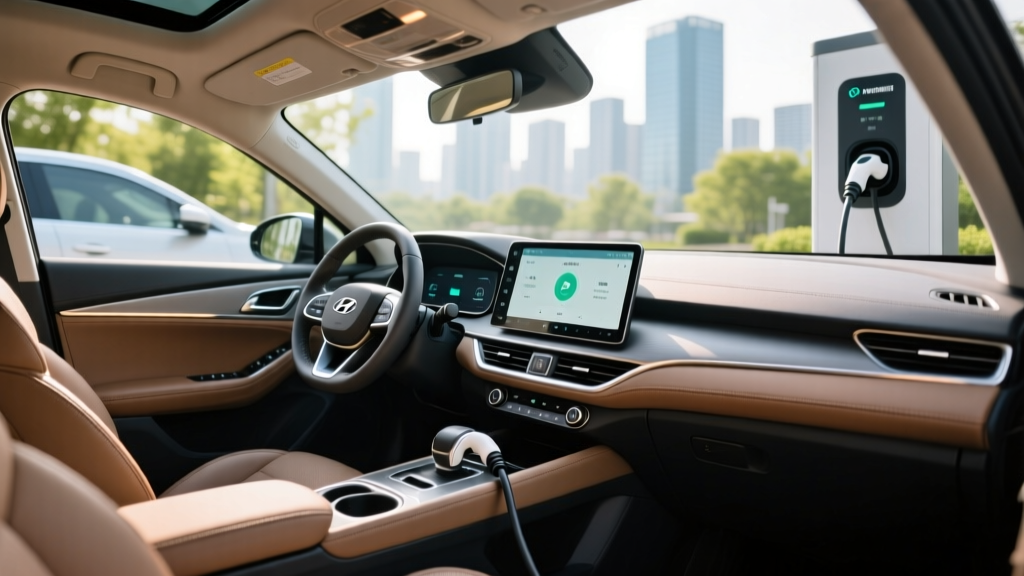
Hyundai Elantra Hybrid Interior and Cabin Quality
The Elantra Hybrid's interior is where this car makes its strongest case against budget EVs like the Chevy Bolt EV or Nissan Leaf, which often compromise on cabin materials to offset battery costs.
Standard on all trims: a 10.25-inch digital instrument cluster and an 8-inch touchscreen infotainment system with wireless Apple CarPlay and Android Auto. The SEL and Limited trims upgrade to a 10.25-inch touchscreen with built-in navigation, dual-zone automatic climate control, and Hyundai's Digital Key (using your smartphone as the key fob).
Seating and space: Front seats are well-bolstered with adequate cushioning for long drives. The Limited trim adds leather-trimmed seats with a power-adjustable driver's seat and heated/ventilated front seats. Rear legroom measures 38.0 inches — competitive with the Toyota Corolla Hybrid and noticeably more generous than the Mazda3. The hybrid battery is packaged under the rear seats, so trunk volume remains a practical 14.2 cubic feet, identical to the gas Elantra.
Technology highlights: Hyundai's Bluelink connected services include remote start, vehicle status monitoring, and hybrid-specific energy flow displays. The Limited trim adds a Bose premium audio system, a wireless phone charger, and Highway Driving Assist (HDA) — Hyundai's Level 2 driver-assistance system combining adaptive cruise control with lane-centering on divided highways.
Important: Highway Driving Assist and all Hyundai SmartSense features are SAE Level 2 driver-assistance systems. The driver must remain fully engaged, keep hands on the wheel, and monitor the road at all times. These systems do not make the Elantra Hybrid a self-driving vehicle.
Battery Warranty, Lifespan, and Replacement Cost
Hybrid battery longevity is one of the top concerns for first-time hybrid buyers. Here's what you need to know about the Elantra Hybrid's battery:
Hybrid Battery Warranty: 10 years / 100,000 miles (whichever comes first)
Hybrid System Components Warranty: 10 years / 100,000 miles — covers the electric motor, inverter, and related electronics
Capacity retention threshold: Hyundai covers the battery if it falls below approximately 70% of original capacity during the warranty period
Emissions warranty (California/PZEV states): 10 years / 150,000 miles on hybrid-specific emissions components
The 1.56 kWh battery in the Elantra Hybrid is small and operates within a conservative state-of-charge window (roughly 40–80% SoC), which dramatically reduces degradation compared to a full EV battery that cycles through wider ranges. Real-world data from high-mileage Hyundai and Kia hybrid owners suggests these batteries routinely last 150,000–200,000+ miles with minimal capacity loss.
What If the Battery Needs Replacement?
Outside of warranty, a replacement hybrid battery for the Elantra Hybrid typically costs between $2,000 and $3,500 including labor at a dealership. Independent hybrid specialists may offer refurbished battery packs for $1,200–$2,000. This is vastly less than a full EV battery replacement ($8,000–$20,000+) because the hybrid battery is small and modular. Individual cells can sometimes be replaced rather than the entire pack.
Pricing and Tax Credit Eligibility
| Trim | MSRP (approx.) | Federal Tax Credit |
|---|---|---|
| Blue | $26,250 | Not eligible |
| SEL | $28,500 | Not eligible |
| Limited | $31,100 | Not eligible |
The Elantra Hybrid does not qualify for the federal §30D clean vehicle tax credit. Under current IRS rules, only plug-in electric vehicles (PHEVs and BEVs) with a minimum battery capacity of 7 kWh are eligible. The Elantra Hybrid's 1.56 kWh battery falls well below this threshold. This applies to all conventional HEVs regardless of manufacturer.
Some states offer their own hybrid-specific rebates or HOV lane access for high-MPG vehicles — check your state's energy office or department of environmental quality for current programs. These vary by jurisdiction and change frequently.
Pros and Cons
Pros
- 54 MPG combined (Blue trim) — best-in-class efficiency
- No plug-in required — works with any lifestyle
- 10-year / 100,000-mile hybrid battery warranty
- Spacious rear seat (38.0" legroom) and full 14.2 cu-ft trunk
- 6-speed DCT feels more natural than a CVT
- Low starting price vs. PHEVs and EVs
- Strong standard safety suite (SmartSense)
Cons
- No electric-only driving mode — always uses gasoline
- No federal tax credit eligibility
- 0–60 in ~8.2 seconds — adequate but not quick
- Higher trims (Limited) push past $31K, approaching PHEV territory
- Road noise is noticeable on coarse pavement
- No AWD option (available on some hybrid competitors)
Frequently Asked Questions
How many MPG does the Hyundai Elantra Hybrid get?
The EPA rates the 2026 Elantra Hybrid Blue at 53 city / 56 highway / 54 combined MPG. The SEL and Limited trims are rated at 49 city / 52 highway / 50 combined. Real-world city driving often yields 52–58 MPG in the Blue trim thanks to regenerative braking in stop-and-go traffic.
Does the Elantra Hybrid need to be plugged in?
No. The Elantra Hybrid is a conventional hybrid (HEV). Its battery is recharged exclusively by the gasoline engine and regenerative braking. You fuel it like any other gas car and never need a charging outlet or station.
How far can the Elantra Hybrid go on a full tank?
With an 11.1-gallon fuel tank and 54 MPG combined (Blue trim), the Elantra Hybrid can travel approximately 550–600 miles between fill-ups. Highway-heavy driving will reduce this to roughly 510–550 miles.
Is the Hyundai Elantra Hybrid reliable?
Hyundai's hybrid powertrain has proven durable over multiple model years. The 1.6L Atkinson-cycle engine is low-stress by design, and the 6-speed DCT avoids the complexity of a CVT. Hyundai backs the hybrid battery and system components with a 10-year / 100,000-mile warranty, among the longest in the industry.
What is the battery replacement cost for the Elantra Hybrid?
Out of warranty, expect $2,000–$3,500 for a new dealership battery replacement, or $1,200–$2,000 for a refurbished pack from an independent hybrid specialist. Given the conservative charge window and small 1.56 kWh capacity, most owners never need a replacement during the vehicle's normal lifespan.
Hybrid vs PHEV vs EV — which is right for me?
Choose the Elantra Hybrid (HEV) if you want maximum MPG without plugging in and don't have reliable home charging. Choose a PHEV (like the Toyota Prius Prime) if you have Level 2 charging and want 35–45 miles of electric-only commuting plus a gas engine for road trips. Choose a full EV (like the Hyundai Ioniq 6) if you have home charging, want zero tailpipe emissions, and your daily driving stays under 250 miles. The Elantra Hybrid wins on simplicity and lowest upfront cost; PHEVs and EVs win on daily electric driving and potential tax credits.
Does the Elantra Hybrid qualify for any tax credits?
The Elantra Hybrid does not qualify for the federal §30D clean vehicle tax credit, which is limited to plug-in vehicles with batteries of at least 7 kWh. Some states may offer separate incentives for high-efficiency hybrids — consult your state energy office or a tax professional for current eligibility.