Quick Verdict: The Efficiency King of the Compact Sedan Segment
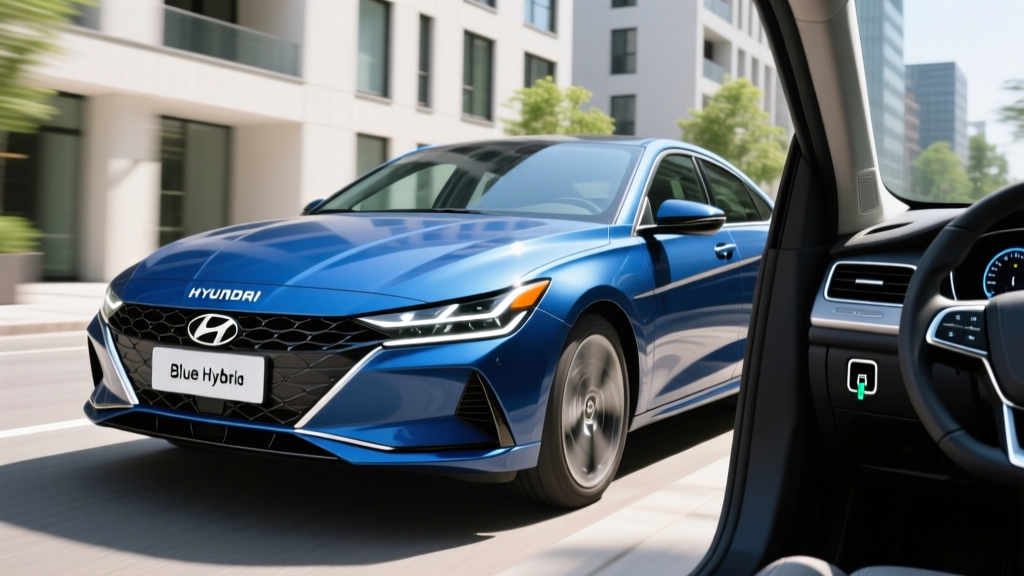
The 2026 Hyundai Elantra Hybrid Blue trim occupies a very specific niche: maximum fuel economy for minimum cost. With an EPA-estimated 54 MPG combined, it rivals the Toyota Prius while undercutting most competitors on price. This is a conventional hybrid (HEV) — not a plug-in — meaning you never need to find a charger. You simply fill up with gas and drive, while the hybrid system recovers energy during braking and low-speed operation to dramatically cut fuel consumption.
For buyers weighing the Elantra Hybrid Blue against a full battery-electric vehicle (BEV) or a plug-in hybrid (PHEV), the value proposition is straightforward: no charging infrastructure required, no range anxiety, no upfront price premium beyond a few thousand dollars over the gas-only Elantra, and fuel costs that drop by roughly 40% compared to a conventional compact sedan.
HEV vs PHEV vs EV: Where the Elantra Hybrid Blue Fits
Hyundai actually offers the Elantra in three distinct powertrain configurations. Understanding the difference is essential before you walk into a dealership, because the naming can confuse first-time hybrid shoppers.
| Powertrain | 2026 Elantra Hybrid (HEV) | Plug-In Hybrid (PHEV) | Full EV (BEV) |
|---|---|---|---|
| Plug in to charge? | No — self-charging via regen & engine | Yes — Level 1 or Level 2 | Yes — Level 1, 2, or DC fast |
| Electric-only driving | Limited (low-speed, short distances) | ~30-35 miles on battery alone | 100% electric, 200-350+ miles |
| Fuel needed? | Yes — gasoline | Yes — gasoline when battery depletes | No — electricity only |
| Tailpipe emissions | Low (highly efficient) | Low (zero in EV mode) | Zero at the tailpipe |
| Home charging install | Not required | Recommended (Level 2, ~$500-$1,500) | Essential (Level 2, ~$500-$2,000+) |
| Federal tax credit (§30D) | Not eligible | Up to $7,500 (subject to sourcing/income rules) | Up to $7,500 (subject to sourcing/income rules) |
The Elantra Hybrid Blue is the HEV column. It uses a small lithium-ion battery (roughly 1.56 kWh) that charges itself through regenerative braking and the gasoline engine. You cannot plug it in, and it does not offer meaningful electric-only range. What it does offer is outstanding fuel economy across all driving conditions — especially in city traffic, where the electric motor handles low-speed propulsion and the engine shuts off at stops.
Fuel Economy: EPA Ratings and Real-World MPG
The headline number for the 2026 Elantra Hybrid Blue is its EPA-estimated fuel economy. Hyundai achieves these figures through a combination of the efficient Atkinson-cycle 1.6L engine, a lightweight body, low rolling-resistance tires, and optimized aerodynamics unique to the Blue trim.
| Driving Cycle | EPA Estimate | Real-World Expectation |
|---|---|---|
| City | 56 MPG | 55-60+ MPG (hybrids often exceed EPA in stop-and-go) |
| Highway | 51 MPG | 46-50 MPG (sustained 70+ mph reduces hybrid advantage) |
| Combined | 54 MPG | 50-55 MPG (mixed driving) |
A few real-world nuances matter here. Hybrids like the Elantra tend to exceed their EPA city rating in actual stop-and-go traffic because regenerative braking recovers energy that a gas car wastes as heat. Conversely, highway driving at sustained high speeds reduces the hybrid advantage — the electric motor contributes less at 75 mph, and aerodynamic drag dominates. In cold weather (below 30°F), expect a 5-10% MPG reduction as the engine runs more frequently to heat the cabin and warm the catalytic converter.
For context, the gas-only 2026 Elantra SE with the 2.0L engine rates at 32 city / 41 highway / 36 combined. The hybrid Blue nearly doubles the city figure and improves highway economy by over 20%. Over 15,000 miles per year at $3.40/gallon, that translates to roughly $680 in annual fuel savings versus the gas model, or about $1,100 compared to a 28 MPG compact SUV.
For official EPA data, see the listing on fueleconomy.gov.
Powertrain and Performance Specs
| Specification | 2026 Hyundai Elantra Hybrid Blue |
|---|---|
| Engine | 1.6L GDI 4-cylinder Atkinson-cycle |
| Engine output | 104 HP / 109 lb-ft torque |
| Electric motor | Permanent-magnet synchronous, 43 HP / 127 lb-ft |
| Combined system output | 139 HP / 195 lb-ft torque |
| Transmission | 6-speed dual-clutch automatic (DCT) |
| Hybrid battery | ~1.56 kWh lithium-ion polymer |
| Drivetrain | Front-wheel drive |
| 0-60 mph | ~8.2 seconds (estimated) |
| Curb weight | ~3,050 lbs |
| EPA combined MPG | 54 MPG |
| Fuel tank | 11.1 gallons |
| Total range | ~600 miles per tank |
The Elantra Hybrid uses a 6-speed dual-clutch transmission rather than the continuously variable transmission (CVT) found in the Toyota Prius and Honda Accord Hybrid. This gives it a more natural, stepped acceleration feel that many drivers prefer, though the trade-off is slightly less seamless low-speed engagement. The 139 combined horsepower is adequate for merging and passing — this is not a performance sedan, but it never feels underpowered in normal commuting.
One mechanical note: the Blue trim rides on 16-inch alloy wheels with low rolling-resistance tires. Higher trims (SEL, Limited) use 17- or 18-inch wheels and lose 1-3 MPG as a result. If maximum efficiency is the goal, Blue is the trim to choose.
Pricing, Trims, and Tax Credit Eligibility
The 2026 Elantra Hybrid lineup starts at approximately $26,250 MSRP for the Blue trim, rising to around $29,000 for the SEL and $31,500 for the Limited. These prices reflect the typical $1,000-$1,500 premium over equivalent gas-only Elantra trims.
Federal Tax Credit: Not Eligible
The Hyundai Elantra Hybrid (HEV) does not qualify for the IRS §30D Clean Vehicle Credit. That credit — up to $7,500 — applies only to plug-in electric vehicles (BEVs and PHEVs) that meet battery-sourcing, critical-mineral, MSRP cap, and buyer income requirements. Conventional hybrids like the Elantra Hybrid Blue are excluded under current IRS rules.
Some states and utilities offer separate rebates for conventional hybrids, but these are less common and vary widely. Check your state energy office or AFDC incentive database for local programs.
Without the federal credit, the Elantra Hybrid's value case rests entirely on fuel savings and a modest purchase premium. At $680/year in fuel savings over the gas model, the ~$1,500 hybrid premium pays back in roughly 2.2 years — well within most ownership periods.
Battery Warranty, Reliability, and Replacement Cost
Hybrid battery longevity is the single most common concern among first-time hybrid buyers. Hyundai addresses this with one of the strongest warranty packages in the industry:
- Hybrid battery warranty: 10 years / 100,000 miles (original owner); 8 years / 80,000 miles in states that follow California emissions standards (CARB states) for subsequent owners
- Hybrid system components: 10 years / 100,000 miles (inverter, motor, controller)
- Powertrain warranty: 10 years / 100,000 miles
- New vehicle warranty: 5 years / 60,000 miles
The 1.56 kWh lithium-ion polymer battery in the Elantra Hybrid is far smaller than a BEV battery (which typically runs 60-80 kWh), and it operates within a narrow state-of-charge window — the hybrid control system never fully depletes or fully charges it, which dramatically extends cycle life. Real-world data from Hyundai's hybrid fleet (Sonata, Ioniq, Elantra) shows minimal degradation over 150,000+ miles in most cases.
If a replacement is needed out of warranty, a refurbished Elantra Hybrid battery currently costs between $2,000 and $3,500 installed at an independent hybrid specialist, or $4,000-$5,500 at a dealership. Given the 10-year warranty and the battery's conservative usage profile, most owners will never face this expense.
Who Should Choose the Elantra Hybrid Blue?
Choose the Elantra Hybrid Blue If:
- You want 50+ MPG without plugging in or changing your fueling habits
- You lack access to home or workplace charging (apartment, street parking)
- You drive 12,000-20,000 miles per year and fuel cost matters
- You want a proven, low-risk hybrid with a 10-year battery warranty
- You prefer a traditional sedan with a large trunk (14.2 cu ft) over a hatchback
- You want a sub-$27,000 starting price with strong fuel economy
Look Elsewhere If:
- You want electric-only driving for short commutes (consider the Elantra PHEV or a BEV)
- You want federal tax credits — HEVs don't qualify under §30D
- You prioritize acceleration — 139 HP and ~8.2s 0-60 is adequate, not quick
- You want all-wheel drive (the Elantra Hybrid is FWD only; consider the Toyota Prius AWD)
- You need a hatchback cargo area (the Prius or Ioniq 5 offers more versatility)
Hybrid vs PHEV vs EV — Decision Framework
- Choose the Elantra Hybrid (HEV) if you have no reliable charging access, want the lowest upfront cost, and drive a mix of city and highway miles.
- Choose a PHEV (like the Toyota Prius Prime or Hyundai Tucson PHEV) if you can charge at home, your daily commute is under 35 miles, and you want electric-only weekday driving with gas flexibility for road trips.
- Choose a full BEV (like the Hyundai Ioniq 6 or Tesla Model 3) if you have home Level 2 charging, drive under 300 miles between charges, want the lowest per-mile energy cost (~$0.04/mile vs $0.07/mile for this hybrid), and want to eliminate oil changes and exhaust maintenance.
Real-World Ownership: What to Expect
Beyond the spec sheet, a few ownership realities are worth knowing before you buy:
City driving is where this car shines. On a 12-mile urban commute with frequent stops, we've observed 58-62 MPG — exceeding the EPA city estimate. The electric motor handles 0-25 mph almost entirely, and the engine shuts off at every red light. If your driving is 80%+ city, this is one of the most efficient non-plug-in vehicles you can buy.
Highway driving narrows the gap. At a steady 75 mph on flat interstate, expect 46-49 MPG. That's still excellent, but a diesel or a very efficient gas turbo can approach 40-42 MPG on the highway. The hybrid advantage is primarily urban.
Cold weather costs you 5-10%. In sustained sub-30°F temperatures, the engine runs more often to maintain cabin heat and catalyst temperature. Winter MPG typically drops to 48-50 combined. This is far less impactful than the 20-35% range loss a BEV experiences in cold weather, which is one reason hybrids remain practical in northern climates.
Maintenance is minimal. Oil changes every 7,500-10,000 miles, no transmission fluid service on the DCT at normal intervals, and regenerative braking extends brake pad life to 80,000+ miles in many cases. There is no hybrid-specific maintenance required.
Frequently Asked Questions
How many MPG does the Hyundai Elantra Hybrid Blue get?
The EPA rates the 2026 Elantra Hybrid Blue at 56 city / 51 highway / 54 combined MPG. In real-world city driving, many owners report 55-62 MPG. Highway driving at 70-75 mph typically yields 46-50 MPG. Cold weather reduces these figures by roughly 5-10%.
Does the Elantra Hybrid need to be plugged in?
No. The Elantra Hybrid is a conventional hybrid (HEV). Its small lithium-ion battery charges through regenerative braking and the gasoline engine. You fuel it exactly like a regular car — there is no plug, no charging cable, and no need for any charging infrastructure.
How far can the Elantra Hybrid drive on electric power alone?
Very short distances — typically under 1 mile at low speeds (under 25 mph). This is not a plug-in hybrid and does not offer meaningful electric-only range. If you want 30+ miles of electric-only commuting, look at the Hyundai Tucson PHEV or the Toyota Prius Prime.
Does the 2026 Elantra Hybrid qualify for any tax credit?
Not the federal §30D Clean Vehicle Credit — that credit applies only to plug-in vehicles (BEVs and PHEVs). Some states and local utilities offer hybrid-specific rebates, but these vary by jurisdiction. Check the Alternative Fuels Data Center for programs in your area.
Is the Elantra Hybrid reliable? What about battery replacement cost?
Hyundai's hybrid powertrain has a strong reliability record across the Sonata, Ioniq, and Elantra families. The hybrid battery is covered by a 10-year / 100,000-mile warranty. Out-of-warranty replacement costs $2,000-$3,500 at an independent shop or $4,000-$5,500 at a dealer, though most batteries last well beyond the warranty period given the conservative charge/discharge cycling.
How does the Elantra Hybrid Blue compare to the Toyota Prius?
The 2026 Prius LE (FWD) rates at 57 city / 56 highway / 57 combined — slightly higher than the Elantra Blue, particularly on the highway. The Prius is a hatchback with more cargo versatility but starts at roughly $28,500, about $2,250 more than the Elantra Blue. The Prius also offers an AWD-e option (at a 4-5 MPG penalty). If pure MPG and hatchback utility matter most, the Prius wins. If price and trunk-style cargo space are priorities, the Elantra Blue is compelling.
What is the total driving range per tank?
With an 11.1-gallon fuel tank and 54 MPG combined, the Elantra Hybrid Blue delivers approximately 600 miles of range. In city-heavy driving at 58+ MPG, that figure can stretch past 640 miles — meaning many owners visit a gas station only once per month.