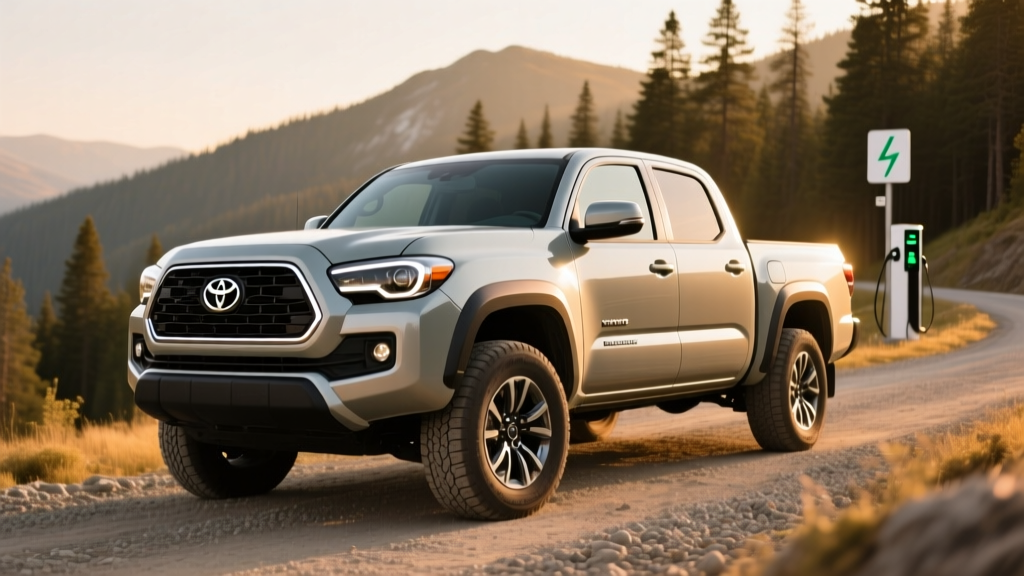
Toyota finally electrified its best-selling mid-size pickup with the i-FORCE MAX hybrid powertrain, and the result is a truck that delivers meaningful fuel savings without sacrificing the towing and off-road capability Tacoma buyers demand. The hybrid Toyota Tacoma isn't a plug-in — it's a conventional hybrid (HEV) that recovers energy through regenerative braking and assists the turbocharged gas engine with a compact electric motor sandwiched between the engine and transmission. No charging cables, no range anxiety, just better MPG and more torque.
But how much fuel does it actually save compared to the standard gas Tacoma, and does the hybrid premium pay for itself? We've broken down every spec, from EPA MPG to real-world efficiency, pricing across trims, and long-term battery reliability.
i-FORCE MAX Powertrain: How the Hybrid Tacoma Works
The hybrid Toyota Tacoma uses Toyota's i-FORCE MAX powertrain, which pairs a 2.4-liter turbocharged inline-four engine with a 48-horsepower electric motor integrated into the bell housing of the 8-speed automatic transmission. The combined system output is 326 horsepower and 465 lb-ft of torque — a substantial upgrade over the standard i-FORCE turbo four, which produces 278 hp and 317 lb-ft.
Unlike a plug-in hybrid (PHEV) such as the Toyota RAV4 Prime, the Tacoma hybrid has a small 1.87 kWh nickel-metal hydride (NiMH) battery pack positioned under the rear seats. This battery is charged entirely through regenerative braking and engine power — you never plug it in. The electric motor provides low-end torque fill, smoothing out turbo lag and reducing fuel consumption during city driving and stop-and-go traffic.
The Tacoma hybrid is a conventional hybrid (HEV). It does not plug in, has no electric-only driving range, and cannot operate as a pure EV. A plug-in hybrid (PHEV) like the Ford Escape PHEV offers 30+ miles of electric-only range but requires home charging infrastructure and carries a higher price premium. Toyota currently does not offer a Tacoma PHEV variant.
EPA Fuel Economy: Hybrid Tacoma MPG by Trim
Fuel economy varies by drivetrain and trim configuration. Here are the official EPA figures for the 2026 hybrid Toyota Tacoma, sourced from fueleconomy.gov:
| Configuration | City MPG | Highway MPG | Combined MPG |
|---|---|---|---|
| 4x2 (Limited, SR5) | 23 | 27 | 25 |
| 4x4 (Limited, SR5) | 22 | 26 | 24 |
| 4x4 (TRD Off-Road, Trailhunter) | 22 | 25 | 23 |
For comparison, the non-hybrid 4x4 Tacoma with the standard i-FORCE turbo four rates at 20 city / 26 highway / 22 combined. The hybrid's advantage is most pronounced in city driving, where the electric motor handles more of the low-speed workload — a 2 MPG city improvement that translates to fewer fill-ups in urban commutes.
Real-World MPG: What Owners Actually See
EPA estimates are a starting point, but real-world efficiency in a mid-size pickup depends heavily on driving style, payload, terrain, and climate. Based on aggregated owner reports and independent testing for the current-generation i-FORCE MAX Tacoma:
- City commuting (flat terrain, moderate traffic): 23–26 MPG — the hybrid system shines here, with the electric motor frequently assisting during stop-and-go conditions.
- Highway cruising (70–75 mph, unloaded): 23–25 MPG — at sustained highway speeds, the turbo four does most of the work, and the hybrid advantage narrows.
- Towing (5,000+ lb trailer): 12–15 MPG — hybrid assistance provides minimal benefit under heavy load. Expect fuel consumption similar to the gas-only model.
- Off-road / low-range (Trailhunter, TRD Off-Road): 14–18 MPG — low-speed crawling engages the electric motor more frequently, but aggressive terrain driving consumes fuel rapidly.
- Cold weather (below 30°F): Expect a 1–2 MPG reduction as the engine runs more often to maintain cabin heat and the battery operates less efficiently.
With a 21.1-gallon fuel tank (on 4x4 models), a 4x4 hybrid Tacoma at 24 MPG combined delivers approximately 506 miles of total range. That's roughly 40 more miles per tank than the gas-only 4x4 at 22 MPG combined. For mixed city/highway driving without towing, many owners report achieving or slightly exceeding EPA combined figures.
Hybrid Tacoma Specs: Performance, Towing & Capability
| Specification | i-FORCE MAX Hybrid | Standard i-FORCE (Gas) |
|---|---|---|
| Engine | 2.4L Turbo I-4 + Electric Motor | 2.4L Turbo I-4 |
| Combined Horsepower | 326 hp | 278 hp |
| Combined Torque | 465 lb-ft | 317 lb-ft |
| Transmission | 8-Speed Automatic | 8-Speed Automatic |
| Max Towing Capacity | 6,000 lbs | 6,500 lbs |
| Max Payload | ~1,700 lbs | ~1,805 lbs |
| Hybrid Battery | 1.87 kWh NiMH | N/A |
| 0–60 mph (est.) | ~6.5 sec | ~7.5 sec |
The i-FORCE MAX's 465 lb-ft of torque arrives low in the rev range thanks to electric motor assist, giving the hybrid Tacoma noticeably stronger acceleration from a stop and more confident highway merging. However, the hybrid system adds roughly 200 lbs of weight, which slightly reduces maximum towing (6,000 lbs vs. 6,500 lbs for the gas model) and payload capacity. If you regularly tow near the maximum limit, the gas-only model still holds a slight edge.
Pricing and Trim Availability
The i-FORCE MAX hybrid powertrain is not available on the base SR trim — it's reserved for higher trims where buyers are more likely to absorb the premium. Here's the 2026 MSRP breakdown (destination charge included):
- SR5 (4x2): ~$41,500
- SR5 (4x4): ~$44,000
- Limited (4x4): ~$52,500
- TRD Off-Road (4x4): ~$48,500
- Trailhunter (4x4): ~$54,000
- TRD Pro (4x4): ~$65,000
The hybrid premium over the equivalent gas-only trim is typically $1,500–$2,000. For a driver covering 15,000 miles per year at $3.50/gallon, the 2–3 MPG improvement saves approximately $200–$350 annually in fuel — meaning the hybrid premium pays for itself in roughly 5–7 years. However, the additional 48 hp and 148 lb-ft of torque provide immediate value beyond fuel savings alone.
Tax Credits: Does the Hybrid Tacoma Qualify?
This is where many buyers get confused. The hybrid Toyota Tacoma is a conventional hybrid (HEV), not a plug-in hybrid or battery electric vehicle. Under current IRS §30D Clean Vehicle Credit rules:
- Federal EV tax credit ($7,500): NOT eligible. This credit applies only to plug-in EVs and PHEVs meeting battery capacity and sourcing requirements.
- Used clean vehicle credit (§25E, up to $4,000): NOT eligible for the same reason — no plug-in capability.
- State incentives: A small number of states offer minor rebates for conventional hybrids, but these are increasingly rare as incentive programs shift toward plug-in vehicles. Check your state's energy office or AFDC state law database for current programs.
The bottom line: buy the hybrid Tacoma for the torque and fuel savings, not for tax incentives.
Battery Reliability, Warranty & Replacement Cost
Toyota covers the i-FORCE MAX hybrid battery and all hybrid system components with a 10-year / 150,000-mile warranty (whichever comes first), transferable to subsequent owners. This matches Toyota's broader hybrid battery warranty introduced for 2020+ models and exceeds the industry standard of 8 years / 100,000 miles.
Toyota's hybrid battery track record is among the best in the industry. The Prius, Camry Hybrid, and RAV4 Hybrid have demonstrated that Toyota's NiMH and lithium-ion hybrid batteries routinely last 150,000–200,000+ miles with minimal degradation. The 1.87 kWh pack in the Tacoma is small and operates within a narrow state-of-charge window (roughly 40–80%), which dramatically reduces stress and extends cycle life.
Replacement cost: If the hybrid battery does fail outside of warranty, Toyota dealership replacement currently runs $2,000–$3,500 for the battery module, plus labor. Independent hybrid specialists often offer refurbished battery replacements for $1,200–$2,000. Given the 10-year/150,000-mile warranty and Toyota's reliability history, most original owners will never face this cost.
The broader powertrain — the 2.4L turbo engine and 8-speed automatic — is covered by Toyota's standard 5-year/60,000-mile powertrain warranty. The turbo four is a newer engine (introduced for the Tundra and Tacoma), so long-term reliability data beyond 100,000 miles is still accumulating, but early reports have been positive.
Hybrid Tacoma vs. Gas Tacoma vs. Full EV Truck
The decision between a hybrid Tacoma, a gas-only Tacoma, and a full electric truck like the Ford F-150 Lightning or Rivian R1T comes down to your use case:
✓ Choose the Hybrid Tacoma If
- You want better city MPG without changing your fueling habits
- You need strong low-end torque for towing and off-road use
- You don't have access to home EV charging
- You regularly drive in remote areas with limited charging infrastructure
- You want Toyota's proven hybrid reliability with a 10-year battery warranty
✓ Choose the Gas Tacoma If
- You want the lowest upfront price (SR or SR5 trims)
- You need maximum towing (6,500 lbs) and payload capacity
- Your driving is mostly highway where the hybrid MPG advantage is small
- You prefer a simpler powertrain with fewer components
✓ Choose a Full EV Truck If
- You have Level 2 home charging and a predictable daily range under 250 miles
- You want $7,500 federal tax credit eligibility (income and sourcing rules apply)
- You prioritize lowest per-mile fuel cost ($0.04–$0.08/mile vs. $0.16–$0.20/mile gas)
- You don't need to tow heavy trailers long distances
Frequently Asked Questions
How many MPG does the hybrid Toyota Tacoma get?
The EPA rates the 4x4 hybrid Tacoma at 22 city / 26 highway / 24 combined MPG. The 4x2 version achieves 23/27/25 MPG. Real-world city driving often matches or slightly exceeds EPA estimates thanks to the electric motor's efficiency in stop-and-go traffic.
Does the hybrid Tacoma need to be plugged in?
No. The Tacoma i-FORCE MAX is a conventional hybrid (HEV). The small 1.87 kWh battery charges through regenerative braking and the gas engine. You fuel it exactly like any other gasoline truck.
How far can the hybrid Tacoma go on electric power alone?
It cannot drive on electric power alone for any meaningful distance. The electric motor assists the gas engine but does not independently propel the vehicle at road speeds. This is a key difference from a PHEV like the RAV4 Prime, which offers 42 miles of electric-only range.
Is the hybrid Tacoma reliable? What about battery replacement?
Toyota's hybrid systems have an industry-leading reliability record spanning over 25 years since the original Prius. The hybrid battery is warranted for 10 years / 150,000 miles, and replacement cost (if ever needed) is $2,000–$3,500 at a dealer. Most hybrid batteries outlast 200,000 miles.
Does the hybrid Toyota Tacoma qualify for a federal tax credit?
No. The federal §30D Clean Vehicle Credit applies only to plug-in electric vehicles and PHEVs. As a conventional hybrid, the Tacoma i-FORCE MAX does not qualify for any federal purchase incentive. Some states may offer minor hybrid rebates — check your local programs.
Is the hybrid Tacoma better for towing than the gas model?
The hybrid produces significantly more torque (465 lb-ft vs. 317 lb-ft), which makes it feel stronger when accelerating with a trailer. However, maximum towing capacity is slightly lower (6,000 lbs vs. 6,500 lbs) due to the hybrid system's added weight. For trailers under 5,000 lbs, the hybrid's torque advantage is noticeable. For maximum-rated towing, the gas model holds a slight edge.