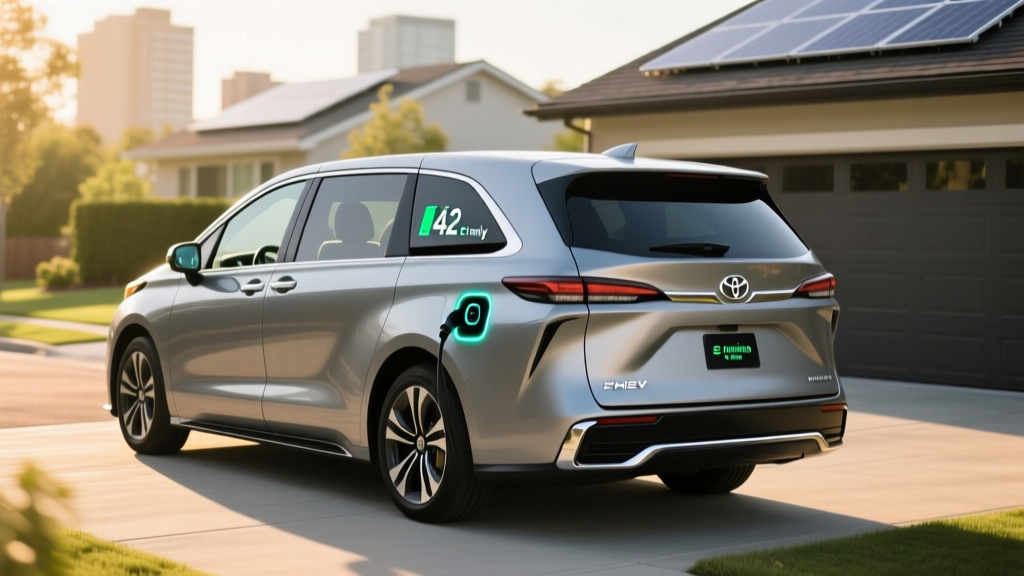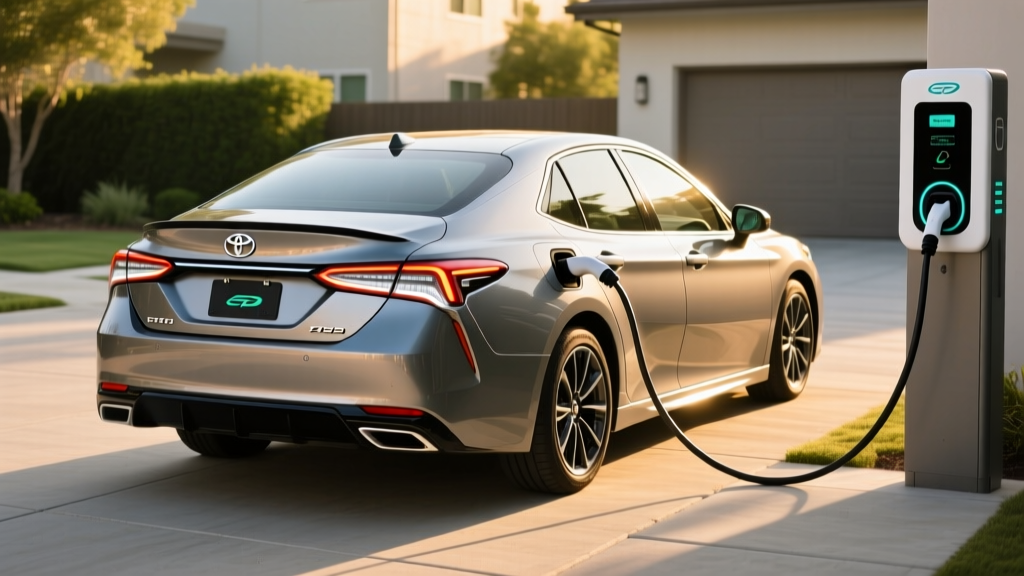
The Toyota Camry went all-hybrid for its ninth generation, and the formula has only gotten more refined for 2026. If you're researching the hybrid Toyota Camry, you're likely weighing its class-leading fuel economy against plug-in hybrids and full EVs. This guide breaks down exact EPA figures, real-world efficiency data, powertrain specs, pricing by trim, and whether the Camry Hybrid still makes sense as a daily driver in 2026.
2026 Camry Hybrid Powertrain and Specs at a Glance
Every 2026 Camry uses Toyota's fifth-generation hybrid system. There is no gas-only variant and no plug-in hybrid (PHEV) option. The powertrain pairs a 2.5-liter four-cylinder engine running the Atkinson cycle with one or two electric motors, depending on drivetrain.
| Spec | FWD Models | AWD Models |
|---|---|---|
| Combined Horsepower | 225 hp | 232 hp |
| Engine | 2.5L I4 Atkinson + 1 front motor | 2.5L I4 Atkinson + front & rear motors |
| Transmission | eCVT | eCVT |
| Drivetrain | Front-wheel drive | Electronic AWD (rear motor) |
| 0–60 mph (est.) | ~7.2 sec | ~6.9 sec |
| Hybrid Battery | ~1.6 kWh lithium-ion (sealed, self-charging) | |
| Plug-in Required? | No — regenerative braking recharges the battery | |
The Camry Hybrid is a conventional hybrid (HEV). It never needs to be plugged in. The small battery recharges via regenerative braking and the gasoline engine. A plug-in hybrid (PHEV), like the Toyota RAV4 Prime or Prius Prime, carries a much larger battery (13–18 kWh), offers 25–44 miles of electric-only range, and must be plugged in to realize its efficiency advantage. The Camry has no PHEV variant for 2026.
EPA Fuel Economy: City, Highway, and Combined MPG
Fuel economy is the Camry Hybrid's headline feature. Here are the official EPA estimates from fueleconomy.gov broken down by trim and drivetrain:
| Trim / Drivetrain | City MPG | Highway MPG | Combined MPG |
|---|---|---|---|
| LE FWD | 53 | 50 | 52 |
| SE / XLE / XSE FWD | 48 | 47 | 47 |
| LE AWD | 51 | 49 | 50 |
| SE / XLE / XSE AWD | 46 | 46 | 46 |
The LE FWD's 52 MPG combined is remarkable for a midsize sedan that seats five comfortably. The drop to 47 MPG on sport and luxury trims comes from larger 18- or 19-inch wheels, wider tires, and added weight from features like panoramic roofs and premium audio.
Real-World MPG: What Owners Actually See
Hybrid powertrains behave differently from gas-only cars in real-world driving. The Camry Hybrid's electric motor handles low-speed acceleration — where gas engines are least efficient — so city and suburban driving often exceeds the EPA city rating. Conversely, sustained highway cruising at 75–80 mph leans more heavily on the gas engine.
Based on aggregated owner data and independent testing:
- LE FWD, mixed suburban driving: 50–56 MPG is common, with some drivers reporting 58+ MPG on flat, moderate-speed commutes.
- Highway at 70 mph: Expect 44–48 MPG on the LE, roughly matching or slightly below the EPA highway figure.
- Highway at 80 mph: Drops to 39–43 MPG due to aerodynamic drag, which affects all vehicles but is more noticeable in efficiency-focused cars.
- Cold weather (below 35°F): Expect a 10–15% reduction in MPG during short trips. The engine runs longer to heat the cabin and bring the catalytic converter to operating temperature. Once warmed up, the penalty shrinks to 5–8%.
The real-world advantage over the EPA sticker is most pronounced for drivers who do a lot of stop-and-go city driving. If your commute is 90% highway at high speed, a Camry Hybrid will still beat any gas midsize sedan, but you may not hit 52 MPG.
Pricing, Trims, and Tax Credit Eligibility
Toyota prices the 2026 Camry Hybrid across four main trims. Here's the MSRP breakdown including destination charges:
| Trim | FWD MSRP | AWD MSRP |
|---|---|---|
| LE | $29,795 | $31,395 |
| SE | $31,295 | $32,895 |
| XLE | $34,495 | $36,095 |
| XSE | $35,495 | $37,095 |
Does the Camry Hybrid Qualify for a Federal Tax Credit?
No. Under IRS Section 30D rules, the federal clean vehicle credit of up to $7,500 applies only to battery electric vehicles (BEVs) and plug-in hybrids (PHEVs) with sufficient battery capacity and qualifying critical-mineral/battery-component sourcing. The Camry Hybrid is a conventional HEV with a ~1.6 kWh battery — far below the 7 kWh minimum threshold. It does not qualify for the federal EV tax credit or the point-of-sale transfer option.
Some states offer their own incentives for hybrids, though these are increasingly rare as state programs shift focus to zero-emission vehicles. Check your state's energy office or department of revenue for current programs. A few states historically offered $500–$1,500 rebates for high-MPG hybrids, but availability varies by jurisdiction and year.
Hybrid Battery Warranty, Lifespan, and Replacement Cost
Toyota covers the Camry Hybrid's battery with a 10-year / 150,000-mile warranty (whichever comes first) in all 50 states. This has been Toyota's standard hybrid battery warranty since the 2020 model year. The broader hybrid system — including the inverter, transaxle, and control modules — is also covered for 8 years / 100,000 miles.
Hybrid battery longevity is one of the most common buyer concerns, and the data is reassuring. Toyota's hybrid batteries in the Camry and Prius have demonstrated exceptional durability:
- Expected lifespan: Most Toyota hybrid batteries last 150,000–200,000+ miles before significant degradation. Many first-generation Prius batteries (2001–2003) exceeded 200,000 miles.
- Failure rate: Independent surveys and warranty claim data suggest a failure rate well under 5% within the warranty period.
- Degradation pattern: Unlike EV batteries that lose range linearly, hybrid batteries tend to work reliably until individual cells weaken, at which point the system flags a fault code.
What Does Replacement Cost?
If your hybrid battery fails outside warranty:
- New OEM battery from Toyota: $2,500–$4,000 installed at a dealership.
- Refurbished/reconditioned battery: $1,200–$2,200 from third-party suppliers.
- Individual cell replacement: Some independent hybrid specialists replace only the failed cells for $500–$1,200, though this requires specialized diagnostics.
Given the 10-year/150,000-mile warranty and Toyota's track record, battery replacement is a low-probability event for most owners. It should not be a deal-breaker for the Camry Hybrid.
Camry Hybrid vs. PHEV vs. Full EV: Which Is Right for You?
The Camry Hybrid occupies a specific niche. Here's a decision framework based on driving patterns and charging access:
- You cannot charge at home or work (no garage, apartment living, street parking)
- You want maximum simplicity — no plugs, no charging apps, no range planning
- You drive a mix of city and highway and want 46–52 MPG without behavior changes
- You want a midsize sedan under $38,000 with strong resale value
- You can charge at home (Level 1 or 2) and have a short commute (25–44 miles)
- You want electric-only daily driving but need gas for road trips
- You qualify for the $7,500 federal credit, offsetting the higher purchase price
- You have reliable home Level 2 charging
- Your daily driving is under 250 miles and you can plan road-trip charging
- You want zero tailpipe emissions and the lowest per-mile fuel cost
- You qualify for federal and state EV incentives
The Camry Hybrid's biggest advantage is its universality. It doesn't require any infrastructure, behavior change, or charging access. It simply delivers exceptional fuel economy the moment you drive it off the lot.
Ownership Costs: Fuel Savings Over 5 Years
To put the Camry Hybrid's efficiency in financial context, here's a five-year fuel cost comparison assuming 15,000 miles/year, $3.50/gallon regular unleaded, and real-world MPG:
| Vehicle | Avg. MPG | Gallons Used | Total Fuel Cost |
|---|---|---|---|
| 2026 Camry Hybrid LE | 50 | 1,500 | $5,250 |
| 2026 Honda Accord (1.5T gas) | 30 | 2,500 | $8,750 |
| 2026 Hyundai Sonata (2.5L gas) | 28 | 2,679 | $9,376 |
| 2025 Tesla Model 3 RWD | 132 MPGe | — | ~$2,700 (electricity) |
Over five years, the Camry Hybrid LE saves approximately $3,500 versus a gas Accord and $4,100 versus a gas Sonata at these fuel prices. A full EV like the Model 3 saves even more on fuel, but carries a higher purchase price and requires home charging infrastructure.
Insurance costs for the Camry Hybrid are generally in line with gas-powered midsize sedans — typically $1,400–$1,800/year depending on your profile and state. Toyota's reliability reputation and high production volume keep premiums moderate.
Safety, Reliability, and What's Standard
Every 2026 Camry Hybrid comes standard with Toyota Safety Sense 3.0, which includes:
- Pre-Collision System with Pedestrian Detection
- Full-Speed Range Dynamic Radar Cruise Control
- Lane Departure Alert with Steering Assist and Lane Tracing Assist
- Automatic High Beams
- Road Sign Assist
- Proactive Driving Assist (gentle braking when approaching slower traffic or curves)
This is an SAE Level 2 driver-assistance suite, meaning the driver must remain fully engaged and hands on the wheel at all times. It is not autonomous driving.
The Camry has historically earned top marks from both IIHS and NHTSA. The ninth-generation model continues to perform well in crash testing, and Toyota's hybrid system has proven among the most reliable powertrains in the industry over two decades of deployment.
Frequently Asked Questions
How many MPG does the hybrid Toyota Camry actually get?
The EPA rates the 2026 Camry Hybrid LE at 53 city / 50 highway / 52 combined MPG. In real-world suburban driving, many owners report 50–56 MPG. Highway-only driving at 75+ mph typically yields 42–48 MPG. Higher trims (SE, XLE, XSE) are rated at 46–47 MPG combined due to larger wheels and added weight.
Does the Camry Hybrid need to be plugged in?
No. The Camry Hybrid is a conventional hybrid (HEV), not a plug-in hybrid. The battery recharges automatically through regenerative braking and the gasoline engine. You simply fill it with regular unleaded gasoline like any other car.
Is the hybrid Toyota Camry reliable?
Toyota's hybrid system has over 25 years of proven reliability across millions of vehicles worldwide. The hybrid battery carries a 10-year / 150,000-mile warranty. Real-world data shows most Toyota hybrid batteries last 150,000–200,000+ miles. The Camry consistently ranks at or near the top of midsize sedan reliability surveys.
Does the Camry Hybrid qualify for any tax credit?
The Camry Hybrid does not qualify for the federal §30D clean vehicle tax credit, which requires plug-in vehicles with at least 7 kWh of battery capacity. Some states may offer small hybrid incentives, but these are increasingly rare. Check your state's energy office for current programs.
How much does it cost to replace the Camry Hybrid battery?
A new OEM replacement battery costs $2,500–$4,000 installed at a Toyota dealership. Refurbished units run $1,200–$2,200. However, with the 10-year/150,000-mile warranty and Toyota's track record, most owners never need a replacement.
Should I get the FWD or AWD Camry Hybrid?
Choose FWD for maximum fuel economy (up to 52 MPG combined on the LE) and a slightly lower price. Choose AWD if you regularly drive on snow, ice, or wet roads — the rear electric motor provides additional traction with only a 2-MPG penalty. The AWD system adds 7 hp (232 total) and slightly improves acceleration.