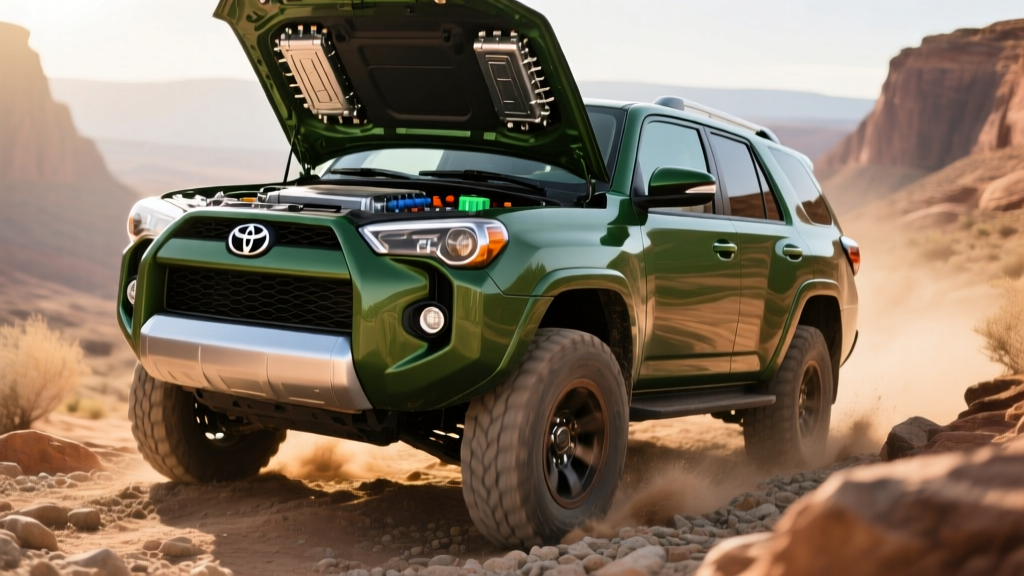
The Toyota 4Runner spent over a decade as a body-on-frame, V6-only relic. That era ended with the sixth generation, and the headline addition to the lineup is the i-FORCE MAX hybrid powertrain. The 2026 Toyota 4Runner hybrid pairs a turbocharged 2.4-liter four-cylinder with an electric motor integrated into the transmission, delivering a combined 326 horsepower and 465 lb-ft of torque. It is a conventional hybrid (HEV), not a plug-in — meaning no charging cable, no electric-only range, and no need to change your fueling habits. What you get instead is substantially improved fuel economy for a body-on-frame SUV, better low-end torque for off-road crawling, and a powertrain that Toyota has already proven in the Tacoma and Land Cruiser.
This guide breaks down everything you need to know about the hybrid Toyota 4Runner: real-world MPG, powertrain specs, trim pricing, battery longevity, tax credit eligibility, and whether the hybrid or the non-hybrid i-FORCE engine is the right call for your driving pattern.
HEV vs PHEV: Where the 4Runner Hybrid Fits
Conventional Hybrid (HEV): The 2026 4Runner i-FORCE MAX is a self-charging hybrid. A small battery (approximately 1.87 kWh, nickel-metal hydride) recovers energy from braking and the engine to assist acceleration and enable brief low-speed electric assist. You never plug it in. You fuel it at a gas station like any other vehicle.
Plug-in Hybrid (PHEV): Toyota does not offer a plug-in 4Runner. If you want a body-on-frame SUV with electric-only driving range, the closest competitor is the Jeep Wrangler 4xe, which offers roughly 21 miles of electric-only range on a 17.3 kWh battery and requires Level 2 charging to maximize its benefit.
Full EV (BEV): There is no electric 4Runner. If zero tailpipe emissions and home charging are your priority, you are looking at unibody crossovers like the Rivian R1S or the upcoming electric body-on-frame platforms from other manufacturers.
The hybrid 4Runner is designed for buyers who want the fuel economy improvement of electrification without any change to their refueling routine. It is not a stepping stone to a PHEV or EV — it is a destination powertrain for drivers who tow, off-road, or simply want a truck-based SUV that does not punish them at the pump.
Fuel Economy: EPA MPG and Real-World Expectations
The i-FORCE MAX hybrid powertrain delivers a meaningful efficiency gain over the standard i-FORCE turbo four-cylinder, particularly in city driving where the electric motor does its heaviest lifting.
| Powertrain | City MPG | Highway MPG | Combined MPG |
|---|---|---|---|
| i-FORCE MAX Hybrid (2WD) | 26 | 27 | 26 |
| i-FORCE MAX Hybrid (4WD) | 23 | 24 | 23 |
| i-FORCE Turbo (2WD) | 20 | 26 | 22 |
| i-FORCE Turbo (4WD) | 19 | 25 | 21 |
Source: fueleconomy.gov — EPA estimates. Actual mileage will vary.
Real-World MPG: What to Actually Expect
Toyota hybrids historically perform at or slightly above their EPA city estimates because regenerative braking is most effective in stop-and-go traffic. On the highway, the story flips: aerodynamic drag dominates a tall, boxy, body-on-frame SUV, and the hybrid advantage shrinks. Expect the 4WD hybrid to deliver:
- City (mixed suburban/urban): 23–26 MPG — the hybrid system shines here, and you may match or slightly beat the EPA city figure in moderate climates.
- Highway (70+ mph sustained): 21–23 MPG — the turbo engine carries most of the load at speed; hybrid assist is minimal.
- Cold weather (below 30°F): Expect a 2–4 MPG drop. The engine runs richer during warm-up, and battery efficiency decreases in cold temperatures. This is normal for all hybrids.
- Off-road/low-speed crawling: The hybrid system excels here, providing precise electric torque at low speeds. Fuel economy is irrelevant in this context, but the drivability improvement is significant.
For a 6,000-pound body-on-frame SUV, 23 MPG combined with 4WD is a genuine achievement. The non-hybrid 4WD model returns 21 MPG combined — that 2 MPG gap translates to roughly 60 fewer gallons per year at 15,000 miles, or about $200 in annual fuel savings at $3.40/gallon.
Powertrain Specs: i-FORCE MAX Under the Hood
| Specification | i-FORCE MAX Hybrid | i-FORCE Turbo |
|---|---|---|
| Engine | 2.4L turbocharged inline-4 | 2.4L turbocharged inline-4 |
| Electric Motor | Integrated into 8-speed transmission | None |
| Combined Horsepower | 326 hp | 278 hp |
| Combined Torque | 465 lb-ft | 317 lb-ft |
| Transmission | 8-speed automatic | 8-speed automatic |
| Drivetrain Options | 2WD, 4WD (part-time/full-time by trim) | 2WD, 4WD |
| Max Towing Capacity | 6,000 lbs | 6,000 lbs |
| 0–60 mph (est.) | ~6.5 seconds (4WD) | ~7.5 seconds (4WD) |
| Battery Type | NiMH (~1.87 kWh) | N/A |
The 48-horsepower and 148 lb-ft advantage of the hybrid is not subtle. The i-FORCE MAX delivers peak torque from very low RPM thanks to the electric motor fill-in, which eliminates the turbo lag that some reviewers noted in the non-hybrid i-FORCE. This is especially noticeable when merging onto highways, climbing grades, or crawling over technical off-road obstacles where precise throttle control matters.
The hybrid battery is a nickel-metal hydride (NiMH) pack, not a lithium-ion unit. Toyota has used NiMH hybrid batteries for over 25 years (since the original Prius), and this chemistry choice reflects a deliberate trade-off: NiMH is heavier and less energy-dense than lithium-ion, but it is extremely durable, tolerant of temperature extremes, and proven over billions of cumulative miles in Toyota hybrids worldwide.
Pricing, Trims, and Tax Credit Eligibility
The i-FORCE MAX hybrid is not available on the base SR5 trim. Toyota positions it on mid-to-upper trims, which pushes the entry price higher but bundles the hybrid with more equipment.
| Trim (4WD, Hybrid) | Approx. MSRP | Key Features |
|---|---|---|
| TRD Off-Road | $54,990 | Crawl Control, locking rear diff, 33" tires available |
| Limited | $58,990 | Leather, panoramic roof, adaptive suspension |
| TRD Pro | $67,990 | FOX shocks, skid plates, roof rack, exclusive colors |
| Trailhunter | $66,490 | ARB bumper, Old Man Emu suspension, integrated air compressor |
MSRP figures are approximate for 2026 model year and subject to change. Destination charges additional. Verify current pricing at toyota.com/4runner.
Does the Hybrid 4Runner Qualify for a Federal Tax Credit?
No. The 2026 Toyota 4Runner hybrid is a conventional HEV, not a plug-in vehicle. The federal §30D Clean Vehicle Credit applies only to battery electric vehicles (BEVs) and plug-in hybrids (PHEVs) that meet battery sourcing, critical minerals, MSRP cap, and buyer income requirements as defined by the IRS. Conventional hybrids do not qualify for §30D.
Some states offer separate incentives for conventional hybrids, but these are increasingly rare as state programs shift toward plug-in vehicles. Check your state's energy office or department of environmental quality for any remaining hybrid-specific rebates.
Battery Warranty, Reliability, and Replacement Cost
Hybrid Battery Warranty: Toyota covers the hybrid battery and all hybrid system components for 10 years / 150,000 miles, whichever comes first. This warranty applies nationwide, including in states that do not follow California emissions standards (previously, non-CARB states received only 8 years/100,000 miles — Toyota extended the coverage uniformly starting with recent model years).
Powertrain Warranty: The engine, transmission, and related drivetrain components carry a 5-year / 60,000-mile warranty.
How Long Will the Hybrid Battery Last?
Toyota's NiMH hybrid batteries have an exceptional longevity record. Data from millions of Prius, Camry Hybrid, and Highlander Hybrid vehicles show that NiMH packs routinely last 150,000–200,000+ miles before any meaningful degradation. Unlike lithium-ion EV batteries, which degrade based on charge cycles and calendar age, NiMH hybrid batteries experience minimal degradation because they operate in a narrow state-of-charge window (roughly 40%–80%) managed by the vehicle's computer. The battery is never fully charged or fully depleted in normal operation.
The 4Runner's hybrid battery is small (~1.87 kWh) and serves a supporting role — it is not the primary energy source. This further reduces stress on the cells.
Battery Replacement Cost
If the hybrid battery does require replacement outside of warranty, expect to pay between $2,000 and $4,000 for a new OEM battery pack, including labor. Refurbished or reconditioned NiMH packs are available from third-party suppliers for $1,000–$2,000. Individual cell modules can be replaced for even less if only a portion of the pack has failed. This is significantly less expensive than EV traction battery replacement, which can exceed $10,000–$20,000.
Toyota's hybrid system reliability is well-documented. The 4Runner's i-FORCE MAX shares its core architecture with the Tacoma and Land Cruiser, both of which have accumulated substantial real-world miles since the powertrain's introduction. There are no widespread failure patterns reported as of early 2026.
Who Should Buy the Hybrid 4Runner (and Who Shouldn't)
Choose the Hybrid 4Runner If:
- You want a body-on-frame SUV with genuine off-road capability and do not want to sacrifice fuel economy
- You tow up to 6,000 lbs and want the torque advantage of the electric motor for grade-holding and low-speed trailer maneuvering
- Your driving includes significant city or suburban stop-and-go miles, where the hybrid system delivers the biggest MPG gain
- You want Toyota's proven hybrid reliability with a 10-year/150,000-mile battery warranty and no plug-in infrastructure requirement
- You value low-speed electric torque for rock crawling and technical off-road terrain
Look Elsewhere If:
- You want electric-only driving for short commutes (you need a PHEV like the Wrangler 4xe or a full EV)
- You want to qualify for the $7,500 federal tax credit (HEVs are ineligible)
- Your driving is almost entirely highway — the hybrid MPG advantage shrinks to 1–2 MPG at sustained 70+ mph speeds
- You want a third row — the hybrid battery packaging limits 4Runner to two rows (5 passengers) on most trims
- Budget is a primary concern — the hybrid is only available on $55K+ trims, whereas the base SR5 i-FORCE starts around $42,000
Hybrid vs PHEV vs EV: Which Powertrain Fits Your Life?
The 4Runner is a hybrid-only proposition in the body-on-frame SUV segment. But the broader question is whether a hybrid, plug-in hybrid, or full EV is the right powertrain for your situation. Here is a practical decision framework:
| Factor | HEV (4Runner Hybrid) | PHEV (e.g., Wrangler 4xe) | BEV (e.g., Rivian R1S) |
|---|---|---|---|
| Plug in required? | No | Yes (for EV range) | Yes (always) |
| Electric-only range | None (brief low-speed assist) | ~21 mi | ~300+ mi |
| Fuel cost per mile | ~$0.15 (gas) | ~$0.05 (electric) / ~$0.15 (gas) | ~$0.04–$0.06 (electric) |
| Home charging needed? | No | Recommended | Essential |
| Federal tax credit | None | Up to $7,500 (if eligible) | Up to $7,500 (if eligible) |
| Off-road capability | Excellent | Excellent | Good–Excellent |
| Towing | 6,000 lbs | 3,500 lbs (Wrangler 4xe) | 7,700 lbs (R1S) |
| Maintenance | Low (no plug system) | Moderate (two systems) | Lowest (no engine) |
If you have a garage or driveway where you can install a Level 2 charger, a short commute (under 25 miles), and do not regularly tow or off-road, a PHEV or BEV will save you more money over time. If you live in an apartment, lack home charging access, tow regularly, or drive in remote areas where charging infrastructure is sparse, the 4Runner hybrid is the most practical electrified choice in the off-road SUV segment.
Ownership Costs: 5-Year Outlook
Here is a rough 5-year/75,000-mile cost comparison for the 4Runner Hybrid 4WD vs. the non-hybrid i-FORCE 4WD, assuming $3.40/gallon regular unleaded and 15,000 miles/year:
| Cost Factor | i-FORCE MAX Hybrid (4WD) | i-FORCE Turbo (4WD) |
|---|---|---|
| Fuel (75,000 mi) | ~$11,087 (23 MPG combined) | ~$12,143 (21 MPG combined) |
| Fuel savings over 5 years | ~$1,056 in favor of hybrid | |
| Maintenance | Comparable (same engine, regenerative braking reduces brake wear) | Comparable |
| Insurance | Comparable (same vehicle class) | Comparable |
The fuel savings alone do not justify the hybrid's trim-level premium. The real value proposition is the 48 additional horsepower, 148 additional lb-ft of torque, and the refined driving experience that the electric motor provides. The hybrid 4Runner is not a cost-savings play — it is a performance and refinement upgrade that happens to be more efficient.
Frequently Asked Questions
How many MPG does the hybrid Toyota 4Runner get?
The 2026 4Runner i-FORCE MAX hybrid achieves 26 MPG combined (26 city / 27 highway) in 2WD and 23 MPG combined (23 city / 24 highway) in 4WD, per the EPA. Real-world city driving often matches or slightly exceeds the EPA city figure thanks to regenerative braking. Highway mileage at sustained speeds above 70 mph typically falls 1–3 MPG below the EPA highway estimate due to the 4Runner's tall, boxy aerodynamics.
Does the hybrid 4Runner need to be plugged in?
No. The 4Runner i-FORCE MAX is a conventional hybrid (HEV). It charges its small battery through regenerative braking and the gasoline engine. You never plug it in. There is no electric-only driving range — the electric motor assists the gas engine but cannot propel the vehicle alone at meaningful speeds.
How far can the hybrid 4Runner go on electric only?
It cannot. Unlike a plug-in hybrid (PHEV), the 4Runner hybrid has no electric-only driving mode. The electric motor provides torque fill during acceleration and enables very brief low-speed creeping (such as in a parking lot), but the gasoline engine is always the primary power source. If electric-only commuting is a priority, you need a PHEV or BEV.
Is the hybrid Toyota 4Runner reliable?
Toyota's hybrid systems are among the most reliable powertrains in the automotive industry. The i-FORCE MAX shares its architecture with the Tacoma and Land Cruiser, and Toyota has built tens of millions of hybrid vehicles since 1997 with no widespread systemic failures. The NiMH hybrid battery is covered for 10 years / 150,000 miles and routinely lasts well beyond that in real-world use.
What does it cost to replace the 4Runner hybrid battery?
A new OEM hybrid battery replacement costs approximately $2,000–$4,000 including labor. Refurbished packs are available for $1,000–$2,000. Given the proven longevity of Toyota's NiMH batteries and the 10-year/150,000-mile warranty, most owners will never need to replace the hybrid battery during their ownership period.
Does the hybrid 4Runner qualify for any federal tax credit?
No. The federal §30D Clean Vehicle Credit applies only to plug-in vehicles (BEVs and PHEVs). Conventional hybrids like the 4Runner i-FORCE MAX are not eligible. Some states may offer minor incentives for hybrid vehicles, but these are uncommon. Consult the IRS Clean Vehicle Credit page for current federal eligibility rules.
Is the hybrid 4Runner good for towing?
Yes. The i-FORCE MAX hybrid is rated to tow 6,000 pounds, the same as the non-hybrid i-FORCE. The hybrid's 465 lb-ft of combined torque — available at low RPM thanks to the electric motor — makes it particularly well-suited for towing on grades and for low-speed trailer maneuvering. Toyota includes an integrated trailer brake controller on towing-equipped trims.
What is the difference between the i-FORCE and i-FORCE MAX?
The i-FORCE is the standard turbocharged 2.4-liter four-cylinder engine producing 278 hp and 317 lb-ft. The i-FORCE MAX adds an electric motor between the engine and transmission, boosting output to 326 hp and 465 lb-ft. The MAX is the hybrid variant. Both use the same 8-speed automatic transmission and are available in 2WD and 4WD.