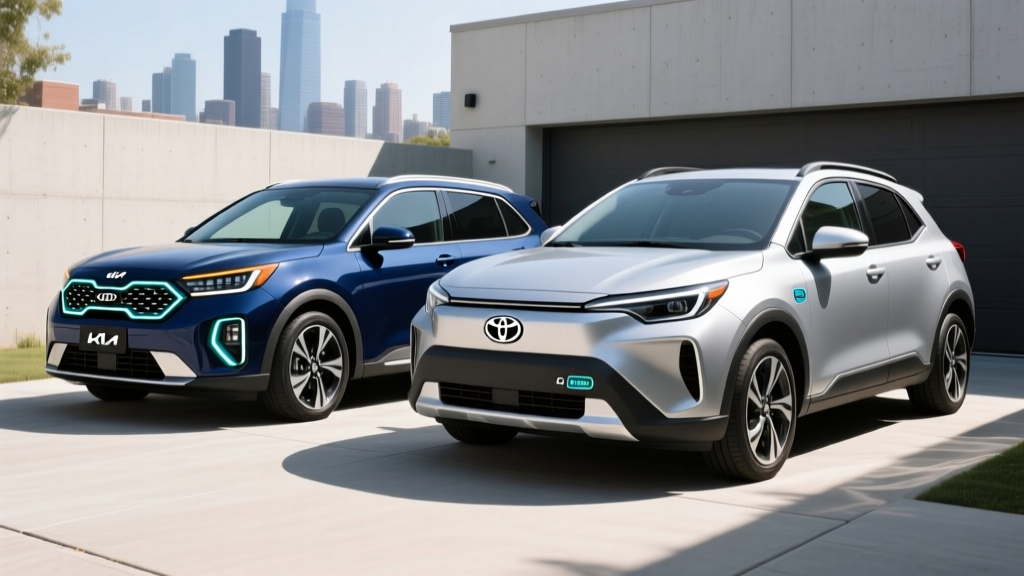
The subcompact hybrid SUV segment has matured into one of the smartest purchases in the auto market. You get elevated seating, genuine cargo space, all-wheel-drive availability, and combined fuel economy that hovers around 50 MPG — all without plugging in or changing your driving habits. For 2026, two nameplates dominate buyer shortlists: the Kia Niro (redesigned for its second generation) and the Toyota Corolla Cross Hybrid. Both are conventional hybrids (HEVs), not plug-ins, and both start under $30,000. But their powertrain philosophies, real-world efficiency profiles, and ownership equations differ in ways that matter.
This guide breaks down exact EPA figures, real-world MPG behavior, battery longevity data, warranty terms, and total cost of ownership so you can decide which hybrid subcompact SUV earns a spot in your driveway — or whether a PHEV or full EV might serve you better.
HEV vs PHEV vs EV: What Kind of Electrified Subcompact SUV Do You Actually Need?
Before comparing trims and MPG stickers, it's worth clarifying what you're buying. The Niro and Corolla Cross discussed here are conventional hybrids (HEVs) — they regenerate braking energy and use a small battery to assist the gas engine, but you never plug them in. Kia also sells the Niro PHEV, a plug-in variant we'll address separately below.
Quick Reference: HEV vs PHEV vs BEV
| Attribute | HEV (e.g., Niro, Corolla Cross Hybrid) | PHEV (e.g., Niro PHEV) | BEV (e.g., Kia EV6, Toyota bZ4X) |
|---|---|---|---|
| Plugs in? | No | Yes (Level 1/2) | Yes (Level 1/2/DC) |
| Electric-only range | ~1 mi at low speed | 33 mi (Niro PHEV) | 230–310 mi typical |
| Fuel/energy cost per mile | ~$0.10–0.12 | ~$0.04 electric / $0.11 gas | ~$0.04–0.06 |
| Federal tax credit | None (§30D is BEV/PHEV only) | Up to $7,500 if eligible | Up to $7,500 if eligible |
| Best for | No home charging, simplicity | Home charging + short commutes | Home charging + lowest running cost |
If you have a garage or driveway where you can install a Level 2 charger and your daily commute is under 35 miles round-trip, the Niro PHEV can run almost entirely on electricity most days while keeping a gas engine for road trips. If you lack reliable charging access — apartment dwellers, street parkers — a conventional HEV is the pragmatic choice. You get roughly 40–50% better fuel economy than a gas-only equivalent with zero behavioral change.
2026 Kia Niro Hybrid: Specs, MPG, and Real-World Efficiency
The second-generation Kia Niro rides on the K3 platform and pairs a 1.6-liter GDI four-cylinder with a 32 kW (43 hp) permanent-magnet electric motor integrated into a 6-speed dual-clutch automatic. Combined system output is 139 horsepower and 195 lb-ft of torque. Front-wheel drive is standard; AWD is not offered on the HEV (it is available on the Niro PHEV).
| Spec | Value |
|---|---|
| Powertrain | 1.6L I-4 + 32 kW electric motor, 6-speed DCT |
| Combined HP | 139 hp / 195 lb-ft |
| Hybrid battery | 1.56 kWh lithium-ion polymer |
| EPA MPG (city / hwy / combined) | 53 / 54 / 53 (LX trim, 16" wheels) |
| 0–60 mph | ~9.3 sec (est.) |
| Cargo volume | 22.8 cu ft (rear seats up) / 63.7 cu ft (folded) |
| Base MSRP (LX) | $28,390 |
| Federal tax credit | None (HEV does not qualify for §30D) |
Real-World MPG: What Owners Actually See
The EPA rates the Niro LX at 53 MPG combined, one of the highest figures in any non-plug-in vehicle sold in the U.S. Hyundai-Kia's hybrid tuning favors low-speed electric assist, which means city driving often matches or slightly exceeds the EPA city number. In suburban stop-and-go driving, owners on Fuelly and Edmunds forums routinely report 52–56 MPG. Highway-only driving at 70–75 mph typically drops to 46–49 MPG because the small 1.6L engine works harder at sustained speed and aerodynamic drag rises sharply.
Cold weather (below 35°F) reduces efficiency roughly 8–12% as the engine runs longer to heat the cabin and the battery's internal resistance rises. Expect ~46–48 MPG combined in winter if you live in the northern U.S.
2026 Toyota Corolla Cross Hybrid: Specs, MPG, and AWD Advantage
Toyota's approach is mechanically distinct. The Corolla Cross Hybrid uses the fifth-generation Toyota Hybrid System (THS): a 2.0-liter Dynamic Force four-cylinder combined with two motor-generators and an electronically controlled CVT (eCVT). The result is 196 combined horsepower — a decisive advantage over the Niro — and standard electronic all-wheel drive via a rear-mounted 30 kW motor. There is no mechanical driveshaft; the rear axle is powered purely by electricity.
| Spec | Value |
|---|---|
| Powertrain | 2.0L I-4 + 2 motor-generators, eCVT, eAWD |
| Combined HP | 196 hp |
| Hybrid battery | ~1.0 kWh lithium-ion (bipolar) |
| EPA MPG (city / hwy / combined) | 45 / 38 / 42 |
| 0–60 mph | ~7.5 sec |
| Cargo volume | 25.0 cu ft (rear seats up) / 66.3 cu ft (folded) |
| Base MSRP (S Hybrid) | $30,185 |
| Federal tax credit | None (HEV does not qualify for §30D) |
Real-World MPG: Toyota's City-Strong Tuning
Toyota hybrids have a well-documented tendency to beat their EPA city estimates in real-world driving. The Corolla Cross Hybrid's 45 MPG city figure is conservative; in mild weather with moderate traffic, 47–50 MPG city is common. Highway efficiency, however, is the trade-off: the EPA's 38 MPG highway number is realistic, and some drivers report 35–37 MPG at sustained 75–80 mph speeds, especially with roof racks or cargo. The AWD system's rear motor adds mechanical drag on the highway that the FWD-only Niro doesn't have.
Overall combined real-world figures cluster around 40–44 MPG for most owners, per fueleconomy.gov user MPG tracking. That's still excellent for an AWD crossover, but it trails the Niro by roughly 10 MPG combined.
Side-by-Side: Niro Hybrid vs Corolla Cross Hybrid
| Category | 2026 Kia Niro Hybrid LX | 2026 Toyota Corolla Cross Hybrid S |
|---|---|---|
| Base MSRP | $28,390 | $30,185 |
| EPA Combined MPG | 53 | 42 |
| Horsepower | 139 hp | 196 hp |
| Drivetrain | FWD only | eAWD standard |
| Cargo (behind rear seats) | 22.8 cu ft | 25.0 cu ft |
| Hybrid Battery Warranty | 10 yr / 100,000 mi | 10 yr / 150,000 mi |
| 0–60 mph | ~9.3 sec | ~7.5 sec |
| Towing | Not rated | Not rated |
The Niro wins decisively on fuel economy and entry price. The Corolla Cross Hybrid wins on power, AWD capability, and cargo space. Neither offers towing, which is typical for the subcompact class.
Battery Longevity, Warranty, and Replacement Cost
Hybrid Battery Warranty Snapshot
- Kia Niro Hybrid: 10 years / 100,000 miles (hybrid battery & components)
- Toyota Corolla Cross Hybrid: 10 years / 150,000 miles (hybrid battery — Toyota extended coverage for 2020+ models)
- Federal mandate minimum: 8 years / 100,000 miles for hybrid/EV battery components
How Long Do Hybrid Batteries Actually Last?
Conventional hybrid batteries are far smaller and less stressed than full EV packs. The Niro's 1.56 kWh battery and the Corolla Cross's ~1.0 kWh unit operate in a narrow state-of-charge window (typically 40–80% SoC), which dramatically reduces degradation. Toyota's hybrid fleet — the Prius, Camry Hybrid, RAV4 Hybrid — has amassed two decades of field data showing hybrid batteries routinely lasting 150,000–200,000+ miles before capacity loss becomes noticeable. Kia's system is newer but follows the same engineering principles.
If a hybrid battery does fail out of warranty, replacement costs are substantially lower than EV battery replacements:
- Toyota hybrid battery replacement: $2,000–$4,000 (refurbished/aftermarket) or $4,000–$6,000 (OEM new)
- Kia/Hyundai hybrid battery replacement: $2,500–$5,000 depending on source
- Individual module replacement (repairing only failed cells) is increasingly available from independent hybrid specialists for $800–$1,500
For context, a full EV traction battery replacement runs $10,000–$22,000+. The hybrid battery replacement risk is real but modest, and most owners will sell the vehicle before it becomes relevant.
The PHEV Option: 2026 Kia Niro Plug-In Hybrid
If you have access to Level 1 or Level 2 home charging and a commute under 35 miles, the Kia Niro PHEV is worth serious consideration. It uses a larger 11.1 kWh lithium-ion polymer battery paired with a 62 kW (83 hp) electric motor and the same 1.6L engine, producing 180 combined horsepower.
| Electric-only range (EPA) | 33 miles |
| Total combined range | ~430 miles (electric + gas) |
| MPGe (electric mode) | 108 MPGe combined |
| MPG (hybrid mode, battery depleted) | 48 MPG combined |
| Charge time (Level 2, 240V) | ~2 hours 45 minutes |
| DC fast charging | Not available |
| Base MSRP | $35,590 |
| Federal tax credit (§30D) | Up to $7,500 — subject to income, MSRP, and battery-sourcing rules |
At 33 miles of electric-only range, the Niro PHEV covers most daily commutes without burning a drop of gasoline. When the battery depletes, it reverts to a conventional hybrid at 48 MPG combined — still excellent. The absence of DC fast charging is standard for PHEVs in this class; the battery is simply too small to justify the hardware cost.
Tax Credit Eligibility for the Niro PHEV
Unlike the conventional Niro HEV, the Niro PHEV may qualify for the IRS §30D clean vehicle credit of up to $7,500. However, eligibility depends on several requirements that change annually:
- MSRP cap: SUVs must be under $80,000 (Niro PHEV qualifies at ~$35,590 base)
- Buyer income cap: Modified AGI ≤ $150,000 (single) / $300,000 (joint)
- Battery sourcing: Critical minerals and battery components must meet escalating domestic-content thresholds — for 2026, these requirements are stringent and may reduce the credit to $3,750 or disqualify certain trim/build combinations
- Point-of-sale transfer: You can transfer the credit to the dealer for an immediate price reduction, or claim it on your tax return
Always verify current eligibility with a tax professional and the IRS's official guidance before assuming the full $7,500 credit. Kia's assembly location and battery supply chain determine whether a specific VIN qualifies.
Who Should Buy Which? A Decision Framework
Choose Based on Your Situation
Choose the Kia Niro Hybrid if:
- Maximum fuel economy is your top priority (53 MPG combined, real-world 50–56 city)
- You live in a mild climate and don't need AWD
- You want the lowest entry price in the segment ($28,390)
- You drive mostly city/suburban routes under 65 mph
Choose the Toyota Corolla Cross Hybrid if:
- You need AWD for snow, rain, or light trail use
- You want more power (196 hp vs 139 hp) for highway merging and hills
- Cargo space matters (25.0 cu ft vs 22.8 cu ft)
- You prioritize Toyota's long-term reliability reputation and 150,000-mile battery warranty
Choose the Kia Niro PHEV if:
- You have home or workplace Level 2 charging
- Your daily round-trip commute is ≤ 30 miles
- You want near-EV running costs on weekdays with gas-engine freedom on weekends
- You may qualify for the §30D federal tax credit (up to $7,500)
Choose a full EV (e.g., Kia EV6, Hyundai Ioniq 5) if:
- You have reliable home Level 2 charging and your daily driving is under 250 miles
- You want the lowest per-mile energy cost (~$0.04–0.06/mi vs $0.10–0.12/mi for HEV)
- You want to eliminate oil changes and most powertrain maintenance entirely
Pros and Cons at a Glance
Kia Niro Hybrid — Pros
- Class-leading 53 MPG combined
- Lowest starting price ($28,390)
- Generous 10yr/100k-mi warranty
- Strong city-EV driving feel
- Spacious rear seats for the class
Kia Niro Hybrid — Cons
- No AWD option
- Modest 139 hp — sluggish highway merging
- Smaller cargo area than Corolla Cross
- 9.3-sec 0–60 is slowest in segment
- No federal tax credit (HEV)
Toyota Corolla Cross Hybrid — Pros
- Standard eAWD — rare in the segment
- 196 hp — confident acceleration
- Real-world city MPG often beats EPA
- 10yr/150k-mi hybrid battery warranty
- Larger cargo area (25.0 cu ft)
Toyota Corolla Cross Hybrid — Cons
- 42 MPG combined trails Niro by 11 MPG
- Higher starting price ($30,185)
- Highway MPG dips to ~35–37 at 75+ mph
- eCVT can drone under hard acceleration
- No federal tax credit (HEV)
Frequently Asked Questions
How many MPG does a hybrid subcompact SUV actually get?
The 2026 Kia Niro Hybrid achieves an EPA-rated 53 MPG combined (53 city / 54 highway), while the Toyota Corolla Cross Hybrid delivers 42 MPG combined (45 city / 38 highway). In real-world driving, the Niro often returns 50–56 MPG in city conditions, and the Corolla Cross Hybrid typically achieves 40–44 MPG combined. Highway driving at 70+ mph reduces both figures by 5–10 MPG.
Do hybrid subcompact SUVs need to be plugged in?
No. Conventional hybrids (HEVs) like the Niro Hybrid and Corolla Cross Hybrid never plug in. They recharge their small batteries through regenerative braking and the gas engine. Only plug-in hybrids (PHEVs) like the Niro PHEV require charging to access their electric-only range.
How far can the Niro PHEV go on electric only?
The 2026 Kia Niro PHEV has an EPA-rated electric-only range of 33 miles. That covers the average American's one-way commute (roughly 16 miles each way per the U.S. Census Bureau). Once the battery depletes, the vehicle operates as a conventional hybrid at 48 MPG combined.
Are hybrid SUV batteries reliable, and what does replacement cost?
Hybrid batteries are among the most reliable components in modern vehicles. Toyota's hybrid batteries have demonstrated 150,000–200,000+ mile lifespans across millions of vehicles. Both the Niro and Corolla Cross Hybrid carry 10-year hybrid battery warranties (Kia: 100,000 mi; Toyota: 150,000 mi). Out-of-warranty replacement runs $2,000–$6,000 depending on OEM vs aftermarket — far less than an EV battery.
Does a hybrid subcompact SUV qualify for a federal tax credit?
Conventional hybrids (HEVs) do not qualify for the federal §30D clean vehicle credit — that credit is reserved for battery-electric vehicles (BEVs) and plug-in hybrids (PHEVs). The Kia Niro PHEV may qualify for up to $7,500 depending on the buyer's income, the vehicle's MSRP, and battery-sourcing requirements. Always verify eligibility via the IRS §30D guidance and consult a tax professional.
Hybrid vs PHEV vs EV — which should I choose?
Choose a conventional hybrid (HEV) if you lack home charging access and want maximum simplicity with 40–53 MPG. Choose a PHEV if you can charge at home and want 30+ miles of daily electric driving with a gas backup. Choose a full EV if you have reliable charging, drive under 250 miles daily, and want the lowest per-mile energy cost and minimal maintenance. Each powertrain has a clear ideal use case — there is no single best answer.
Is AWD important in a hybrid subcompact SUV?
If you live in a region with snow, ice, or frequent rain, AWD significantly improves traction and confidence. The Corolla Cross Hybrid offers standard eAWD; the Niro Hybrid is FWD-only. For dry, mild climates, FWD is adequate and more fuel-efficient. If AWD is non-negotiable and you want the Niro, the Niro PHEV offers an AWD variant.
Sources: EPA fueleconomy.gov, Kia America official specifications, Toyota Motor North America official specifications, IRS §30D clean vehicle credit guidance. Pricing and tax credit rules reflect 2026 model-year data and are subject to change. Verify all figures with your dealer and tax advisor before purchasing.