The Reality of a Hybrid Sprinter Van in 2026
If you've been searching for a hybrid Sprinter van, you've likely hit a wall. As of the 2026 model year, Mercedes-Benz does not offer a factory hybrid (HEV) or plug-in hybrid (PHEV) Sprinter in the United States. The Sprinter lineup has split into two distinct camps: the traditional diesel-powered Sprinter (BlueTEC 2.0L turbo-diesel I4) and the fully electric eSprinter. There is no middle-ground PHEV Sprinter rolling off the Stuttgart assembly line.
That doesn't mean your options are exhausted. Several upfitters now offer PHEV conversion kits for the Sprinter platform, and the eSprinter has become a viable zero-tailpipe alternative for many commercial fleets and vanlifers. This guide breaks down every electrified Sprinter option available in 2026 — including real-world range, charging specs, pricing, and whether a federal tax credit applies.
- Conventional Hybrid (HEV): A small battery recharged by regenerative braking and the engine. No plug. Typical electric-only assist at low speeds. Think Toyota Prius. No Sprinter HEV exists from the factory.
- Plug-in Hybrid (PHEV): A larger battery (typically 10–25 kWh) that charges via a plug and delivers 20–45 miles of electric-only driving before the gas/diesel engine engages. Available only through aftermarket Sprinter conversions.
- Battery Electric (BEV): No engine at all — fully electric. This is the Mercedes-Benz eSprinter.
2026 Mercedes-Benz eSprinter: The Factory-Electric Sprinter
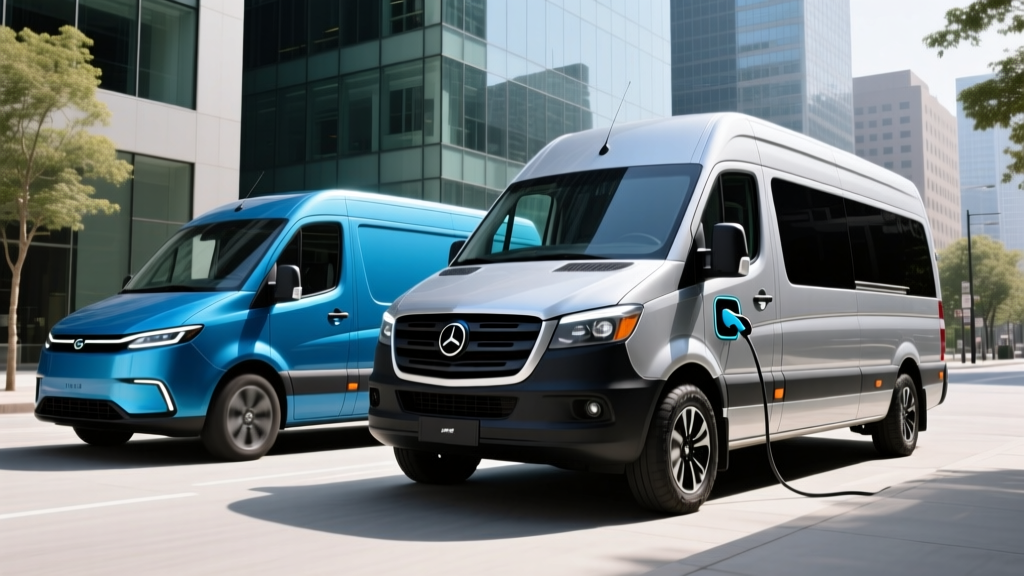
The closest thing Mercedes-Benz offers to an electrified Sprinter is the 2026 eSprinter, a fully battery-electric van built on the same VS30 platform as the diesel Sprinter. It's not a hybrid — it's a BEV — but for many buyers cross-shopping a "hybrid Sprinter van," the eSprinter is the realistic factory-electrified option.
| Spec | 150 kWh Battery (Extended) | 113 kWh Battery (Standard) |
|---|---|---|
| EPA-Est. Range | ~247 miles | ~200 miles |
| Usable Battery | 150 kWh (NMC) | 113 kWh (NMC) |
| Motor Output | 201 hp / 273 lb-ft (front-mounted) | 201 hp / 273 lb-ft |
| DC Fast Charge (peak) | 115 kW (CCS1) | 115 kW (CCS1) |
| 10–80% DC Charge | ~42 minutes | ~28 minutes |
| Level 2 Charge Rate | 11 kW (AC) | 11 kW (AC) |
| Cargo Volume (max) | 533 cu ft (extended wheelbase, high roof) | 533 cu ft |
| Payload Capacity | ~2,624 lbs | ~3,190 lbs |
| Base MSRP (Cargo Van) | ~$80,000 | ~$72,000 |
Aftermarket PHEV Sprinter Conversions
For buyers who specifically need a plug-in hybrid Sprinter van — someone who wants 30+ miles of electric-only driving around town but unlimited diesel range for long hauls — aftermarket PHEV conversions exist. Companies like XL Fleet (now part of Spruce Power) and European upfitters have offered PHEV drivetrain kits for the Sprinter platform, typically pairing a diesel engine with an electric motor and a 15–25 kWh battery pack.
These conversions generally deliver:
- Electric-only range: 25–40 miles (depending on payload and battery size)
- Combined fuel economy: 22–28 MPG (vs. the stock diesel Sprinter's ~19–21 MPG combined)
- Added cost: $15,000–$30,000 on top of the base diesel Sprinter price
- Warranty impact: Varies — some conversions void portions of the factory Mercedes-Benz powertrain warranty
The trade-off is complexity. You're adding a high-voltage system on top of an already complex diesel powertrain, and service networks for these conversions are limited. For most commercial fleets, the math favors either the stock diesel Sprinter (lowest upfront cost) or the factory eSprinter (lowest operating cost and zero tailpipe emissions).
How Many MPG Does the Diesel Sprinter Get?
For comparison, the 2026 diesel Sprinter (2.0L turbo-diesel I4, 208 hp) returns the following EPA-estimated figures:
| Cycle | MPG |
|---|---|
| City | 19 |
| Highway | 22 |
| Combined | 20 |
In real-world driving, many Sprinter owners report 17–22 MPG combined depending on load, terrain, and driving style. Highway-only runs at 65 mph with a light load can push toward 23–24 MPG. City delivery routes with frequent stops often drop to 15–17 MPG — exactly the scenario where a hybrid or electric drivetrain shines thanks to regenerative braking.
For the eSprinter, efficiency is measured in MPGe and kWh/100mi rather than MPG. The 150 kWh variant achieves roughly 1.8–2.2 kWh/mile in mixed use, translating to approximately 55–65 MPGe depending on conditions. At a national average electricity rate of $0.16/kWh, that's roughly $0.29–$0.35 per mile in energy cost — compared to ~$0.38–$0.44/mile for the diesel at $3.80/gallon.
Charging the eSprinter: Home and Public Infrastructure
Charging a van of this size requires planning. The eSprinter uses a CCS1 connector for DC fast charging and a standard J1772 inlet for Level 2 AC charging. Here's what to expect:
| Level | Power | Miles Added/Hour | Full Charge Time |
|---|---|---|---|
| Level 1 (120V) | 1.4 kW | ~3 mi/hr | ~100+ hours (150 kWh) |
| Level 2 (240V) | 11 kW | ~25 mi/hr | ~14 hours (150 kWh) |
| DC Fast Charge | 115 kW peak | ~150 mi/hr (peak) | 10–80% in ~42 min |
A critical note on the DC fast-charging curve: the eSprinter peaks at 115 kW only between roughly 10–40% state of charge. Above 60%, the charge rate tapers significantly to protect the NMC battery cells. Plan for the full 10–80% session to take approximately 42 minutes for the 150 kWh pack, and avoid relying on peak-kW marketing numbers for route planning.
For home or depot charging, you'll want a hardwired Level 2 station rated at 48 amps or higher on a dedicated 60-amp circuit. Installing a commercial-grade Level 2 charger (like a ChargePoint CPF50 or EVBox BusinessLine) typically runs $2,500–$6,000 including electrical work, depending on your panel capacity and conduit run distance.
Tax Credits and Incentives for the eSprinter
The 2026 eSprinter may qualify for federal and state incentives, but the rules are specific and subject to change:
- IRC §30D Clean Vehicle Credit (up to $7,500): The eSprinter's GVWR exceeds 8,500 lbs in some configurations, which may classify it under the Commercial Clean Vehicle Credit (§45W) instead of §30D. The §45W credit provides up to $7,500 for vehicles under 14,000 lbs GVWR and up to $40,000 for heavier vehicles. Consult IRS.gov or a tax professional for your specific configuration.
- MSRP Cap: §30D has MSRP caps ($80,000 for vans/SUVs), and the eSprinter's higher trims may exceed this threshold — making §45W the more applicable credit for commercial buyers.
- Income Cap (§30D): AGI limits apply — $300K joint / $225K head of household / $150K individual. §45W (commercial) does not have buyer income caps.
- Battery Sourcing: The critical-minerals and battery-component requirements under current §30D rules apply. Mercedes-Benz sources battery cells globally; verify current-year compliance on the fueleconomy.gov tax credit lookup.
- Point-of-Sale Transfer: Eligible buyers can transfer the credit to the dealer at purchase, reducing the purchase price upfront rather than waiting for a tax refund.
- State Incentives: States like California (CVRP), Colorado, and New York offer additional rebates for commercial EVs. Check your state's energy office for current programs.
Battery Warranty, Lifespan, and Replacement Costs
For the diesel Sprinter's conventional 12V battery and the standard hybrid components in any aftermarket PHEV conversion, warranty terms vary. Most reputable PHEV upfitters offer 3–5 years / 50,000–100,000 miles on the hybrid system. By comparison, factory hybrid batteries from manufacturers like Toyota carry 10-year / 150,000-mile warranties — a benchmark that aftermarket Sprinter conversions have not yet matched.
Battery replacement cost: If the eSprinter's 150 kWh NMC pack requires full replacement out of warranty, expect a cost in the range of $25,000–$40,000 (parts and labor). However, NMC batteries in commercial applications with proper thermal management typically retain 80–85% capacity after 200,000 miles. Full replacement is uncommon within the first decade of service.
For aftermarket PHEV conversions, replacement battery packs (15–25 kWh) typically cost $5,000–$12,000, depending on chemistry and supplier availability.
Who Should Choose Electric, Hybrid, or Diesel?
- Your daily routes are under 180 miles with predictable depot charging
- You operate in a city with clean-air zones or emissions mandates
- You want the lowest per-mile fuel cost (~$0.30/mi vs $0.40/mi diesel)
- You can install Level 2 depot charging
- You qualify for the §45W commercial credit
- You need electric-only city driving but long-range diesel capability
- Your routes are mixed urban/highway with no reliable en-route charging
- You're willing to accept higher maintenance complexity
- You can absorb a $15K–$30K conversion premium
- Your routes exceed 250+ miles daily with no charging infrastructure
- You tow heavy loads or operate in extreme cold regularly
- Upfront cost is the primary concern ($50K–$55K vs $72K+ for eSprinter)
- You need maximum payload (diesel Sprinter carries ~600 lbs more than eSprinter)
Pros and Cons at a Glance
- Zero tailpipe emissions — ideal for urban delivery and campervan use
- Significantly lower fuel cost per mile vs diesel
- Quiet, smooth powertrain — excellent for luxury camper conversions
- Instant torque (273 lb-ft from 0 RPM) for confident merging
- Regenerative braking reduces brake wear in stop-and-go routes
- Federal tax credit up to $7,500 (§30D) or $40,000 (§45W commercial)
- Minimal drivetrain maintenance — no oil changes, no DEF fluid
- $72,000–$80,000+ MSRP — roughly $20K–$30K more than diesel equivalent
- Real-world range drops to 170–210 mi when loaded or in cold weather
- 115 kW peak DC charging is modest — 42 min for 10–80%
- Reduced payload capacity (~600 lbs less than diesel Sprinter)
- No factory PHEV option — conversion adds cost and complexity
- Public CCS charging infrastructure still sparse in rural areas
- Battery replacement cost ($25K–$40K) is a long-term liability
Frequently Asked Questions
Does Mercedes-Benz make a hybrid Sprinter van?
No. As of the 2026 model year, Mercedes-Benz offers the Sprinter as either a diesel (2.0L turbo-diesel I4) or a fully electric eSprinter. There is no factory HEV or PHEV Sprinter. Aftermarket PHEV conversions exist but are not sold through Mercedes-Benz dealerships.
How many MPG does the diesel Sprinter get?
The 2026 diesel Sprinter achieves an EPA-estimated 19 city / 22 highway / 20 combined MPG. Real-world results typically fall between 17–22 MPG combined depending on payload, terrain, and driving style. A PHEV conversion may improve combined economy to 22–28 MPG, but adds significant upfront cost.
How far can the eSprinter go on a single charge?
The 2026 eSprinter with the 150 kWh battery has an EPA-estimated range of approximately 247 miles. In real-world use with cargo and highway driving, expect 170–210 miles. The 113 kWh variant is rated at approximately 200 miles EPA, with real-world range of 140–175 miles.
Is the eSprinter reliable? What about battery lifespan?
The eSprinter's electric drivetrain has fewer moving parts than a diesel engine, reducing routine maintenance. Mercedes-Benz warranties the high-voltage battery for 8 years / 100,000 miles with a 70% capacity retention guarantee. NMC batteries with active thermal management typically retain 80–85% capacity at 200,000 miles. Long-term reliability data for the eSprinter specifically is still accumulating (the model launched for the 2024 model year).
Does the eSprinter qualify for a tax credit?
It depends on your configuration and use case. Commercial buyers may qualify for the IRC §45W Commercial Clean Vehicle Credit (up to $7,500 for vehicles under 14,000 lbs GVWR, up to $40,000 for heavier vehicles). Personal-use buyers may qualify under §30D (up to $7,500), but the eSprinter's MSRP may exceed the $80,000 van cap on higher trims. Battery-sourcing requirements and buyer income limits apply. Always verify on IRS.gov and consult a tax professional.
Can I charge the eSprinter at home?
Yes, with a properly installed Level 2 (240V) home charger rated for at least 48 amps. A full charge from empty on Level 2 takes approximately 14 hours for the 150 kWh battery. Level 1 (120V) charging is impractical for daily use at ~3 miles of range per hour. Budget $2,500–$6,000 for a professional Level 2 installation, and verify your electrical panel has sufficient capacity — you may need a panel upgrade to 200A or higher.
Hybrid vs PHEV vs EV — which Sprinter option fits me?
If your daily mileage is under 180 miles and you can charge at a depot or home, the eSprinter (BEV) offers the lowest operating cost and zero tailpipe emissions. If you need unlimited range with some electric-only city capability and accept higher complexity, an aftermarket PHEV conversion is your only hybrid option. If you regularly drive 300+ miles, tow heavy, or operate in extreme conditions with no charging access, the diesel Sprinter remains the pragmatic choice. There is no factory conventional hybrid (HEV) Sprinter.
Sources: Mercedes-Benz USA Sprinter, fueleconomy.gov, IRS Clean Vehicle Credits. Specifications reflect 2026 model year data available at time of publication. Tax credit eligibility depends on individual circumstances and current-year IRS rules.