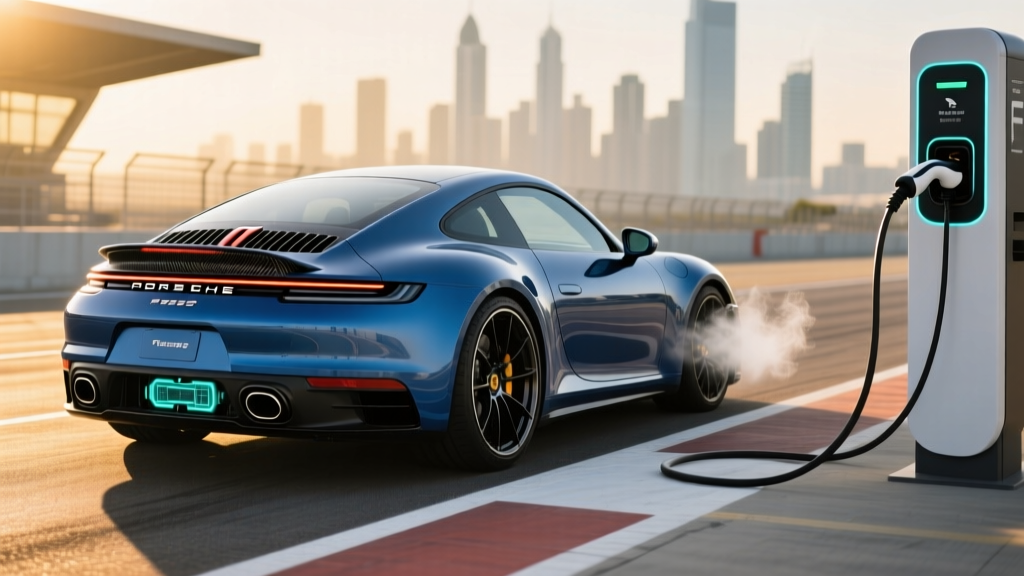
For over sixty years, the Porsche 911 has been defined by its rear-mounted flat-six engine. The 992.2-generation 911 Carrera GTS breaks that tradition with the hybrid Porsche 911 — officially called the T-Hybrid — a powertrain that uses electrification not to chase fuel economy, but to eliminate turbo lag and fill torque gaps. The result is 532 horsepower, a 0–60 mph time of 2.9 seconds, and an EPA-estimated 23 MPG combined.
This is not a plug-in hybrid. There is no electric-only driving mode, no charging port, and no EV range to manage. The T-Hybrid is a conventional performance hybrid (HEV) that recovers energy under braking and deploys it through an electric motor integrated into the transmission. If you're researching the hybrid Porsche 911 to understand what electrification actually means for this icon, here are the exact numbers.
T-Hybrid Powertrain: How Porsche Electrified the Flat-Six
The 992.2 Carrera GTS T-Hybrid replaces the twin-turbo 3.0L flat-six of the previous GTS with a newly developed 3.6-liter single-turbocharged flat-six paired with a permanent-magnet synchronous electric motor mounted between the engine and the 8-speed PDK dual-clutch transmission.
| Specification | Value |
|---|---|
| Engine | 3.6L turbocharged flat-six (single turbo) |
| Electric Motor | Integrated into PDK housing |
| Combined Horsepower | 532 hp |
| Combined Torque | 450 lb-ft |
| 0–60 mph | 2.9 seconds (with Sport Chrono) |
| Top Speed | 188 mph |
| Transmission | 8-speed PDK dual-clutch |
| Drivetrain | Rear-wheel drive (GTS); AWD available (GTS 4) |
| Hybrid Battery | 1.9 kWh (usable), lithium-ion, 400V |
| Hybrid System Weight Add | ~110 lbs over non-hybrid GTS |
The 1.9 kWh battery pack is mounted under the rear deck lid, replacing the traditional rear-seat area (which is already largely decorative in the 911). This is a high-voltage (400V) system — far more advanced than the 48V mild-hybrid systems found in competitors like the Mercedes-AMG GT or the BMW M4's starter-generator setup.
The electric motor serves a specific performance function: it spools the turbocharger electrically (an e-turbo) and provides instantaneous torque fill during the milliseconds before the turbo reaches boost pressure. The result is throttle response that mimics a naturally aspirated engine while delivering turbocharged power levels.
Fuel Economy: EPA MPG and Real-World Expectations
Porsche's T-Hybrid system prioritizes performance over efficiency, but the electrified powertrain still delivers measurable fuel economy gains over the outgoing twin-turbo 992.1 GTS.
| Driving Cycle | EPA Estimate | Real-World Expectation |
|---|---|---|
| City | 20 MPG | 19–22 MPG (regen assists in stop-and-go) |
| Highway | 27 MPG | 24–26 MPG (electric motor less active at sustained speed) |
| Combined | 23 MPG | 21–24 MPG depending on driving style |
For context, the previous-generation 992.1 Carrera GTS (480 hp, twin-turbo 3.0L) was rated at 18 city / 24 highway / 20 combined. The T-Hybrid gains approximately 3 MPG combined while producing 52 more horsepower.
HEV vs PHEV vs EV: Where Does the Hybrid Porsche 911 Fit?
A common question from buyers cross-shopping electrified performance cars: is the 911 T-Hybrid a plug-in? The answer is no. Here's how the three electrified powertrain types break down for a buyer considering this segment.
| Feature | HEV (911 T-Hybrid) | PHEV (e.g., Corvette E-Ray) | BEV (e.g., Taycan) |
|---|---|---|---|
| Plug-in Required? | No — self-charging via regen | Yes — plug in for EV range | Yes — must plug in to charge |
| Electric-Only Range | None | ~12–30 mi typical | 200–300+ mi |
| Battery Size | 1.9 kWh | 10–20 kWh typical | 75–100+ kWh |
| Primary Benefit | Torque fill, throttle response | Short EV commutes + performance | Zero tailpipe emissions, instant torque |
| Weight Penalty | ~110 lbs | ~300–500 lbs | ~800–1,200 lbs |
| Home Charging Needed? | No | Recommended (Level 2) | Essential (Level 2) |
Porsche's decision to pursue HEV rather than PHEV for the 911 is deliberate. A plug-in system with meaningful EV range would require a larger, heavier battery pack — anathema to a car whose identity is built on power-to-weight ratio and rear-engine weight distribution. The T-Hybrid adds just 110 pounds while the Chevrolet Corvette E-Ray's PHEV system adds over 350 pounds.
If you want a plug-in Porsche with electric-only commuting capability, the Panamera E-Hybrid and Cayenne E-Hybrid fill that role. The 911 T-Hybrid is engineered for drivers who want electrification's performance benefits without any change to their fueling routine.
Pricing, Trims, and Federal Tax Credit Eligibility
The 2026 hybrid Porsche 911 is available exclusively in the Carrera GTS and Carrera GTS 4 (all-wheel drive) trims. Pricing reflects its position above the Carrera S and below the Turbo and GT3 variants.
| Trim | Base MSRP | Typical As-Tested |
|---|---|---|
| 911 Carrera GTS (RWD, Coupe) | $166,895 | $180,000–$195,000 |
| 911 Carrera GTS 4 (AWD, Coupe) | $173,495 | $187,000–$200,000 |
| 911 Carrera GTS Cabriolet (RWD) | $179,895 | $195,000–$210,000 |
| 911 Carrera GTS 4 Cabriolet (AWD) | $186,495 | $200,000–$215,000 |
Some states offer hybrid or efficiency incentives that may apply, but these vary significantly by jurisdiction. Check your state's energy or DMV website for current programs.
Battery Warranty, Reliability, and Long-Term Costs
Hybrid battery longevity is a top concern for any electrified vehicle buyer. Porsche engineers the T-Hybrid's high-voltage battery for performance cycling rather than deep discharge cycles, which actually favors longevity.
- High-Voltage Hybrid Battery: 8 years / 100,000 miles (whichever comes first), covering defects and capacity loss below a defined threshold
- Powertrain (engine + PDK + electric motor): 4 years / 50,000 miles
- Limited Vehicle Warranty: 4 years / 50,000 miles
- Corrosion Perforation: 12 years / unlimited miles
The 1.9 kWh battery operates in a narrow state-of-charge window — it never fully charges or fully depletes. This shallow-cycling strategy is the same approach Toyota has used for decades with the Prius, and it is proven to extend lithium-ion cell life well beyond the warranty period. Because the battery is small and the system is performance-oriented rather than range-oriented, degradation has minimal impact on the driving experience: even with 15–20% capacity loss over a decade, the torque-fill function remains effective.
Estimated battery replacement cost: Based on comparable Porsche high-voltage systems (Taycan, Panamera E-Hybrid), a replacement hybrid battery pack for the 911 T-Hybrid is expected to cost between $4,000 and $7,000 out of warranty, including labor. This is significantly less than a full EV battery replacement because the pack is small (1.9 kWh vs. 80–100 kWh in a BEV).
Regarding overall reliability: the 992-generation 911 has performed well in owner surveys. The T-Hybrid adds complexity (electric motor, high-voltage system, e-turbo) but removes one turbocharger (single-turbo vs. the previous twin-turbo setup), partially offsetting the new components. IIHS and NHTSA crash ratings are not typically published for low-volume sports cars, but the 992 platform includes standard front and side airbags, Porsche Stability Management, and available Porsche InnoDrive adaptive cruise.
Who Should Buy the Hybrid Porsche 911?
Choose the 911 GTS T-Hybrid If:
- You want the most responsive 911 below the Turbo/GT3 tier
- You value throttle response and torque fill over raw peak power
- You have no home charging capability and don't want to plug in
- You want a 911 with marginally better fuel economy for daily driving
- You plan to keep the car within the 4yr/50k warranty period
Look Elsewhere If:
- You want electric-only commuting (consider Panamera E-Hybrid or Taycan)
- You want federal tax credit eligibility (no HEV credit; PHEVs/BEVs only)
- You prioritize fuel economy above all else (a Prius gets 57 MPG)
- You want a manual transmission (T-Hybrid is PDK only)
- Track weight is your top concern (the GT3 is lighter and naturally aspirated)
The hybrid Porsche 911 occupies a narrow but compelling position: it's the daily-drivable 911 with the sharpest throttle response in the lineup, without requiring any change to how you fuel or maintain the car. For buyers who see electrification as a performance tool rather than an environmental statement, the T-Hybrid delivers exactly what it promises.
Frequently Asked Questions
How many MPG does the hybrid Porsche 911 get?
The 2026 Porsche 911 Carrera GTS T-Hybrid is EPA-rated at 20 city / 27 highway / 23 combined MPG. Real-world results range from 21–24 combined depending on driving style, with highway cruising yielding the best figures and aggressive driving dropping observed MPG into the mid-teens.
Does the hybrid Porsche 911 have electric-only range?
No. The 911 T-Hybrid is a conventional hybrid (HEV), not a plug-in hybrid (PHEV). It cannot drive on electric power alone. The 1.9 kWh battery and integrated electric motor exist solely to provide torque fill and improve throttle response. There is no charging port.
Is the hybrid Porsche 911 a plug-in hybrid?
No. The T-Hybrid charges its battery exclusively through regenerative braking and engine-driven generation. You never need to plug it in. This is fundamentally different from PHEVs like the Panamera E-Hybrid or Cayenne E-Hybrid, which offer 15–30 miles of electric-only range when plugged in.
Does the 911 T-Hybrid qualify for any tax credit?
No. Under current IRS §30D rules, the federal clean vehicle credit applies only to plug-in EVs (BEVs and PHEVs) that meet MSRP, income, and battery sourcing requirements. The 911 T-Hybrid is a conventional HEV and its MSRP exceeds the $55,000 sports car/sedan cap regardless. No federal hybrid-specific credit exists for HEVs.
How reliable is the T-Hybrid system and what does battery replacement cost?
The T-Hybrid's 1.9 kWh battery operates in a shallow charge-discharge window that promotes longevity, similar to proven Toyota hybrid strategies. Porsche covers the high-voltage battery for 8 years / 100,000 miles. Out-of-warranty replacement is estimated at $4,000–$7,000 — far less than a full EV battery due to the small pack size. The overall powertrain carries Porsche's 4yr/50,000-mile warranty.
Why didn't Porsche make the 911 a plug-in hybrid or full EV?
Weight and packaging. A PHEV system with meaningful EV range would add 300–500 lbs and require a larger battery that compromises the 911's rear-engine weight distribution. A full EV (like the Taycan) adds 800+ lbs. Porsche determined that a lightweight HEV system (~110 lbs) delivers the performance benefits of electrification — torque fill, e-turbo spooling — without compromising the 911's driving dynamics.